
 Repository
Current collected state Current
Observed since 20 Oct, 23:06 UTC
No superseded metadata states collected. Unchanged observations do not create new revisions.
Shared in-memory LRU caches for Node.js cluster workers, with atomic counters, coordinated fetches, and optional local caching.




Let your Node.js workers share what they have already learned. When one worker caches a database result, the others can reuse it instead of loading and storing their own copies.
This package keeps namespaced LRU caches in a Node.js cluster's primary process. LRU means least recently used: when the cache fills up, it removes the entries you have used least recently. Workers access the shared cache through an asynchronous API over inter-process communication, or IPC. Atomic counters and fetch coordination also run in the primary.
No separate cache service is required. The shared data lives in memory for the lifetime of the primary process. Optional local L1 caches keep hot values inside individual workers to avoid repeated IPC reads.
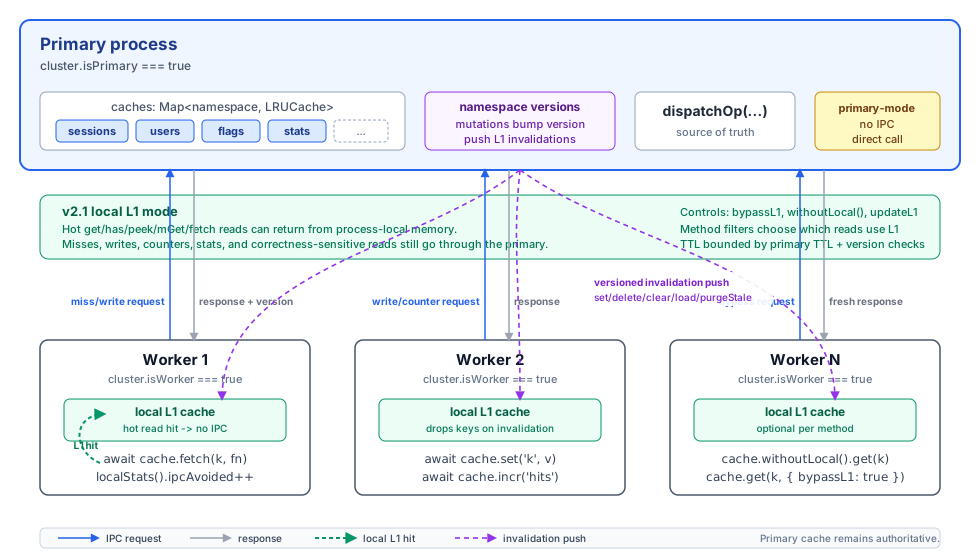
Each worker can reuse the same cached data, take a turn loading a missing value, and update shared counters without racing another worker.
| Capability | How it works |
|---|---|
| Shared cache storage | One primary-owned cache per namespace, with optional extra copies in worker L1 caches. |
| Shared warm entries | A value loaded by one worker becomes available to the others. |
| Atomic counters | incr() and decr() execute in the primary; later increments preserve the original expiration. |
| Coordinated loading | fetch() and memoize() coordinate concurrent misses for a key through a primary-owned claim. |
| Temporary claims | setIfAbsent() atomically claims a key while it remains cached. |
| Optional local reads | L1 can serve repeated reads without IPC, with eventual consistency. |
| Compression and codecs | wrap() converts values on writes and reads through your encoder and decoder. |
| Metrics and errors | Namespace statistics, local L1 statistics, and structured IPC errors. |
Install this package and the cache engine it uses. Both JavaScript and TypeScript applications can use it.
npm install @0xdoublesharp/lru-cache-clustered lru-cache@^11
For pnpm or Yarn, use pnpm add or yarn add with the same package names. lru-cache is a peer dependency, so your application controls its installed version within the supported range.
Requires Node.js 22 or newer. Includes ESM and CommonJS builds and TypeScript declarations.
@0xdoublesharp/lru-cache-clusteredis the canonical package name.lru-cache-for-clusters-as-promisedis published from the same build at the same version.
Start a few workers and give their caches the same name. A write from any worker goes into the shared cache in the primary.
Save this as app.mjs and run node app.mjs after installing the packages:
import cluster from 'node:cluster';
import { LRUCacheClustered } from '@0xdoublesharp/lru-cache-clustered';

LRUCacheClustered.bootstrap();

const options = {
  namespace: 'greetings',
  max: 1000,
  ttl: 60_000,
  failsafe: 'reject',
};

if (cluster.isPrimary) {
  const cache = await LRUCacheClustered.getInstance(options);
  await cache.set('hello', 'Hello from the shared cache');
  cluster.fork();
  cluster.fork();
} else {
  const cache = await LRUCacheClustered.getInstance(options);
  console.log(`Worker ${cluster.worker.id}: ${await cache.get('hello')}`);
  process.disconnect();
}
Both workers read the same entry. getInstance() waits for namespace registration and rejects if initialization fails. Reuse the returned instance in each process, especially with L1 enabled.
Import the package in the primary before cluster.fork(). The import installs the IPC listener; bootstrap() makes that setup explicit. Instances that share a namespace must agree on primary cache options such as max and ttl.
Use it when several workers in one Node.js cluster need the same temporary data. The most useful patterns save repeated work or coordinate short-lived state.
| Idea | Pattern | Example |
|---|---|---|
| Stop a popular profile from triggering duplicate database queries | memoize() or fetch() lets workers reuse a cached result and coordinate concurrent misses. | User lookup server |
| Limit API requests across workers | incr() updates one shared counter. Its first write starts the TTL window; later increments keep that deadline. | Rate limiter |
| Share temporary session data | set(), get(), and delete() share entries across workers. Keep durable session state elsewhere. | Session server |
| Suppress repeated job submissions | setIfAbsent() lets one worker claim a cached key. Expiration, eviction, or restart can allow another claim. | Idempotent intake |
| Keep large generated documents in less cache space | wrap() compresses stored values and decodes them on reads. | Compressed documents |
| Reduce repeated Redis reads | Use this shared cache in front of Redis, then add a small worker L1 for hot reads. | Multilayer cache |
For example, a report endpoint can use the report parameters as a cache key and fetch() to coordinate generation. Include tenant and authorization context when they affect the result.
The cache belongs to one primary process. Separate clusters, containers, and machines do not share it. Use a remote cache or database when you need that wider scope, durable state, or coordination that must survive eviction and restarts. Shared counters and claims are atomic while their keys remain present; they do not provide durable quotas or exactly-once job processing.
Namespaces separate application data by name. They do not restrict worker access, so all workers must be trusted.
Start an example server, send it requests, and watch workers share cached results. The example guide has curl commands, ports, and environment settings.
| Command | What to explore |
|---|---|
pnpm example:users | Shared read-through user cache with memoize() and fetch(). |
pnpm example:rate-limit | Fixed-window counters across workers. |
pnpm example:sessions | Shared session reads and writes. |
pnpm example:idempotency | Temporary job claims with setIfAbsent(). |
pnpm example:documents | Compression with wrap(). |
pnpm example:l1 | Method filtering, bypass reads, local invalidation, and write-through L1 population. |
pnpm example:multilayer | Shared memory caching in front of Redis. Requires Redis. |
The basic L1 server can also run with node --import tsx examples/clustered-l1-server.ts.
Keep a small copy of frequently read values inside each worker. Repeated reads can stay in that worker instead of asking the primary again.
Enable the optional L1 cache with localL1. The primary remains the source of truth and owns every write. Invalidation messages tell workers to drop local entries after changes, but delivery is asynchronous.
type Product = { sku: string; name: string };

const products = new LRUCacheClustered<string, Product>({
  namespace: 'products',
  max: 25_000,
  ttl: 60_000,
  localL1: { enabled: true, experimental: true, ttl: 2_000 },
});
L1 improves repeated read latency by avoiding IPC, but it can briefly serve stale data. Keep L1 TTL short and bypass L1 for correctness-sensitive reads.
Set experimental: true to opt in. Without an explicit local TTL, the default is 10% of a positive primary TTL, up to 5 seconds, with a 100 ms floor. With no primary expiration, including ttl: 0, it defaults to 5 seconds. Each local entry is also capped at the remaining lifetime reported by the primary.
Reuse one cache instance per namespace in each worker. Each constructor or getInstance() call creates a separate local L1, so recreating the instance per request loses its warm entries.
A cold fetch() claims the key and stores the result in two IPC requests. Followers poll the claim once per cycle and reuse the leader's result.
L1 misses receive values and remaining TTLs in one primary response. A cold mGet() uses one IPC request for the batch, and a fully warm batch uses none. Local hits cannot extend an entry past the primary expiration recorded in that response, even with updateAgeOnGet or allowStale enabled.
Read paths can bypass L1 per call:
await products.get('sku:123', { bypassL1: true });
await products.mGet(['sku:123', 'sku:456'], { bypassL1: true });
await products.fetch('sku:789', loadProduct, { ttl: 60_000, bypassL1: true });
For a reusable fresh-read view, use withoutLocal():
const freshProducts = products.withoutLocal();
await freshProducts.get('sku:123'); // always goes to the primary
Local controls and metrics:
| Method | Description |
|---|---|
localStats() | Returns { enabled, hits, misses, sets, invalidations, evictions, staleHits, size, ipcAvoided }. |
clearLocal() | Flushes this instance's local L1 without touching the primary cache. |
invalidateLocal(key) | Drops one local L1 key without touching the primary cache. |
withoutLocal() | Returns a read-through-primary wrapper over the same cache instance. |
on(event, listener) | Subscribes to L1 events: l1:hit, l1:miss, l1:set, l1:invalidate, l1:evict, and l1:stale-hit. |
off(...) / once(...) | Standard event listener helpers. |
localL1.methods can restrict which read families use L1:
localL1: {
  enabled: true,
  experimental: true,
  methods: { get: true, has: false, fetch: true },
}
When methods is provided, omitted method keys are disabled. memoize() delegates to fetch(), so its L1 behavior follows the fetch setting.
By default, same-process and cross-worker writes broadcast invalidations so hot local entries are dropped before their TTL expires. If you intentionally want TTL-only consistency, set localL1.invalidation: 'ttl-only'.
See docs/l1.md for the full consistency model, stats, events, method options, and failure modes.
Think of the primary as a shared cupboard and the workers as people borrowing from it. A namespace names one cupboard. Workers with the same namespace share its contents.
new LRUCacheClustered(...) branches at construction:
cluster.isPrimary === true), the instance owns and operates on the in-process LRUCache for its namespace directly, without IPC.Instances in different workers that share a namespace operate on the same primary-side cache. Those instances should agree on cache options (max, ttl, allowStale, ...): reusing a namespace with conflicting options throws rather than silently keeping whichever process initialized it first.
Initialization semantics. In a worker,
new LRUCacheClustered(...)eagerly sends theinitmessage, butcache.readyis ordering-only and intentionally swallows init failure. Useawait cache.healthCheck()orawait LRUCacheClustered.getInstance(...)when startup should fail fast if the primary cannot register the namespace.
Sharing saves duplicate cache storage, but asking another process for a value takes time. A small local cache can speed up repeated reads, at the cost of extra copies and a brief stale-data window.
| Read path | Cost and behavior |
|---|---|
| Primary process | Dispatches to the local lru-cache without IPC. |
| Worker without L1 | Reads and writes use IPC. A cache hit still crosses processes. |
| Worker with L1 | Eligible local hits avoid IPC; misses and writes reach the primary. |
| Concurrent cache misses | One leader runs the fetcher while followers poll for the result, subject to claim expiry and forced refresh. |
Use this package when sharing cached data is worth the IPC cost. Use plain per-process lru-cache when worker independence and the lowest local read latency matter more. Benchmark with your payload sizes, worker count, and read/write mix using pnpm bench.
The benchmark runs real workers with L1 enabled and disabled, checks every returned value, and reports JSON lines with throughput, mean/p95/p99 latency, IPC request counts, local hits, and fetcher calls. It covers hot reads, 95% reads with unrelated writes, batches of ten reads, and concurrent fetch misses. Initialization and warmup are excluded. The default uses two workers and 128-byte and 16-KiB payloads. Fetch cases use at most 50 keys with a simulated 5 ms upstream delay.
BENCH_WORKERS=1,4 BENCH_PAYLOAD_BYTES=128,16384 BENCH_ITERATIONS=2000 pnpm bench
BENCH_SERIALIZATION=advanced pnpm bench
Compare results on the same machine and Node.js version. Latency samples measure the cache operation; aggregate throughput also includes result validation and benchmark messaging.
Choose how much the cache can hold and how long values stay fresh. max limits the number of entries; ttl, or time to live, sets their lifetime in milliseconds.
The serializable subset of lru-cache constructor options passes through (max, maxSize, maxEntrySize, ttl, allowStale, updateAgeOnGet, updateAgeOnHas, noDeleteOnStaleGet, ttlAutopurge). Plus:
| Option | Type | Default | Description |
|---|---|---|---|
namespace | string | 'default' | Logical name. Instances sharing a namespace share state on the primary. |
timeout | number | 100 | Worker IPC timeout in ms. |
failsafe | 'resolve' | 'reject' | 'resolve' | On worker IPC timeout: 'resolve' resolves with undefined; 'reject' rejects with Error('IPC timeout'). |
localL1 | false | LocalL1Options | undefined | Optional local hot-read cache. Pass { enabled: true, experimental: true } to opt in. |
LocalL1Options:
| Option | Type | Default | Description |
|---|---|---|---|
enabled | boolean | true | Set false to disable when an options object is reused. |
experimental | boolean | required | Must be true to opt in to eventual consistency. |
max | number | 1000 | Maximum local entries per instance. |
maxSize | number | undefined | Optional local size bound. Uses one size unit per entry. |
ttl | number | derived | Local TTL in ms, capped by primary TTL and per-entry remaining TTL. |
updateAgeOnGet | boolean | true | Passed to the local lru-cache. |
allowStale | boolean | false | Passed to the local lru-cache; Stale returns and rejected expired/version-stale local entries increment staleHits. |
invalidation | 'broadcast' | 'ttl-only' | 'broadcast' | Whether this instance subscribes to local/IPC invalidation pushes or relies only on local TTL expiry. |
methods | { get?, has?, fetch? } | all enabled | Restrict which read families use L1. If present, omitted keys are disabled. |
cacheUndefined | boolean | unsupported | Reserved for future negative-result caching; currently forced off. |
Function-valued lru-cache options such as dispose, disposeAfter, sizeCalculation, or fetchMethod do not cross IPC and are not supported by this wrapper.
failsafe: 'resolve'caveat. Most single-result operations returnundefinedon an IPC timeout with'resolve', even when their declared return type differs.mGet()can return an empty or partial map.fetch(),getInstance(), andhealthCheck()reject on IPC timeouts. Forget/peekthat is natural; forhas/set/delete/incr/decr/sizeit can surprise callers (undefined + 1 === NaN). Use'reject'if typed-shape correctness on timeout matters.
Size-bounded caches. When you use
maxSizeormaxEntrySize, providesizeon every write path (set,setIfAbsent,mSet,fetch,memoize, and the firstincr/decrfor a counter key).sizeCalculationdoes not cross IPC, so the primary cannot infer it for you.
Fail-fast startup.
LRUCacheClustered.getInstance()andcache.healthCheck()always reject if the primary cannot answer, regardless offailsafe, so you can use them as hard startup checks.
Key/value contract. Like
lru-cache, keys and values must be non-nullish. Passingnullorundefinedrejects. Use string keys across workers: IPC copies object keys, so object identity cannot be shared between processes.
The same methods work in the primary and in workers. Await shared-cache operations; local-cache controls run immediately in the calling process.
These helpers set up the shared cache before you start using it.
| Method | Description |
|---|---|
LRUCacheClustered.bootstrap() | Installs the primary-side cluster listener immediately. Useful when you want an explicit bootstrap call instead of relying on module import side effects. |
LRUCacheClustered.getInstance(options) | Async factory. In a worker, awaits the init message so the primary has registered the namespace before returning. Preferred when worker startup should fail fast on init errors. |
LRUCacheClustered.getAllCaches() | Returns the Map<namespace, LRUCache> registry. Primary only; throws in workers. |
Store a value, read it back, check whether it exists, or remove it.
| Method | Returns | Notes |
|---|---|---|
get(key, { bypassL1? }) | Promise<V | undefined> | |
set(key, value, { ttl?, size?, updateL1? }) | Promise<boolean> | updateL1 populates the caller's L1 after a successful write. |
setIfAbsent(key, value, { ttl?, size? }) | Promise<boolean> | Atomic on the primary. false if the key already exists. |
delete(key) | Promise<boolean> | |
has(key, { bypassL1? }) | Promise<boolean> | |
peek(key, { bypassL1? }) | Promise<V | undefined> | Does not update LRU position. |
clear() | Promise<void> | Clears the primary cache and this instance's L1. |
Handle several keys in one call to avoid a separate trip to the primary for every key. Batch writes are not transactions; a later failure can leave earlier writes applied.
| Method | Returns | Notes |
|---|---|---|
mGet(keys, { bypassL1? }) | Promise<Map<K, V | undefined>> | Preserves input key order even when L1 partially hits. |
mSet(entries, { ttl?, size? }) | Promise<void> | entries: Iterable<[K, V] | [K, V, { ttl?, size? }]>; outer opts apply as defaults. Clears this instance's L1. |
mDelete(keys) | Promise<void> |
Inspect the contents or take a snapshot for later restoration. These methods return whole collections, so large caches create large responses.
| Method | Returns | Notes |
|---|---|---|
keys() | Promise<K[]> | Most recently used first. |
values() | Promise<V[]> | Most recently used first. |
entries() | Promise<[K, V][]> | Most recently used first. |
[Symbol.asyncIterator]() | AsyncIterableIterator<[K, V]> | for await (const [k, v] of cache). Materializes the full set. |
dump() | Promise<[K, Entry][]> | Serializable snapshot. |
load(entries) | Promise<void> | Restores from a dump(), preserving per-entry TTL metadata. |
size() | Promise<number> |
Count events without workers overwriting each other, or load a missing value once and share the result. Cache-aside means checking the cache before doing the expensive work.
| Method | Returns | Notes |
|---|---|---|
incr(key, amount?, { ttl?, size? }) | Promise<number> | Atomic on the primary. ttl is set on the first write only; later increments do not reset it (rate limiters). |
decr(key, amount?, { ttl?, size? }) | Promise<number> | Same. |
fetch(key, fetcher, { ttl?, size?, forceRefresh?, bypassL1? }) | Promise<V> | Cache-aside with cluster-wide single-flight semantics. See Single-flight semantics. |
memoize(cache, fn, keyFn, opts?) | (args) => Promise<V> | Top-level helper. Single-flight via cache.fetch(). See memoize helper. |
These controls affect the extra cache inside this process. They help you see whether local reads are saving trips to the primary.
| Method / event | Returns / payload | Notes |
|---|---|---|
localStats() | L1Stats | undefined | undefined when local L1 is disabled. |
clearLocal() | void | Local-only flush. |
invalidateLocal(key) | void | Local-only single-key invalidation. |
withoutLocal() | LRUCacheClustered<K, V> | Bypass view for get, has, peek, mGet, and fetch; writes pass through normally. |
on('l1:hit' | 'l1:miss' | 'l1:set', listener) | { namespace, key } | Key is the original cache key, not an internal encoded key. |
on('l1:invalidate', listener) | { namespace, key } | key may be '*' for namespace-wide invalidation. |
on('l1:evict' | 'l1:stale-hit', listener) | { namespace, key } | stale-hit also fires when an expired or version-stale local entry is rejected. |
off(event, listener) / once(event, listener) | this | Standard event helpers. |
Check the cache, inspect its activity, change its limits, or remove its namespace.
| Method | Returns | Notes |
|---|---|---|
getRemainingTTL(key) | Promise<number> | ms until expiry. Infinity for keys with no TTL; 0 for missing keys. |
purgeStale() | Promise<boolean> | Removes expired entries. |
healthCheck() | Promise<void> | Verifies that the primary can resolve the namespace and answer requests. |
stats() | Promise<Stats> | { hits, misses, sets, deletes, evictions, size, namespace }. |
destroy() | Promise<boolean> | Removes the namespace cache, stats, and primary-side coordination state. Later use of the same instance recreates it with the original options. |
getCache() | LRUCache | undefined | Underlying lru-cache for this namespace. Primary only. |
ready | Promise<void> | Waits for worker initialization but swallows failures. Use getInstance() when initialization errors should reject. |
max(value?) | Promise<number> | Getter and setter. Setter preserves primary entries and remaining TTL metadata, then clears this instance's L1. |
ttl(value?) | Promise<number> | Getter and setter. Setter clears this instance's L1. |
allowStale(value?) | Promise<boolean> | Getter and setter. |
Large documents take less cache space when compressed. A codec converts values before storage and converts them back when you read them.
wrap(cache, codec) returns a typed view where values pass through an encode / decode pair on the way in and out. Use it for compression (gzip, brotli), serialization (MessagePack), or any custom symmetric transform. Supply the codec that fits your data.
import { gzipSync, gunzipSync } from 'node:zlib';
import { LRUCacheClustered, wrap } from '@0xdoublesharp/lru-cache-clustered';

// Encode to a string (base64 here) so the wire format is Buffer-safe in workers.
// See the Buffer caveat below.
const inner = new LRUCacheClustered<string, string>({ namespace: 'big-blobs', max: 1000 });

const cache = wrap(inner, {
  encode: (v: unknown) => gzipSync(Buffer.from(JSON.stringify(v), 'utf8')).toString('base64'),
  decode: (raw: string) => JSON.parse(gunzipSync(Buffer.from(raw, 'base64')).toString('utf8')),
});

await cache.set('user:42', { id: 42, name: 'ada' });
await cache.get('user:42'); // decoded back to { id: 42, name: 'ada' }
encode and decode may be sync or async. The wrapper encodes or decodes values for (get, set, setIfAbsent, peek, mGet, mSet, values, entries, async iteration, fetch) and forwards lifecycle and metric methods (has, delete, keys, size, clear, destroy, healthCheck, purgeStale, getRemainingTTL, stats). Wrapped get, has, peek, mGet, and fetch forward read options such as { bypassL1: true } to the underlying cache.
incr() and decr() operate on numbers. dump() and load() operate on raw stored values. The wrapper does not expose those methods. Reach them via wrapped.cache if you need them.
Binary values. Default cluster IPC uses JSON serialization and turns a
Bufferinto{ type: 'Buffer', data: number[] }. Encode to base64 or rehydrate it indecode. If you control cluster setup,cluster.setupPrimary({ serialization: 'advanced' })preserves buffers and other supported built-in types. Configure it before forking workers.
memoize helperGive a function a memory. Calling it again with the same cache key can reuse the previous result instead of repeating a database query or API request.
memoize(cache, fn, keyFn, opts) calls cache.fetch() under the hood. keyFn must include every input that can change the result, including tenant or permission context when relevant.
import { LRUCacheClustered, memoize } from '@0xdoublesharp/lru-cache-clustered';

type User = { id: string; name: string };

// fetchUserFromDB is your application's database lookup.
const cache = new LRUCacheClustered<string, User>({ namespace: 'users', max: 1000, ttl: 60_000 });

const getUser = memoize(
  cache,
  (id: string) => fetchUserFromDB(id),
  (id) => `user:${id}`,
  { ttl: 60_000 },
);

await getUser('42'); // first call: hits DB
await getUser('42'); // second call: cached
If several workers ask for the same missing value, one does the work while the others wait. This reduces duplicate requests to your database or upstream API.
Both memoize() and cache.fetch() coordinate through the primary so concurrent misses for the same key collapse to one in-flight fetch across instances and workers.
An explicit write supersedes older fetch work for the affected key. This includes set(), delete(), and batch mutations; clear(), load(), and destroy() supersede claims across the namespace. The fetcher itself keeps running, but its old result cannot overwrite a newer write or restore a removed entry. When it finishes, the fetch returns the newer cached value if one exists, otherwise it rejects with an error indicating that its claim was superseded. A delete cancels a pending claim even when no value has been stored yet. Waiting followers also retain their claim generation, so they cannot take fresh leadership and restore a removed entry after that generation is revoked. Ordinary leader failure or lease expiry still permits takeover.
Follower registrations are released when calls settle. Cancellation or an uncertain claim response may require an additional cleanup request. Successful value and store responses clean up directly, so an uncontended cold fetch still uses two requests, and warm L1 hits use none.
Passing forceRefresh: true skips both the cache lookup and any in-flight claim and starts a fresh leader fetch. On a cache miss, concurrent callers without forceRefresh wait on the current fetch and reuse its result. During a forced refresh, other instances can still read an existing cached value until the refresh finishes. Passing bypassL1: true skips local L1 reads and population for that call while preserving the primary-side single-flight behavior.
A fetch claim has a 30-second lease. A later caller can take over an expired claim, and a worker exit releases its claims. Fetchers must tolerate duplicate execution after a lease expires or a forced refresh replaces a claim.
The cache timeout option only bounds each worker IPC request. It does not cancel user fetcher work after a worker owns the primary-side single-flight lock, so production fetchers should enforce their own upstream timeout or abort policy.
A missing key is normal. A failed operation is different: handle its rejected promise, and choose whether an IPC timeout should reject or return undefined.
Worker mode. When a primary-side handler throws, the worker's promise rejects with a reconstructed Error carrying the original name, message, code, stack, and cause chain. The rejected value is always a plain Error (IPC does not preserve subclass identity), but .name, .code, and .cause are intact, so logging and cause-chain walking work. Errors travel as { name, message, code?, stack?, cause? } on the wire.
Primary mode. No IPC: a thrown Error rejects as-is (subclass identity preserved); a thrown non-Error value is wrapped in new Error(String(value)). Custom error subclasses retain their identity only in primary mode.
Turn on logs to see whether workers are reaching the primary and which requests they send.
DEBUG=lru-cache-clustered-* node app.js
Available namespaces:
lru-cache-clustered-primary logs cache creation and registry events.lru-cache-clustered-messages logs IPC requests and responses.lru-cache-clustered-invalidations logs errors thrown by local invalidation subscribers.Existing applications can move to the scoped package name while keeping the compatibility alias during the transition.
LRUCacheClustered is the canonical class; LRUCacheForClustersAsPromised remains an alias. The migration guide maps the older methods, options, and package name. The changelog records release-specific changes.
Clone the project, install its dependencies, and run the checks before changing code. The examples are small servers you can use to explore the behavior yourself.
For development, use a current Node.js 22 LTS patch release, at least 22.13, or Node.js 24 LTS. Use the pnpm version recorded in package.json; the runtime minimum for applications remains Node.js 22.
git clone https://github.com/doublesharp/lru-cache-clustered.git
cd lru-cache-clustered
corepack enable
pnpm install --frozen-lockfile
pnpm check
| Command | What it does |
|---|---|
pnpm check | Lint, typecheck, tests, unused-code checks, type coverage, build, and bundle-size checks. |
pnpm test | Unit, fuzz, and real cluster-worker tests. |
pnpm test:coverage | Text and LCOV reports in coverage/; requires 100% source statements, branches, functions, and lines. |
pnpm build | ESM and CommonJS bundles with TypeScript declarations in dist/. |
pnpm bench | Compare worker reads with and without local L1. |
pnpm example:users | Start the shared user-cache example. |
src/primary.ts owns shared state and executes operations. src/worker.ts manages IPC requests and responses. src/index.ts exposes the public API and connects it to src/l1.ts. Codec and memoization helpers live in src/codec.ts and src/memoize.ts.
When changing cache behavior, add a regression test that retains the same cache instances and checks the resulting values. For L1 changes, verify warm hits, invalidation, and expiration. Cluster tests use child processes under both JSON and advanced serialization.
Dependency resolution waits seven days after publication through minimumReleaseAge in pnpm-workspace.yaml. Use frozen lockfile installs for reproducible checks. Release preparation with pnpm prepare:publish creates scoped and legacy package directories under dist-publish/; the publishing workflow handles publication.
You can use, modify, and distribute this package under the MIT license. See LICENSE for the terms.
Download counts and popularity will appear here as the collector receives them.
This describes our collected data; it is not a security assessment.
Shared repository data · GitHub
Observed since 20 Oct, 23:06 UTC
No superseded metadata states collected. Unchanged observations do not create new revisions.
package:2a0f6fd4ac782ebc63ca3107db9466cb7612757e07e2baac1de135b7bc901a7b