
 Repository
Current collected state Current
Observed since 20 Oct, 21:26 UTC
No superseded metadata states collected. Unchanged observations do not create new revisions.
A service worker router with async middleware and neato type-inference inspired by Koa

Wanted: a better logo
A service worker router with async middleware and neato type-inference inspired by Koa

npm install -S 8track
-- Or yarn
yarn add 8track
This library is written in TypeScript, so typings are bundled.
import { Router, handle } from '8track'

const router = new Router()

router.all`(.*)`.use(async (ctx, next) => {
  console.log(`Handling ${ctx.event.request.method} - ${ctx.url.pathname}`)
  await next()
  console.log(`${ctx.event.request.method} - ${ctx.url.pathname}`)
})

router.get`/`.handle((ctx) => ctx.html('Hello, world!'))

router.all`(.*)`.handle((ctx) => ctx.end('Not found', { status: 404 }))

addEventListener('fetch', (event) => handle({ event, router }))
import { Router } from '8track'

const router = new Router()

router.all`(.*)`.use(async (ctx, next) => {
  const allowedOrigins = ['https://www.myorigin.com']
  const allowedHeaders = ['Content-type', 'X-My-Custom-Header']
  const allowedMethods = ['GET', 'HEAD', 'PUT', 'POST', 'DELETE', 'PATCH']

  ctx.response.headers.append('Vary', 'Origin')
  ctx.response.headers.append('Access-Control-Allow-Origin', allowedOrigins.join(','))
  ctx.response.headers.append('Access-Control-Allow-Headers', allowedHeaders.join(','))
  ctx.response.headers.append('Access-Control-Allow-Methods', allowedMethods.join(','))
  ctx.response.headers.append('Access-Control-Allow-Credentials', 'true')

  if (ctx.req.method === 'OPTIONS') {
    return ctx.end('', { status: 204 })
  }

  await next()
})
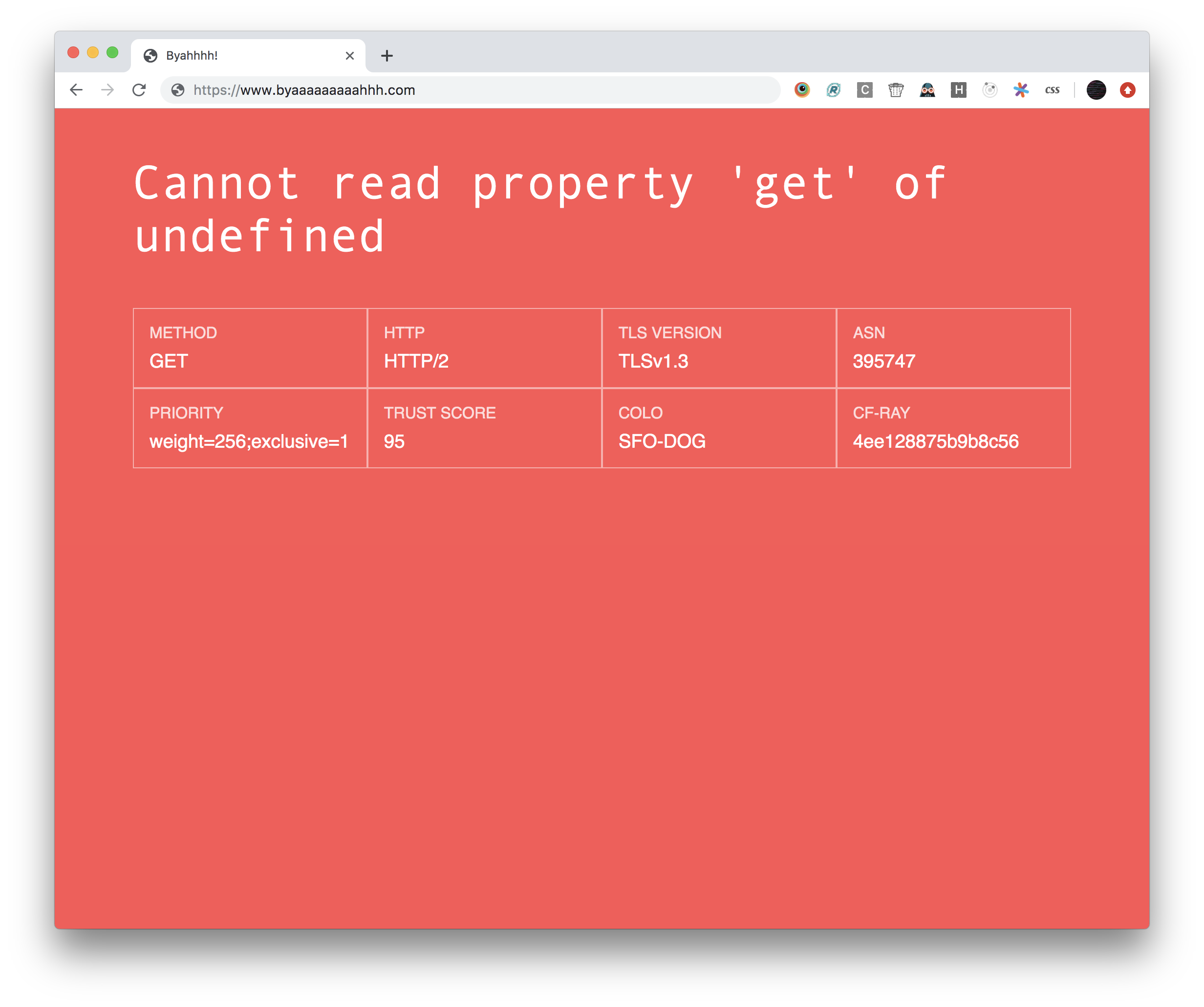
import { Router, getErrorPageHTML } from '8track'

const router = new Router()

addEventListener('fetch', (e) => {
  const res = router.getResponseForEvent(e).catch(
    (error) =>
      new Response(getErrorPageHTML(e.request, error), {
        status: 500,
        headers: {
          'Content-Type': 'text/html',
        },
      }),
  )

  e.respondWith(res as any)
})
Each Middleware and route handler receives a new copy of the ctx object, but a special object under the data property is mutable and should be used to share data between handlers
interface User {
  id: string
  name: string
}

// Pretend this is a function that looks up a user by ID
async function getUserById(id: string): Promise<User | undefined> {
  return null as any
}

// The describes the shape of the shared data each middleware will use
interface RouteData {
  user?: User
}

// This middleware attaches the user associated to the route to the request
const getUserMiddleware: Middleware<RouteData, { userId: string }> = async (ctx, next) => {
  ctx.data.user = await getUserById(ctx.params.userId)
  await next()
}

const router = new Router<RouteData>()

// For all user requests, attach the user
router.all`/users/${'userId'}`.use(getUserMiddleware)

router.get`/users/${'userId'}`.handle((ctx) => {
  if (!ctx.data.user) return ctx.end('Not found', { status: 404 })
  ctx.json(JSON.stringify(ctx.data.user))
})
const apiRouter = new Router()
const usersRouter = new Router()
const userBooksRouter = new Router()

usersRouter.get`/`.handle((ctx) => ctx.end('users-list'))
usersRouter.get`/${'id'}`.handle((ctx) => ctx.end(`user: ${ctx.params.id}`))
userBooksRouter.get`/`.handle((ctx) => ctx.end('books-list'))
userBooksRouter.get`/${'id'}`.handle((ctx) => ctx.end(`book: ${ctx.params.id}`))

usersRouter.all`/${'id'}/books`.use(userBooksRouter)
apiRouter.all`/api/users`.use(usersRouter)
Instantiate a new router
const router = new Router<{ logger: typeof console.log }>()
Given an event, run the matching middleware chain and return the response returned by the chain.
The primary way to interact with the router is to add routes via method tags:
router.post`/api/users`.handle((ctx) => ctx.json({ id: 123 }))
In the above example, the post tag returns a RouteMatchResult object.
Each of these methods returns a RouteMatchResult object.
When you use a template tag on the router, you create a RouteMatchResult.
router.patch`/api/users/${'id'}` // RouteMatchResult
The RouteMatchResult object allows you to mount a route handler or a middleware that only runs when the pattern is matched.
router.patch`/api/users/${'id'}`.use(async (ctx, next) => {
  console.log('Before: User ID', ctx.params.id)
  await next()
  console.log('After: User ID', ctx.params.id)
})
Mount a route handler that should return an instance of Response
Mount a route middleware that can optionally terminate the chain early and handle the request.
router.patch`/api/users/${'id'}`.use(async (ctx, next) => {
  console.log('Before: User ID', ctx.params.id)

  if (ctx.params.id === '123') {
    return ctx.end(Response.redirect(302))
  }

  await next()

  console.log('After: User ID', ctx.params.id)
})
Each route handler and middleware receives an instance of Context.
readonly event: FetchEventreadonly params: Paramsresponse: Responsedata: Dataurl: URLend(body: string | ReadableStream | Response | null, responseInit: ResponseInit = {})html(body: string | ReadableStream, responseInit: ResponseInit = {})json(body: any, responseInit: ResponseInit = {})8track uses a JavaScript feature called tagged templates in order to extract parameter names from url patterns. TypeScript is able extract types from tagged template literals:
const bar = 123
const baz = new Date()

// Extracted type here is a tuple [number, Date]
foo`testing: ${bar} - ${baz} cool`

// But things get interesting when using literal types
// Extracted type here is a tuple ['bar', 'baz']
foo`testing: ${'bar'} - ${'baz'} cool`
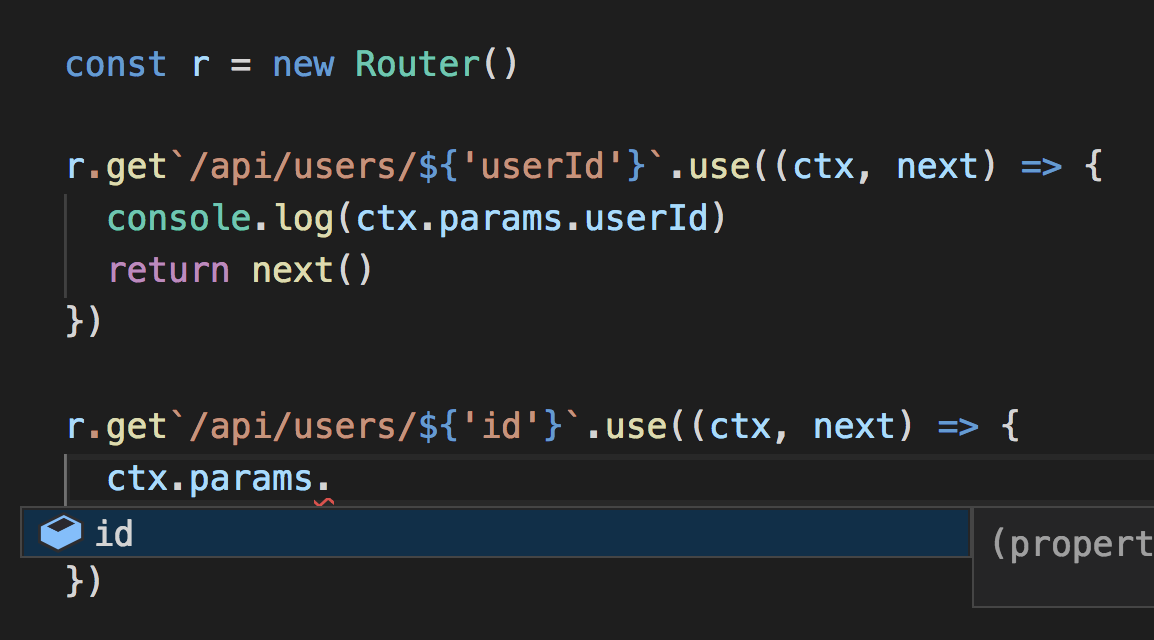
Since the template literal is able to extract a tuple whose types are the literal values passed in, we can utilize generics to describe the shape of the route parameters:
Serves files from Cloudflare KV.
import { Router, kvStatic } from '8track'

const router = new Router()

router.all`(.*)`.use(kvStatic({ kv: myKvNamespaceVar, maxAge: 24 * 60 * 60 * 30 }))
8track comes with a CLI to upload your worker and sync your kv files. In order to use 8track's kv static file middleware, you must upload your files using this CLI.
Add a deploy script to your package.json:
{
  "scripts": {
    "deploy": "8track deploy --worker dist/worker.js --kv-files dist/client.js,dist/client.css"
  }
}
Note: This does not support globs yet!
You'll need the following environment variables set:
# Your Cloudflare API Token
CF_KEY
# Your Cloudflare account email
CF_EMAIL
# Your Cloudflare account ID
CF_ID
# The ID of the namespace
KV_NAMESPACE_ID
# The name of the KV namespace you want to use
KV_NAMESPACE
# The variable name your KV namespace is bound to
KV_VAR_NAME
Download counts and popularity will appear here as the collector receives them.
| Version | Published | Direct dependencies | Open version |
|---|---|---|---|
| 1.3.3Registry latest | 19 Jun 2024 | 12 | |
| 1.3.3-beta-1 | 19 Jun 2024 | 12 | |
| 1.3.2 | 18 Mar 2024 | 12 | |
| 1.3.1 | 22 Jun 2021 | 12 | |
| 1.3.0 | 20 Jun 2021 | 12 | |
| 1.2.0 | 20 Jun 2021 | 12 | |
| 1.1.3 | 22 Dec 2020 | 10 | |
| 1.1.2 | 15 Dec 2020 | 10 | |
| 1.1.1 | 8 Apr 2020 | 10 | |
| 1.0.7 | 22 Aug 2019 | 10 | |
| 1.0.6 | 21 Aug 2019 | 10 | |
| 1.0.5 | 20 Aug 2019 | 10 | |
| 1.0.4 | 1 Aug 2019 | 10 | |
| 1.0.3 | 12 Jul 2019 | 10 | |
| 1.0.2 | 13 Jun 2019 | 5 | |
| 1.0.1 | 31 May 2019 | 4 | |
| 1.0.0 | 22 May 2019 | 4 |
This describes our collected data; it is not a security assessment.
Observed since 20 Oct, 21:26 UTC
No superseded metadata states collected. Unchanged observations do not create new revisions.
package:9cf40ec38b1341962b2090c2f3274a87c335e7eb52080eecd827d3fc9ee131fa