
 Repository
Current collected state Current
Observed since 20 Oct, 17:00 UTC
No superseded metadata states collected. Unchanged observations do not create new revisions.
Approximate all-nearest-neighbor search using neighborhood graphs, implemented in Rust with Python bindings.
AANNApproximate All Nearest-Neighbor ("aann") search using neighborhood graphs. Implemented in Rust with Python bindings. Based on Soudani & Karami (2018).
It is optimised for many nearest-neighbour joins that reuse the same clouds — build each cloud's index once, then query it again and again (e.g. an all-by-all join). See Usage.
Given two point clouds Q and P, for each point q in Q find its nearest neighbor p among the points in P.
q in Q and traverse P using an A* search to find its nearest neighbor p.q and search P for its nearest neighbor using p as the start. Since we start the search where we have already established spatial proximity the A* search should finish quickly.Q.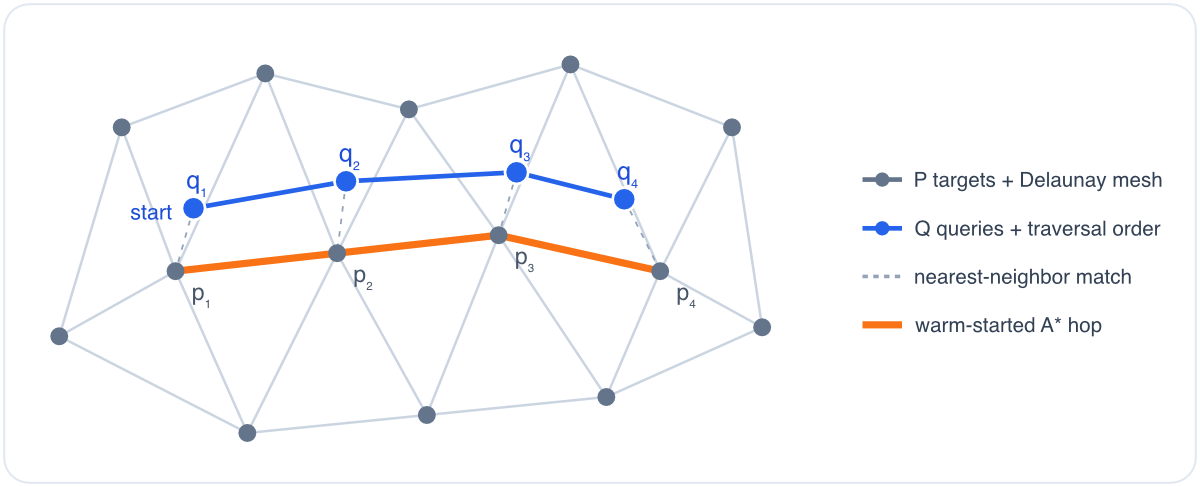
We currently only support 3D point clouds and Euclidean distances but may extend this to N-dimensions and other metrics in the future.
We provide prebuilt wheels for Linux, macOS, and Windows on PyPI:
pip install aann
aann is built for repeated nearest-neighbour queries against prepared
indices. Building an AANN index does the expensive work up front — triangulate
the cloud into a neighbourhood graph, SIMD-pack its coordinates, and (by default)
reorder them for cache locality — so that every subsequent .query is cheap. The
payoff grows the more you reuse an index; for a single one-off search the build
cost dominates and a plain KD-tree is simpler.
import aann
import numpy as np

target = np.random.rand(10_000, 3)
index = aann.AANN(target)              # pay the build cost once...

for query in query_clouds:             # ...then amortise it over many queries
    distances, indices = index.query(query)

# k nearest neighbours per point -> (N, k) arrays, rows sorted by distance
# (k>1 is approximate; raise `ef` to trade search breadth for recall):
distances, indices = index.query(query, k=4)

# Ignore matches beyond a cutoff (scipy convention: misses get
# distance=inf and neighbour index=len(target)):
distances, indices = index.query(query, distance_upper_bound=0.05)
The query cloud can be a raw (N, 3) array, a scipy/shull Delaunay, or
another AANN — passing a prepared AANN skips re-triangulating it (the fast
path the all-by-all below uses). k counts returned neighbours (as in
scipy.spatial.cKDTree.query); the degree of the optional graph="knn"
neighbourhood graph is graph_k.
This is where aann pulls ahead. Build one index per cloud with prepare_many
(parallel), then join them with all_by_all: every index is built and packed
once and reused across every pair it appears in, and the Rust search releases
the GIL so the pairs run concurrently across cores.
indexes = aann.prepare_many(clouds)                 # list[AANN], built in parallel
results = aann.all_by_all(indexes)                  # every ordered i != j pair
results = aann.all_by_all(indexes, pairs=[(0, 1)])  # ...or a specific subset
# results[m] is the (distances, indices) for pairs[m] (query = i, target = j)
Because a cloud that appears in many pairs is triangulated and packed only once,
a full all-by-all over n clouds does O(n) index builds rather than O(n²) —
the reason aann suits workloads like NBLAST neuron-vs-neuron matrices.
k=1, experimental)Two opt-in variants speed up the k=1 descent without changing the result (they
are exact up to occasional equal-distance ties in the returned index):
# Blocked: reuse each target vertex's neighbour gather across a block of query
# points (~1.4x on the descent). Works per query too; supports distance_upper_bound.
# Assumes Morton-coherent query order (the aann default, reorder=True); a block
# size in ~8-64 is the useful range.
d, i = index.query(other_index, blocked=True, block=8)
results = aann.all_by_all(indexes, blocked=True)

# Grouped: concatenate ALL query neurons' points and Morton-sort them ONCE, then
# descend that shared set against each target so co-located points from different
# neurons share gathers. Fastest for a large multi-threaded all-by-all (~4x
# multi-thread / ~2x single-thread here at block=32); k=1 only. See the docstring
# for the scaling caveats (memory, parallelism = #targets, data-dependent speedup,
# and that it descends the whole query set per target).
results = aann.all_by_all_grouped(indexes, distance_upper_bound=40.0)  # block=32
aann vs a KD-treeUnlike a KD-tree, aann is a cloud-vs-cloud method: the query points are
themselves triangulated into a graph, so the warm-started descent starts each
query near the previous answer. That is what makes it fast on coherent clouds
(neurons, meshes, space-filling data) — but pass a whole cloud, not a handful of
scattered points, and expect approximate results for k>1 (k=1 is exact on a
Delaunay graph).
The core search is a plain Rust library — the Python bindings sit behind the
non-default python cargo feature. It builds on stable Rust (SIMD comes
from the wide crate):
[dependencies]
aann-graph = { git = "https://github.com/schlegelp/aann" }
The package is named aann-graph (plain aann is taken on crates.io by an
unrelated project) but its library target is aann, so in code you import it
as aann:
use aann::{graph_from_simplices, PreparedF64};
use aann::ndarray::array; // re-exported ndarray

// Target cloud + its Delaunay simplices (rows of 4 vertex ids):
let points = array![[0.0, 0.0, 0.0], [1.0, 0.0, 0.0], [0.0, 1.0, 0.0], [0.0, 0.0, 1.0]];
let (indptr, indices) = graph_from_simplices(array![[0u64, 1, 2, 3]].view(), 4);
let target = PreparedF64::new(points.view(), indptr.view(), indices.view());

// Query cloud with its own CSR neighbourhood graph (`u32` indices -- the
// adjacency is the largest allocation in a big run, and a single cloud never
// approaches 2^32 points):
let queries = array![[0.1, 0.0, 0.0], [0.9, 0.1, 0.0]];
let (qptr, qidx) = (array![0u32, 1, 2], array![1u32, 0]);
let (dists, idxs) = target.query(queries.view(), qptr.view(), qidx.view());
PreparedF64::query_k(..., k, ef) gives k nearest neighbours,
query_prepared(&other) is the pack-free prepared-vs-prepared fast path, and
everything exists in an F32 flavour too (see the crate docs for the full
API, including the lower-level Neighborhood*/search_* functions).
bench.py contrasts aann with scipy.spatial.KDTree on uniform random 3D
clouds, single-threaded (so it compares the algorithms, not the thread pools).
It makes the trade-off concrete — an aann index is expensive to build but cheap
to query, so it only pays off once reused. Representative run (N = 5000
points/cloud, float64; numbers are indicative and machine-dependent):
| build | query | |
|---|---|---|
| scipy KDTree | 0.6 ms | 2.5 ms |
| aann index | 19 ms | 0.5 ms |
The index costs ~30× more to build but answers each query ~5× faster, so it
breaks even after ~9 reuses. In a full all-by-all — where every cloud's index is
built once and reused across all its pairs — aann's total wall-clock
(build + every pair) overtakes scipy at roughly a dozen clouds and keeps
pulling ahead (≈1.6× faster at n = 20). Recall vs the exact KDTree is 100% on
this uniform data. Reproduce with python bench.py.
k>1 uses an approximate best-first search; recall tunable via ef)query_radius (analagous to scipy.spatial.cKDTree.query_ball_tree)Requires Python ≥ 3.10. The extension is built against the stable ABI
(abi3-py310), so a single wheel works across all supported CPython versions.
cd into directorysource .venv/bin/activatematurin build --release to build a wheel or use maturin develop to compile and install in development modeaann uses the wide crate for SIMD, which
works on stable Rust. One thing to be aware of:
sse2 is enabled during compilation (on x86-64). It is very likely that your processor supports newer extensions such as avx2 or even avx512f. To check what's supported run:
$ cargo install cargo-simd-detect --force
$ cargo simd-detect
extension       width                   available       enabled
sse2            128-bit/16-bytes        true            true
avx2            256-bit/32-bytes        true            false
avx512f         512-bit/64-bytes        true            false
# To activate a specific extension
export RUSTFLAGS="-C target-feature=+avx2"

# Alternatively to activate all available extensions
export RUSTFLAGS="-C target-cpu=native"
First make sure pytest and pandas are installed:
pip install pytest -U
Then run the test-suite like so:
pytest --verbose -s
Note that unless you compiled with maturin develop --release the timings will
be much slower (up to 10x) than in a release build.
Soudani, N. M., & Karami, A. (2018). All nearest neighbor calculation based on Delaunay graphs (Version 1). arXiv. https://doi.org/10.48550/ARXIV.1802.09594
Download counts and popularity will appear here as the collector receives them.
| Version | Published | Direct dependencies | Open version |
|---|---|---|---|
| 0.3.0 | 20 Jul 2026 | 3 |
This describes our collected data; it is not a security assessment.
Observed since 20 Oct, 17:00 UTC
No superseded metadata states collected. Unchanged observations do not create new revisions.
package:af9928b9d2b0b4ce912275e8553cff327cacf0207196d485cc1505b6c88eb167