
 Repository
Current collected state Current
Observed since 20 Oct, 17:45 UTC
No superseded metadata states collected. Unchanged observations do not create new revisions.
A (branching) Behavior Synthesizer



Absynthe came about in response to the need for test data for analysizing the
performance and accuracy of log analysis algorithms. Even though plenty of real
life logs are available, e.g. /var/log/ in unix-based laptops, they do not
serve the purpose of test data. For that, we need labels, which are
difficult to obtain without an understanding the source code of the applications
that are generating these logs.
A more interesting situation arises while trying to test log analytic (and anomaly detection) solutions for distributed applications where multiple sources or modules emit their respective log messages in a single log queue or stream. This means that consecutive log lines could have originated from different, unrelated application components. Absynthe provides ground truth models to simulate such situations.
You need Absynthe if you wish to simulate the behavior of any well defined process -- whether it's a computer application or a business process flow.
Each business process or compuater application is modelled as a control flow graph (or CFG), which typically has one or more roots (i.e. entry) nodes and multiple leaf (i.e. end) nodes.
An example of a simple, tree-like CFG generated using Absynthe is shown below.
This is like a tree since nodes are laid out in levels, and nodes at level i
have outgoing edges only to nodes at level i + 1.
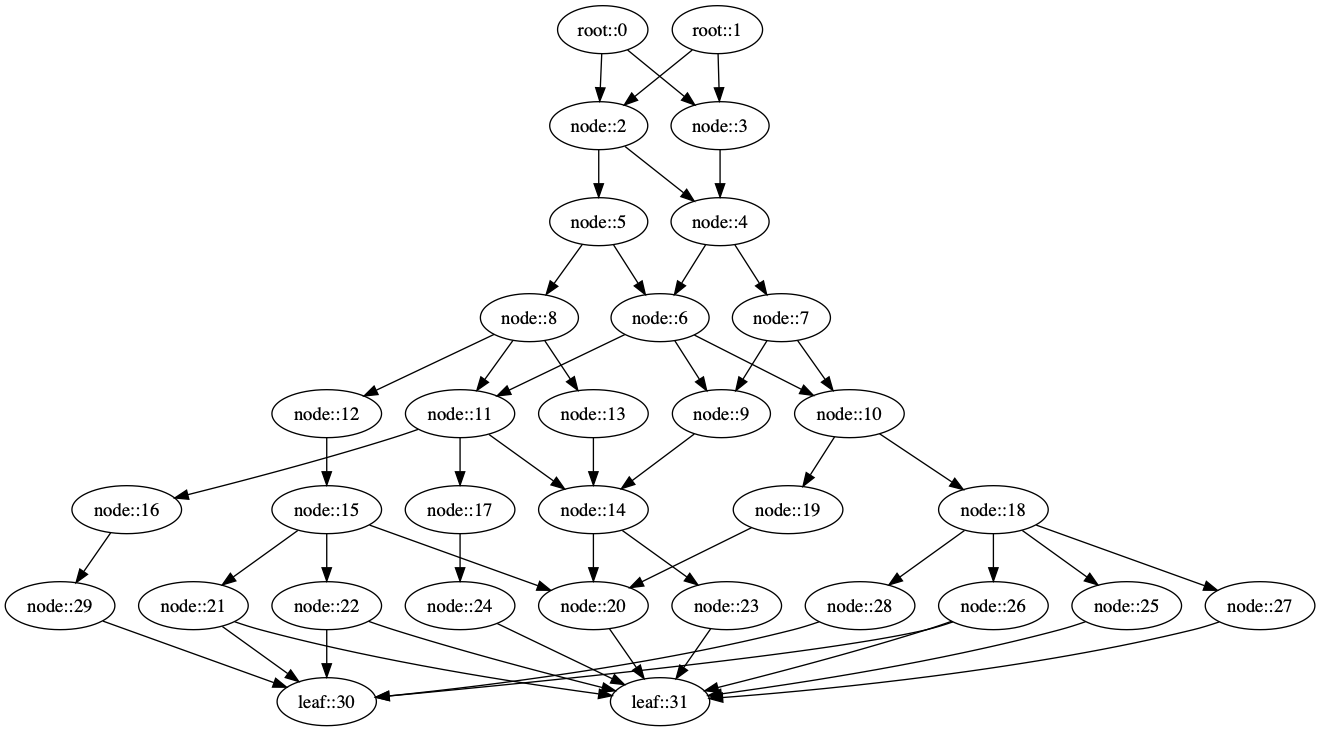
Each behavior is the sequence of nodes encountered while traversing this CFG from a root to a leaf. Of course, a CFG might contain loops which could be traversed multiple times before arriving at the leaf. Moreover, if there are multiple CFGs, then Absynthe can synthesize interleaved behaviors. This means that a single sequence of nodes might contain nodes from multiple CFGs. We are ultimately interested in this interleaving behavior, which is produced by multiple CFGs.
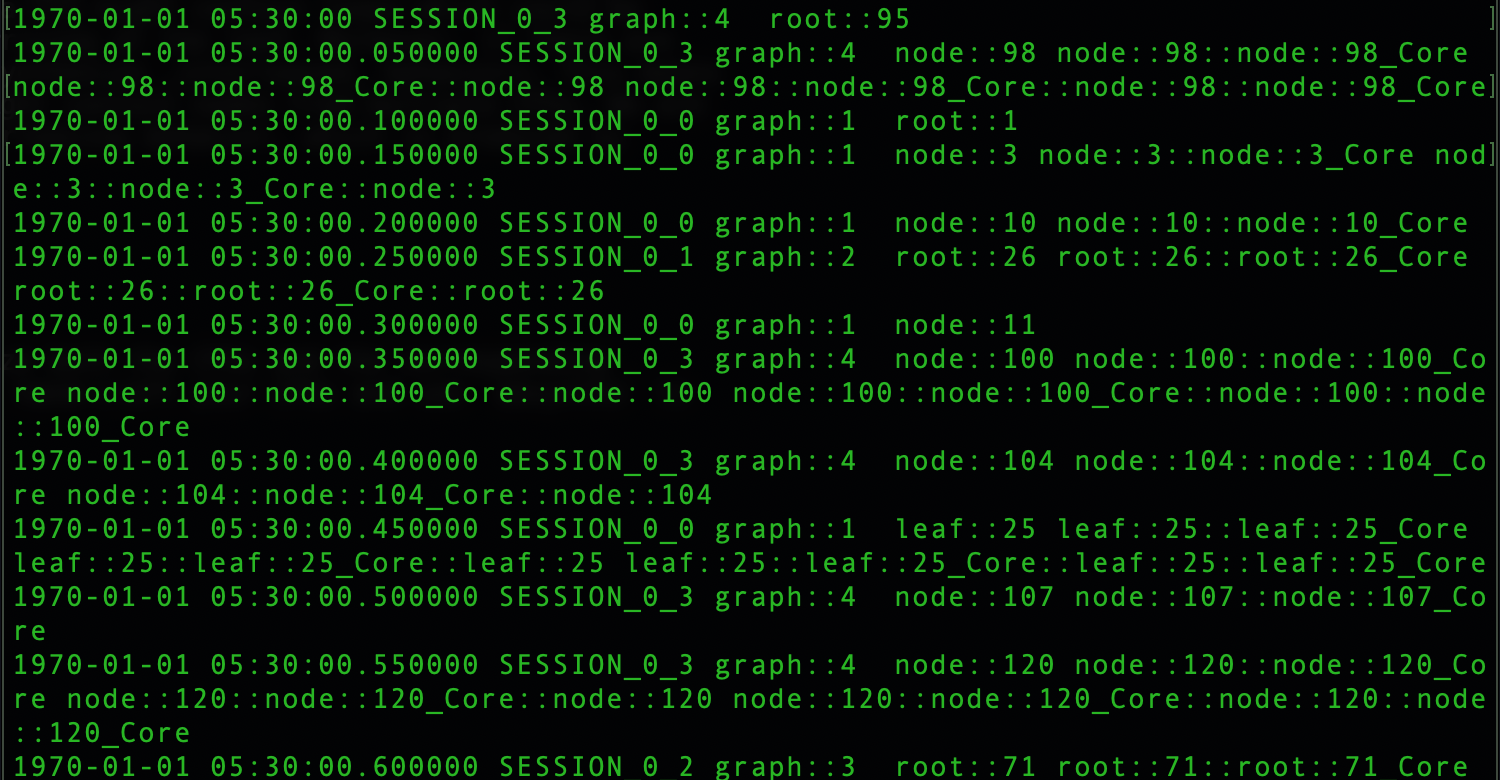
The above screenshot shows logs generated by Absynthe. Each log line starts with a time stamp, followed by a session ID, CFG ID, and a log message. At present, the log message is simply a random concatenation of the node ID to which the log message corresponds. A single CFG might participate in multiple sessions, where each session is a different traversal of the CFG. Therefore, we maintain both session ID and CFG ID in the log line.
An example of a more complex CFG, a directed cyclic graph, is shown in the figure below. It expands the tree-like graph illustrated above by:
i to a
node at level ≥(i + 2), andi to a node at level ≤(i - 1).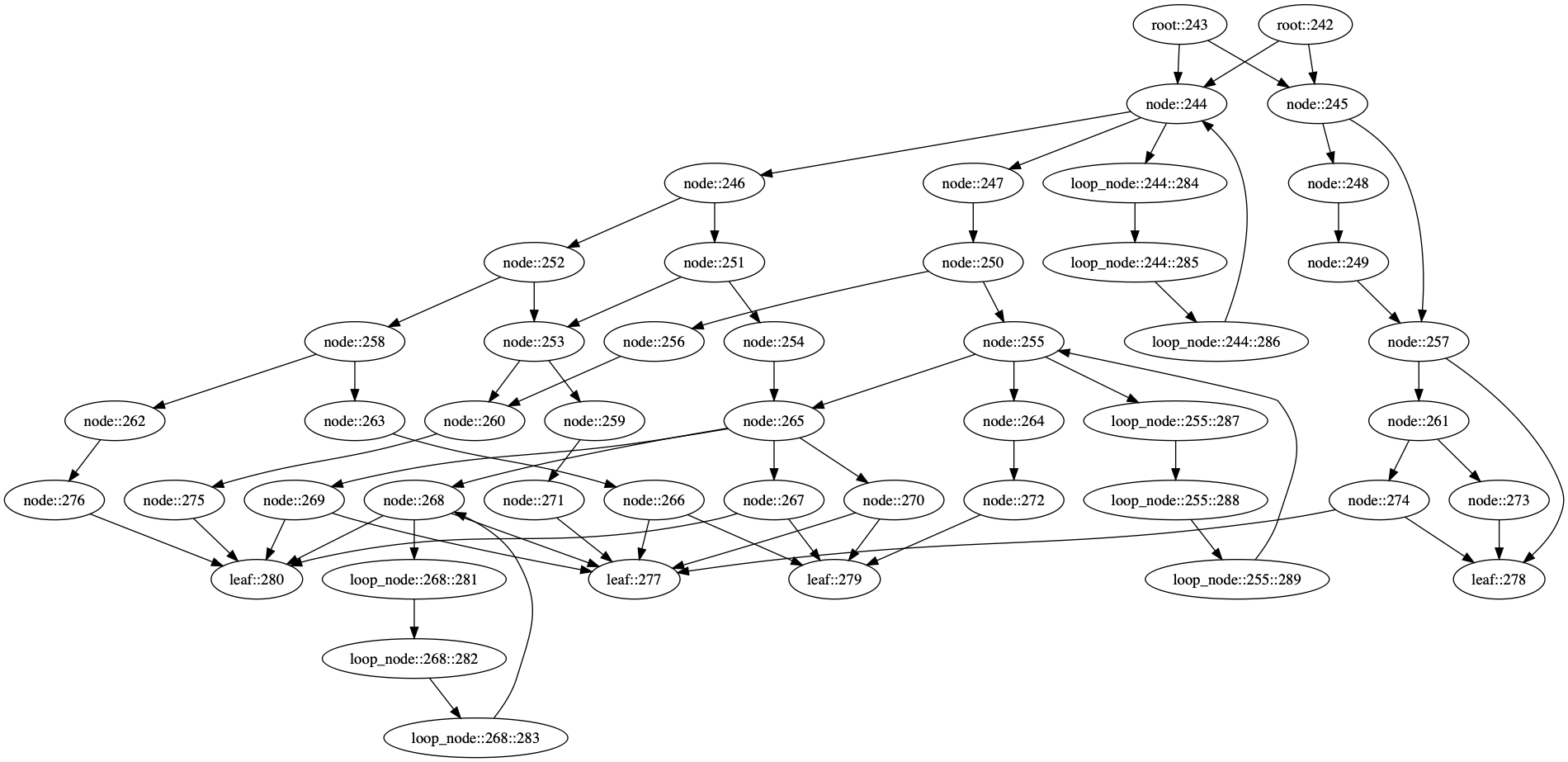
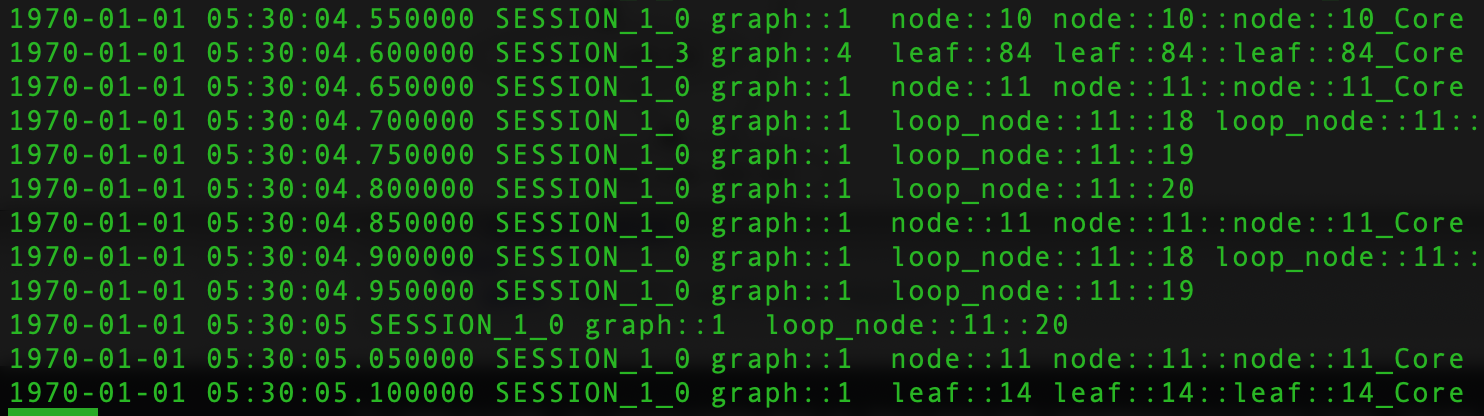
The identifiers of nodes appearing loops are helpfully prefixed with the identifiers of nodes where these loops start and finish. Moreover, loops could be traversed multiple times in a single behavior, as illustrated in the figure below.
This package requires Python >= 3.10 and depends on scipy.
The latest release is available on PyPI, simply pip install absynthe.
The main branch of this repository always contains the latest source, including any
changes merged since the last tagged release. To install from source:
# Change dir to absynthe
cd /path/to/absynthe

# Install absynthe and its dependencies
pip install .
It is possible to start using Absynthe with two classes:
GraphBuilder class, which
generates CFGs, andBehavior class, which
traverses the CFGs generated above and emits log messages.For instance, consider the basicLogGeneration method in
./examples/01_generateSimpleBehavior.py:
from absynthe.graph_builder import TreeBuilder
from absynthe.behavior import MonospaceInterleaving


def basicLogGeneration(numRoots: int = 2, numLeaves: int = 4,
                       branching: int = 2, numInnerNodes: int = 16,
                       loggerNodeTypes: str = "SimpleLoggerNode"):
    # Capture all the arguments required by GraphBuilder class
    tree_kwargs = {TreeBuilder.KW_NUM_ROOTS: str(numRoots),
                   TreeBuilder.KW_NUM_LEAVES: str(numLeaves),
                   TreeBuilder.KW_BRANCHING_DEGREE: str(branching),
                   TreeBuilder.KW_NUM_INNER_NODES: str(numInnerNodes),
                   TreeBuilder.KW_SUPPORTED_NODE_TYPES: loggerNodeTypes}

    # Instantiate a concrete GraphBuilder. Note that the
    # generateNewGraph() method of this class returns a
    # new, randomly generated graph that (more or less)
    # satisfies all the parameters provided to the
    # constructor, viz. tree_kwargs in the present case.
    simpleTreeBuilder = TreeBuilder(**tree_kwargs)

    # Instantiate a concrete behavior generator. Some
    # behavior generators do not print unique session ID
    # for each run, but it's nice to have those.
    exBehavior = MonospaceInterleaving()

    # Add multiple graphs to this behavior generator. The
    # behaviors that it will synthesize would essentially
    # be interleavings of simultaneous traversals of all
    # these graphs.
    for _ in range(4):
        # Add 4 graphs to the behavior
        exBehavior.addGraph(simpleTreeBuilder.generateNewGraph())

    # Specify how many behaviors are to be synthesized,
    # and get going.
    wSessionID: bool = True
    numTraversalsOfEachGraph: int = 2
    for logLine in exBehavior.synthesize(numTraversalsOfEachGraph, wSessionID):
        print(logLine)
    return
In order to generate behaviors from a directed cyclic CFG, create a DCG as shown
in ./examples/03_generateControlFlowDCG.py and then generate behaviors after
adding the DCG to a behavior object as shown in the code snippet above.
Note: When generating a behavior, i.e. when traversing a graph, successors
of nodes are chosen based on the probability distributions associated with those
nodes. Different nodes rely on different distributions and these nodes are
randomly assigned in the graphs that are constructed by generateNewGraph()
methods, resulting in graphs with a mix of nodes.
Note: This tool is still in alpha stage, so backward compatibility is not
guaranteed between releases. However, inasmuch as users stick to graph builders'
generateNewGraph() methods, they will stay away from compatibility problems.
setup.py to
pyproject.toml (hatchling), dependency management via uv, ruff for
linting/formatting, mypy for type checking, pytest for tests, GitHub
Actions for CI, and a Trusted Publishing (OIDC) release flow to PyPI --
replacing the old, manual twine upload process.Python < 3.10. Python 3.10-3.13 are tested in CI.develop branch: a new
MonospaceSimple behavior class, and the withSessionID flag moved from
MonospaceInterleaving's constructor to its synthesize() method (breaking
change for any existing callers of MonospaceInterleaving.__init__).numpy dependency; scipy is now the only runtime
dependency.DAGBuilder and DCGBuilder, which build
CFGs with skip-level edges and loops respectively.BinomialNode, which exploits the binomial distribution
in order to select its successors at the time of graph traversal.Utils in absynthe.cfg.utils.py to
create a new Node object from any of the concrete implementations of Node at
random. All concrete implementations of Node therefore transparently available
to graph builders (and everyone else) through this utility.Download counts and popularity will appear here as the collector receives them.
| Version | Published | Direct dependencies | Open version |
|---|---|---|---|
| 0.1.0 | 14 Aug 2026 | 1 |
This describes our collected data; it is not a security assessment.
Observed since 20 Oct, 17:45 UTC
No superseded metadata states collected. Unchanged observations do not create new revisions.
package:536189cab1c53bc4c21ed9bfcf4aaf5d4196b38197e494edc58dfb6d501b6f76