
 Repository
Current collected state Current
Observed since 20 Oct, 18:39 UTC
No superseded metadata states collected. Unchanged observations do not create new revisions.
The Actor-Gatherer framework: a context management framework for AI agents.




What is the Actor-Gatherer Framework · Install · Quickstart · Examples · How it works · Extensions
Actor-Gatherer is a new paradigm in agent design where the context across agents is managed proactively and externally, separating solving a task from context management needed to do so. An Actor (your coding agent: Claude Code, Codex, OpenCode or Pi) works on the task. A Gatherer (also AI-powered) monitors the Actor, other agents and the environment, and before every model call decides what context the Actor gets. The Gatherer:
Without a Gatherer, each agent operates largely on its own history, which is typically summarized as it grows. This can leave agents unaware of relevant past interactions, work done by other agents, or changes made by the user.
You need Python 3.11+ and the harness you want to run on your PATH. Install ag from PyPI:
pip install actor-gatherer
Or from source:
git clone https://github.com/ucbepic/actor-gatherer && cd actor-gatherer
pip install -r requirements.txt        # `ag` from this clone, editable, with every dependency
The Gatherer uses LLMs to manage the context of Actors, so you must set the model the
Gatherer uses. It can be an API-based model, called through
LiteLLM. Name it as provider/model, and set that provider's API key, e.g.,
ag model openai/gpt-6-sol                    # "provider/model"; the key from OPENAI_API_KEY
export OPENAI_API_KEY=...

ag model gemini/gemini-3.8-flash             # or a Gemini model; the key from GEMINI_API_KEY
export GEMINI_API_KEY=...
Or it can be a coding agent, such as Claude Code or Codex, named as
ag model claude-code/sonnet
ag model codex/gpt-6-sol
which runs Claude Code or Codex for the Gatherer. To use Codex, make sure OpenAI's Codex SDK is installed:
pip install openai-codex
To check the model that is set:
ag model
Put ag --gatherer NAME in front of the agent command you would normally run.
ag --gatherer demo claude                                # Claude Code
ag --gatherer demo codex exec "fix the tests"            # Codex
ag --gatherer demo opencode run "add a --verbose flag"   # OpenCode
ag --gatherer demo pi                                    # Pi
Agents join the gatherer specified (demo above). Agents with the same gatherer
share information with each other, whichever harness runs them (see the example). Agents in
different gatherers don't share context and each gatherer keeps its own history.
For example, the first two agents below share information; the third, in a gatherer of its own, sees neither of them:
ag --gatherer frontend claude                            # shares with the Codex below
ag --gatherer frontend codex                             # shares with the Claude Code above
ag --gatherer backend codex                              # shares with neither
Without --gatherer, a session joins the gatherer default:
ag codex # the same as: ag --gatherer default codex
Use --gatherer . to create a new, unnamed gatherer. Agents created
this way don't share context with other agents:
ag --gatherer . codex
To see every gatherer:
ag gatherers # each one's policy, pollers, event count, last activity
The Actor-Gatherer framework improves accuracy in three settings:
Below are two short examples of the latter two.
ag proactively shares information across agents when one needs it, as long as
they are in the same gatherer, even if they run in different harnesses.
1. Terminal 1: start Codex in a gatherer named demo, with a first message.
ag --gatherer demo codex "Let X = 5. What is 2X?"
You → Codex: Let X = 5. What is 2X?
Codex: If X = 5, then 2X = 2 × 5 = 10.
2. Terminal 2 (or after the first session has ended): start Claude Code in the same gatherer.
ag --gatherer demo claude "What is 3X?"
You → Claude Code: What is 3X?
Claude Code: 3X = 15.
Your question doesn't define X, so I took X = 5 from your message to the other agent ("Let X = 5. What is 2X?").
Claude Code never saw the Codex session. Both are in demo, so the Gatherer
gave it Codex's request, and told it where to read the rest of that session's
work.
ag observes the agent's environment, such as the files in its working
directory, and tells the agent when something it relied on has changed. The
example's data file is in this repo, at demo/salaries.csv.
1. Terminal 1: copy the demo file and start Codex next to it. The copy keeps the repo's file as it is when you edit it.
mkdir -p /tmp/ag-salaries && cp demo/salaries.csv /tmp/ag-salaries/ && cd /tmp/ag-salaries
ag --gatherer salaries codex
2. In Codex: ask about the file.
You → Codex: I'm putting together a compensation benchmark from salaries.csv. Where does Germany's average salary sit relative to the median of the countries listed?
Codex: Germany ($58,940) sits $3,820 above the median ($55,120, the United Kingdom).
3. Terminal 2: change the file while the Codex session stays open. This changes Japan from 42,180 to 47,152 (or edit the file by hand):
f=/tmp/ag-salaries/salaries.csv; c=$(<"$f"); printf '%s\n' "${c/Japan,42180,/Japan,47152,}" > "$f"
4. In the same Codex session: ask a second question.
You → Codex: How large is the gap between France and Japan, in USD?
Codex: France: $49,310. Japan: $47,152. The gap between France and Japan is $2,158.
Before this question reached the model, the Gatherer told Codex that
salaries.csv had changed after it last read it, so Codex read the file again.
To compare, repeat the steps with plain codex, starting from a fresh copy:
mkdir -p /tmp/plain-salaries && cp demo/salaries.csv /tmp/plain-salaries/ && cd /tmp/plain-salaries
codex
Asked the same two questions, with the same change in between, plain Codex answers $7,130 to the second, which is incorrect: it uses Japan's old value from its first read.
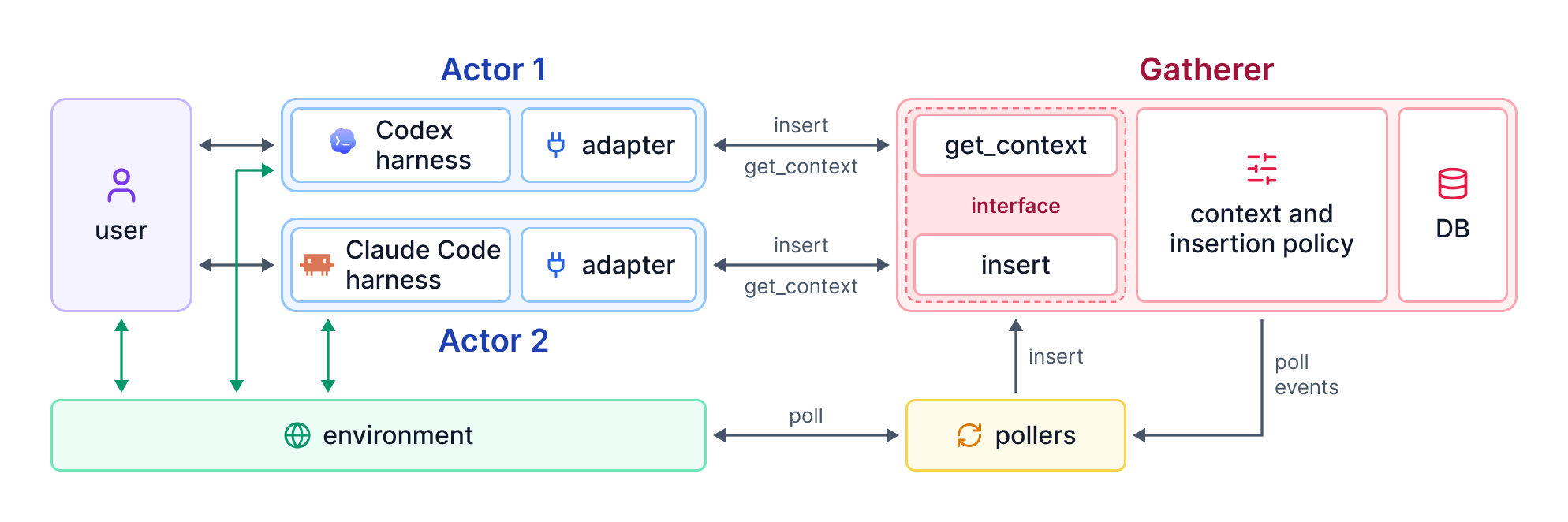
The Gatherer is a server that many Actors talk to, and the Actors can come from different coding harnesses. An Actor is a harness plus its adaptor, which turns the harness's messages into a unified data representation and the Gatherer's context back into message format the harness supports. Each Actor uses two calls on the Gatherer:
insert gives the Gatherer what the Actor has seen and done.get_context runs before each model call, and returns the context the model gets.Pollers bring in information from the environment, such as files changed under the working directory. The Gatherer asks them for new events in the environment, and they insert those events like an Actor would. A context management policy inside the Gatherer then decides what context each Actor gets, using everything it has gathered from every Actor and from the environment.
ag currently uses:
ClaudeAdaptor,
CodexAdaptor,
OpencodeAdaptor and
PiAdaptor, each with the
launcher ag uses to start that harness connected to the Gatherer.FileChangePoller,
which reports files changed under the agent's working directory since it last
looked.ProactiveContextManager,
which searches earlier history in the
background, and adds what other sessions asked for and what changed in the
environment.ag is extensible. You can:
ag.See Extending ag in the docs.
Download counts and popularity will appear here as the collector receives them.
| Version | Published | Direct dependencies | Open version |
|---|---|---|---|
| 0.1.0 | 17 Oct 2026 | 5 |
This describes our collected data; it is not a security assessment.
Observed since 20 Oct, 18:39 UTC
No superseded metadata states collected. Unchanged observations do not create new revisions.
package:7306cf9313f0431a83e03e5a245b308ef585b257f81b750785544779d13167c8