
 Repository
Current collected state Current
Observed since 20 Oct, 20:04 UTC
No superseded metadata states collected. Unchanged observations do not create new revisions.
Anthropic's Advisor Strategy as a drop-in DeepAgents middleware — pair a powerful advisor with a fast executor
advisor-middleware




Problem • How it works • Quick start • Configuration • Benchmark
Open-source implementation of Anthropic's Advisor Strategy — a pattern that pairs a fast, cheap executor model with a powerful advisor model. The executor runs end-to-end; the advisor is consulted only on critical decisions. Result: better performance at lower cost.
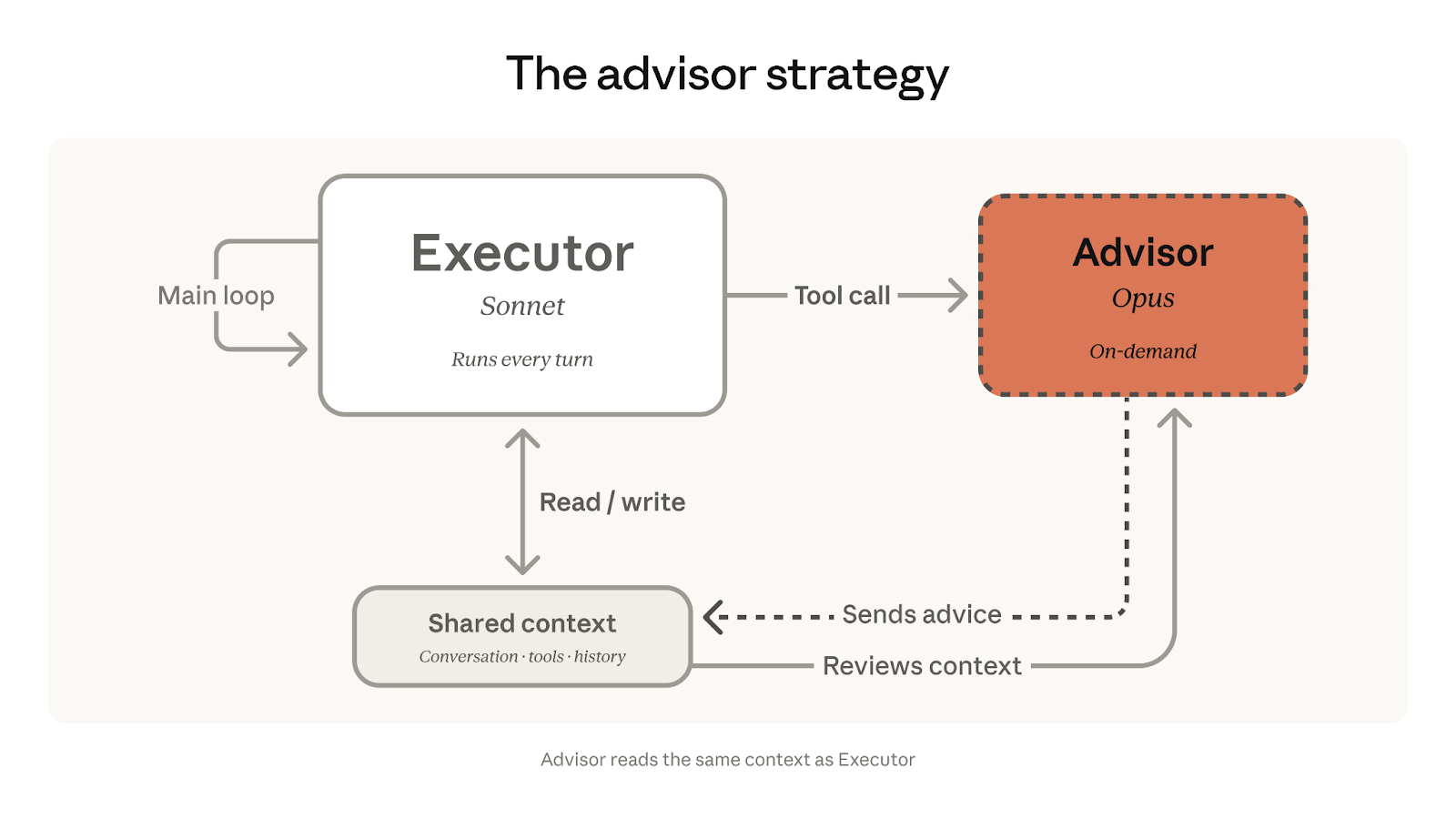
advisor-middleware makes this a single import for DeepAgents. It handles provider detection, native API routing, fallback invocation, cost guardrails, and context curation — so you just plug it in and your agents get smarter.
| Traditional sub-agent pattern | Advisor Strategy |
|---|---|
| Large orchestrator decomposes work into tasks | Small executor drives end-to-end |
| Expensive model runs every turn | Expensive model consulted only when needed |
| Worker pools + orchestration overhead | Zero orchestration — just a tool call |
| Hard to predict costs | max_uses guardrail caps advisor spend |
flowchart TD
    A["Executor (Sonnet/Haiku)"] -->|"Runs every turn"| B{"Stuck on a\nhard decision?"}
    B -->|No| C["Continue executing\n(read, write, search, execute)"]
    C --> A
    B -->|Yes| D["Call advisor tool"]
    D --> E["Advisor (Opus)\nReviews shared context"]
    E -->|"Returns plan/correction/stop"| F["Executor resumes\nwith guidance"]
    F --> A

    style A fill:#fff,stroke:#333,color:#333
    style E fill:#c0392b,color:#fff
    style C fill:#2d6a4f,color:#fff
    style F fill:#2d6a4f,color:#fff
The middleware operates in two modes depending on the executor's provider:
advisor_20260301 server-side tool spec. The API handles everything internally — zero extra round-trips, zero overhead on simple turns.advisor tool backed by a direct LLM call to the advisor model. Works with any executor/advisor combination.pip install advisor-middleware
# Or from source
pip install git+https://github.com/emanueleielo/advisor-middleware.git
from deepagents import create_deep_agent
from advisor_middleware import AdvisorMiddleware

mw = AdvisorMiddleware(advisor_model="claude-opus-4-6")

agent = create_deep_agent(
    model="anthropic:claude-sonnet-4-6",
    system_prompt="You are a senior software engineer.",
    backend=backend,
    middleware=[mw],
)
That's it. Sonnet executes, Opus advises. The middleware auto-detects Anthropic and uses the native API tool — no extra configuration needed.
from advisor_middleware import AdvisorMiddleware, AdvisorConfig

mw = AdvisorMiddleware(
    config=AdvisorConfig(
        advisor_model="anthropic:claude-opus-4-6",
        prefer_native=False,  # force fallback mode
        max_uses_per_turn=2,
    ),
)

agent = create_deep_agent(
    model="openai:gpt-4o",  # any provider as executor
    middleware=[mw],
)
from advisor_middleware import AdvisorMiddleware
from compact_middleware import CompactionMiddleware, CompactionToolMiddleware

advisor_mw = AdvisorMiddleware(advisor_model="claude-opus-4-6")
compact_mw = CompactionMiddleware(model="anthropic:claude-sonnet-4-6", backend=backend)
compact_tool_mw = CompactionToolMiddleware(compact_mw)

agent = create_deep_agent(
    model="anthropic:claude-sonnet-4-6",
    backend=backend,
    middleware=[advisor_mw, compact_mw, compact_tool_mw],
)
AdvisorConfig| Parameter | Type | Default | Description |
|---|---|---|---|
advisor_model | str | BaseChatModel | "claude-opus-4-6" | Advisor model ID or resolved instance |
max_uses_per_turn | int | 3 | Max advisor calls per agent turn |
max_uses_per_session | int | None | None | Lifetime cap (None = unlimited) |
prefer_native | bool | True | Use native advisor_20260301 when possible |
max_tokens | int | 1024 | Max tokens the advisor can generate per consultation |
temperature | float | 1.0 | Advisor temperature (fallback mode only) |
advisor_system_prompt | str | None | None | Override advisor prompt (fallback only) |
context | ContextCurationConfig | (see below) | Controls context forwarded to advisor |
ContextCurationConfig| Parameter | Type | Default | Description |
|---|---|---|---|
include_system_prompt | bool | True | Forward executor's system prompt |
include_tool_results | bool | True | Include tool results in context |
max_context_messages | int | None | None | Limit messages sent to advisor |
max_context_chars | int | None | None | Hard character budget for context |
config = AdvisorConfig(
    max_uses_per_turn=2,        # max 2 consultations per turn
    max_uses_per_session=10,    # max 10 total in the session
    context=ContextCurationConfig(
        max_context_messages=10,  # only last 10 messages
        include_tool_results=False,  # skip bulky tool outputs
    ),
)
Native (advisor_20260301) | Fallback (LLM call) | |
|---|---|---|
| When | Anthropic executor + prefer_native=True | Any other executor, or prefer_native=False |
| How | Server-side tool spec injected into API call | Direct LLM call to advisor model |
| Round-trips | 0 extra (handled by API) | 1 per consultation |
| Overhead | Zero on simple turns | Minimal (only when called) |
| Model freedom | Anthropic advisor only | Any model as advisor |
| Context curation | Handled by API | Configurable via ContextCurationConfig |
The middleware auto-detects the executor's provider and routes accordingly. You can force fallback mode with prefer_native=False for full control over context curation.
We tested with a real debugging task: a 4-file async task queue system (connection pool + circuit breaker + rate limiter + retry logic) with interacting bugs that cause tasks to be silently dropped under load. The agent must read all files, diagnose cross-component interactions, and fix every bug.
python examples/benchmark.py
| Haiku Solo | Haiku + Opus Advisor | |
|---|---|---|
| Tests passing | 11/12 | 12/12 |
| Turns | 11 | 6 |
| File writes | 7 (3 rewrites) | 3 (all correct first try) |
| Advisor calls | 0 | 1 |
| Duration | 210.7s | 90.3s |
What happened: Haiku solo rewrote connection.py four times, going in circles trying to fix the semaphore leak. It never solved the circuit breaker recovery issue.
Haiku + Advisor consulted Opus once after reading all files. Opus confirmed the bug diagnosis, corrected a proposed fix, and flagged an issue Haiku missed. Haiku then wrote all three fixes correctly on the first attempt.
The advisor doesn't help on simple tasks — Haiku handles routine reads, writes, and obvious fixes alone. The value shows on cross-file reasoning where Haiku gets stuck in trial-and-error loops:
One well-timed consultation eliminated multiple cycles of incorrect rewrites.
From the original blog post:
| Config | SWE-bench Multilingual | Cost per task |
|---|---|---|
| Sonnet + Opus Advisor | +2.7pp vs Sonnet solo | -11.9% |
| Haiku + Opus Advisor (BrowseComp) | 41.2% vs 19.7% solo | 85% cheaper than Sonnet |
Track advisor usage programmatically:
mw = AdvisorMiddleware(advisor_model="claude-opus-4-6")

# ... after agent execution ...

print(f"Total consultations: {mw.get_total_uses()}")
print(f"Total advisor tokens: {mw.get_total_advisor_tokens()}")

for event in mw.get_events():
    print(f"  Turn {event['turn']}: {event['strategy']} — {event['advisor_tokens']} tokens")
    print(f"    Q: {event['question'][:80]}...")
    print(f"    A: {event['advice'][:80]}...")
advisor_middleware/
├── __init__.py        # Public API: AdvisorMiddleware, AdvisorConfig, ...
├── middleware.py       # Core middleware — dual-mode wrap_model_call
├── config.py          # AdvisorConfig + ContextCurationConfig dataclasses
├── state.py           # AdvisorState + AdvisorEvent TypedDicts
├── prompts.py         # Executor + advisor system prompts
├── providers.py       # Provider detection, native spec, fallback invocation
└── py.typed           # PEP 561 type marker
# Install with dev dependencies
pip install -e ".[dev,deepagents,anthropic]"

# Run tests
pytest

# Lint
ruff check advisor_middleware/

# Type check
mypy advisor_middleware/
MIT — Emanuele Ielo
Download counts and popularity will appear here as the collector receives them.
| Version | Published | Direct dependencies | Open version |
|---|---|---|---|
| 0.1.1 | 10 Apr 2026 | 10 |
This describes our collected data; it is not a security assessment.
Shared repository data · GitHub
Observed since 20 Oct, 20:04 UTC
No superseded metadata states collected. Unchanged observations do not create new revisions.
package:aebbab3fce87e29d3e308ab8458ae4cb2802fad0d075acc50a58adaf33602614