
 Repository
Current collected state Current
Observed since 20 Oct, 20:24 UTC
No superseded metadata states collected. Unchanged observations do not create new revisions.
Atomistic simulation tools based on Gaussian Processes Regression
Efficient Data Augmentation for ANN Potential Training Using GPR Surrogate Models
aenet-gpr is a Python package that enables scalable and cost-efficient training of artificial neural network (ANN) potentials by leveraging Gaussian Process Regression (GPR) as a surrogate model.
It automates data augmentation to:
📬 Contact:
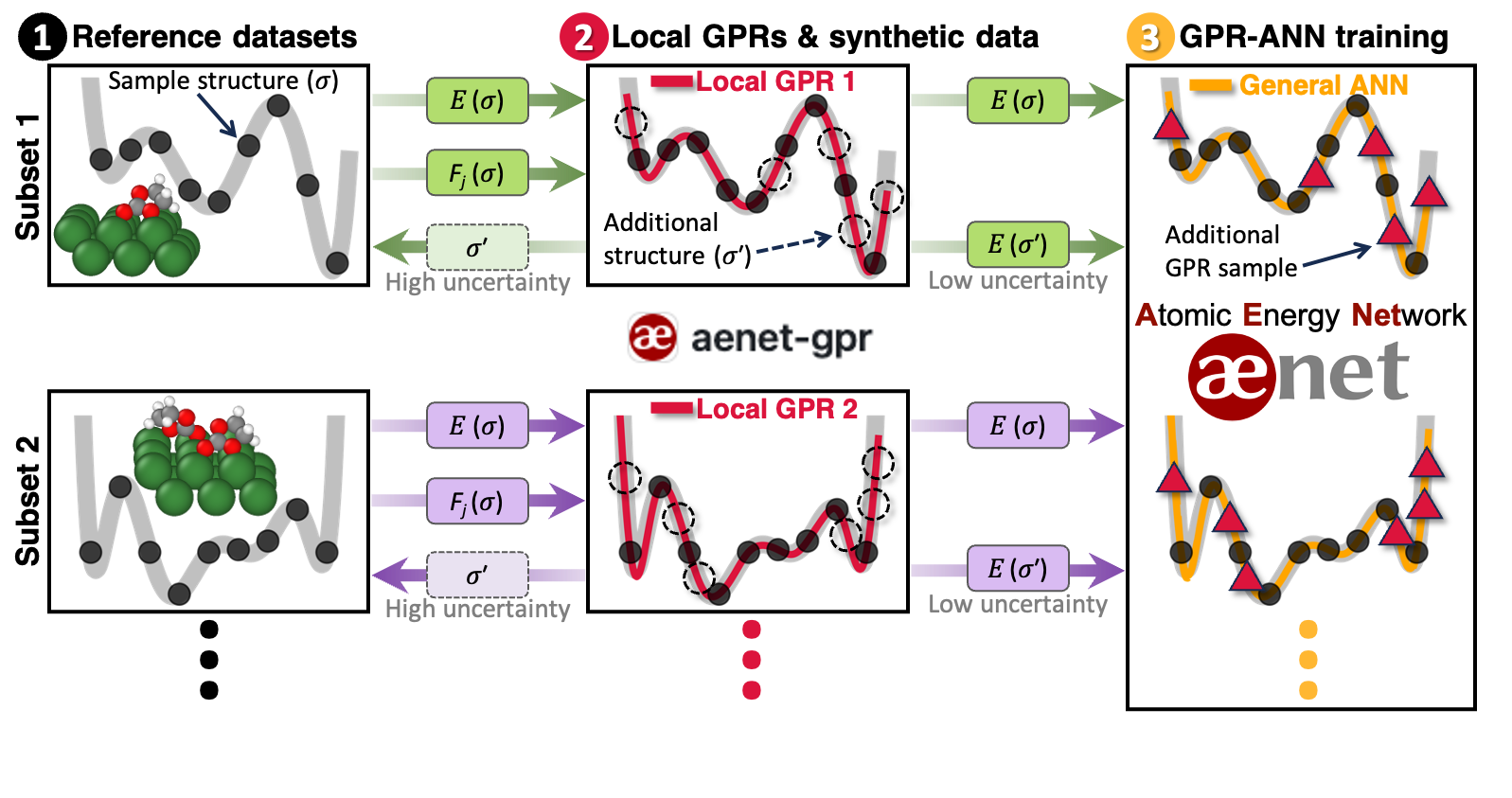
Data Grouping
Train
Test
Augment
✅ Outputs are saved in XCrysDen Structure Format (XSF), fully compatible with the ænet package for indirect force training (GPR-ANN).
train.in)Requirements:
numpy, ASE) are automatically installed when installing aenet-gprRefer to official guide and install compatible versions depending on availablity of GPU and CUDA:
With CUDA (optional for GPU support):
$ pip install torch torchvision torchaudio --index-url https://download.pytorch.org/whl/cu118
CPU-only:
$ pip install torch torchvision torchaudio --index-url https://download.pytorch.org/whl/cpu
Installation using pip
$ pip install aenet-gpr
Find interactive notebooks *.ipynb in the ./tutorial/ folder, or run directly on Google Colab:
The ./example/ directory includes example input and output data files.
By default, input data is provided in .xsf format.
The first comment line should specify total energy of a structure. Each line following the keyword ATOMS contains atomic symbol, three Cartesian coordinates, and the three components of atomic forces. The length, energy, and force units are Å, eV, and eV/Å.
# total energy =  -0.0970905812353288 eV

ATOMS
H    -0.91666666666667    0.00000000000000    0.00000000000000    0.32660398877491    0.00000000000000    0.00000000000000
H    0.91666666666667    0.00000000000000    0.00000000000000    -0.32660398877491    0.00000000000000    0.00000000000000
# total energy = -16688.9969866290994105 eV

CRYSTAL
PRIMVEC
 10.31700000000000 0.00000000000000 0.00000000000000
 0.00000000000000 10.31700000000000 0.00000000000000
 0.00000000000000 0.00000000000000 32.00000000000000
PRIMCOORD
 46 1
Li     -0.02691046000000     0.02680527000000     10.32468480000000     -0.01367780493112     -0.01466501222916     0.08701630310868
Li     -0.04431013000000     3.46713645000000     10.25290534000000     0.06865473174602     -0.00786890285541     0.15426435842600
Li     0.02355300000000     6.82569825000000     10.31803445000000     0.00877419275000     0.03943267659765     0.14805797440506
...
Other formats such as VASP OUTCAR (with a line of File_format vasp-out in train.in below) are also supported as long as they can be read through ASE.
train.in (comments are provided to guide the keyword meanings)# File path
Train_file ./example/3_Li-EC/train_set/file_*.xsf
Test_file ./example/3_Li-EC/test_set/file_*.xsf
# File format (default: xsf)
File_format xsf # Other DFT output files, which can be read via ASE such as "vasp-out" "aims-output" "espresso-out", are also supported
# Uncertainty estimation (default: True)
Get_variance True # False -> only energy and forces are evaluated without uncertainty estimate
# Descriptor (default: cartesian coordinates)
Descriptor cart # cart or soap
# Kernel parameter (default: Squared exponential)
scale 0.4 # default: 0.4
weight 1.0 # default: 1.0
# Data process (default: batch, 25)
data_process batch # batch (memory cost up, time cost down) or iterative (no-batch: memory down, time up)
batch_size 25
# Flags for xsf file writing (default: False)
Train_write False # True -> xsf files for reference training set are written under "./train_xsf/" directory
Test_write False # True -> xsf files for reference test set are written under "./test_xsf/" directory
Additional_write False # True -> additional xsf files are written under "./additional_xsf/" directory; False -> Augmentation step is not executed
# Data augmentation parameter (default: 0.055, 25)
Disp_length 0.05
Num_copy 20 # [num_copy] multiples of reference training data are augmented
With the train.in file and datasets prepared, simply run:
$ python -m aenet_gpr ./train.in > train.out
The Train–Test–Augment steps will be executed sequentially. Augmented data will be saved in the ./additional_xsf/ directory.
To run aenet_gpr on an HPC cluster using SLURM, use a batch script like the following:
#!/bin/bash
#SBATCH --job-name=aenet-job
#SBATCH --nodes=1
#SBATCH --tasks-per-node=8
#SBATCH --cpus-per-task=4
#SBATCH --time=1:00:00

module load anaconda3
source activate aenet-env

ulimit -s unlimited
python -m aenet_gpr ./train.in > train.out
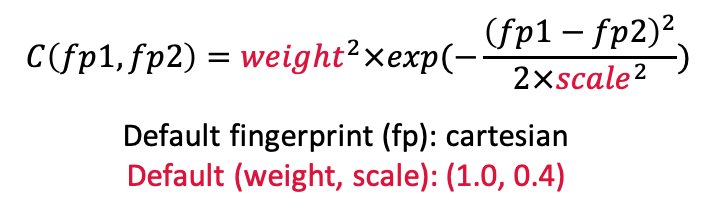
Following figure shows energy prediction errors of the ./example/3_Li-EC/ example with different kernel parameters and descriptors.
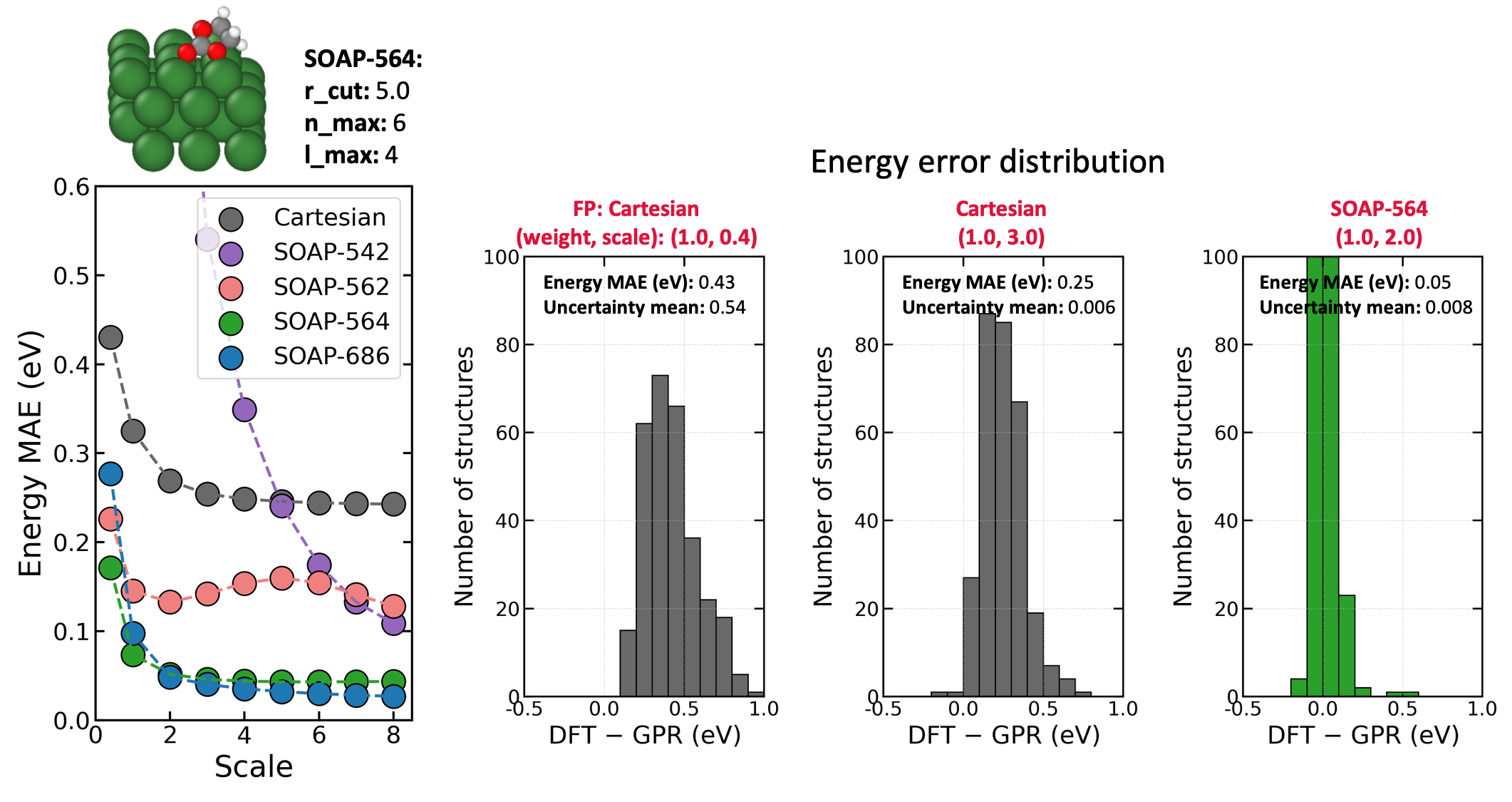
When using the Cartesian descriptor (gray circles), the error decreases as the scale parameter increases, and it converges at scale = 3.0. When using the periodic SOAP descriptor (for details, see DScribe documentation), the error is significantly reduced by one order of magnitude compared to the Cartesian descriptor.
As demonstrated in the examples for the ./example/2_EC-EC/ (results available in the example directory), non-periodic systems can be well-represented using non-periodic Cartesian descriptors, while periodic systems are expected to yield better accuracy when using periodic SOAP descriptors.
For the example of SOAP descriptor here, eight uniformly distributed points in the Li slab Rectangular cuboid were used as centers argument for SOAP.
The corresponding train.in input arguments are
Descriptor soap
soap_r_cut 5.0
soap_n_max 6
soap_l_max 4
soap_centers [[2.20113706670393, 2.328998192856251, 6.952547732109352], [2.20113706670393, 2.328998192856251, 11.895790642109352], [2.20113706670393, 6.760484232856251, 6.952547732109352], [2.20113706670393, 6.760484232856251, 11.895790642109352], [6.63924050670393, 2.328998192856251, 6.952547732109352], [6.63924050670393, 2.328998192856251, 11.895790642109352], [6.63924050670393, 6.760484232856251, 6.952547732109352], [6.63924050670393, 6.760484232856251, 11.895790642109352]]
soap_n_jobs 4

scale 2.0
weight 1.0
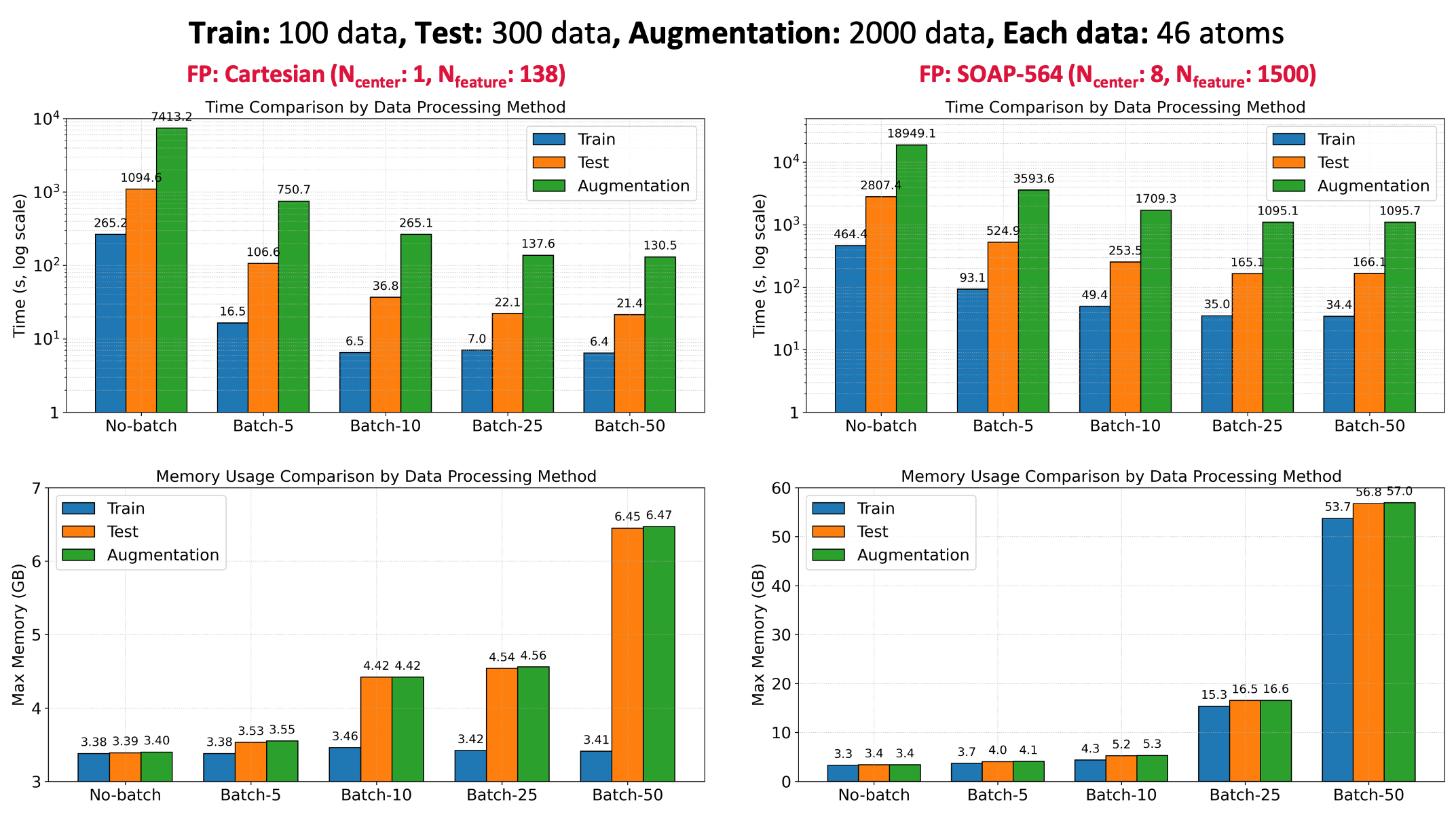
data_process iterative: Computing kernels data-by-data involves n_data × n_data sequential kernel evaluations, minimizing the memory overhead but significantly increasing computational time.
data_process batch: aenet-gpr supports batch processing by grouping the data process into a specific size (batch_size 25), which significantly reduces train and evaluation time while keeping memory usage efficient.
Below, we provide a benchmark comparing the required time and memory for different batch sizes on the ./example/3_Li-EC/ example.
Download counts and popularity will appear here as the collector receives them.
| Version | Published | Direct dependencies | Open version |
|---|---|---|---|
| 3.7.9 | 24 Dec 2025 | 1 |
This describes our collected data; it is not a security assessment.
Observed since 20 Oct, 20:24 UTC
No superseded metadata states collected. Unchanged observations do not create new revisions.
package:c99effa85b874d26b2cd97695f4d626540e5763468d17dd415cfb50a6c1defa1