
 Repository
Current collected state Current
Observed since 20 Oct, 20:27 UTC
No superseded metadata states collected. Unchanged observations do not create new revisions.
Learning to rumble: Automated elephant call classification, detection and endpointing using deep architectures




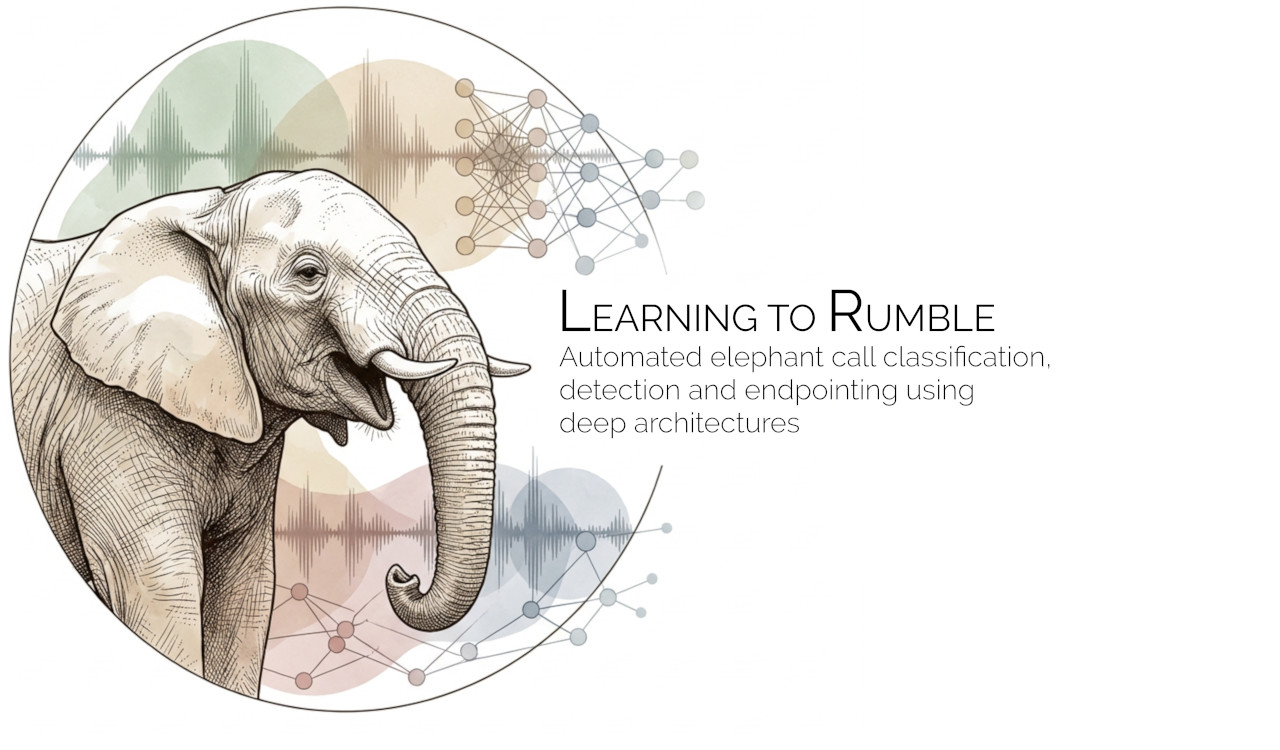
A deep learning system for automatically detecting, classifying, and endpointing elephant calls in continuous audio recordings. Elephants communicate using a rich vocal repertoire — from low-frequency rumbles that travel kilometres to trumpets and roars — and understanding these calls is key to monitoring their behaviour and supporting conservation efforts. This system uses an audio spectrogram transformer (AST) with transfer learning to perform frame-level call detection and classify calls into types (e.g. rumble, trumpet, roar) and sub-call categories, achieving state-of-the-art results on both Asian and African elephant vocalisation datasets.
PyTorch Hub automatically handles downloading and installing the required code. No additional installations beyond PyTorch are needed.
# Required dependencies: numpy torch torchaudio
import torch

# Load a pretrained model (single fold, downloads weights automatically)
model, preprocess = torch.hub.load("CMGeldenhuys/AERD_inference", "aerd")

# 10 seconds of audio at 16 kHz
audio = torch.randn(1, 16000 * 10)

# Raw probabilities — shape (1, 62, 5) for 62 time frames × 5 classes
probs = model.predict(audio, output="tensor")

# Per-frame class labels above a confidence threshold
labels = model.predict_labels(audio, threshold=0.5)
# [                          ← batch
#   [                        ← frames
#     ["rumble"],            ← frame 0: one class detected
#     ["rumble"],            ← frame 1
#     [],                    ← frame 2: nothing above threshold
#     ...
#     ["roar", "trumpet"],   ← frame 61: two classes detected
#   ]
# ]

# Probabilities as a label-keyed dictionary
label_dict = model.predict(audio, output="dict")
# {"not-call": tensor(...), "rumble": tensor(...), "roar": tensor(...),
#  "cry": tensor(...), "trumpet": tensor(...)}
Install the package to access ensemble (k-fold) prediction and all available weight variants:
pip install aerd
import torch
from aerd import aerd_ensemble, AERD_Weights

# Load all k-fold models for ensemble prediction
models, preprocess = aerd_ensemble(weights=AERD_Weights.EV_CALL)

audio = torch.randn(1, 16000 * 10)

# Average predictions across folds
ensemble_probs = torch.stack([m.predict(audio) for m in models]).mean(dim=0)

# Available weight variants:
# AERD_Weights.EV_CALL      — 5-class elephant call type (EV dataset, 5 folds)
# AERD_Weights.EV_SUBCALL   — 8-class sub-call type (EV dataset, 5 folds)
# AERD_Weights.EV_BINARY    — binary call detection (EV dataset, 5 folds)
# AERD_Weights.LDC_POOLE    — 6-class Poole taxonomy (LDC/Asian dataset, 10 folds)
# AERD_Weights.LDC_BINARY   — binary call detection (LDC/Asian dataset, 10 folds)
pip install aerd
git clone https://github.com/CMGeldenhuys/AERD_inference.git
cd AERD_inference
pip install .
The models were trained and evaluated on two annotated elephant vocalisation datasets:
Pre-trained model weights are available in the GitHub Releases section. Weights can be loaded automatically via PyTorch Hub or downloaded manually.
If you use this work in your research, please cite:
Geldenhuys, C. M., & Niesler, T. R. (2025). Learning to rumble: Automated elephant call and sub-call
classification, detection and endpointing using deep architectures. Bioacoustics.
https://doi.org/10.1080/09524622.2025.2487099
@article{Geldenhuys2025LearningToRumble,
    author = {Geldenhuys, Christiaan M. and Niesler, Thomas R.},
    title = {Learning to rumble: automated elephant call and sub-call classification, detection and endpointing using deep architectures},
    journal = {Bioacoustics},
    volume = {34},
    number = {3},
    year = {2025},
    doi = {10.1080/09524622.2025.2487099},
    url = {https://www.tandfonline.com/doi/full/10.1080/09524622.2025.2487099}
}
We welcome contributions to improve AERD! Please feel free to submit issues, fork the repository, and create pull requests.
Christiaan M. Geldenhuys 
Thomas R. Niesler 
The authors gratefully acknowledge Telkom (South Africa) for their financial support, and the Stellenbosch Rhasatsha high performance computing (HPC) facility for the compute time provided to the research presented in this work.
This project is licensed under the GNU General Public License v3.0 (GPL-3.0) — a copyleft license that requires anyone who distributes the code or a derivative work to make the source available under the same terms. All code and model weights are provided as is.
Published in Bioacoustics, Volume 34, Issue 3, 2025.
Download counts and popularity will appear here as the collector receives them.
| Version | Published | Direct dependencies | Open version |
|---|---|---|---|
| 1.1.5 | 17 Feb 2026 | 6 |
This describes our collected data; it is not a security assessment.
Shared repository data · GitHub
Observed since 20 Oct, 20:27 UTC
No superseded metadata states collected. Unchanged observations do not create new revisions.
package:20d77a7aa9a355841aefd30fc5eef5b621f1d68da1f7272a38240d947413eb2d