
 Repository
Current collected state Current
Observed since 20 Oct, 21:33 UTC
No superseded metadata states collected. Unchanged observations do not create new revisions.
LLM agent execution tracer with failure attribution
agent-blame)




LLM Agent Execution Tracer with Failure Attribution — strace for LLM pipelines.
[!NOTE] Package Identity: Available on PyPI as
agent-blame(pip install agent-blame). Inside your Python code, import asimport tracebackai. Command-line interface is available viatracebackor shorthandtb.
Your LLM agent failed. The final answer was hallucinated, truncated, or incomplete, but your pipeline ran five tool calls, two retrieval steps, and three prompt transforms. Which step actually caused the failure?
agent-blame instruments any LLM or agent pipeline, records execution spans in local SQLite storage, evaluates step-level health metrics, and deterministically attributes root-cause failures to the exact offending step.
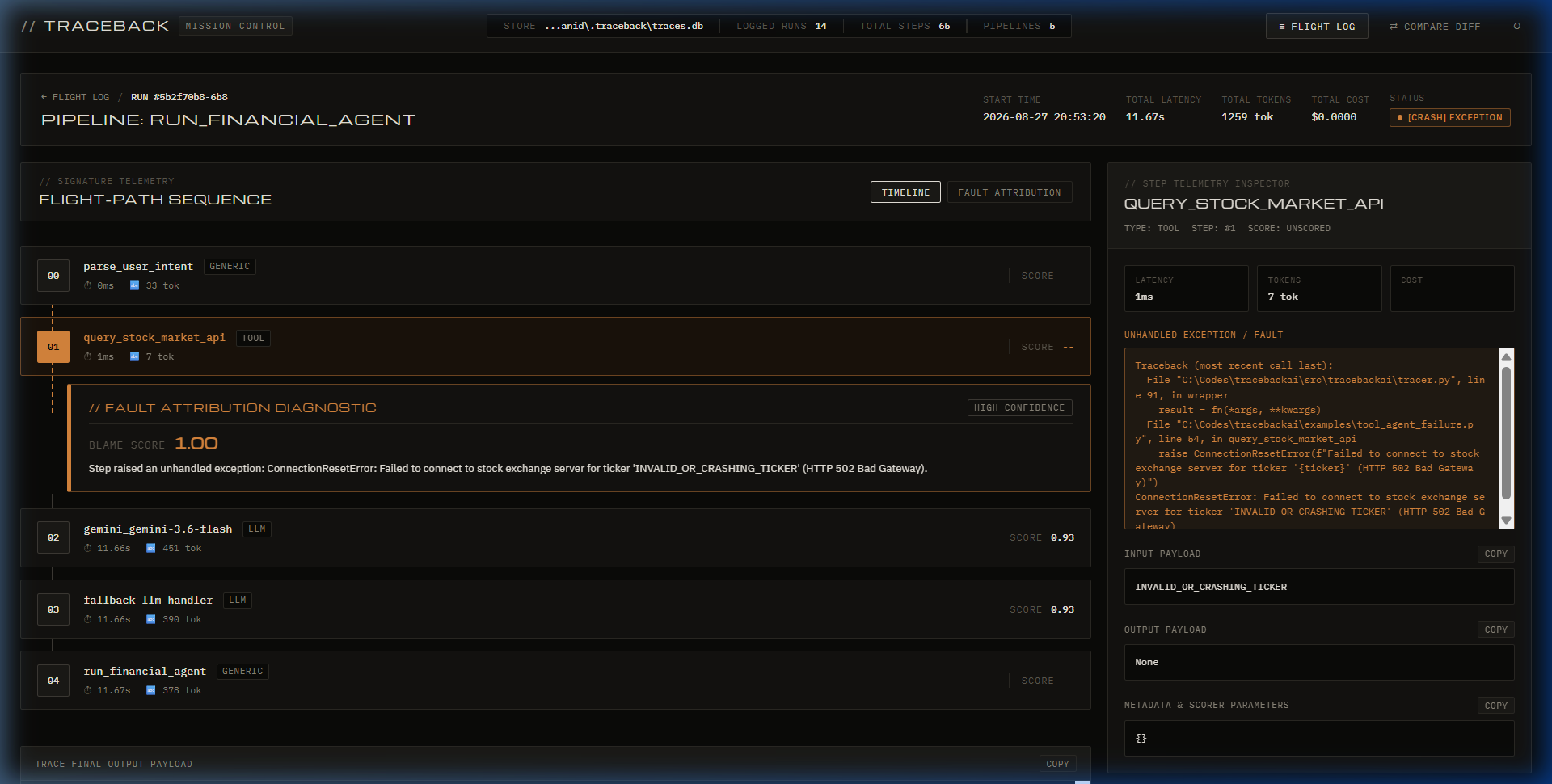
Launch the local interactive Mission Control dashboard to inspect execution timelines, step health scores, failure attribution diagnostics, and cross-run diff comparisons:
traceback serve
# or shorthand:
tb serve
pip install agent-blame

# Optional extras:
pip install "agent-blame[semantic]"    # Sentence-transformers semantic embeddings
pip install "agent-blame[gemini]"      # Google Gemini SDK instrumentation
pip install "agent-blame[anthropic]"   # Anthropic SDK instrumentation
pip install "agent-blame[openai]"      # OpenAI SDK instrumentation
pip install "agent-blame[langchain]"   # LangChain callbacks
pip install "agent-blame[all]"         # All integrations & extras
Instrument your functions with @trace. Decorate your pipeline entrypoint with @trace(pipeline=True):
from tracebackai import trace

@trace(step_type="retrieval")
def retrieve_docs(query: str) -> list[str]:
    # Returns relevant passages from your database or index
    return ["Retrieval-augmented generation combines search with LLMs."]

@trace(step_type="prompt")
def build_prompt(query: str, docs: list[str]) -> str:
    return f"Context:\n{chr(10).join(docs)}\n\nQuestion: {query}"

@trace(step_type="llm")
def generate_answer(prompt: str) -> str:
    # Call Claude, Gemini, GPT-4, or any custom model
    return "RAG combines search retrieval with generative language models."

@trace(pipeline=True)
def answer_pipeline(query: str) -> str:
    docs = retrieve_docs(query)
    prompt = build_prompt(query, docs)
    return generate_answer(prompt)

if __name__ == "__main__":
    answer_pipeline("What is RAG?")
Every execution is persisted to ~/.traceback/traces.db (configurable via TRACEBACK_DB_PATH).
traceback show / tb show)$ tb show abc123def
Run: abc123def | Pipeline: answer_pipeline | 2026-08-25 14:32:01
──────────────────────────────────────────────────────────────────────
[0] retrieve_docs retrieval 12ms tokens=48 score=0.91 [OK]
input: What is RAG?
output: ["Retrieval-augmented generation combines search with LLMs."]
[1] build_prompt prompt 1ms tokens=82
input: What is RAG?
output: Context: Retrieval-augmented generation...
[2] generate_answer llm 840ms tokens=120 score=0.93 [OK]
input: Context: Retrieval-augmented generation...
output: RAG combines search retrieval with generative language models.
──────────────────────────────────────────────────────────────────────
Total: 853ms | Final Output: RAG combines search retrieval with...
traceback blame / tb blame)$ tb blame bad456xyz
Analyzing run bad456xyz (rag_pipeline, 4 steps)...
[BLAME] Step [0] retrieve_docs (retrieval)
Score: 0.00 (threshold: 0.33)
Blame score: 1.82 (high confidence)
Reason: Retrieved passages had low query similarity (0.00 < 0.33). Downstream steps were starved of relevant context.
Co-blame: none
Other steps: build_prompt (unscored), generate_answer (0.93 [OK])
traceback diff / tb diff)$ tb diff abc123def bad456xyz
Comparing abc123def -> bad456xyz
Pipeline: answer_pipeline
STEP SCORE_A SCORE_B DELTA STATUS
─────────────────────────────────────────────────────────────────
generate_answer 0.93 0.50 -0.43 [-] REGRESSED <-- highest delta
retrieve_docs 0.91 0.91 +0.00 -> stable
build_prompt N/A N/A +0.00 -> stable
Verdict: REGRESSION in generate_answer
Details: Significant quality regression in 'generate_answer' (delta: -0.43).
Before traces are written to SQLite, each step is evaluated by registered step scorers:
step_type="retrieval"): Measures semantic cosine similarity between the query input and retrieved chunks using sentence-transformers (all-MiniLM-L6-v2), clamped to [0.0, 1.0]. Automatically falls back to pure-Python BM25 term overlap if dependencies are absent. Uses method-aware thresholding (flags weak retrieval when score $< 0.55$ for semantic embeddings, or $< 0.33$ for BM25 term overlap).step_type="llm"): Evaluates a composite of response completeness (scaled against an absolute floor of 20 tokens so concise correct answers to large RAG prompts are never penalized), refusal detection (detects refusal strings like "I cannot", "As an AI" and zeroes the score), and self-consistency (pairwise ROUGE-L across multi-sample completions).step_type="tool"): Evaluates exceptions, validates non-empty payloads, validates against optional expected_type metadata, and dynamically penalizes based on historical failure rates in SQLite.traceback blame ranks candidate failure steps deterministically without expensive or recursive LLM calls:
$$\text{blame_score}(\text{step}) = \text{deficiency} \times \text{weight}(\text{step_type}) \times \text{recency_weight}(\text{index}, \text{total})$$
retrieval: 1.4 (retrieval failures compound downstream), llm: 1.2, tool: 1.1, prompt: 0.9, generic: 0.8.score is None) are excluded from blame candidacy so they never corrupt attribution. If all steps are unscored, blame identifies the slowest execution bottleneck.agent-blame is continuously evaluated across 19 realistic failure and healthy scenarios spanning retrieval, LLM, tool, conversational BM25, and cascading degradations (benchmarks/blame_accuracy.py):
| Category | Correct | Total | Accuracy |
|---|---|---|---|
retrieval | 3 | 3 | 100.0% |
llm | 4 | 4 | 100.0% |
tool | 3 | 3 | 100.0% |
cascading | 2 | 2 | 100.0% |
fallback | 2 | 2 | 100.0% |
Add automated failure-attribution gates to pull requests in GitHub Actions:
name: Eval Gate
on: [pull_request]

jobs:
  eval:
    runs-on: ubuntu-latest
    steps:
      - uses: actions/checkout@v4
      - uses: actions/setup-python@v5
        with: { python-version: "3.11" }
      - run: pip install -e ".[all]"
      - run: traceback run examples/simple_rag.py --input examples/test_cases.json --fail-on-blame 0.7
| Integration | Usage | Traced Metrics |
|---|---|---|
| Google Gemini | from tracebackai.integrations.gemini import TracedGemini | model, input_tokens, output_tokens, latency_ms |
| Anthropic | from tracebackai.integrations.anthropic import TracedAnthropic, patch_anthropic | model, input_tokens, output_tokens, stop_reason |
| OpenAI | from tracebackai.integrations.openai import TracedOpenAI, patch_openai | model, input_tokens, output_tokens, finish_reason |
| LangChain | from tracebackai.integrations.langchain import TracebackCallbackHandler | on_llm_*, on_retriever_*, on_tool_* |
@trace, Click CLI (list, show)traceback serve / tb serve)Licensed under the MIT License. See CONTRIBUTING.md for local development guidelines.
Download counts and popularity will appear here as the collector receives them.
| Version | Published | Direct dependencies | Open version |
|---|---|---|---|
| 0.1.2 | 29 Aug 2026 | 14 |
This describes our collected data; it is not a security assessment.
Shared repository data · GitHub
Observed since 20 Oct, 21:33 UTC
No superseded metadata states collected. Unchanged observations do not create new revisions.
package:63be79018950b6b00530a5816871af88e66cace9d555f1184d304979d56ee133