

 Repository
Current collected state Current
Observed since 20 Oct, 21:37 UTC
No superseded metadata states collected. Unchanged observations do not create new revisions.
Causal capture SDK for branching multi-agent systems



Causal debugging for branching multi-agent systems — plus capture adapters for OpenCode and LangGraph.
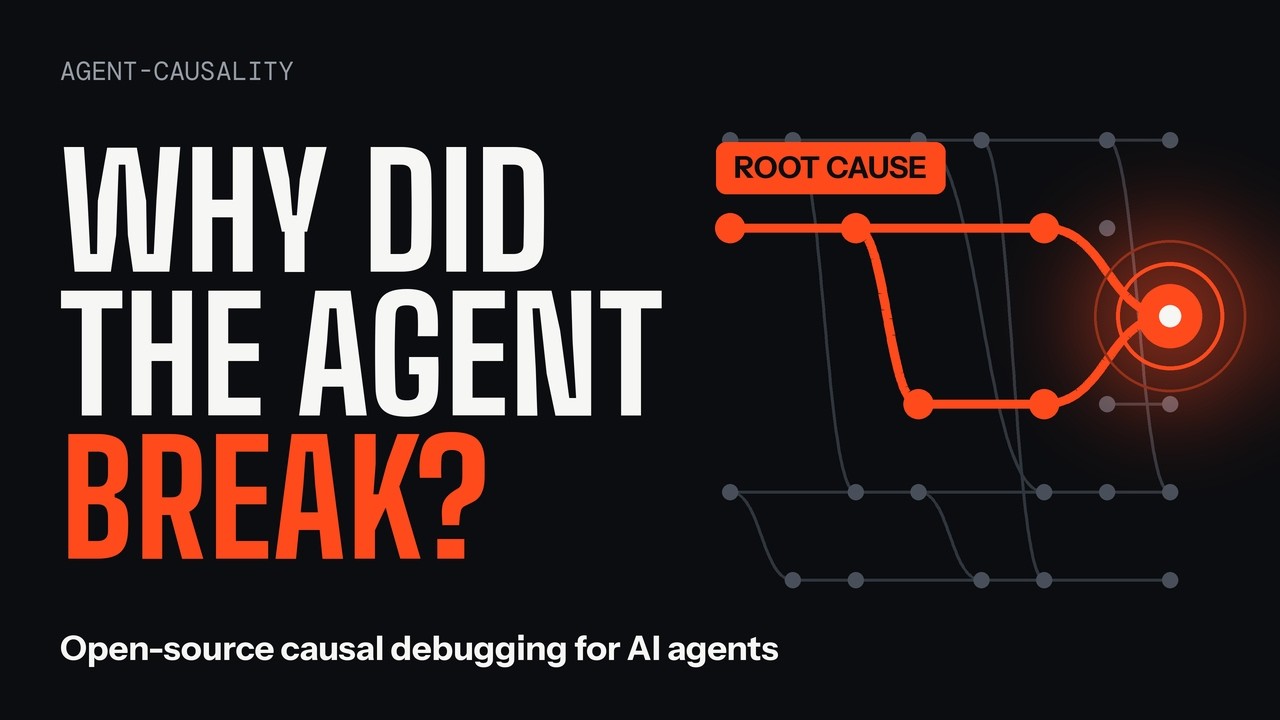
Agent-Causality records what your agents did as a causal event graph, then explains failures with grounded evidence instead of guesses.
This README is identical on both registries. The full system needs both packages:
- Python (
agent-causalityon PyPI) — SDK, CLI, ingest receiver (causality-opencode-ingest), and Visual DAG Explorer (causality-explorer). Installing only this gives you the offline demo but no live OpenCode capture.- JavaScript (
@psionic-labs/opencode-agent-causalityon npm) — OpenCode plugin (telemetry capture only). Installing only this gives you events with nowhere to persist or view them.
Demo video · Install · 30-second demo · Single-run capture · Explorer · OpenCode · LangGraph · Docs
Full walkthrough, click the thumbnail to watch on YouTube.
The Video follows the Single-run capture given below
Logs and traces show what happened. When several agents branch, merge, and share state, that isn't enough to tell what actually caused a bad outcome.
Agent-Causality adds three things ordinary observability lacks:
| Gap in ordinary observability | What Agent-Causality records |
|---|---|
| Scattered logs, no links | Explicit causal parents for every event |
| Decisions with no reference point | Decision contracts with baselines |
| Guesses about "what if" | Counterfactual replay that tests which inputs flip the outcome |
Agent execution → event capture → causal graph → slice / provenance / interaction → grounded diagnosis
Published as agent-causality==0.1.4
(PyPI) and
@psionic-labs/opencode-agent-causality==0.1.4
(npm).
Requires Python 3.11+ and uv
for source checkouts; PyPI/npm consumers only need pip/opencode.
# 1. Python side (SDK + receiver + explorer + CLI)
pip install agent-causality
# or, inside a uv project:
uv add agent-causality

# 2. JavaScript side (OpenCode capture plugin — telemetry only)
opencode plugin add @psionic-labs/opencode-agent-causality
npm-only installers: you still need the PyPI package — the Visual DAG Explorer and the
causality-opencode-ingestreceiver ship only inagent-causality, not in this npm package.PyPI-only installers: you still need the npm package for live OpenCode capture —
pip install agent-causalityalone cannot observe an OpenCode session without the plugin.
Optional — AI explanation extra. Only needed for LLM-grounded explain /
Generate AI analysis (needs httpx + OPENROUTER_API_KEY):
# pip consumer
pip install "agent-causality[explain]"
# uv project
uv add "agent-causality[explain]"
# source checkout
uv sync --extra explain
uv run python examples/customer_approval.py
It captures two agent results and a wrong approval, then explains the failure:
Outcome: approved
Diagnosis: The terminal event is marked 'failure' because the decision returned
'approved' with customer_status='eligible' and risk_score=0.2.
Evidence:
- Minimal tested chain: customer_status + risk_score -> decision -> terminal failure
- Canonical baselines were 'ineligible' and 0.8
- Interaction between customer_status and risk_score: 1.0
Limitations: the evidence does not establish why the upstream tools produced these values.
The minimal end-to-end loop. One isolated SQLite file per run keeps traces
separate (.causality/single-run.db below is just an example — any path
works) and port 8797 avoids clashing with the default 8766 explorer.
Terminal 1 — start the receiver:
# PyPI install
causality-opencode-ingest --db .causality/single-run.db
# Source checkout
uv run causality-opencode-ingest --db .causality/single-run.db
Terminal 2 — run one instrumented agent task (plugin posts automatically):
opencode run "Run the existing tests before editing. Diagnose and fix the bug in discount.py so both tests pass. Do not modify the tests. Rerun the tests and summarize the change."
Optional — enable AI explanations for this project:
uv add "agent-causality[explain]"
# pip equivalent: pip install "agent-causality[explain]"
Terminal 3 — inspect the trace in the Visual DAG Explorer:
# PyPI install
causality-explorer --db .causality/single-run.db --port 8797
# Source checkout
uv run python -m explorer.server --db .causality/single-run.db --port 8797
Then open http://127.0.0.1:8797. Each opencode run appends to the same
--db file; use a fresh --db path per task for one-trace-per-file
(any filename works).
Open any capture as an interactive causal graph — no API key needed.
The Explorer ships inside the agent-causality PyPI wheel (no clone needed):
# PyPI install
pip install agent-causality
causality-explorer
causality-explorer --db .causality/opencode.db --port 8766
# Source checkout
uv run python -m explorer.server
uv run python -m explorer.server --db .causality/opencode.db --port 8766
# Single-run variant from the section above:
uv run python -m explorer.server --db .causality/single-run.db --port 8797
Then open http://127.0.0.1:8766 (or :8797 for the single-run variant).
The bundled demo trace loads: a failing test, the fix edit, and the passing
retry, with the failure path highlighted.

Freshly captured shared_state_contamination run (240 events, 6 causal
edges) — the checker's failure node selected, its causal chain in the
inspector.

Bundled demo trace in the Timeline view — per-agent lanes (run, bash, edit),
the retry's tool_result ("app tests pass") selected as the failure target,
with the "Why did it fail?" strip and event inspector alongside.
What you get:
causality-explorer --db .causality/opencode.db
(source checkout: uv run python -m explorer.server --db .causality/opencode.db).explain extra
(pip install "agent-causality[explain]" / uv add "agent-causality[explain]"),
set OPENROUTER_API_KEY (and optionally OPENROUTER_MODEL, default
nvidia/nemotron-3-ultra-550b-a55b:free), then click Generate AI analysis
in the "Why did it fail?" strip. The model text lives in its own labeled
block — never mixed with the evidence.Full acceptance procedure: TEST.md §29.
import causality

causality.init(".causality/events.db")

@causality.agent(role="risk_checker")
def check_risk(customer): ...

@causality.merge_decision(...)
def approve(customer_status, risk_score): ...
See
examples/customer_approval.py
for a complete runnable example.
Capture live coding-agent sessions. Telemetry is fail-open: it never interrupts your agent. Requires both packages (receiver from PyPI, plugin from npm).
# Terminal 1: receiver (PyPI install; source checkout: uv run causality-opencode-ingest ...)
causality-opencode-ingest --db .causality/opencode.db
# Terminal 2: agent (plugin posts automatically)
opencode run "Read RESEARCH.md, implement sort_items in task.py as recommended, run the test script."
# Terminal 3: Visual DAG
causality-explorer --db .causality/opencode.db
Full consumer flow: install agent-causality (PyPI) → install the OpenCode
plugin (opencode plugin add @psionic-labs/opencode-agent-causality, npm) →
start the receiver → run OpenCode → launch causality-explorer → inspect the
recorded trace. No repository clone is needed.
Representative committed result (
stale_research, OpenCode1.19.0):completed (exit 0), 331 events, capture coverage 1.0, diagnosis scored(seebenchmark/results/opencode/opencode.md). No video artifact ships with this release. Setup guide →
The npm plugin forwards OpenCode's global event stream plus explicit hooks
(tool.execute.before/after, permission.ask, command.execute.before,
chat.message, chat.params). The Python receiver maps these onto canonical
events, registers file writes with Resource-Version machinery, and redacts
secrets before SQLite persistence. It is telemetry capture only — the
Explorer and CLI live in the PyPI distribution.
CausalityCallbackHandler is a LangChain callback handler: point your
graph's config at it and every node, tool, and LLM run lands in the
causal graph — fail-open, with parent_run_id containment converted into
explicit causal edges (unknown parents are dropped, never invented).
from adapters.langgraph import CausalityCallbackHandler
from storage.sqlite import SQLiteEventStore

store = SQLiteEventStore(".causality/langgraph.db")
handler = CausalityCallbackHandler(store)

app.invoke(inputs, config=handler.config())
Worked example: a deterministic replay of the documented July 2025 Replit
incident — freeze violated, production rows deleted, fabricated data
written, false rollback claim — captured as 22 causally-validated events
in
examples/replit_incident.py
(write-up:
docs/case-study-replit.md).
Adapter guide →
Offline, provider-neutral suite (uv run causality-benchmark ...) plus a
real OpenCode coding-agent benchmark. Full results in
docs/benchmarks.md
and benchmark/results/.
1.19.0): capture
micro/macro-average 1.0; cause recall mean 0.3 (structural-slice
ancestry under explicit-evidence edges only); joint ancestry 0.0 —
genuine causal interaction is unsupported from live traces.Terminology is precise: live-trace branch results are reported as
joint ancestry (not causal interaction), and minimal slices as a
required-cause preservation proxy (not causal minimality).
| Topic | Link |
|---|---|
| Getting started | GETTING_STARTED.md |
| OpenCode integration | docs/opencode.md |
| LangGraph integration | docs/langgraph.md |
| Replit incident case study | docs/case-study-replit.md |
| CLI and Python reference | docs/reference.md |
| Benchmarks and results | docs/benchmarks.md |
| Scope and limits | docs/reference.md |
| Research background | docs/thesis.md, docs/research-memo.md |
| Contributing and tests | TEST.md, CONTRIBUTING.md |
| Release notes | CHANGELOG.md |
Download counts and popularity will appear here as the collector receives them.
| Version | Published | Direct dependencies | Open version |
|---|---|---|---|
| 0.2.0 | 19 Oct 2026 | 3 |
This describes our collected data; it is not a security assessment.
Shared repository data · GitHub
Observed since 20 Oct, 21:37 UTC
No superseded metadata states collected. Unchanged observations do not create new revisions.
package:e2a0bb5bf869bebbd5e4ef7efa35c95221f951a84cf033e40769d90038838cce