

 Repository
Current collected state Current
Observed since 20 Oct, 21:42 UTC
No superseded metadata states collected. Unchanged observations do not create new revisions.
Reliability layer for AI agent workflows: validate state, handoffs, and outcomes before agents continue.




Tool success is not business success.
agent-consistency is a zero-dependency Python safety interlock for AI agent
workflows that take irreversible or customer-visible actions. It catches
false-success bugs: cases where a tool call returns success, but the confirmed
result is still missing or false.
A refund API returns
200 OK. The provider status is stillpending. The agent is about to email "your refund is complete."agent-consistencyblocks the message and records why.
Traces show what happened. Evals score what was said. agent-consistency
decides whether the workflow was allowed to continue.
Live demo: scan workflows for unverified completion risks | Quickstart | Benchmark | Production | Compliance
Get a pre-integration false-success report card in under 30 seconds:
agent-consistency scan .
agent-consistency scan . --format markdown
agent-consistency scan . --fail-on high
agent-consistency scan https://github.com/org/repo
The scanner is conservative. Low-confidence findings say "Possible risk, needs
review" and should be treated as review prompts, not certain bugs. Use
--format markdown for a copyable report suitable for GitHub issues, PR
comments, or social posts.
Benchmark: raw caught 0/6; agent-consistency caught 6/6 on the deterministic
false-success suite in benchmark/. This is a reproducible scenario-suite
result, not a universal reliability guarantee.
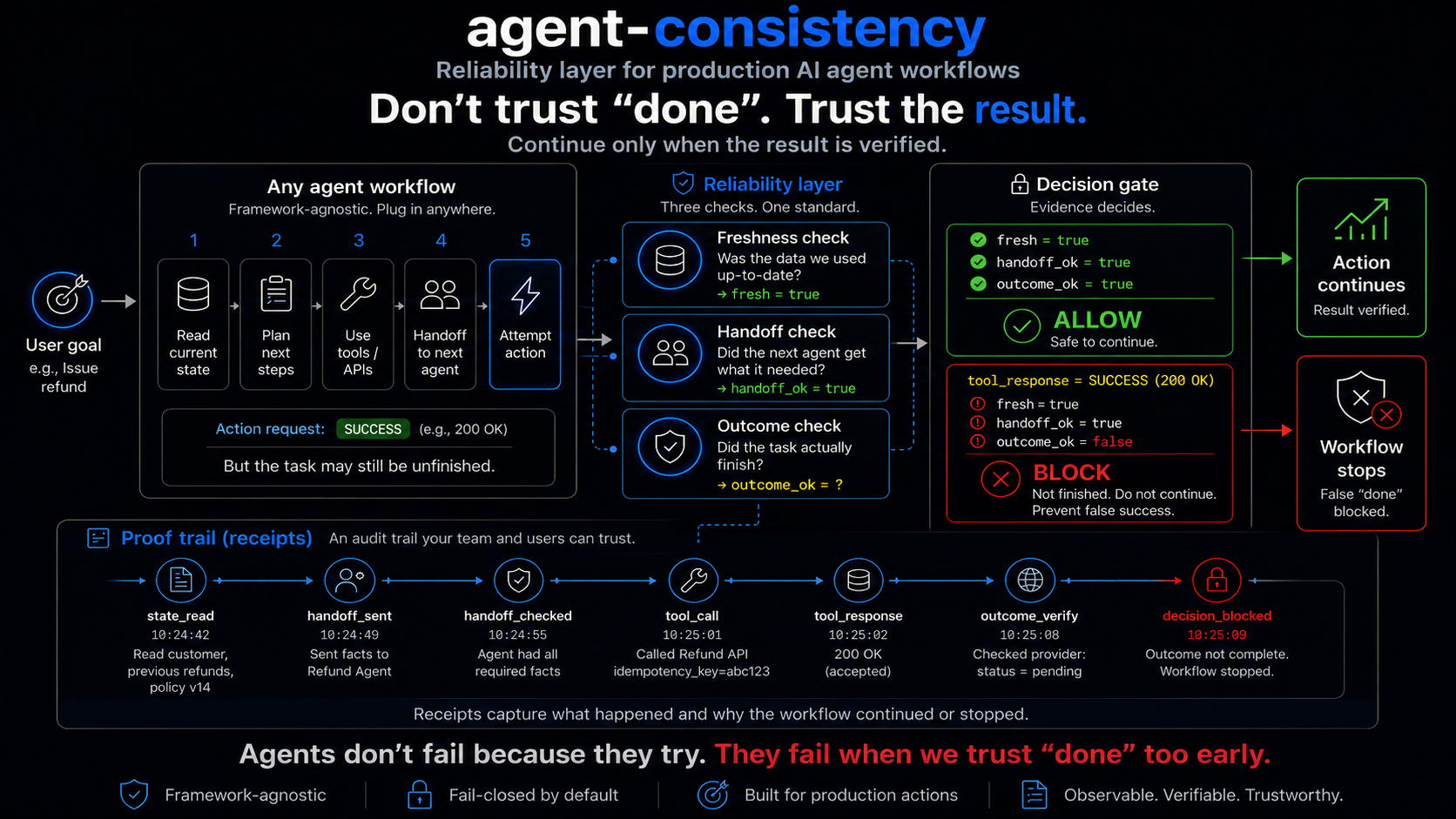
The image uses compact labels such as fresh=true, handoff_ok=true, and
outcome_ok=false for readability. Stored receipts use structured JSON fields.
See the diagram-to-receipt map and the generated
pending-refund receipt sample.
python -m pip install agent-consistency
A false-success bug happens when an agent reports completion before the source system confirms the result.
Common forms:
200 OK, but
provider status is still pending.Output validation checks response shape. Tracing records the path taken. Neither blocks the next workflow step when the confirmed result is still missing.
from agent_consistency import WorkflowRun

run = WorkflowRun("refund-ord-1", on_violation="record")

with run.step("refund-agent", "issue_refund", step_id="refund") as step:
    provider_result = {"refund_id": "rf_1", "status": "pending"}
    step.write_state("refund", provider_result, include_value=True)
    step.verify_outcome(
        "refund_settled",
        lambda: provider_result["status"] == "settled",
        failure_reason="refund provider did not confirm settlement",
        details=provider_result,
    )

receipt = run.receipts()[-1]
print(receipt.status)             # failed
print(receipt.issues[0].message)  # outcome 'refund_settled' failed...
The tool returned. The receipt says the outcome failed. In the default blocking mode, the same failed outcome raises before the customer message can run.
Start in detect mode before you refactor a workflow around gates:
from agent_consistency.integrations import detect_workflow

risk_report = detect_workflow(existing_workflow)
print(risk_report.to_dict())
Or run it against stored receipts in CI:
agent-consistency detect runs/demo-pending-refund/receipts.jsonl
detect reports missing gates, stale reads, dropped handoff facts, failed
outcomes, and customer-visible actions after unresolved or unverified outcomes.
It exits non-zero on high-severity risk. It cannot know what an agent claimed
unless your workflow declares the outcomes and evidence that matter.
Use verified_step when you want to wrap an existing callable without changing
frameworks:
from agent_consistency import RefundSettlementVerifier, WorkflowRun, verified_step

run = WorkflowRun("refund-ord-1")
provider_status = lambda refund_id: {"refund_id": refund_id, "status": "settled"}

@verified_step(
    run,
    "refund-agent",
    "issue_refund",
    criticality="financial",
    idempotency_key="refund:ord_1",
    outcome_verifier=lambda refund: RefundSettlementVerifier(
        refund["refund_id"],
        provider_status,
    ),
)
def issue_refund():
    return {"refund_id": "rf_1"}
Use reliability_gate as a context manager when you need direct access to the
receipt-backed step. If agent-consistency[otel] is installed, the API emits
standard gen_ai.* and agent_consistency.* span attributes.
agent-consistency report runs/demo-pending-refund/receipts.jsonl
agent-consistency detect runs/demo-pending-refund/receipts.jsonl
agent-consistency verify runs/demo-pending-refund/receipts.jsonl
agent-consistency schema
Receipts are a flight recorder for AI agents: portable evidence you can inspect after an incident to see state reads, handoff facts, artifacts, outcomes, and the blocked reason.
verify separates file integrity from run semantics, so a deliberately blocked
pending-refund run can report Integrity: verified and Run status: failed as expected.
| Category | What it answers | What it misses without agent-consistency |
|---|---|---|
| Guardrails | Is the output shaped correctly? | Whether the confirmed result exists. |
| Evals | Was the answer good in a test? | Whether this live workflow may continue. |
| Tracing | What happened? | Whether the next action should be blocked. |
| Orchestration | Which node runs next? | Whether the handoff facts and outcomes are valid. |
| Policy engines | What rule applied? | Whether the agent used a fresh policy snapshot. |
Keep those tools. Add receipts and gates where agents make claims that require source-system confirmation.
The canonical false-success examples live in examples/:
minimal_outcome_gate.pyrefund_false_success.pyhandoff_contract.pystale_state.pycustomer_message_supported_claims.pyThere is also a dependency-free LangGraph-style adapter example in
examples/langgraph_style_wrapper.py, plus CrewAI-style and AutoGen-style
examples in examples/crewai_style_adapter.py and
examples/autogen_style_adapter.py.
There are two Microsoft Agent Framework paths:
MicrosoftAgentFrameworkNativeIntegration for real async Agent Framework
seams: Agent.run(...), async middleware, function/tool middleware, and
streaming methods. Install it with agent-consistency[microsoft] on Python
3.10+.MicrosoftAgentFrameworkConsistencyAdapter as the dependency-light fallback
for MAF-shaped callables.from agent_consistency.integrations import MicrosoftAgentFrameworkNativeIntegration
integration = MicrosoftAgentFrameworkNativeIntegration(run_id="refund-maf")
refund_agent = integration.wrap_agent_run(
maf_refund_agent,
action="issue_refund",
criticality="financial",
outcome_name="refund_settled",
outcome_check=lambda result: result["status"] == "settled",
)
The native integration keeps Microsoft packages out of the base install and
uses the official Agent Framework middleware shape. See
Microsoft Agent Framework. The quickest
generic path is still in examples/instrument_existing_agent/.
CI also includes a microsoft-live job that installs the optional Microsoft
extra and runs a real agent_framework.Agent with a deterministic local
BaseChatClient provider, so the native wrapper is checked against the actual
package without requiring cloud credentials.
python -m pip install -e ".[dev]"
python -m pytest
ruff check src tests examples
Apache-2.0.
Download counts and popularity will appear here as the collector receives them.
| Version | Published | Direct dependencies | Open version |
|---|---|---|---|
| 0.3.7 | 26 Jun 2026 | 11 |
This describes our collected data; it is not a security assessment.
Shared repository data · GitHub
Observed since 20 Oct, 21:42 UTC
No superseded metadata states collected. Unchanged observations do not create new revisions.
package:6f0996a9cfee6896c2c7ad88f6b1fd399b9d4eac884a1883c55b300d40110905