
 Repository
Current collected state Current
Observed since 20 Oct, 22:28 UTC
No superseded metadata states collected. Unchanged observations do not create new revisions.
Intercept and log AI coding agent <-> API traffic for prompt-architecture analysis.
English · 繁體中文
agent-interlude intercepts the traffic between an AI coding agent (Claude Code,
Codex) and its API, persisting the prompt structure (system / tools /
messages) of every request/response pair as JSONL. Use it to analyze the
fixed skeleton vs. dynamic slots of a prompt, and to compare across agents.
The built-in web UI (agent-interlude-report serve) is a dark monitoring console
for browsing captured traffic.
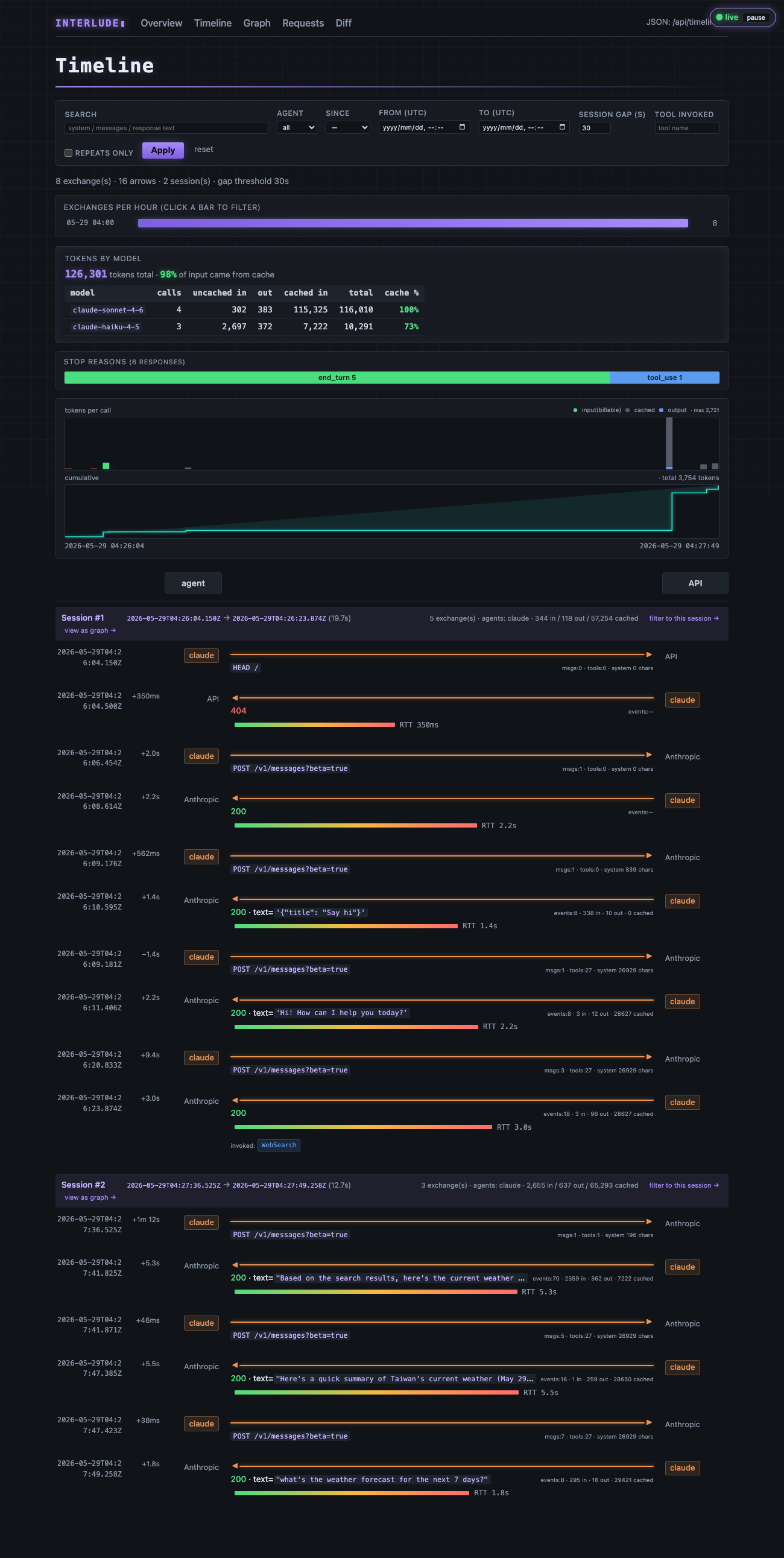
Timeline — per-model token usage and cache-hit rate, stop-reason breakdown, a token-usage chart, and every request/response grouped into sessions and threads.
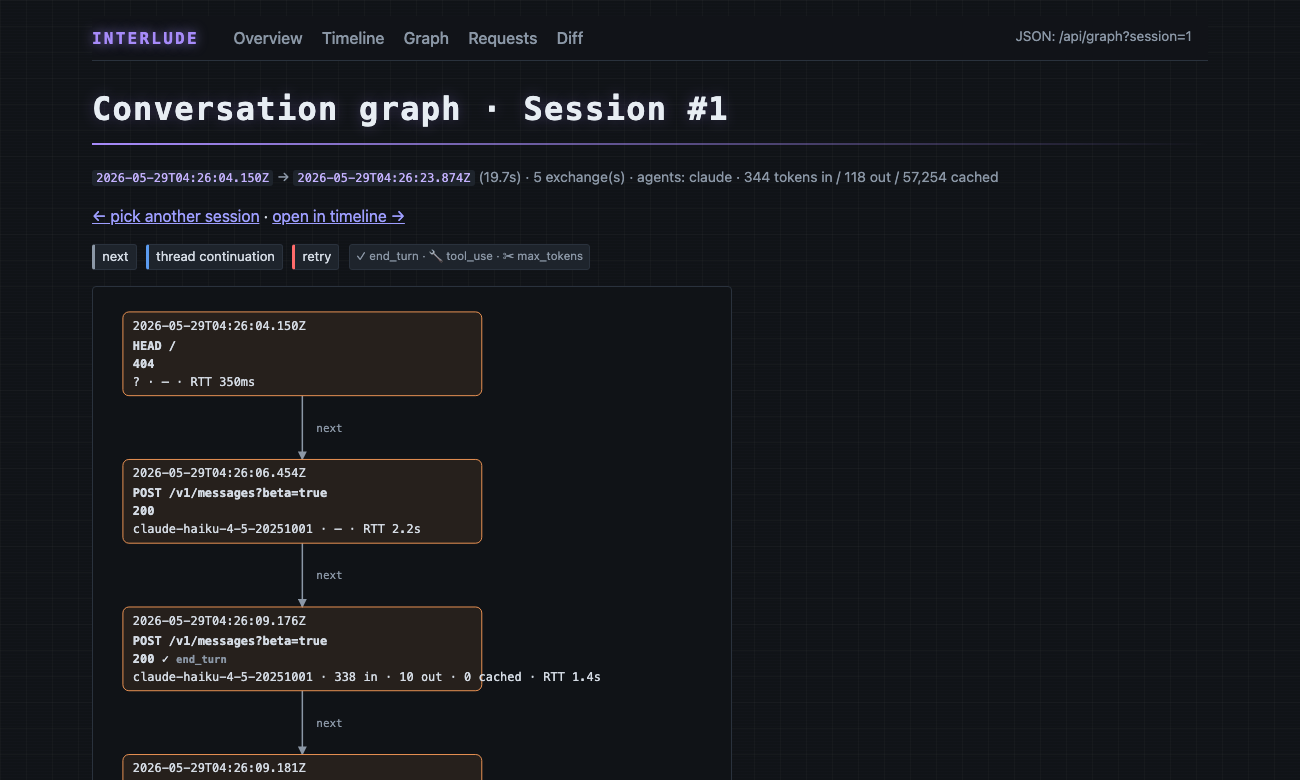
Conversation graph — one session projected as nodes and edges: continuations, retries, and the tools invoked at each step.
Both agents let you override the API base URL via an environment variable, so no transparent MITM or certificate forgery is needed. agent-interlude is an explicit reverse proxy:
Claude Code ──(A) plain HTTP──▶ agent-interlude proxy ──(B) normal HTTPS──▶ api.anthropic.com
              localhost:8788                      (proxy re-encrypts as the client)
Segment (A) has no TLS, so the proxy reads the plaintext body straight off the socket — that's the interception point, and it never touches credentials. Responses are copied as they stream through a relay, then the SSE events are reassembled and archived once the stream ends. The agent notices nothing.
Install once with pipx (recommended) or
uv tool — both put the
agent-interlude command on your PATH in an isolated environment, no
project-level setup needed:
pipx install agent-interlude
# or
uv tool install agent-interlude
Requires Python 3.11+ and the agent CLIs you want to capture
(claude and/or codex). Zero runtime dependencies — agent-interlude is
stdlib-only.
For contributors hacking on agent-interlude itself, see Development setup below.
# 1. One command: starts the 3 proxy listeners AND the web UI on :8000
agent-interlude

# 2. In another terminal, point Claude Code at it
ANTHROPIC_BASE_URL=http://localhost:8788 claude

# 3. Open the live browser UI as captures stream in
open http://127.0.0.1:8000/timeline
On startup the bundled launcher prints:
[agent-interlude] claude: http://127.0.0.1:8788 -> https://api.anthropic.com
[agent-interlude] codex:  http://127.0.0.1:8789 -> https://api.openai.com   (Codex + API key)
[agent-interlude] codex:  http://127.0.0.1:8790 -> https://chatgpt.com      (Codex + ChatGPT login)
[agent-interlude] logging to .agent-interlude/log-<timestamp>.jsonl
[agent-interlude] web UI: http://127.0.0.1:8000/timeline (auto-started; disable with --no-ui)
[agent-interlude-report] http://127.0.0.1:8000
[agent-interlude-report] watching .agent-interlude/log-*.jsonl
[agent-interlude-report] auto-reload on (disable with --no-reload)
.agent-interlude/log-<timestamp>.jsonl lands under your current working
directory (not next to the installed module), so run agent-interlude from
wherever you want the logs collected.
The web UI runs in a child process. Ctrl-C on agent-interlude tears down
both proxy and UI cleanly.
Each launch opens a fresh log file; every request prints one line such as
[claude] POST /v1/messages.
Variants:
agent-interlude --no-ui            # proxy-only (e.g. CI / headless capture)
agent-interlude --ui-port 9000     # bind the UI on a different port
agent-interlude-report serve       # UI only, against existing logs
agent-interlude-analyze            # text report, no server
python -m agent_interlude          # module-form, equivalent to `agent-interlude`
To hack on agent-interlude itself, clone and use the source layout directly:
git clone https://github.com/zondatw/agent-interlude.git
cd agent-interlude
uv sync                              # installs the package in editable mode
uv run agent-interlude                     # runs from src/agent_interlude/
For contributors: install pre-commit and
gitleaks (brew install pre-commit gitleaks),
then run pre-commit install once. Subsequent git commit will auto-run
ruff lint+format, hygiene checks (trailing whitespace, EOF, private keys,
yaml/toml syntax), codespell, and gitleaks. Run pre-commit run --all-files
to check the whole tree at once.
Release flow (PyPI Trusted Publishing via the beta and release
branches) is documented in docs/release.md.
An environment variable is enough (Claude Code appends /v1/messages to the
base URL itself):
ANTHROPIC_BASE_URL=http://localhost:8788 claude
# Non-interactive:
ANTHROPIC_BASE_URL=http://localhost:8788 claude -p "say hi"
Codex's built-in openai provider does not honor a base-URL override
(OPENAI_BASE_URL is ignored), so you must define a custom provider. Pick the
route that matches your login method.
Point the custom provider at the proxy's chatgpt.com listener (port 8790,
path /backend-api/codex). Codex sends your ChatGPT token, the proxy forwards
to the real https://chatgpt.com/backend-api/codex/responses, and the response
is recorded too:
codex exec -s read-only \
  -c model_provider=agent-interlude \
  -c 'model_providers.agent-interlude.base_url="http://localhost:8790/backend-api/codex"' \
  -c 'model_providers.agent-interlude.wire_api="responses"' \
  "say hi"
For a durable setup, write it into ~/.codex/config.toml:
[model_providers.agent-interlude]
name = "agent-interlude"
base_url = "http://localhost:8790/backend-api/codex"
wire_api = "responses"
Then switch to it per-invocation with -c model_provider=agent-interlude (do not
set a top-level model_provider, or Codex breaks whenever the proxy is down):
codex -c model_provider=agent-interlude exec -s read-only "say hi"
If you have an OPENAI_API_KEY with the api.responses.write scope, point at
the proxy's api.openai.com listener instead (port 8789, path /v1):
codex exec -s read-only \
  -c model_provider=agent-interlude \
  -c 'model_providers.agent-interlude.base_url="http://localhost:8789/v1"' \
  -c 'model_providers.agent-interlude.wire_api="responses"' \
  "say hi"
Note — Using ChatGPT login but pointing at
api.openai.com(route B without a key) returns 401 (the ChatGPT token lacks theapi.responses.writescope). The request is still recorded in full; you just get no response back — switch to route A instead.
Logs live in .agent-interlude/log-<timestamp>.jsonl. Each exchange is two lines
paired by id:
// kind="request"
{"id":"ab12…","kind":"request","agent":"claude","wire":"claude-messages",
 "headers_kept":{…},                  // authorization / x-api-key already filtered out
 "request":{…full parsed body…},
 "extract":{"system":…,"tools":…,"messages":…}}

// kind="response" (same id)
{"id":"ab12…","kind":"response","agent":"claude","status":200,
 "stream":true,"event_count":7,"event_types":{…},
 "reconstructed":{"model":"…","text":"…","usage":{…},"tool_uses":[…]}}
A non-streaming response (e.g. Codex's 401) is recorded as
"stream":false,"body":{…} instead.
Supported wire formats: claude-messages (/v1/messages), codex-responses
(/responses), codex-chat (/chat/completions).
agent-interlude-analyze                    # read every log in .agent-interlude
agent-interlude-analyze --agent claude     # one agent only
agent-interlude-analyze --max-slots 30     # print more dynamic slots
agent-interlude-analyze path/to/log.jsonl  # a specific file / glob
The report covers:
git status and date that Claude injects are flagged as dynamic slots).input_schema /
Codex=parameters).To surface Codex's dynamic slots, run a few sessions with different prompts / at different times (multiple retries of the same prompt share one system prompt and count as just 1 distinct sample).
For a browsable view of the same data — with per-request drill-in, skeleton-vs-slot highlighting in context, and a tools schema browser — launch the local web UI:
agent-interlude-report serve                  # http://127.0.0.1:8000 (default)
agent-interlude-report serve --port 9000
agent-interlude-report serve --logs "other/path/log-*.jsonl"
Routes:
| Path | What it shows |
|---|---|
/ | Cross-agent overview + per-agent stats |
/timeline[?agent=…&since=…&from=…&to=…&session_gap=…] | Sequence-diagram view of every exchange: agent ↔ API lanes, two arrows per exchange (request + response), auto-grouped into sessions (gap-threshold configurable), per-hour density histogram on top, RTT bars on every response arrow. Click an arrow to expand only that half (request → system/tools/messages; response → reassembled text/usage/event_types). |
/requests[?agent=…] | Sortable list of exchanges with model / token columns |
/requests/<id> | Collapsible system / tools / messages + paired reassembled response |
/skeleton/<agent> | Canonical system sample with fixed lines greyed and dynamic slots highlighted in yellow |
/tools/<agent> | Collapsible JSON schema per tool |
Every HTML page has a matching /api/<same path> endpoint that returns the
same data as JSON — built in from day one so future features (token usage
charts, search/filter, live update) consume a stable backend instead of
re-scraping HTML. The page nav surfaces the JSON URL on every view.
Bound to 127.0.0.1 only (the logs hold full prompts; never expose them on
LAN). The JSONL loader is mtime-cached, so re-reads stay cheap while the
proxy keeps appending — just refresh the page to see new captures.
./dogfood.sh
Starts the proxy → fires one Claude and one Codex call → verifies both request
and response were recorded with zero credential leakage → tears the proxy down,
and finally prints RESULT: PASS.
To confirm each link in the chain by hand (rather than just running
dogfood.sh):
Terminal 1 — start the proxy:
agent-interlude
Terminal 2 — send one message through Claude Code; it should reply PONG
(proving the relay + streaming are intact):
ANTHROPIC_BASE_URL=http://localhost:8788 claude -p "Reply with exactly the word PONG and nothing else."
Back in Terminal 1, the proxy console should show a line:
[claude] POST /v1/messages.
Check the log landed (a structural summary that does not dump prompt contents):
LOG=$(ls -t .agent-interlude/log-*.jsonl | head -1)
uv run python - "$LOG" <<'PY'
import json, re, sys
recs = [json.loads(l) for l in open(sys.argv[1], encoding="utf-8")]
for r in recs:
    if r.get("kind", "request") == "request":
        ex = r.get("extract") or {}
        present = [k for k in ("system", "tools", "messages") if ex.get(k) is not None]
        print(f"REQ  {r['agent']:<7} {r['wire']:<16} extract={present}")
    else:
        txt = (r.get("reconstructed") or {}).get("text")
        info = f"text={txt!r}" if r.get("stream") else f"body={type(r.get('body')).__name__}"
        print(f"RESP {r['agent']:<7} status={r['status']:<3} {info[:70]}")
blob = "\n".join(json.dumps(r) for r in recs)
leaks = re.findall(r"Bearer\s+\S{20,}|sk-ant-\S{20,}|eyJ[\w-]{10,}\.eyJ[\w-]{10,}", blob)
print("\ncredential leaks:", len(leaks))
PY
You should see at least one pair:
REQ  claude  claude-messages  extract=['system', 'tools', 'messages']
RESP claude  status=200 text='PONG'

credential leaks: 0
(The first line may be REQ claude unknown → RESP claude status=404; that's
Claude Code's connection pre-check HEAD / and can be ignored.)
View the structure analysis:
agent-interlude-analyze
When done, press Ctrl-C in Terminal 1 to shut the proxy down.
.agent-interlude/ contains the full prompt (your code, possibly secrets) → it
is gitignored; do not commit or share it.authorization / x-api-key / cookie) are forwarded only and
never written to the log; headers_kept retains an allowlist of fields
only.accept-encoding, so the recorded bytes are
always plaintext (no gzip/br to deal with).lsof -nP -iTCP -sTCP:ESTABLISHED | grep Python, and confirm the proxy only connects to api.anthropic.com /
api.openai.com / chatgpt.com.Edit the LISTENERS list at the top of src/agent_interlude/proxy.py and add a
row (port, upstream_host, label). Wire detection lives in detect_wire(),
and field normalization in extract() (requests) and reconstruct()
(responses).
| Symptom | Cause / fix |
|---|---|
port 8788 already in use | A previous proxy is still running. lsof -nP -iTCP:8788 -sTCP:LISTEN to find the PID → kill <PID> |
Codex isn't recorded, startup prints provider: openai | You used the OPENAI_BASE_URL shortcut, which the built-in provider ignores. Use a custom provider instead |
Codex returns 401 (missing api.responses.write scope) | You're on ChatGPT login but pointing at api.openai.com (8789). Switch to route A (8790 + /backend-api/codex); see "Pointing an agent at the proxy › Codex" |
Agent refuses http:// | Fall back to TLS: the proxy terminates TLS with a self-signed CA, and Claude Code trusts it via NODE_EXTRA_CA_CERTS (not needed currently) |
| Path | Purpose |
|---|---|
src/agent_interlude/proxy.py | Three-listener reverse proxy, streaming relay + SSE tee/reassembly. Entry point: agent-interlude |
src/agent_interlude/analyze.py | Cross-request diff, fixed skeleton vs. dynamic slots, cross-agent comparison (text report). Entry point: agent-interlude-analyze |
src/agent_interlude/report.py | Local web UI (HTML + JSON) over the same analysis. Entry point: agent-interlude-report |
dogfood.sh | One-command end-to-end verification (contributor-facing, not shipped in the wheel) |
docs/release.md | PyPI Trusted Publishing setup + per-release flow |
.github/workflows/ | beta.yml (push to beta → test.pypi.org), release.yml (push to release → pypi.org) |
.agent-interlude/ | JSONL output, written under the user's cwd (gitignored, sensitive) |
Download counts and popularity will appear here as the collector receives them.
| Version | Published | Direct dependencies | Open version |
|---|---|---|---|
| 0.2.1 | 21 Jun 2026 | 0 |
This describes our collected data; it is not a security assessment.
Observed since 20 Oct, 22:28 UTC
No superseded metadata states collected. Unchanged observations do not create new revisions.
package:d5173cd495199448af33b6b1c121940b0656da79c08522a3de37d1394c09ca92