
 Repository
Current collected state Current
Observed since 20 Oct, 22:50 UTC
No superseded metadata states collected. Unchanged observations do not create new revisions.
Run several coding agents in isolated worktrees with shared coordination.

Agent Parley runs several coding agents on one repository, each in its own worktree, and records who owns what: every claim, handoff, wake and refusal.
curl -LsSf https://github.com/suneel944/agent-parley/releases/latest/download/install.sh | sh

Try it without an account: agent-parley demo runs the story this
video is cut from, with stub lanes in a throwaway sandbox and no native CLI,
model or network.




See it · Install · Run · Coordination · Monitoring · Providers · Commands · Limits
plan propose; it applies on its own only inside the plan's [revisions]
envelope, and otherwise waits for plan approve.budget enforce caps the tokens, calls or hours
every lane spends together; once reached, nothing new starts until
budget resume.unattended set names the issues
and the target branch; unattended run, or the service itself when the
policy adds --auto, merges on the same gate as
participant merge, and a failed integration holds every other merge until
it is verified.issue show, problems and a notification.status, top and problems show what
needs you; the readers take --json, and a failure prints one error
document.Every terminal frame in the launch video at the top is captured command output
from the shipped coordination path; only the native client is a stand-in, so
no model runs. It is re-cut with
docs/video.
make demo-stub records the full nine-chapter walkthrough with
scripts/record_demo.py;
make demo records real claude and codex sessions with
scripts/record_live.py.
agent-parley top reads like Linux top: three summary lines, one row per
lane with its state, issues, mail, leases, denials, idle time and last prompt,
and one note per problem under the table. Read-only, no model call, q quits.
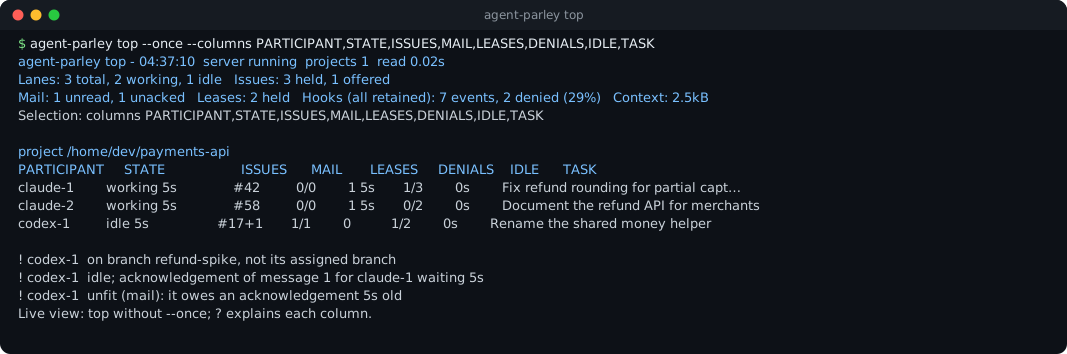
A lane reads working while its session is alive and current, idle once its
activity passes the inactivity threshold, and stopped only when its session
process is gone: a quiet lane is not a lost one. Stopped lanes that hold
nothing are counted in the summary; top --all draws them. top --serve
serves the same view read-only to a browser tab and a Prometheus scraper on
127.0.0.1.
Monitoring
covers the columns, keys, filters, problems, metrics, the web view,
watch and report usage, which lists what each resolved issue used.
You need Git. No clone. The wheel needs no third-party runtime packages. One command installs everything on Linux, macOS and WSL2:
curl -LsSf https://github.com/suneel944/agent-parley/releases/latest/download/install.sh | sh
It installs uv only when uv is missing, then
installs or upgrades agent-parley, adds the plugin to each of claude and
codex found on PATH with agent-parley plugins install, and runs
agent-parley doctor. It never uses sudo, and re-running it upgrades in place.
It ends with the next command for the first of claude, codex, copilot,
gemini, opencode and amp on PATH, such as
Next: cd your-repo && agent-parley run gemini; only claude and codex
take a plugin. With none of them on PATH it says to install one first and
offers agent-parley demo.
To install by hand instead:
macOS
brew install uv
uv tool install agent-parley
Linux, or Windows through WSL2
curl -LsSf https://astral.sh/uv/install.sh | sh
uv tool install agent-parley
Native Windows is not supported. On WSL2, keep the repository in the Linux
file system, not under /mnt/c.
To track the default branch instead of the latest release, run
uv tool install git+https://github.com/suneel944/agent-parley.
Then add the plugin to whichever of claude and codex you drive:
agent-parley plugins install does it for each one on PATH, or run the
commands yourself. One marketplace serves both. gemini, copilot,
opencode and amp lanes take no plugin; the launcher configures them per
session.
claude plugin marketplace add suneel944/agent-parley
claude plugin install agent-parley@agent-parley
codex plugin marketplace add suneel944/agent-parley
codex plugin add agent-parley@agent-parley
The plugin carries only the coordinate skill, which teaches an agent to read
state, claim issues and hand work off. The launcher does the rest: worktrees,
the coordination service, and per-session MCP configuration and hooks. The
plugin without the launcher has nothing to coordinate through.
For a pinned, checksummed install, take a wheel from
Releases instead. Checking
install.sh against the release SHA256SUMS before it runs, shell
completion, upgrades and the supported platforms are in
Operations.
Not sure where to start? Run agent-parley with no arguments in the
repository. It reads, and writes nothing: whether this is a Git checkout,
whether it has a first commit and uncommitted changes, whether the project is
registered, which of the six providers are on PATH and, for claude and
codex, the only two that take a plugin, whether each has it, and
whether the coordination service is running. It then names the next one to
three commands for exactly that state, such as agent-parley plugins install,
agent-parley run claude or agent-parley top, or agent-parley demo when no
native CLI is installed. A checkout with no commits yet puts git commit
first, and one with uncommitted changes puts git status first, because lanes
start from the last commit.
Agent Parley coordinates native coding CLIs in one repository.

Found:
  Here      Git repository, clean
  Project   not registered
  CLIs      claude (plugin added), codex (plugin added)
  Service   not running

Next:
  agent-parley run claude  Register the repository and start a lane.

Full reference: agent-parley --help
Once the project is registered and its service runs, the screen also reads
what agent-parley problems would list. A line such as
Needs you 2 problems: … gives the count and the two most urgent rows, and
agent-parley problems then leads the next commands. With lanes but no
outbound notification transport, or one missing a setting it needs to send,
a Notify off line appears and
agent-parley notify setup joins the next commands. A project with nothing
pending shows neither line.
From a committed, clean checkout, one terminal per agent:
# Terminal 1
agent-parley run claude

# Terminal 2
agent-parley run codex
That is the whole setup. The first run registers the repository, creates the lane's worktree and branch, starts the coordination service and hands you the native CLI.
Lanes start from the last commit. A repository with no commits yet cannot
start one: setup and run stop with "This repository has no commits yet"
and suggest a first commit. If the checkout has uncommitted or untracked
changes when the project is first registered, they are stashed, not
discarded, and the command prints the git stash apply <entry> line that
restores them; run in a terminal prints it again after the native CLI
exits. Until the entry is dropped, agent-parley in that checkout lists it
as Stashed git stash apply <entry>. Commit first to carry the changes
into the lanes.
Prompt the native CLI as you always do. Another account or provider is one
more terminal. Each tab title names its lane, state and progress, such as
[codex] idle with claim #412 - 2/5 done; the supervision key titles turns
this off, and agent-parley title prints the same line for a Claude Code
status line. agent-parley run codex --issue 412 claims issue 412 for the lane
and opens it with the issue's text already read from the forge.
Then watch the work, and steer a lane without taking over its terminal:
agent-parley status   # this project's open work: issue, owner, state, PR
agent-parley top      # every lane live, including what enforcement denied
agent-parley problems # only what needs you now, oldest first
agent-parley say codex "Rebase onto main before you open the pull request."
agent-parley ask codex "Which test is still failing?"  # read-only, lane untouched
Work across several repositories, such as a front end and a back end, from one terminal. Every project you set up or run in is remembered in the state root, never in the repository, and a named workspace groups them:
agent-parley projects                      # registered projects, recent first
agent-parley run codex --project backend   # launch there, not in the cwd
agent-parley workspace set stack frontend backend
agent-parley up --workspace stack          # resume the stopped lanes of both
agent-parley status --workspace stack      # both projects in one view
Each project keeps its own claims, reservations and integration target; lanes stay on the local host.
agent-parley --help prints the grouped command list; agent-parley version
prints the version and state directory. Single records read through show:
issue show 42, participant show codex, provider show claude,
credentials show work, and each of those, like status, top and
problems, accepts --json. The mail readers take
--as NAME, so you can open a lane's mail from the main checkout without
acknowledging or marking anything for it.
Mail never blocks work: it arrives as context, most relevant first. A tool call
is refused only when it is unsafe now, such as a write to a path a peer
reserved or a git worktree add outside the lane's <lane>-wt/ directory.
Broadcasts reach only the lanes they concern, and a newer note on a
topic replaces the older one.
When a lane's work is ready, integrate it from the base checkout, or send it for review:
agent-parley participant merge codex
agent-parley participant pr codex
With pull_request.self_service on in the private project settings (off by
default), a lane opens its own pull request once it has reported ready, passed
the gate, stayed on its assigned branch and touched no peer's reservation.
Each such pull request records what authorized it. Merging stays an
operator step: participant merge, or unattended run for the issues a
recorded unattended policy lists, which the service runs itself only when
that policy was recorded with --auto.
Merged lanes are reclaimed by the service on its own; agent-parley gc runs
the same sweep on demand:
agent-parley gc           # what would be reclaimed, and what is kept and why
agent-parley gc --apply   # reclaim the lanes whose work has landed
agent-parley gc --apply --force  # also dirty lane-made worktrees, checkpointed
agent-parley gc --project ROOT --apply  # drop a gone root's project state
A lane is reclaimed only when it is idle, holds no claim, has nothing
uncommitted or unpushed, and its pull request merged or its branch is gone.
Every kept lane is reported with the reason. A stray worktree is moved into
the project state directory first, never deleted by the move, and uncommitted
work is removed only with --force, after a recovery
checkpoint. A quiet lane-made worktree whose unpushed commits already landed
through another branch is removed without --force, its commits bundled into
a recovery checkpoint first.
A lane that crashed, hung or lost its host comes back with one command:
agent-parley participant restart codex
A restart is refused while the session is alive and current; one silent past
inactive_after is ended first. The lane's claims go into a recovery
checkpoint, uncommitted work stays in place, and the new session starts in the
same worktree. After a host restart every lane reads stopped and restarts the
same way.
Running lanes covers bulk steering, pausing, merge plans, the pre-merge gate, approvals and lane setup.
max_claims_per_lane claims, two by default.agent-parley issue next ranks
the unclaimed, unblocked issues with a reason for each, and claims nothing.@followup
records the idea with its likely duplicates and the lane keeps working.
agent-parley followup accept ID files the issue in the active milestone
and offers it to an idle lane; followup list shows what waits.agent-parley issue resolve closes it with the forge evidence. Only
the opt-in run budget gates: it stops new wakes, dispatch, retries and
launches until agent-parley budget resume.agent-parley decide, enters a project-wide log every lane
can search, so settled questions stay settled.Coordination documents each rule with its commands and evidence.
flowchart TD
    Repo[Your repository] --> Launcher[Agent Parley launcher]
    Launcher --> Claude[Participant · own worktree]
    Launcher --> Codex[Participant · own worktree]
    Claude <-->|Seventeen scoped MCP tools| Server[Local coordination service]
    Codex <-->|Seventeen scoped MCP tools| Server
    Server --> DB[(SQLite WAL · mail and reservations)]
    Claude --> Claims[Atomic issue claims and handoffs]
    Codex --> Claims
    DB --> Hooks[Native checkpoints · bounded updates]
    Claims --> Hooks
    Hooks -.-> Claude
    Hooks -.-> Codex
The coordination engine is built in-house with Python's standard library. It has no runtime dependencies and makes no model calls. Your existing logins and permission settings still apply.
Agent Parley can forward the moments that need you to a Telegram bot, an email address, or a Slack, Discord, Teams or other HTTPS webhook. Email and webhooks are outbound only. The Telegram bot can also take status queries and decision answers back once inbound is on, as described in Asking for status from the chat. With inbound off, nothing arrives over the channel and a permission prompt is answered only in your terminal.
Fourteen changes notify: a handoff offered to a lane, a lane
blocked on a permission prompt, a lane's tool call denied by its native
permission check, a lane held by a native dialog, a lane still
blocked past the escalation bound, a lane idle with no claim past
stalled_after, issues waiting on an idle claim, a dead lane's claims waiting
on your decision, a lane keeping a key refused to a peer past its deadline, an
issue that is not converging, the enforced run budget running out, a lane run
that finished, a hook refusal, and the inbound status path locking after
repeated wrong passcodes. An unchanged situation sends nothing further.
Sending never blocks a hook or tool call. Each of these situations is kept as a
decision with a stable identifier, its options and a recommended one. So is
each operator-owned agent-parley problems row younger than a day for an
unresolved completion, an unacknowledged message, a bounced share, shares to a
retired lane, a dirty worktree, a refused key still held, a second session, a
refused recovery, an unverified integration, a wake needing attention, a wait
on approval, a native dialog hold or a crossing ready, and those decisions are
sent the same way. Nothing else notifies. A decision is retried
with backoff on the next supervision poll until every transport accepts it, so
a send cut short by a hook exiting still arrives. Decisions due together go
out as one digest with one row of Telegram buttons each.
Store the Telegram settings once, and the service, hooks and lanes all read
them. The token is read from a hidden prompt, or from standard input when
piped, and is written owner-only to notify.json in the state directory;
add --inbound to also store the status passcode. Environment variables
still work and override a stored value for one process. agent-parley status, doctor and up say whether outbound and inbound are on, and why
not.
agent-parley notify setup --chat 123456789
agent-parley notify test
| Variable | Meaning |
|---|---|
AGENT_PARLEY_NOTIFY | Comma-separated transports: telegram, email, webhook, or any mix. Unset means notifications are off. |
AGENT_PARLEY_TELEGRAM_TOKEN | Bot token from BotFather. |
AGENT_PARLEY_TELEGRAM_CHAT | Chat identifier the bot posts to. |
AGENT_PARLEY_SMTP_HOST | SMTP server host. |
AGENT_PARLEY_SMTP_PORT | SMTP port; defaults to 587, or 465 with implicit TLS. |
AGENT_PARLEY_SMTP_TLS | starttls (default), implicit or none. |
AGENT_PARLEY_SMTP_USER | SMTP user; omit for a server that needs no login. |
AGENT_PARLEY_SMTP_PASSWORD | SMTP password. |
AGENT_PARLEY_SMTP_FROM | Sender address. |
AGENT_PARLEY_SMTP_TO | Comma-separated recipients. |
AGENT_PARLEY_WEBHOOK_URL | Webhook URL; https://, or http:// to 127.0.0.1 or localhost for a local relay. Treat it as a secret. |
AGENT_PARLEY_WEBHOOK_SECRET | Optional; signs each request with an X-Agent-Parley-Signature: sha256=<HMAC of the body> header. |
export AGENT_PARLEY_NOTIFY=telegram,email
agent-parley notify test
A webhook receives one JSON POST per message. text suits Slack and Teams
incoming webhooks, content suits Discord, and subject and body suit any
other receiver. The URL is read from a hidden prompt or standard input, the
signing secret from the next line, and both are stored owner-only beside the
Telegram settings; the webhook is added to the transports already stored.
Neither notify test nor an error ever prints the URL.
agent-parley notify setup --webhook   # paste https://hooks.slack.com/services/...
agent-parley notify test
notify test sends one message per transport, prints each answer and exits 1
when any transport refuses. With inbound configured it also says whether the
running service is long polling Telegram.
The same Telegram bot takes two things back: status, with the filters
agent-parley status takes, and answers to decisions. Tap a decision's
button, send decide ID OPTION [NOTE], or reply to a one-decision message
with the option and a note. The answer is recorded once, the message is
edited to say who chose what and when, and the waiting lane gets it as mail
that wakes it. A second answer is refused with the first one's name. An
irreversible option needs a confirming tap. A note reaches the lane quoted,
never as an instruction. A native prompt holding a lane, such as a tool
permission or a question picker, arrives as a decision with the options the
screen draws; the launcher presses the chosen option only while that same
prompt is still on screen, and an option that widens a permission needs a
confirming tap. No other text is typed into a session. The service
long-polls the Bot API, so no port is opened and no webhook is registered.
Every typed message starts with a passcode, and both the passcode and the chat identifier must match. A button tap is accepted only from the configured chat and only for an open decision this state root issued:
hunter2-and-then-some status --pending
hunter2-and-then-some status codex
hunter2-and-then-some status --provider claude --issue 14
hunter2-and-then-some decide 3f9c2a1b7e40 decline wait for the rebase
| Variable | Meaning |
|---|---|
AGENT_PARLEY_INBOUND | telegram turns the reader on. Unset means no inbound path at all. |
AGENT_PARLEY_INBOUND_PASSCODE | Passcode every message must start with; at least 12 characters. |
The bot token and chat identifier are the outbound ones above. A wrong chat or passcode gets silence, not a hint. Five wrong passcodes in ten minutes lock the inbound path for an hour and send one notification. Only a salted hash of the passcode is held, compared in constant time and never stored or logged. The accepted message is deleted from the chat when the bot has permission.
With the passcode unset or short, the reader refuses to start and
agent-parley status says so:
Notify: outbound on (telegram); inbound off: AGENT_PARLEY_INBOUND_PASSCODE must
be set and at least 12 characters; inbound status queries are off.
participant merge, or
unattended run for an issue a recorded unattended policy lists; with
--auto the service runs it and mails the lane every decision.approve_bridge_tools allows this project's own MCP tools in every CLI's
own per-server allow except Amp's, which has none, plus the CLI run as one
plain command in a claude lane, and auto_mode starts the claude
client's own auto permission mode, whose classifier still decides each
command. Record either
with agent-parley approval resume --bridge-tools on or
--auto-mode on. A CLI call combined with a variable, cd, ;, &&, a
pipe or a redirect is refused with that one-command rule instead of
stopping on a prompt.ready is not done. A ready report means ready for review, not verified
completion.CONTEXT counts the bytes coordination injects
and TOKENS repeats what a claude, codex, copilot, gemini or
opencode lane's client counted; amp lanes report no token count.
Neither is billed spend.Every tool below runs several coding agents at once, each in its own Git worktree. The difference is what happens between the worktrees. Each claim is taken from the project's own documentation, linked so you can check it.
| Project | What its own documentation describes | What Agent Parley records instead |
|---|---|---|
| Claude Squad | A terminal manager for background sessions, each in its own worktree, over Claude Code, Codex, Aider and Amp. Isolation is the conflict answer: separate workspaces, "so no conflicts". | The same isolation, plus state the worktrees share: an atomic issue claim, an advisory reservation that names the blocking owner and reason, and a handoff that only moves ownership when a peer accepts it. |
| Crystal | Parallel Claude Code and Codex sessions with diffs and test output in one window. The repository now points to its successor, Nimbalyst, and its README describes editor streaming and worktree isolation. | A record rather than a view: who holds which issue, which paths are reserved, what evidence a lane attached to a ready report, and whether a peer reviewed that report. |
| Conductor | A polished macOS app for running Claude Code in parallel worktrees. Closed source, macOS only. | A standard-library service with no runtime dependencies that runs on Linux, macOS and WSL2, drives Claude, Codex, Gemini, Amp, OpenCode and Copilot through their own CLIs, and keeps its coordination state outside your repository. |
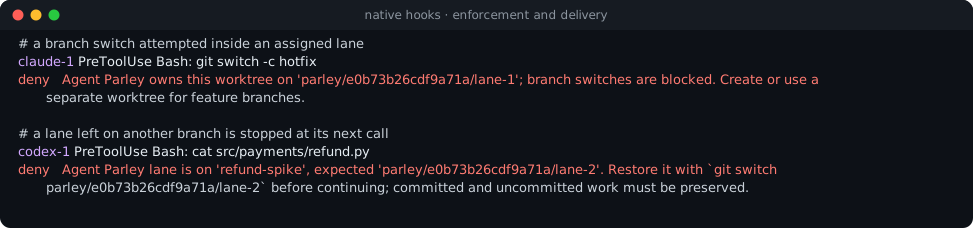
| Vibe Kanban | A task board in front of coding agents. Its vendor announced a shutdown in April 2026 and the project continues community-maintained and fully local. | Coordination in the agents' own path rather than a board in front of it: native hooks refuse a branch switch inside an assigned lane and catch drift after a bypass, which no board can see. |
None of them documents a searchable decision log shared by every lane, or a refusal to let an assistant sign your commits.
Hosted agents and container isolation answer a different question: where one agent runs, rather than how several share a repository.
| Project | What its own documentation describes | What Agent Parley records instead |
|---|---|---|
| GitHub Copilot cloud agent | Researches a repository, plans changes and implements them in the background, editing files and running tests in an ephemeral cloud development environment. | Runs the CLIs you already use on your own machine, under their own sign-in, and coordinates several of them on one repository through claims, reservations and handoffs. |
| OpenAI Codex cloud | Works through coding tasks in the cloud, from investigating bugs to building features. | The same local, multi-CLI coordination; a codex lane is the Codex CLI on your machine, not Codex cloud. |
| container-use | Gives each coding agent a fresh container in its own Git branch. | No isolation of its own; it records who owns which issue and path, and does not sandbox what an agent runs. |
Conductor is the smoother macOS app, and a board reads faster at a glance. Pick Agent Parley when several agents share one repository and "who owns this, on what evidence" must be recorded, not remembered.
| Page | What it covers |
|---|---|
| Running lanes | Launching, steering, pausing, merging, unattended integration, pull requests, gates and approvals. |
| Coordination | Claims, handoffs, reservations, mail, hooks, deadlines, budgets and history. |
| Monitoring | status, top, problems, metrics, watch, report usage and the four presence states. |
| Providers | Which native CLI drives a lane, adapters, accounts and credential profiles. |
| Accounts | Provider, account and participant; a second account of one provider, end to end. |
| Commands | The whole command surface, the MCP tools and the --json contract. |
| Operations | The operator reference: install, platforms, run budgets, integration recovery, JSON errors, plugins and releases. |
| Troubleshooting | First-run failures: the message, its cause and the command that fixes it. |
| Architecture | Module boundaries, protocol, persistence and stated limits. |
Run make check before opening a PR: formatting, lint, typing, documentation
rules, package builds and tests. A minor or major release also needs
tests/test_fault_acceptance.py passing on the release commit.
Contributing · Architecture · Operations · Security · Code of Conduct · MIT license
Tried it? Questions, rough edges and setups worth showing are welcome in GitHub Discussions.
Download counts and popularity will appear here as the collector receives them.
| Version | Published | Direct dependencies | Open version |
|---|---|---|---|
| 0.21.0 | 18 Oct 2026 | 0 |
This describes our collected data; it is not a security assessment.
Observed since 20 Oct, 22:50 UTC
No superseded metadata states collected. Unchanged observations do not create new revisions.
package:1860e7f92a3f76615969cd047719f2623626a0a19a911c27cb936c7dec2fdb25