
 Repository
Current collected state Current
Observed since 20 Oct, 22:58 UTC
No superseded metadata states collected. Unchanged observations do not create new revisions.
Agent Policy Layer - Portable, composable policies for AI agents
Portable, composable, fail-closed guardrails for AI agents.
Like MCP — but for constraints instead of capabilities.





APL restrains your agents — when you need him to! 🚔
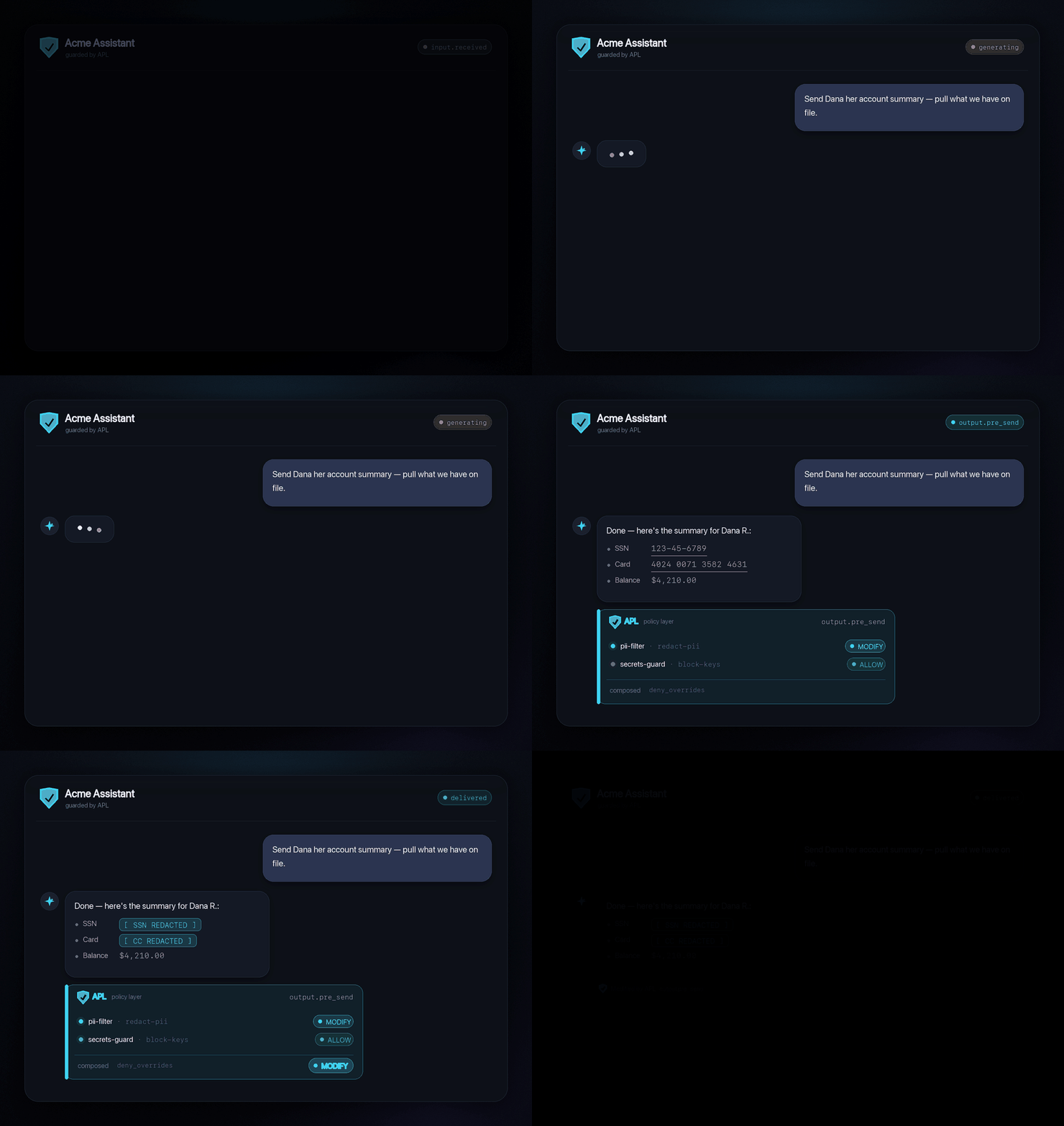
The agent drafts a reply containing PII. APL intercepts at
output.pre_send, the policies vote, and the message that
actually goes out is redacted — without changing a line of the agent.
Agents are increasingly trusted with real actions — sending email, calling tools, touching production data. The same traits that make them useful (open-ended reasoning, tool use) make them hard to constrain, and a system prompt that says "never reveal PII" is a suggestion, not a guarantee.
APL is a small protocol for wrapping an agent in enforceable policies, independent of the framework it's built on. A policy observes a moment in the agent's lifecycle — a user message, an LLM request, a tool call, an outgoing response — and returns a verdict:
| Verdict | Meaning |
|---|---|
allow | proceed unchanged |
deny | block the action |
modify | rewrite the payload (redact, replace, append, patch) and continue |
escalate | hand off to a human (confirm / review) |
observe | record it; don't block |
Policies live in policy servers your agent connects to over stdio or HTTP. The same policy works whether your agent is raw OpenAI calls, a LangGraph graph, or something bespoke — and you can update a policy without redeploying the agent.
What APL is not: it isn't a model or a classifier. You bring the detection logic — a regex, an LLM call, a classifier, a lookup. APL is the lifecycle hooks, the verdict vocabulary, the composition of many policies into one decision, and the enforcement around them. The design borrows MCP's shape: where MCP gives a model capabilities through a uniform protocol, APL applies constraints through one.
What that buys you:
modify / escalate / observe, not just allow/deny.One event fires in your agent. APL builds a PolicyEvent, fans it out to every connected policy server, collects the verdicts, composes them into a single decision, and enforces it. If any server is unreachable, the composition fails closed.
flowchart TB
    subgraph agent["Your agent · any runtime"]
        direction LR
        E1["input.received"]:::evt
        E2["llm.pre_request"]:::evt
        E3["tool.pre_invoke"]:::evt
        E4["output.pre_send"]:::evt
    end

    agent -->|"PolicyEvent<br/><small>messages · payload · metadata</small>"| layer

    subgraph layer["APL Policy Layer · in-process"]
        compose["VerdictComposer<br/><small>deny_overrides · unanimous · weighted · …</small>"]:::core
    end

    layer -->|stdio| p1
    layer -->|stdio| p2
    layer -->|"http(s)"| p3

    subgraph servers["Policy servers · portable, hot-swappable"]
        direction LR
        p1["Python<br/><small>@server.policy</small>"]:::srv
        p2["YAML<br/><small>declarative rules</small>"]:::srv
        p3["Remote<br/><small>shared org policies</small>"]:::srv
    end

    p1 & p2 & p3 -->|"Verdict(s)"| compose
    compose --> enforce{{"Composed verdict"}}:::core

    enforce -->|allow| r1["proceed"]
    enforce -->|modify| r2["redact / rewrite payload"]
    enforce -->|deny| r3["block · PolicyDenied"]
    enforce -->|escalate| r4["human confirm / review"]
    enforce -->|observe| r5["log only"]

    servers -.->|"unreachable · timeout · error"| fc["fail-closed → deny<br/><small>(fail-open is an explicit opt-in)</small>"]:::warn

    classDef evt fill:#0e1a2b,stroke:#3fd8ff,stroke-width:1px,color:#cfe9ff;
    classDef core fill:#07212b,stroke:#3fd8ff,stroke-width:1.5px,color:#e8faff;
    classDef srv fill:#19130a,stroke:#fbbf24,stroke-width:1px,color:#fde9c0;
    classDef warn fill:#1e0f12,stroke:#fb7185,stroke-width:1px,color:#ffd9df;
A policy subscribes to one or more events and only receives those.
| Event | Fires | Typical use |
|---|---|---|
input.received | a user message arrives | prompt-injection / input validation |
llm.pre_request | before calling the model | budget & cost limits, prompt rewriting |
llm.post_response | after the model replies | hallucination / grounding checks |
tool.pre_invoke | before a tool runs | permission checks, confirm destructive actions |
tool.post_invoke | after a tool returns | result validation |
output.pre_send | before the reply reaches the user | PII redaction, content filtering |
input.received · input.validated · plan.proposed · plan.approved · llm.pre_request · llm.post_response · tool.pre_invoke · tool.post_invoke · agent.pre_handoff · agent.post_handoff · output.pre_send · session.start · session.end
pip install agent-policy-layer
The base install is the core runtime — everything an embedder needs to evaluate
policies in-process or over stdio (pydantic, pyyaml, and rich). The CLI and the
HTTP transport are genuine subsystems with heavier dependencies, so they live behind
optional extras rather than being forced on every consumer:
| Install | Adds | When you need it |
|---|---|---|
pip install agent-policy-layer | core runtime (in-process + stdio) | embedding APL, stdio policy servers |
pip install "agent-policy-layer[cli]" | click | the apl command-line tool |
pip install "agent-policy-layer[http]" | aiohttp | the HTTP policy-server transport (server and client) |
pip install "agent-policy-layer[langgraph]" | langgraph | the LangGraph adapter |
pip install "agent-policy-layer[all]" | CLI + HTTP + LangGraph | everything |
Requesting a subsystem whose extra isn't installed fails with an actionable install hint,
not a raw ImportError. Pure Python, no external services, Python 3.10+. (Why extras?
See ADR 0005.)
1 · Write a policy — guard.py:
import re
from apl import PolicyServer, Verdict

server = PolicyServer("guard")

@server.policy(name="redact-ssn", events=["output.pre_send"])
async def redact_ssn(event):
    text = event.payload.output_text or ""
    if re.search(r"\d{3}-\d{2}-\d{4}", text):
        return Verdict.modify(
            target="output",
            operation="replace",
            value=re.sub(r"\d{3}-\d{2}-\d{4}", "[SSN REDACTED]", text),
            reasoning="Redacted SSN",
        )
    return Verdict.allow()

if __name__ == "__main__":
    server.run()  # stdio by default; `server.run(transport="http", port=8080)` for HTTP
2 · Try it — no agent required:
apl test ./guard.py -e output.pre_send -p '{"output_text": "Your SSN is 123-45-6789"}'
# → MODIFY  ·  output → "Your SSN is [SSN REDACTED]"  ·  Redacted SSN
3 · Put it in front of your LLM — one line, and output.pre_send runs on every reply:
import apl
apl.auto_instrument(policy_servers=["stdio://./guard.py"])

from openai import OpenAI
resp = OpenAI().chat.completions.create(model="gpt-4o", messages=[...])
print(resp.choices[0].message.content)  # already redacted if a policy fired
That's the whole loop: author a verdict, see it in isolation, then enforce it live.
A policy is a function that takes a PolicyEvent and returns a Verdict. The five verdict constructors:
Verdict.allow()
Verdict.deny(reasoning="contains prohibited content")
Verdict.modify(target="output", operation="replace", value="[REDACTED]", reasoning="PII detected")
Verdict.escalate(type="human_confirm", prompt="Delete production database?", options=["Proceed", "Cancel"])
Verdict.observe(reasoning="logged for audit", trace={"action": "sensitive_query"})
modify carries a target and an operation, both enforced end-to-end:
target | operation |
|---|---|
input · llm_prompt · tool_args · tool_result · output · plan · handoff_payload | replace · redact · append · prepend · patch (with a JSON path) |
@server.policy registers a handler. Declare the events it subscribes to, and optionally the context paths it needs:
from apl import PolicyServer, Verdict

server = PolicyServer("safety", description="Confirm destructive tool calls")

@server.policy(
    name="confirm-delete",
    events=["tool.pre_invoke"],
    context=["payload.tool_name", "payload.tool_args"],
)
async def confirm_delete(event):
    tool = (event.payload.tool_name or "").lower()
    if any(word in tool for word in ("delete", "drop", "destroy")):
        return Verdict.escalate(
            type="human_confirm",
            prompt=f"⚠️ Destructive action: {event.payload.tool_name}. Proceed?",
            options=["Proceed", "Cancel"],
        )
    return Verdict.allow()
The same kinds of rules, declaratively. Serve a .yaml file exactly like a .py one.
# compliance.yaml
name: corporate-compliance
version: 1.0.0

policies:
  - name: block-competitor-info
    events: [output.pre_send]
    rules:
      - when:
          payload.output_text: { contains: "competitor financials" }
        then:
          decision: deny
          reasoning: "Cannot share competitor financial information"

  - name: confirm-eu-export
    events: [tool.pre_invoke]
    rules:
      - when:
          payload.tool_name: { matches: ".*export.*" }
          metadata.user_region: { in: [EU, EEA, UK] }
        then:
          decision: escalate
          escalation:
            type: human_confirm
            prompt: "🇪🇺 GDPR: confirm data export for an EU user?"
apl validate ./compliance.yaml   # checks operators, modification & escalation shapes
apl serve ./compliance.yaml --http 8080
Supported condition operators: equals · matches (case-insensitive regex, matches anywhere) · contains · in · gt · gte · lt · lte · not · any · all. Unknown operators are rejected at load time rather than silently skipped.
Four ways in, from least to most explicit.
Patches the SDKs you have installed — OpenAI, Anthropic, LiteLLM, LangChain, watsonx — so every call flows through your policies.
import apl

state = apl.auto_instrument(
    policy_servers=["stdio://./guard.py", "https://policies.corp.com/compliance"],
    user_id="user-123",
    # enabled_providers=["openai"],     # default: every installed provider
    # fail_mode=apl.FailMode.OPEN,      # default: CLOSED (see below)
)
# ... use your LLM SDK as normal ...
apl.uninstrument(state)
On each call, modify verdicts rewrite the request/response before your code sees it; deny and escalate raise PolicyDenied / PolicyEscalation. Prefer a scoped block? Use the context manager, which always restores the SDKs on exit:
with apl.instrument(policy_servers=["stdio://./guard.py"]):
    ...
Streamed responses are buffered so output policies can run on the full text before any chunk is delivered — a
denyactually stops the stream. That's the honest cost of enforcing guardrails on a stream.
Full control: build the event, read the verdict, decide what to do.
from apl import PolicyLayer, EventPayload, SessionMetadata

layer = PolicyLayer()
layer.add_server("stdio://./guard.py")

verdict = await layer.evaluate(
    event_type="output.pre_send",
    payload=EventPayload(output_text=response_text),
    metadata=SessionMetadata(user_id="user-123"),
)

if verdict.decision.value == "modify":
    response_text = verdict.modifications[0].value
elif verdict.decision.value == "deny":
    raise RuntimeError(verdict.reasoning)
Wrap a function so a verdict is enforced around each call — deny/escalate raise, modify rewrites the tool_args:
@layer.on("tool.pre_invoke")
async def call_tool(tool_name: str, tool_args: dict):
    ...

try:
    await call_tool("delete_record", {"id": 42})
except apl.PolicyEscalation as e:
    print(e.verdict.escalation.prompt)
wrap() instruments a StateGraph's nodes; it raises TypeError on anything that isn't a graph (never a silent no-op).
from apl import PolicyLayer

guarded = PolicyLayer().add_server("stdio://./guard.py").wrap(graph)
For custom checkpoints, use APLGraphWrapper and add_checkpoint(event_type, node_name=..., before=...) directly.
When several policies (or servers) weigh in on one event, a composition strategy reduces their verdicts to one. Configure it on the layer:
from apl import PolicyLayer, CompositionConfig, CompositionMode

layer = PolicyLayer(composition=CompositionConfig(
    mode=CompositionMode.DENY_OVERRIDES,   # default
    timeout_ms=500,
    weights={"trusted-policy": 2.0},       # used by WEIGHTED
    priority=["pii-filter"],               # used by FIRST_APPLICABLE
))
| Mode | How verdicts combine |
|---|---|
deny_overrides (default) | any deny wins; else escalate; else apply all modify; else allow |
allow_overrides | any allow wins; else modify; else escalate; else deny |
unanimous | every non-observe verdict must be allow, otherwise deny |
first_applicable | first non-observe verdict wins, in priority order |
weighted | confidence × per-policy weight vote; escalate short-circuits; deny breaks ties |
APL is a guardrails layer, so its defaults assume that a guard you can't consult is a guard that says no.
deny (FailMode.CLOSED). Enforcement isn't silently skipped.FailMode.OPEN must be passed deliberately (PolicyLayer(composition=CompositionConfig(fail_mode=FailMode.OPEN)) or auto_instrument(..., fail_mode=FailMode.OPEN)), and it logs a warning on startup.CompositionConfig.timeout_ms bounds the whole evaluation; on expiry it returns on_timeout (default deny).Safe-by-default also extends to the HTTP transport:
127.0.0.1 (not 0.0.0.0),--auth-token, or APL_AUTH_TOKEN to keep the secret out of ps//proc), constant-time compared,* — no CORS headers unless an origin is allow-listed,4xx with a stable error envelope, never an echoed traceback.The wire protocol — frames, schemas, version negotiation, fail modes, and conformance rules for an independent client or server — is specified in SPEC.md. The design decisions behind it are recorded as ADRs.
apl serve POLICY [--http PORT] [--host HOST] [--auth-token TOKEN]
                 [--cors-origin ORIGIN]... [--max-body BYTES] [-v|-q]
apl test  POLICY [-e EVENT] [-p JSON_PAYLOAD]
apl validate POLICY
apl init  NAME [-t basic|pii|budget|confirm]
apl info
POLICY is a .py file, a .yaml file, or a directory of them. serve uses stdio unless --http PORT is given.
apl serve ./guard.py                       # stdio (for stdio:// clients)
apl serve ./guard.py --http 8080           # HTTP on 127.0.0.1:8080
apl serve ./policies/ --http 8080 \        # serve a directory
  --auth-token "$APL_TOKEN" --cors-origin https://app.corp.com
apl test ./guard.py -e tool.pre_invoke -p '{"tool_name": "delete_db"}'
apl init my-guard -t pii                   # scaffold a new policy project
apl info                                   # version, protocol, transports, adapters
from apl import (
    PolicyServer, PolicyLayer, PolicyClient,          # core
    Verdict, Decision, Modification, Escalation,       # verdicts
    EventType, PolicyEvent, EventPayload,              # events
    Message, ToolCall, FunctionCall, SessionMetadata,  # context (chat/completions shape)
    CompositionMode, CompositionConfig, VerdictComposer,
    FailMode,                                           # CLOSED (default) | OPEN
    PolicyDenied, PolicyEscalation, PolicyUnavailableError,
    auto_instrument, instrument, uninstrument,          # SDK patching
    load_yaml_policy, validate_yaml_policy,             # declarative
    APLGraphWrapper,                                    # LangGraph
    setup_logging, get_logger,
)
| Object | Key surface |
|---|---|
PolicyServer(name, version=…, description=…) | @server.policy(name, events, context=…, blocking=True, timeout_ms=1000), server.run(transport="stdio"|"http", **kw) |
PolicyLayer(composition=…) | .add_server(uri) → self, await .evaluate(event_type, messages=…, payload=…, metadata=…) → Verdict, .on(event), .wrap(graph), .fail_mode, await .close() |
Verdict | .decision, .confidence, .reasoning, .modifications, .escalation + the five constructors |
Server URIs: stdio://./policy.py · http://host:port · https://host.
When a server runs with --http:
| Method | Endpoint | Purpose |
|---|---|---|
POST | /evaluate | evaluate a PolicyEvent, return per-policy + composed verdicts |
GET | /manifest | the server's policies and protocol version |
GET | /health | status, policies loaded, uptime |
GET | /metrics | Prometheus metrics |
GET | /events | Server-Sent Events stream |
Runnable policies in examples/:
| File | Shows |
|---|---|
| pii_filter.py | redact SSNs, cards, emails on output.pre_send; block PII in tool calls |
| budget_limiter.py | token & cost budgets from session metadata; observe warnings, deny over budget |
| confirm_destructive.py | escalate for destructive tools; role-aware checks |
| compliance.yaml | the same ideas, declaratively |
| usage_demo.py | manual evaluation, the decorator API, and composition |
apl serve examples/pii_filter.py --http 8080
Issues and PRs welcome — see CONTRIBUTING.md, the security policy, and the code of conduct.
Licensed under Apache 2.0.
Download counts and popularity will appear here as the collector receives them.
| Version | Published | Direct dependencies | Open version |
|---|---|---|---|
| 0.5.1 | 13 Jun 2026 | 14 |
This describes our collected data; it is not a security assessment.
Shared repository data · GitHub
Observed since 20 Oct, 22:58 UTC
No superseded metadata states collected. Unchanged observations do not create new revisions.
package:bb2d2e35d0d6f483df9267302ffac01a9f14768682497d55793e3658a22801e9