
 Repository
Current collected state Current
Observed since 20 Oct, 23:35 UTC
No superseded metadata states collected. Unchanged observations do not create new revisions.
Authorization boundary and security regression testing for AI agent tool calls (MCP): decide on arguments against delegated authority, bind decisions to single-use grants, replay, and pin denials as CI tests. Experimental.
Put a real authorization boundary between your AI agent and its tools, and turn every dangerous action into a regression test so it cannot silently come back.
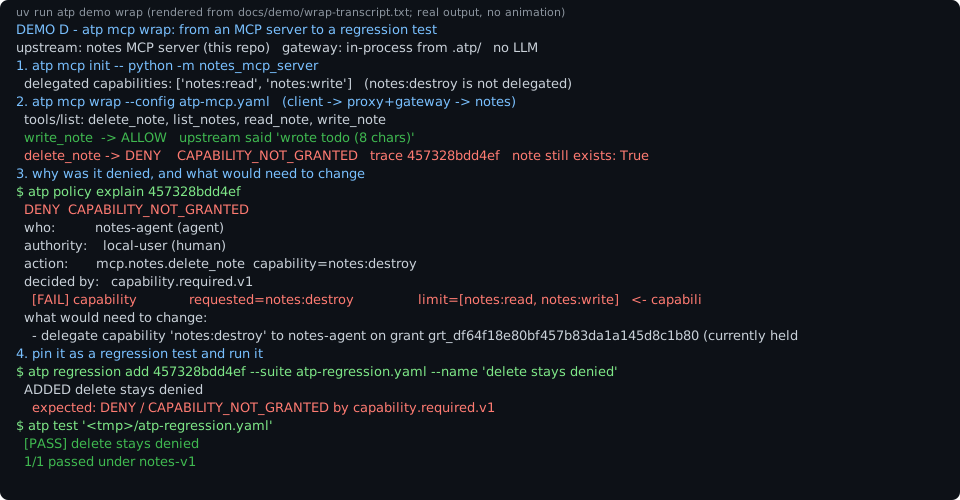
uv run atp demo wrap                        # a real MCP server, wrapped; one ALLOW, one DENY, one regression test
uv run atp mcp init -- <your mcp server>    # then: atp mcp wrap   (Streamable HTTP upstreams: --url)
uv run atp regression add <trace> && uv run atp test atp-regression.yaml
Status: experimental, v0.3.2, no users yet, not independently audited. Every claim below is backed by a test in this repository or says otherwise. What it does not protect is in docs/security/threat-model.md.
Agents act on tool calls, and the tool call is where prompt injection turns into damage: pay this account, delete that file, move this repo. Gateways in front of MCP servers authenticate the caller and allow tools by name; most cannot decide on the arguments (amount, path, destination) and none replay a recorded decision or keep it fixed in CI (research, with citations). ATP does that part and only that part: it is a decision-and-evidence layer, not a gateway (why-atp.md).
agent / MCP client ──stdio──▶ atp mcp wrap ──▶ upstream MCP server (stdio or Streamable HTTP)
                                   │
                    authenticate the agent; resolve HUMAN → agent delegation (capabilities,
                    resource scope, limits — a child can only narrow)
                    build an ActionEnvelope from the call (paths normalised, args bounded)
                    decide: kernel policies + your declared policy set   →  ALLOW / DENY / WOULD_DENY
                    ALLOW  → single-use grant over the exact action hash → forward → record outcome
                    DENY   → refuse (enforce)  |  forward and record WOULD_DENY (shadow)
                    everything on a hash-chained trace in .atp/
Then, offline: atp trace list · atp policy explain TRACE · atp regression add TRACE · atp test · atp policy impact --from A --to B · atp mutate TRACE · atp evidence export TRACE.
Prerequisites: Python ≥ 3.12 and uv. No API keys, no Docker, no database setup, no secrets to copy.
git clone <this repository> && cd agent-trust-plane
uv run atp demo wrap          # syncs the workspace on first run; 37 s cold on the maintainer machine
The same commands work in PowerShell. uv run atp doctor explains anything missing. Other demos: atp demo injection (an injected invoice tries to pay $12,500 on a $1,000 delegation), atp demo regression (a permitted payment reveals a policy hole; replay under the fix flips it), atp demo mcp (the proxy against a remote-style gateway) — docs/demos.md.
uv run atp mcp init --name fs -- npx -y @modelcontextprotocol/server-filesystem /abs/sandbox
#   reads tools/list; proposes capabilities from the server's annotations (unverified: review them);
#   writes atp-mcp.yaml and .atp/policies.yaml (declared set fs-v1)
uv run atp mcp wrap --mode shadow      # observe first: denials are recorded as WOULD_DENY and forwarded
uv run atp mcp wrap                    # enforce
Tools the server itself marks destructive (write_file, edit_file, move_file on the reference server) get fs:destroy, which is not delegated by default: the first write is denied with CAPABILITY_NOT_GRANTED until you add fs:destroy to authority.capabilities in atp-mcp.yaml — a deliberate fail-closed default, and the one thing the first-user test tripped over.
Point your MCP client at the wrap command instead of the server (config example). Verified upstreams: this repo's notes server (stdio and Streamable HTTP, every CI run) and the reference @modelcontextprotocol/server-filesystem (opt-in test, run 2026-09-17). Everything else is listed as not verified in docs/integrations/compatibility.md.
Scope paths, not just tool names: resource_scope: ["path:/abs/sandbox/*"] with .., separators and (optionally) case normalised before matching. Argument limits go in .atp/policies.yaml:
rules:
  - id: no-large-writes
    applies_to: {tool: mcp.fs, action: write_file}
    kind: argument_max_length
    argument: content
    max_length: 20000
uv run atp trace list                                   # what was ALLOWed / DENIED / WOULD_DENY
uv run atp policy explain 457328bdd4ef                  # which constraint failed, and what would need to change
uv run atp regression add 457328bdd4ef --name "delete stays denied"
uv run atp test atp-regression.yaml                     # exit 1 if the decision ever changes; --junit/--json for CI
uv run atp policy impact --from fs-v1 --to fs-v2        # which recorded actions flip; DENY -> ALLOW first
uv run atp mutate 457328bdd4ef                          # perturb the recorded action; authorize only, never execute
A suite is YAML: principals, a delegation graph, cases with the expected outcome / reason / policy. Runs use an ephemeral in-process gateway and call only /authorize — a spy on execute sees zero calls. CI example without secrets: examples/regression-suite and a copy-in composite action. Guide: docs/regression/regression-testing.md.
Protocol-neutral kernel (atp_core envelope/decision, atp_identity credentials + delegation chains, atp_policy engine + declared sets, atp_audit hash chain, atp_gateway service/grants/API) with adapters on the edge (atp_adapter_mcp proxy, atp_adapter_http client) and the atp CLI. One distribution, agent-trust-plane, installs everything (uvx --from <wheel-or-git-url> atp …). The kernel imports nothing from MCP — a test enforces it. Details: docs/architecture/architecture.md, first principles, ADRs.
Overhead (docs/benchmarks.md, single machine, sequential): policy engine 0.26 ms; atp mcp wrap adds ~11 ms p50 to an MCP tool call with durable SQLite evidence; the HTTP-gateway proxy path adds ~21 ms.
Guarantees, assumptions, deployment requirements, non-guarantees and known gaps are separated in docs/security/threat-model.md; attempted attacks and results in docs/red-team/architecture-attacks.md; the self-review with severities in docs/security/security-review.md. Headlines:
.atp/keys.env) is omnipotent; agent credentials are bearer tokens with expiry and revocation, no proof of possession.Evidence for what is handled: 439 tests including property-based tests (delegation monotonicity, scope-algebra soundness, a stateful grant lifecycle with tampering and revocation interleaved), an exhaustive check of the grant state machine (spec), eight adversarial evals, and real-protocol MCP end-to-end tests.
CONTRIBUTING.md, DEVELOPMENT.md (module map, invariants not to break, how to add a policy or adapter), ROADMAP.md, docs/good-first-issues.md, SECURITY.md for reporting a vulnerability, CHANGELOG.md. MIT licensed (dependency and copyright record: docs/release/licensing.md). No telemetry.
Download counts and popularity will appear here as the collector receives them.
| Version | Published | Direct dependencies | Open version |
|---|---|---|---|
| 0.3.2 | 22 Sept 2026 | 7 |
This describes our collected data; it is not a security assessment.
Shared repository data · GitHub
Observed since 20 Oct, 23:35 UTC
No superseded metadata states collected. Unchanged observations do not create new revisions.
package:1594f2bc7cd86efbb1d424755d4991866993474453dee8f96214d9865a4975bb