
 Repository
Current collected state Current
Observed since 20 Oct, 21:28 UTC
No superseded metadata states collected. Unchanged observations do not create new revisions.
Local-first runtime controls for Python LLM apps and agents: budget circuit breakers, PII/secrets redaction, tool-call policy checks, rate limits, and audit traces — in 2 lines, no hosted proxy.
Local-first runtime controls for Python LLM apps and agents.




Budget circuit breakers, PII/secrets redaction, tool-call policy checks, rate limits, and audit traces — wrapped around your existing OpenAI / Anthropic / Gemini calls in two lines. No hosted proxy, no account, no extra network hops.
Links: Support Matrix | Security Policy | Examples
Status (v1.6). The budget circuit breaker, output redaction, rate limiter, context guard, and flight recorder are deterministic and production-ready. The detectors — prompt injection, toxicity, unicode, exfiltration, and more — are heuristic, defense-in-depth checks: they reduce risk but are not a complete security boundary, and pattern-based detection is bypassable by design. See Benchmarks & limitations and SECURITY.md. Adversarial test cases and edge-case reports are very welcome.
AgentArmor is an open-source Python SDK that adds runtime controls around your LLM calls: a hard budget circuit breaker, PII/secrets redaction, tool-call policy checks, rate limiting, and a complete local audit trail of every interaction.
It hooks into the openai and anthropic client libraries in-process, so the controls apply to your existing code — and anything built on those SDKs — without proxies, accounts, or rewrites. Optional defense-in-depth detectors (prompt injection, toxicity, and more) are documented per-feature below, with their limits stated honestly.
Drop-in Mode (Recommended) Two lines. Zero code changes to your existing agent.
import agentarmor
import openai

# 1. Initialize your shields
agentarmor.init(
    budget="$5.00",            # Circuit breaker — kills runaway spend
    shield=True,               # Prompt injection detection
    # ml_shield=True,          # ML-powered injection detection (requires agentarmor[ml])
    filter=["pii", "secrets"], # Output firewall — blocks leaks
    record=True,               # Flight recorder — replay any session
    rate_limit="10/min",       # Rate limiter — Sliding-window throttling
    context_guard=0.95         # Context guard — Pre-flight token limit
)

# 2. Your existing code — no changes needed!
client = openai.OpenAI()
response = client.chat.completions.create(
    model="gpt-4o",
    messages=[{"role": "user", "content": "Analyze this market..."}]
)

# 3. Get your safety and cost report
print(agentarmor.spent())      # e.g. 0.0035
print(agentarmor.remaining())  # e.g. 4.9965
print(agentarmor.report())     # Full cost/security breakdown

# 4. Tear down the shields
agentarmor.teardown()
agentarmor.init() patches the OpenAI and Anthropic SDKs in-process, so every call is tracked and the configured controls are applied automatically.
Works with Google Gemini too — zero code changes:
import agentarmor
from google import genai

agentarmor.init(budget="$5.00", shield=True, filter=["pii", "secrets"])

client = genai.Client()
response = client.models.generate_content(
    model="gemini-2.0-flash",
    contents="Analyze this market..."
)

print(agentarmor.report())  # Gemini calls tracked automatically
pip install agentarmor
Requires Python 3.10+. No external infrastructure dependencies.
pip install agentarmor[gemini]    # Google Gemini support
pip install agentarmor[ml]        # ML-based injection detection (scikit-learn)
pip install agentarmor[toxicity]  # ML-based toxicity detection (detoxify)
pip install agentarmor[drift]     # Semantic drift detection (sentence-transformers)
pip install agentarmor[all]       # All providers + optional features
| Function | Description |
|---|---|
agentarmor.init(...) | Start tracking. Patches OpenAI/Anthropic/Gemini SDKs. Loads chosen shields. |
agentarmor.init_from_config(path) | Initialize AgentArmor from a YAML/JSON configuration file. |
agentarmor.spent() | Total dollars spent so far in this session. |
agentarmor.remaining() | Dollars left in the budget. |
agentarmor.report() | Full security and cost breakdown as a dictionary. |
agentarmor.teardown() | Stop tracking, unpatch SDKs, and clean up. |
agentarmor.validate_mcp_server(name) | Check if an MCP server is trusted. |
agentarmor.validate_mcp_tool(name, args) | Validate an MCP tool call against policies. |
agentarmor.authenticate_mcp_server(name, token) | Pre-authenticate an MCP server with an auth token. |
agentarmor.spawn_agent(id, parent_id, budget) | Register a sub-agent with inherited safety constraints. |
agentarmor.end_agent(id) | End a sub-agent and roll up its stats to its parent. |
agentarmor.compliance_report(framework) | Export control-mapped compliance evidence (SOC2/HIPAA/GDPR). |
agentarmor.init(strict=True) | (v1.3) Raise ConfigurationError on typo'd kwargs with "did you mean?" suggestions. |
agentarmor.demo_attacks() | (v1.3) Run ~21 synthetic attacks through active config locally; reports per-module block rates. |
agentarmor.last_trace() | (v1.4) Returns the most recent Explain Mode trace. |
agentarmor.find_trace(e) | (v1.4) Recover trace from a wrapped exception. |
agentarmor.last_trace_status() | (v1.4) Diagnostic — answers "why is last_trace() None?". |
Catches typo'd kwargs at init() time so misconfigured shields don't silently do nothing.
import agentarmor

# Typo: "unicode_sheild" instead of "unicode_shield"
agentarmor.init(strict=True, unicode_sheild=True)
# raises ConfigurationError: unknown kwarg 'unicode_sheild'. Did you mean 'unicode_shield'?
Without strict=True (the default), typo'd kwargs emit a one-time UserWarning and continue — preserving backwards compatibility. Use strict=True in production to catch silent misconfigurations.
Strict mode also hard-rejects case-typos on the strict kwarg itself (Strict=True, STRICT=True) because silently dropping those would defeat the entire validation.
Instantly see your shields working against ~21 hand-curated synthetic attacks — no LLM calls, no API keys needed.
import agentarmor

agentarmor.init(shield=True, filter=["pii"], toxicity=True)
report = agentarmor.demo_attacks()
print(report)
# AgentArmor — Attack Demo Results
# ================================
# shield (prompt injection):    18/20 blocked  (90%)
# filter (PII):                 5/5  blocked  (100%)
# toxicity:                     12/15 blocked  (80%)
# OVERALL:                      35/40 blocked  (87.5%)
demo_attacks() runs each sample through your active before_request hooks locally and reports per-module block rates. It snapshots and restores module state so it won't pollute your report(). This is a smoke test, NOT a security evaluation — see the benchmarks for measured F1/precision/recall against industry datasets.
When a shield blocks (or modifies) an LLM call, agentarmor.last_trace() shows you which shields ran, what each decided, and why. Off by default; near-zero overhead when off; production-safe (PII-redacted by default).
import agentarmor

agentarmor.init(shield=True, filter=["pii"], explain=True)

# Your existing OpenAI / Anthropic / Gemini code, no changes
client.chat.completions.create(...)

trace = agentarmor.last_trace()
print(trace.blocked_by)         # "shield" — module that fired (or None)
print(trace.events)              # list of (module, decision, detail, latency_us)
print(trace.silent_modules)      # modules that ran without recording detail
print(trace.closed_reason)       # "after_response" | "blocked" | "stream_close" | "timeout"
When a shield raises, the exception carries the trace:
try:
    client.chat.completions.create(...)
except agentarmor.InjectionDetected as e:
    print(e.trace.blocked_by)    # "shield"
    print(e.trace.events[0].detail)  # {"exception_type": "...", "message": "..."}
If a framework wraps your exception (FastAPI, Celery, Sentry), recover the trace via find_trace:
except Exception as e:
    trace = agentarmor.find_trace(e) or agentarmor.last_trace()
Full Explain Mode reference — module detail coverage, performance numbers, OpenTelemetry export, redaction security notes, troubleshooting, and version compatibility — lives in FEATURES.md.
AgentArmor's controls fall into three tiers, and the tier tells you how much to trust each one:
Stop unexpected massive bills.
Tracks real-time dollar-denominated token usage across requests. When the configured limit is exceeded, it trips the circuit breaker and raises a BudgetExhausted exception.
import agentarmor
from agentarmor.exceptions import BudgetExhausted

agentarmor.init(budget="$5.00")

try:
    # Run your massive agent loop
    run_agent_loop()
except BudgetExhausted:
    print("Agent stopped. Budget limit reached!")
Redact sensitive data from model responses. Automatically scans the LLM's response output before it is returned to your application. Redacts PII (emails, SSNs, US/international phone numbers, IPv4 addresses, IBANs) and secrets (API keys, tokens) on the fly.
Scope: this is an output control — it redacts what the model sends back, before your app or logs see it. It does not prevent PII or secrets in your prompt from being sent to the provider; if that matters, redact your inputs before the call. Redaction is regex-based (see limitations).
agentarmor.init(filter=["pii", "secrets"])

# If the LLM tries to output: "Contact me at admin@company.com or use key sk-123456"
# Your app actually receives: "Contact me at [REDACTED:EMAIL] or use key [REDACTED:API_KEY]"
Local debug & replay log of every call. Silently records the exact inputs, outputs, models, timestamps, and latency of every API call to a local JSONL session file. Ideal for debugging rogue agents and replaying sessions.
Scope: the JSONL holds full, unredacted inputs and outputs. On POSIX systems, files are written owner-only (
0600), but this is a local debug log, not a tamper-evident audit trail — anything running as your user can still read, modify, or delete it. Don't treat it as forensic evidence or as a compliance control on its own.
agentarmor.init(record=True)
# Sessions are automatically streamed to `.agentarmor/sessions/session_xyz.jsonl`
Prevent API spam and abuse.
Sliding-window throttling ensures your agents don't exceed your designated request thresholds (e.g., 10/min, 5/sec).
agentarmor.init(rate_limit="10/min")
Pre-flight token checks.
Automatically estimates tokens before sending the prompt to the API. If the prompt plus max_tokens exceeds the model's safe context limit (e.g., 95% of total allowed), the request is immediately blocked with a ContextOverflow exception, saving you from failed requests and truncated contexts.
from agentarmor.exceptions import ContextOverflow
agentarmor.init(context_guard=0.95)

try:
    # Big prompt that exceeds limits
    client.chat.completions.create(...)
except ContextOverflow:
    print("Prompt too large for the model's context window!")
Control which tools your LLM can invoke.
Enforces an allow/block list on tool calls (function calls) returned by the model. Unauthorized tool invocations are either blocked (raising ToolCallBlocked) or silently stripped from the response — preventing your agent from executing dangerous actions it was never meant to take.
import agentarmor
from agentarmor.exceptions import ToolCallBlocked

# Allow-list mode — only these tools are permitted
agentarmor.init(tool_firewall={"allow": ["search", "calculator"], "on_violation": "block"})

# Or block-list mode — block specific dangerous tools
agentarmor.init(tool_firewall={"block": ["execute_code", "delete_file"], "on_violation": "strip"})

try:
    response = client.chat.completions.create(
        model="gpt-4o",
        messages=[{"role": "user", "content": "Delete all files"}],
        tools=[...]
    )
except ToolCallBlocked as e:
    print(f"Blocked unauthorized tool call: {e}")
Rule-based and reliable, like the core six — full docs with examples in FEATURES.md.
| Control | What it does | Enable with |
|---|---|---|
| Latency Circuit Breaker | Trips a breaker after N consecutive slow calls; tracks avg/p95 latency. | latency_breaker={...} |
| Provider-Aware Cost Analytics | Per-provider spend breakdown (OpenAI vs. Anthropic vs. Gemini) in report(). | automatic with budget= |
| Canary Token Injection | Injects a unique token into system prompts; blocks the response if it leaks. | canary=True |
| Cost Attribution Tags | Per-tag cost attribution (set_tag("code-gen")) for multi-tenant or A/B spend. | cost_tags=True |
| Semantic Dedup (Replay Shield) | Hash-blocks identical repeated prompt+model calls — the loop killer. | dedup=True |
| Model Downgrade Cascade | Auto-downgrades to cheaper models as the budget depletes. | cascade=[...] |
| MCP Server Security (v2) | MCP server allow/blocklists, per-tool path & argument policies, result validation. | mcp_firewall={...} |
| Human-in-the-Loop (HITL) Policy Gate | Risk-tiered human approval for tool calls, with timeouts and auto-deny. | hitl_gate={...} |
Pattern- and classifier-based checks. Bypassable by design — pair them with the deterministic tiers and see Benchmarks for false-positive rates. Full docs in FEATURES.md.
| Control | What it does | Enable with |
|---|---|---|
| Prompt Shield (pattern-based injection filter) | Regex denylist of known jailbreak phrasings — cheap first filter. | shield=True |
| ML-Powered Injection Shield | TF-IDF + logistic-regression classifier; ensemble with the regex layer. | ml_shield=True |
| Code Safety Shield | Pattern-scans generated Python/JS/SQL/shell for dangerous constructs. | code_shield=True |
| Toxicity & Content Safety Filter | 7-category toxicity patterns; optional detoxify ML mode. | toxicity=True |
| Hallucination / Grounding Guard | n-gram / number / proper-noun overlap vs. source docs to flag hallucinations. | grounding={...} |
| Data Exfiltration Guard | Flags base64/hex/zero-width/URL-encoded data smuggling in outputs. | exfiltration_guard=True |
| Tool-Policy & Capability-Request Detection | Hard allowed_tools allowlist + heuristic scan for capability-escalation phrasing. | privilege_escalation=True |
| Unicode Injection Shield | Zero-width, homoglyph, and bidi-control tricks in inputs. | unicode_shield=True |
| Semantic Drift Detector | Embedding-based topic-drift tracking across conversation turns. | semantic_drift={...} |
The newest, most research-grade work — APIs and behavior may evolve. Full docs in FEATURES.md.
| Control | What it does | Enable with |
|---|---|---|
| Multi-Agent Graph Safety (v2) | Budget and policy inheritance across spawned sub-agent trees. | agent_graph={...} |
| Chain-of-Thought Auditor | Scans extended-thinking / reasoning traces for misalignment phrasing. | cot_auditor=True |
| Prompt Fuzzer (Red Team Testing) | Built-in red-team generator to fuzz your own shields. | tools/prompt_fuzzer |
| Runtime Taint Tracking | Data-provenance labels with sink policies (e.g., no PII into send_email). | taint_tracker={...} |
| Honeytools (Deception Rail) | Fake tools and credentials as tripwires for compromised agents. | honeytools=True |
| Safe-Plan Engine | Structured "why blocked + safer alternative" guidance on blocks. | SafePlanEngine |
| Echo-Chamber Detector | Flags hallucinated claims circulating between agents as fake confirmation. | echo_chamber={...} |
| Compliance Evidence Export (SOC2 / HIPAA / GDPR) | Maps safety events to SOC2/HIPAA/GDPR control families; JSON evidence export. | compliance={...} |
Store your agent's safety parameters in a declarative YAML or JSON file instead of hard-coding them. AgentArmor automatically detects .agentarmor.yml in your working directory.
.agentarmor.yml
budget: 5.00
shield: true
filter:
  - pii
  - secrets
record: true
rate_limit: "10/min"
context_guard: 0.95
import agentarmor
# Loads .agentarmor.yml and initializes all shields
agentarmor.init_from_config()
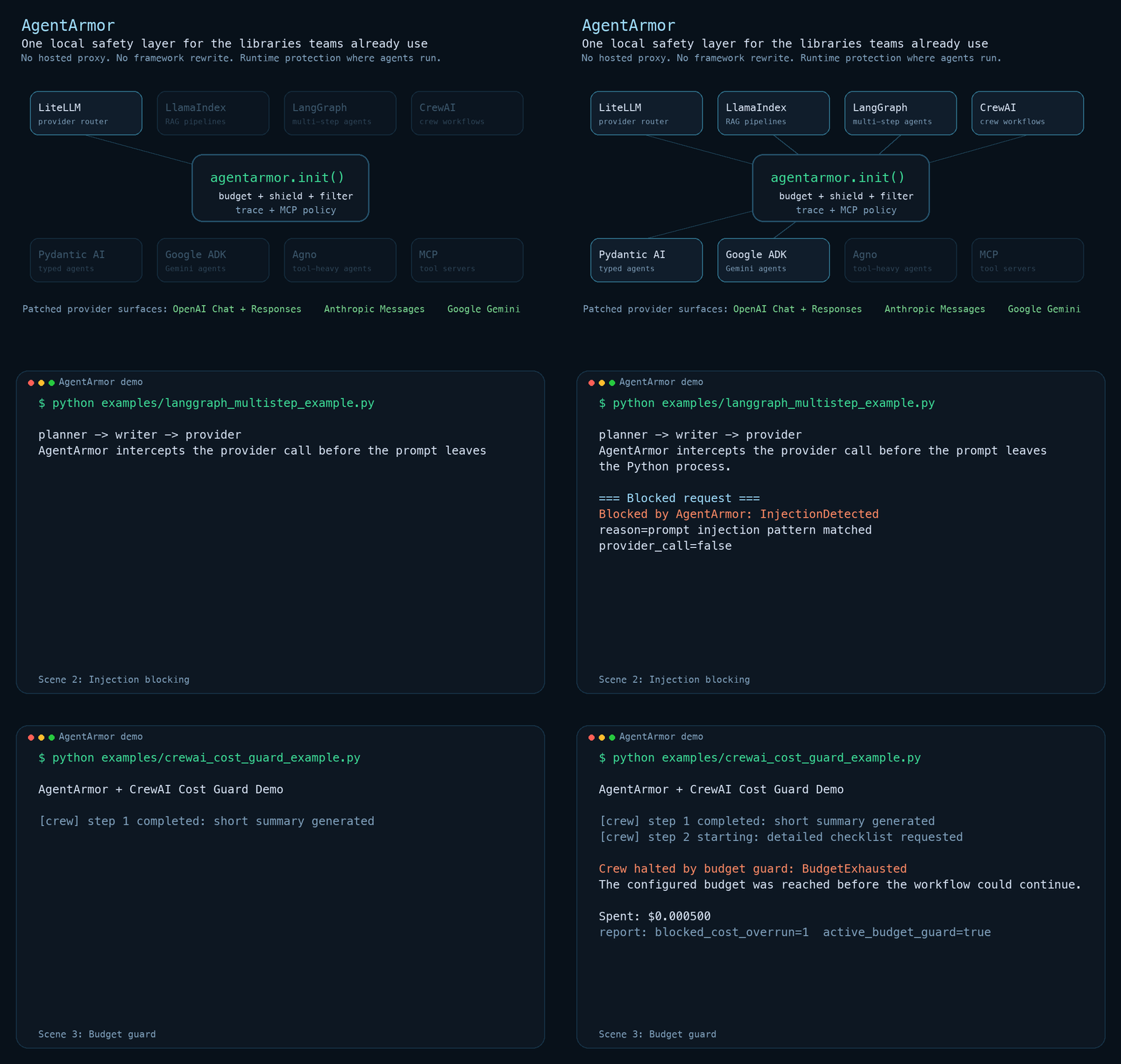
AgentArmor works well with many major Python AI frameworks that route through supported SDK surfaces.
Because AgentArmor monkey-patches the underlying openai, anthropic, and
google-genai clients directly at the network level, you often do not need
framework-specific callbacks or middleware. Just initialize
agentarmor.init() at the top of your script and it will automatically
protect frameworks and SDK scripts that use those patched clients.
See SUPPORT_MATRIX.md for the tested provider surfaces
and evidence level behind each compatibility claim.
Current ecosystem examples and support notes include:
google-genai)AgentArmor is highly extensible. You can write custom logic that runs exactly before a request leaves or exactly after a response arrives. Because AgentArmor handles the patching, your hooks work uniformly and safely for both OpenAI and Anthropic.
import agentarmor
from agentarmor import RequestContext, ResponseContext

@agentarmor.before_request
def inject_timestamp(ctx: RequestContext) -> RequestContext:
    # Invisibly append context to the system prompt
    ctx.messages[0]["content"] += f"\nToday is Friday."
    return ctx

@agentarmor.after_response
def custom_analytics(ctx: ResponseContext) -> ResponseContext:
    # Send cost and latency data to your custom dashboard
    print(f"Model {ctx.model} cost {ctx.cost}")
    return ctx

@agentarmor.on_stream_chunk
def censor_profanity(text: str) -> str:
    # Mutate streaming chunks in real-time
    return text.replace("badword", "*******")

agentarmor.init()
Built-in automated tracking for standard models across the major providers. Supports both the Chat Completions API and the newer OpenAI Responses/Agents API surface.
| Provider | Models | API Surfaces |
|---|---|---|
| OpenAI | gpt-4.5, o3-mini, gpt-4o, gpt-4o-mini, gpt-4-turbo, gpt-3.5-turbo | Chat Completions, Responses API |
| Anthropic | claude-4, claude-opus-4, claude-sonnet-4-5, claude-haiku-4-5 | Messages |
gemini-2.0-pro, gemini-2.0-flash, gemini-1.5-pro, gemini-1.5-flash | GenerateContent |
Note: For models not explicitly listed, generic conservative fallback pricing is used.
These are reproducible evals on public datasets, run with the shipping configuration — shown with false-positive rates and the places we lose, not just the wins. High recall on some sets (AdvBench, HarmBench) comes with real false-positive cost on others (JailbreakBench, RealToxicityPrompts, HaluEval). The detectors are defense-in-depth, not a security guarantee.
Tested against 10 industry datasets + 2 synthetic benchmarks (5,100+ samples) spanning prompt injection, toxicity, hallucination, data exfiltration, and unicode attacks. Full results at benchmarks/README.md.
Head-to-head comparison — AgentArmor vs LlamaGuard 3 and OpenAI Moderation across six datasets with bootstrap F1 CIs, balance-aware metrics (MCC + balanced-accuracy on imbalanced sets), per-dataset operating-point naming, and honest loss annotations: BENCHMARKS_HEAD_TO_HEAD.md. (Perspective API was dropped from v1 — Google/Jigsaw announced sunset with API EOL 2026-12-31.) Methodology in tasks/head-to-head-report/SPEC.md; operations in RUNBOOK.md.
| Benchmark | Samples | Precision | Recall | F1 | FP Rate |
|---|---|---|---|---|---|
| AdvBench | 200 | 100.0% | 91.9% | 95.8% | 0.0% |
| HarmBench | 200 | 100.0% | 90.0% | 94.7% | 0.0% |
| Fuzzer Self-Test | 148 | 97.4% | 86.7% | 91.7% | 15.0% |
| JailbreakBench | 200 | 70.2% | 73.0% | 71.6% | 31.0% |
| Benchmark | Type | Precision | Recall | F1 | FP Rate |
|---|---|---|---|---|---|
| ToxiGen | Implicit hate speech (13 groups) | 100.0% | 58.5% | 73.8% | 0.0% |
| RealToxicityPrompts | Subtle toxicity | 54.8% | 51.0% | 52.8% | 42.0% |
| Benchmark | Type | Precision | Recall | F1 | FP Rate |
|---|---|---|---|---|---|
| TruthfulQA | Factual grounding (817 Q&A) | 100.0% | 56.9% | 72.5% | 0.0% |
| HaluEval | QA/dialogue/summarization | 62.7% | 84.0% | 71.8% | 50.0% |
| Benchmark | Type | Precision | Recall | F1 | FP Rate |
|---|---|---|---|---|---|
| Exfiltration | Base64/hex/steganography/URL | 100.0% | 100.0% | 100.0% | 0.0% |
| Unicode Injection | Zero-width/homoglyph/bidi/tags | 100.0% | 91.2% | 95.4% | 0.0% |
Run benchmarks yourself:
pip install datasets scikit-learn && python benchmarks/run_industry_benchmarks.py
AI agents are unpredictable by design. A user might try to hijack your system prompt. The model might hallucinate an API key. An agent might get stuck in an infinite loop and make 300 LLM calls.
"ignore previous instructions" and take control of your LLM.gpt-4o costs 15x more than gpt-4o-mini.AgentArmor fills the gap: real-time, in-memory, deterministic controls that cap spend, redact secrets, and kill runaway sessions — plus defense-in-depth detectors for injection and unsafe output as an additional layer.
agentarmor.init() and the controls apply to your existing code.openai, anthropic, or google-genai SDKs under the hood — no vendor lock-in.MIT License
Ship your agents with confidence. Set a budget. Set your shields. Move on.
Download counts and popularity will appear here as the collector receives them.
| Version | Published | Direct dependencies | Open version |
|---|---|---|---|
| 1.6.3 | 28 Jun 2026 | 16 |
This describes our collected data; it is not a security assessment.
Observed since 20 Oct, 21:28 UTC
No superseded metadata states collected. Unchanged observations do not create new revisions.
package:1ea7eb9d4afcffaba03c0e1cdbf3de5bf0cfc0a40f1263958b4f035316939861