
 Repository
Current collected state Current
Observed since 20 Oct, 21:32 UTC
No superseded metadata states collected. Unchanged observations do not create new revisions.
Local-first task control plane for coordinating Codex, Claude Code, and Hermes.
中文 | English
AgentBC is a local-first task control system for running background work through agents on your machine. The current release supports Codex/ChatGPT, Claude Code, and Hermes. It gives different agent CLIs one task identity, one Runner gateway, one report contract, and one recovery model.
Public Alpha. Use AgentBC on development projects with version control and review agent output before accepting changes.
Release target (pending publication): 1.0.5A (Python package version 1.0.5a1).
1.0.5A development: Docker installation, platform acceptance and execution fixes are described in development status. The release proposal uses package version
1.0.5a1; historical candidates used1.0.4a1.
4XMC-001 -> 4XMC-002.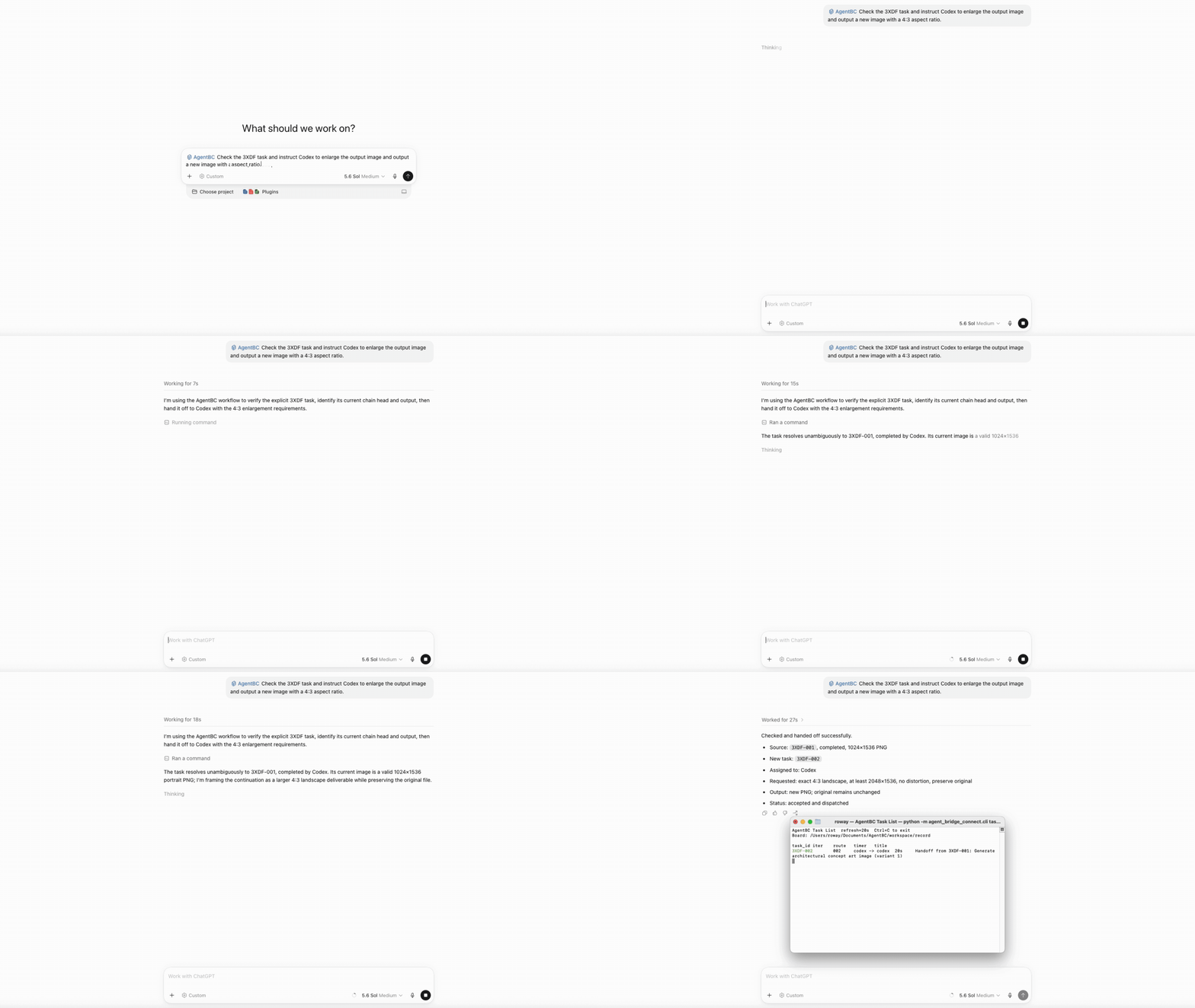
In any supported agent conversation, invoke /agentbc, describe the task in
natural language, and name the executor:
/agentbc Ask Codex (or any supported agent) to write a document summarizing AgentBC's features and use cases.
One command downloads, verifies, installs, and configures AgentBC:
curl -fsSL \
  https://github.com/roway49/agent-bridge-connect/releases/download/v1.0.5A/install-agentbc-alpha.sh \
  | sh -s -- \
  https://github.com/roway49/agent-bridge-connect/releases/download/v1.0.5A
For a package-managed installation from PyPI and Homebrew:
python3 -m pip install agentbc==1.0.5a1
brew install roway49/agentbc/agentbc
brew install agentbc
agentbc setup
Update AgentBC
agentbc update
Start with Quick Start, then use the User Guide for task and Runner commands.
AgentBC is a local control plane. Agent integrations submit structured tasks to one local Runner; Core owns task identity, state, reports, records, and notifications.
flowchart TD
    A[Human or controller agent] --> CLI[CLI and installed skill]
    CLI --> S[TaskService]
    S --> TS[TaskStore]
    CLI --> R[Runner gateway]
    R --> X[Executor adapter]
    X --> E[Codex, Claude Code, or Hermes CLI]
    E --> P[Project or managed artifact root]
    R --> L[RunLease and progress record]
    S --> RP[Task brief and report]
    S --> I[Global task index]
    S --> N[Task List and desktop notification]
CLI and skills. The CLI exposes task, Runner, setup, record, worker, and uninstall operations. Installed skills teach each controller how to select a customer path, preserve dispatcher identity, and choose create versus handoff. Skills cannot bypass Core validation and do not own task truth.
TaskService and TaskStore. TaskService owns state transitions, task-code
allocation, handoff lineage, close and recovery behavior, report finalization,
and index refresh. TaskStore owns compact runtime records. Each task iteration
has a bounded record budget so long-running agents do not create unbounded
metadata.
Runner. Runner is the normal dispatch gateway. It validates the task and path plan, acquires a run lease, launches the executor, records low-frequency progress evidence, and classifies executor termination. Runner does not decide whether a deliverable is good; that remains a user or reviewer decision.
Executor adapters. Adapters translate one task packet into executor-specific arguments and prompts. The executor CLI remains an independent process. Codex and Claude receive scoped writable roots where supported; Hermes runs from the selected project or artifact root and remains subject to its own CLI capabilities.
Reports and records. Readable task briefs and reports are separate from compact machine state. Reports describe requirements, lineage, results, and artifact locations; runtime records preserve exact status and recovery evidence.
A four-character TASKCODE identifies a task chain. The numeric suffix is its
iteration: 4XMC-001 and 4XMC-002 belong to the same chain. Commands may use
the task code to resolve the current head or the full ID for an exact iteration.
Successful execution requires one versioned terminal declaration. The executor's final response must end with exactly one single-line marker:
AGENTBC_FINAL_CALLBACK: {"version":1,"task_id":"4XMC-001","final_state":"completed","summary":"Implemented and verified the requested change","step_results":[{"id":1,"status":"done"}]}
completed is valid only when task_id matches and every declared task step
appears exactly once with status done. Missing or invalid JSON, wrong task IDs,
duplicate/unknown/missing steps, and non-done completion steps fail the flow.
input_required must be explicit and identify at least one declared step as
blocked; permission or approval prose alone is a failure. A two-option choice
declares a concrete decision reason and two label/description objects, for example
"input":{"type":"choice","reason":"why a decision is required","options":[{"label":"A","description":"what A does"},{"label":"B","description":"what B does"}]}.
Approve/deny requests use "input":{"type":"permission","requested_permission":"full","reason":"..."}:
a safe task may stop to request a one-time full continuation, which the user
approves or denies; a full task runs with its strongest documented noninteractive
access and does not ask. Plain approval prose never grants permissions or completes
a task. The desktop dialog explains the reason and both outcomes, then renders the two
labels as direct buttons. Operational deadline and CLI fallback fields remain in
the task record/report but are not shown in the desktop dialog. Ordinary message/choice dialogs
remain visible for up to five minutes; dismissing or timing out leaves the task waiting for a CLI
response. Permission dialogs are strict two-action confirmations with no text input: Deny is the
default, and closing or timing out automatically denies.
completed: a valid completed marker declares every task step done; quality is not asserted.needs_recovery: an explicit retryable transport or infrastructure failure stopped execution.failed: the marker or non-retryable execution contract was missing or invalid.A zero exit is never completion by itself. AgentBC does not inspect Git state, tests, files, or artifact quality when validating the flow marker, and it never automatically retries a recovery state.
A dispatch response such as accepted is not task completion. Task status,
reports, artifacts, and notifications are the source of truth.
Every report and task brief includes a Dispatcher Traceability section labeling
the controller that created or handed off the task: Dispatcher platform and
Dispatcher conversation ID. These labels describe the current dispatcher
conversation, not the source task conversation and not the executor's temporary
session. The conversation ID shows unavailable when no trusted dispatcher ID
was available; AgentBC never guesses it from processes, paths, history, or a
previous task, and a handoff records the current dispatcher conversation.
AgentBC does not delete the dispatcher conversation.
The controller supplies either an explicit user path or the literal
"default path". Runner derives the path plan. Explicit paths receive
deliverables directly; default-path tasks receive an isolated managed artifact
root. Reports and runtime records always remain Core-owned.
~/Documents/AgentBC/workspace/
|-- tasks/
|   |-- artifacts/YYYY-MM-DD/<TASKCODE>/
|   `-- report/YYYY-MM-DD/<TASKCODE>/
|       |-- <TASKCODE>-<NNN>-task.md
|       `-- <TASKCODE>-<NNN>-report.md
`-- record/
    |-- README.md
    |-- TASK_INDEX.md
    |-- task_index.jsonl
    `-- <TASKCODE>/<NNN>/
        |-- task.json
        |-- events.jsonl
        |-- interventions.jsonl
        |-- run_lease.json
        `-- bounded progress and run-log files
Each iteration record is capped at 10KB. agentbc record clean removes only eligible
terminal-task runtime diagnostics while preserving core indexes and state; reports are
never deleted by record cleanup. Empty managed
artifact directories are removed after terminal execution; customer projects
are never automatic-cleanup or uninstall targets.
agentbc claude budget <usd> and agentbc hermes max-turns <turns> set the resource
defaults for future executor runs; each task freezes its effective values at dispatch.agentbc session retention status|enable|disable controls whether executor temporary
sessions survive terminal tasks. Cleanup is background and user-transparent: it manages
only temporary sessions created by the Executor, and AgentBC never deletes the dispatcher
conversation.agentbc doctor (or agentbc doctor --json) is a read-only installation and Runner health
check with a fixed exit-code contract: 0 healthy, 1 warning, 2 unavailable.agentbc task close <TASKCODE> closes the current queued (pending) or active chain head;
terminal and stale non-head iterations are rejected. Customer-project files are never
deleted by close.Runner uninstall honors two isolation controls:
AGENTBC_UNINSTALL_SKIP_RUNNER=1 skips stopping Runner and preserves its live
spool, token, and pid files during uninstall.AGENTBC_RUNNER_SPOOL=/path/to/spool relocates the Runner spool used by the
CLI, setup, and uninstall paths, letting tests and multi-install setups isolate
the spool from the per-user default /tmp/agentbc-runner-v2-<uid>.AgentBC is not a container sandbox. Use source control, normal OS permissions, and executor-native approval controls for defense in depth.
AgentBC is released under the MIT License.
Download counts and popularity will appear here as the collector receives them.
| Version | Published | Direct dependencies | Open version |
|---|---|---|---|
| 1.0.5a1 | 10 Oct 2026 | 1 |
This describes our collected data; it is not a security assessment.
Shared repository data · GitHub
Observed since 20 Oct, 21:32 UTC
No superseded metadata states collected. Unchanged observations do not create new revisions.
package:14d4a710439093506f9e70d68ef2647c092d94bd088b112537025e8098eada9a