

 Repository
Current collected state Current
Observed since 20 Oct, 22:06 UTC
No superseded metadata states collected. Unchanged observations do not create new revisions.
Predict LLM-agent-run failures in real time — and intervene before the tokens are spent


Predict LLM-agent-run failures in real time — and intervene before the tokens are spent.
Every agent-observability tool today (LangSmith, Langfuse, Arize, Braintrust) is reactive: it shows you the trace after the run burned $30 and forty steps going in circles. AgentGuard is predictive: it watches the step stream live, scores the risk that the run is going off the rails, and proposes an intervention (halt / reset context / escalate / downgrade) early enough for it to matter.
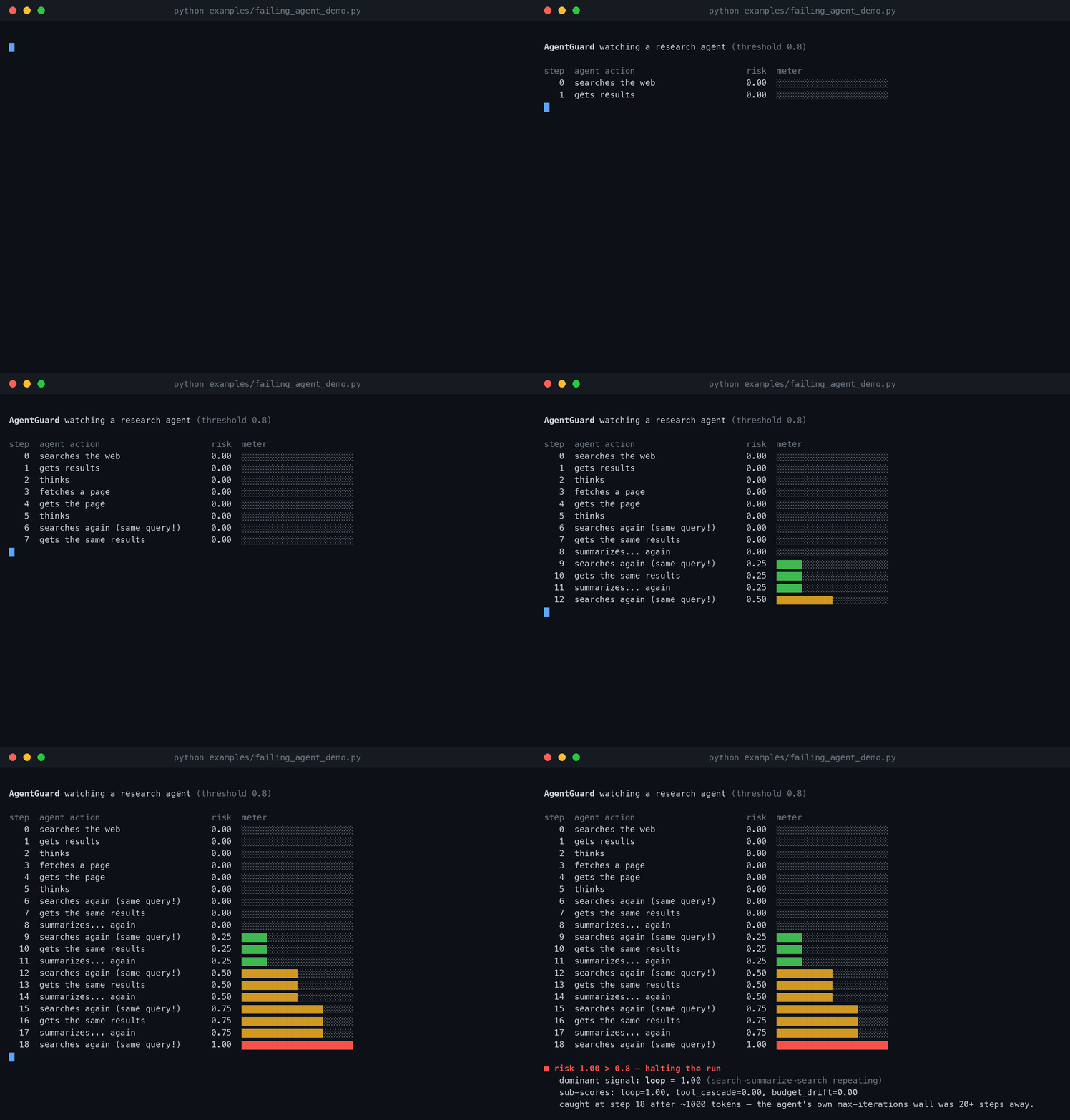
| what | in one line | try it |
|---|---|---|
| 8-line API | wrap any agent loop, read w.risk, propose an intervention | python examples/failing_agent_demo.py |
| 9 predictors | loops, error cascades, budget blowout, semantic/goal drift, RAG drift, hallucination precursors, prompt injection, a learned model | — |
| RAG guarding | re-retrieval loops + groundedness, scored live | python examples/rag_failing_demo.py |
| Multi-agent | cascade prediction across an agent team; LangGraph adapter | python examples/multiagent_demo.py |
| Backtest | replay your traces: catch rate, lead time, false alarms | agentguard replay --demo |
| Real-trace benchmark | honest numbers on 300 real SWE-agent runs | python benchmarks/swe_agent_bench.py |
| Live sidecar | OTLP/OpenInference ingest + live risk dashboard | agentguard serve |
| Policies | rules → interventions → Slack/webhook escalation | — |
| Claude Code hook | hold a looping coding session for confirmation | agentguard hook |
| MCP server | any MCP-capable agent can self-monitor | agentguard mcp |
| Failure memory | RAG over past failures: explain alarms, cluster failure modes | — |
AgentGuard is a direct re-targeting of my published failure-prediction work, [ProactiveGuard: Deep Learning-Based Predictive Failure Detection for Distributed Consensus Systems] — same thesis, new domain.
ProactiveGuard's finding was that consensus-node failures don't happen out of nowhere: they are preceded by observable degradation (rising WAL-fsync latency, climbing heartbeat latency), and a model trained on those precursors can flag a node before it fails, cutting per-failure downtime by 86.7% via graceful leader handoff.
LLM agent runs degrade the same way. The failure precursors just have different names:
| ProactiveGuard (consensus nodes) | AgentGuard (agent runs) |
|---|---|
| WAL fsync latency rising | tool-error rate rising |
| heartbeat latency climbing | step latency / token velocity climbing |
| leader-election churn | repeated tool-call cycles (loops) |
| log-replication lag | semantic drift — the run stops making progress |
| reactive timeout detectors | reactive trace viewers |
| predict → graceful handoff | predict → halt / reset / escalate / downgrade |
The learned risk model here is a port of the ProactiveGuard architecture, not a
lookalike: the same learnable per-feature attention gate, residual connections,
focal loss -(1-p_t)² log(p_t) for the rare-failure class imbalance, and the
same ensemble (five bagged attention-MLPs + a Random Forest at double weight).
pip install agentguard-predict                 # zero-dependency core
pip install "agentguard-predict[langchain]"    # + LangChain callback adapter
pip install "agentguard-predict[embeddings]"   # + sentence-transformers drift detection
pip install "agentguard-predict[memory]"       # + Chroma-backed failure memory
pip install "agentguard-predict[model]"        # + the learned risk model (numpy/sklearn)
pip install "agentguard-predict[mcp]"          # + the MCP server
The distribution is agentguard-predict (the bare name is squatted on PyPI);
the import is still import agentguard.
from agentguard import Guard

guard = Guard(predictors=["loop", "tool_cascade", "budget_drift", "semantic_drift"])

with guard.watch() as w:
    for step in my_agent_loop():        # ANY agent — raw, LangChain, LlamaIndex
        w.record(step)                  # dict or Step; normalized internally
        if w.risk > 0.8:
            w.intervene("halt")         # stop before wasting 20 more steps / $30
w.record accepts a plain dict ({"kind": "tool_call", "name": "search", "content": {...}}) or a Step. w.risk is the current calibrated 0–1 risk;
w.subscores breaks it down per predictor for explainability. w.intervene
proposes — it logs and returns an Intervention; your app owns the control
flow.
Try it now, no keys, no services:
python examples/failing_agent_demo.py
| predictor | type | what it catches |
|---|---|---|
loop | deterministic | repeated tool calls with near-identical args; search→summarize→search cycles; the same LLM output recurring |
tool_cascade | deterministic | tool errors clustering (one error is noise, three in five steps is a cascade) |
budget_drift | deterministic | token velocity blowing past the run's own early baseline |
semantic_drift | embeddings | the run stalling (restating itself) or oscillating (A→B→A) in embedding space instead of progressing |
retrieval_drift | embeddings (RAG) | re-retrieval loops (same chunks again and again) and retrieval starvation (query→chunk relevance decaying) |
grounding_gap | embeddings (RAG) | LLM outputs drifting away from the retrieved context — a hallucination precursor, scored live |
goal_drift | embeddings | outputs wandering away from the stated goal (guard.watch(goal="...")) |
injection | deterministic | context poisoning: instruction-shaped payloads arriving in tool results and retrieved chunks ("ignore previous instructions...") — with a named-pattern audit trail |
model | learned | the ported ProactiveGuard ensemble fusing all sub-signals into one risk |
Sub-scores are fused with a weighted noisy-OR (one strong signal dominates;
several weak signals compound) and can be calibrated to a real probability with
split-conformal calibration (ConformalCalibrator) — a risk score is only as
trustworthy as its calibration.
pip install "agentguard-predict[model]"
python -m agentguard.train        # bootstrap on labeled synthetic scenario runs
guard = Guard(predictors=["model"], threshold=0.8)
Training mirrors the ProactiveGuard bootstrap: generate scenario runs
(healthy / loop / cascade / budget-blowout) with gradual failure onset, label
each step healthy → degraded → failing by distance-to-failure, train the
ensemble on windowed features. A pre-trained model ships with the package;
retrain on your own traced runs by swapping generate_runs.
The attention gate is inspectable — ask the model what it found predictive:
learned feature attention (top 6):
  loop_slope             0.515
  budget_drift_max       0.513
  error_rate             0.512
(In the paper, the analogous top features were WAL-fsync and heartbeat latency.)
RAG agents fail in their own ways, all observable in embedding space while
the run is live. Emit a RETRIEVAL step (or let the LangChain adapter's
retriever hooks do it) and two predictors watch it:
from agentguard import Guard
from agentguard.adapters.raw import retrieval, llm_output

guard = Guard(predictors=["retrieval_drift", "grounding_gap"])
with guard.watch() as w:
    w.record(retrieval(query, chunks))       # what the vector store returned
    w.record(llm_output(answer, tokens=n))   # graded against those sources
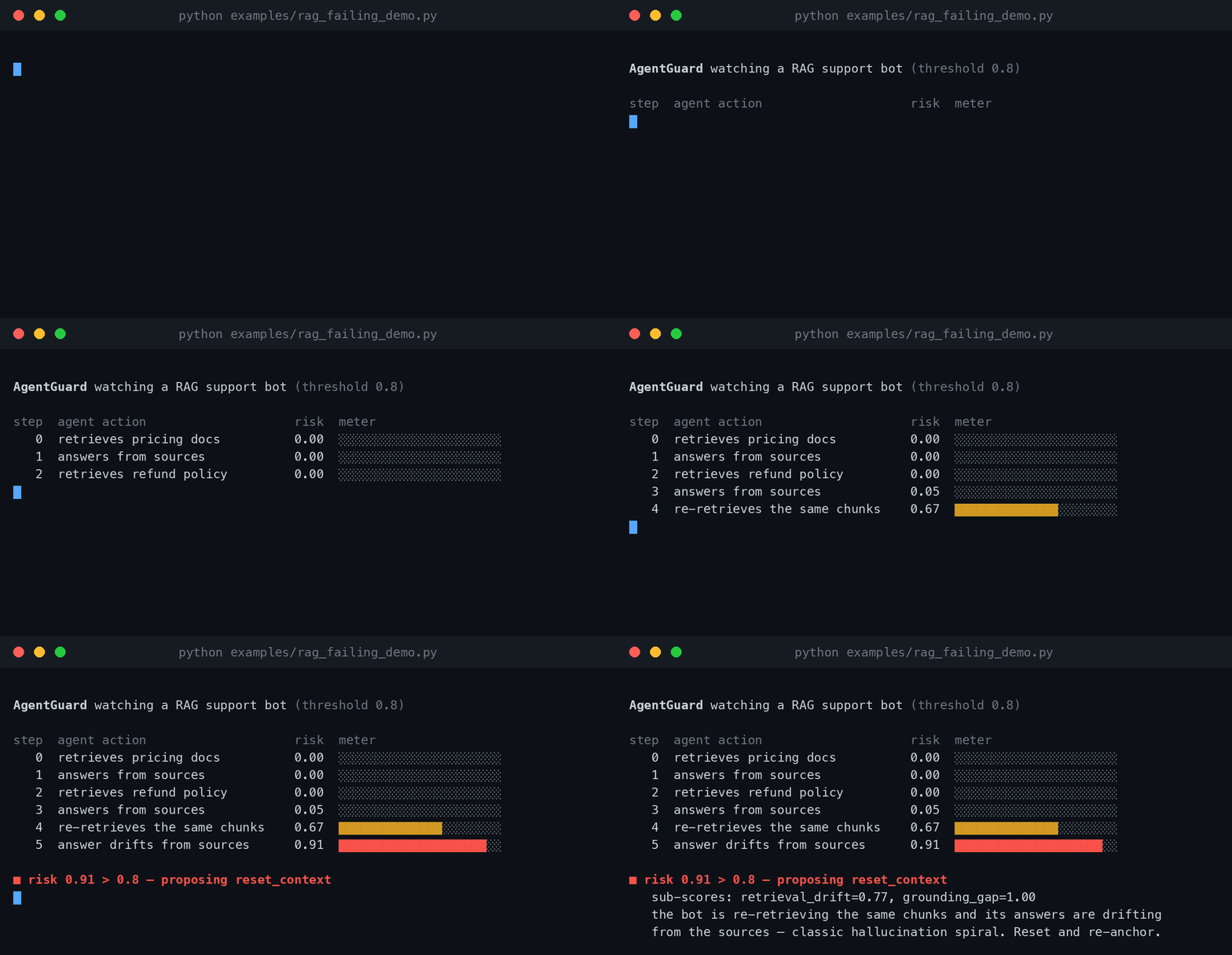
grounding_gap is groundedness made predictive: instead of a post-hoc
eval score, the gap between outputs and retrieved context is tracked
against the run's own best grounding, so the hallucination spiral is
flagged while a reset_context can still save the run. See it happen:
python examples/rag_failing_demo.py
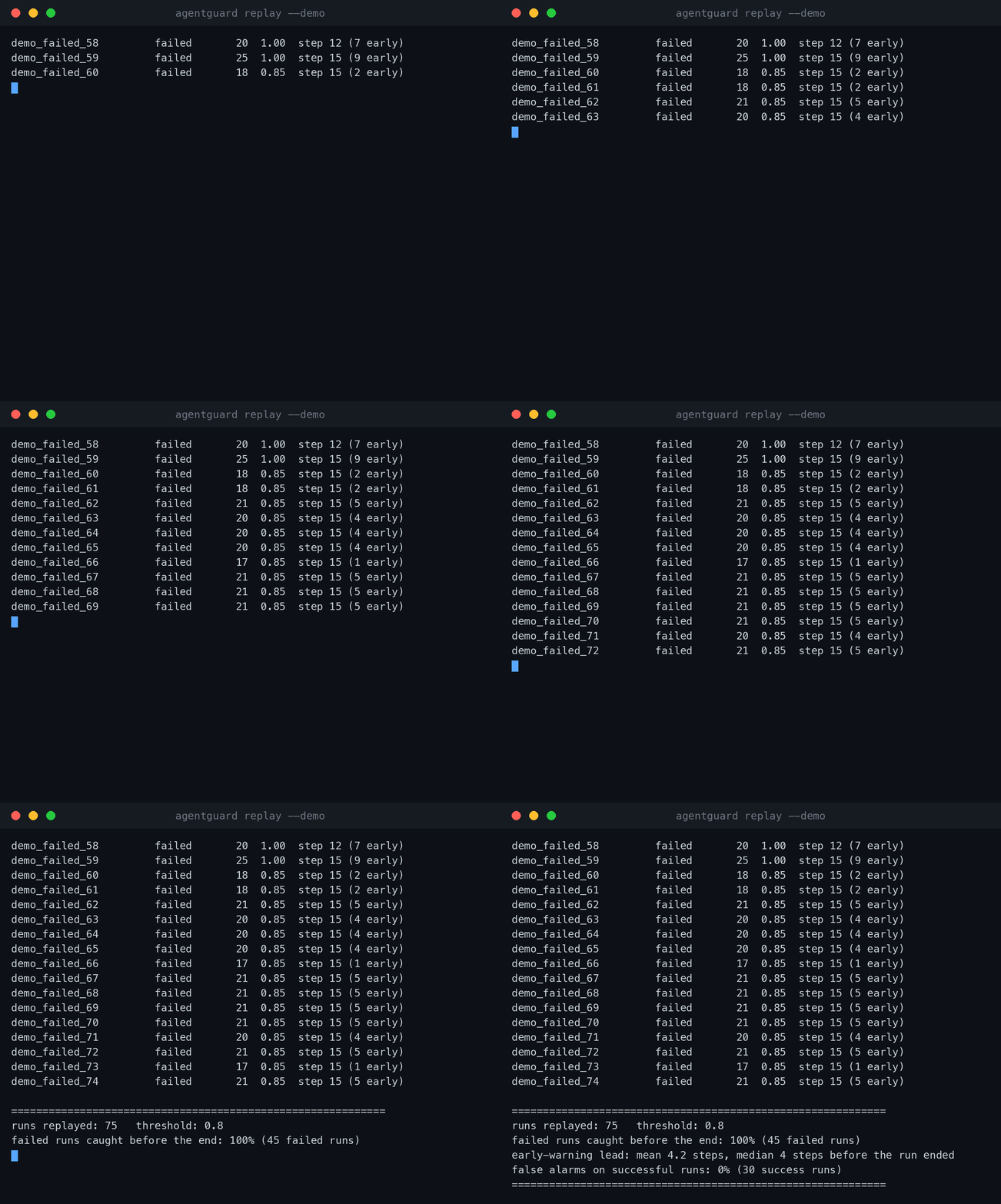
agentguard replay traces.jsonl        # your exported runs (JSONL, see below)
agentguard replay --demo              # synthesized runs, no file needed
Replays historical runs through the predictors and reports the numbers that sell prediction — the same early-warning metrics as the ProactiveGuard paper:
Trace format is one JSON object per line — steps plus optional outcome
lines ({"run_id": "r1", "outcome": "failed"}); anything you can't export
simply doesn't contribute. Use --json for machine-readable output and
--predictors/--threshold to test configurations against history before
changing production.
from agentguard import Guard
from agentguard.adapters.langchain import AgentGuardCallback, AgentGuardHalt

handler = AgentGuardCallback(Guard(), auto_intervene="halt")

try:
    agent.invoke({"input": "..."}, config={"callbacks": [handler]})
except AgentGuardHalt as halt:
    print(halt.watcher.subscores)   # why it was stopped
Every on_tool_start/end/error and on_llm_end becomes a Step — nothing else
about your agent changes. python examples/langchain_demo.py runs a real
LangChain tool-calling loop (scripted fake model, so it's keyless) and shows
AgentGuard stopping it 11 turns before the agent's own iteration cap.
Synthetic backtests are easy; here are the numbers on 300 real SWE-agent runs (nebius/SWE-agent-trajectories), deterministic predictors only, threshold 0.8:
| flagged | false alarms | |
|---|---|---|
runs that died of budget/context exhaustion (exit_cost/exit_context) | 41%, mean 74 steps before the end | — |
| resolved (successful) runs | — | 12% |
At threshold 0.6 that trade is 56% / 18%. A run that submits a clean but
wrong patch mid-flight often looks healthy — AgentGuard predicts
dysfunction, not correctness, and the report says so explicitly. Full
methodology, threshold sweep and caveats: benchmarks/RESULTS.md
(reproduce with python benchmarks/swe_agent_bench.py).
Write the host's decision down once, instead of hand-rolling threshold checks in every loop:
from agentguard.policy import Policy, Rule, SlackWebhook

policy = Policy(
    rules=[
        Rule(signal="loop", threshold=0.8, action="reset_context"),
        Rule(signal="budget_drift", threshold=0.7, sustain=3, action="downgrade"),
        Rule(threshold=0.9, action="escalate"),        # fused risk, any cause
    ],
    notifiers=[SlackWebhook("https://hooks.slack.com/services/...")],
)
guard = Guard(predictors=[...], on_step=policy)
Triggered rules record an Intervention on the run and notify (Slack or
any JSON webhook — payload includes sub-scores and the similar past
failures from the failure memory). Enforcement still belongs to your
loop; notifiers never raise into the run.
Multi-agent failures cascade: a researcher loops, hands garbage to the
writer, the supervisor burns budget retrying both. MultiGuard watches
the team the way ProactiveGuard watched a cluster — per-agent watchers
plus contagion along the data-flow edges you declare:
from agentguard import MultiGuard

mg = MultiGuard(predictors=["loop", "tool_cascade", "budget_drift"])
mg.add_edge("researcher", "writer")     # researcher's output feeds the writer

mg.record("researcher", step)
mg.effective_risk("writer")   # own risk + attenuated worst-upstream risk
mg.system_risk                # P(at least one agent takes the run down)
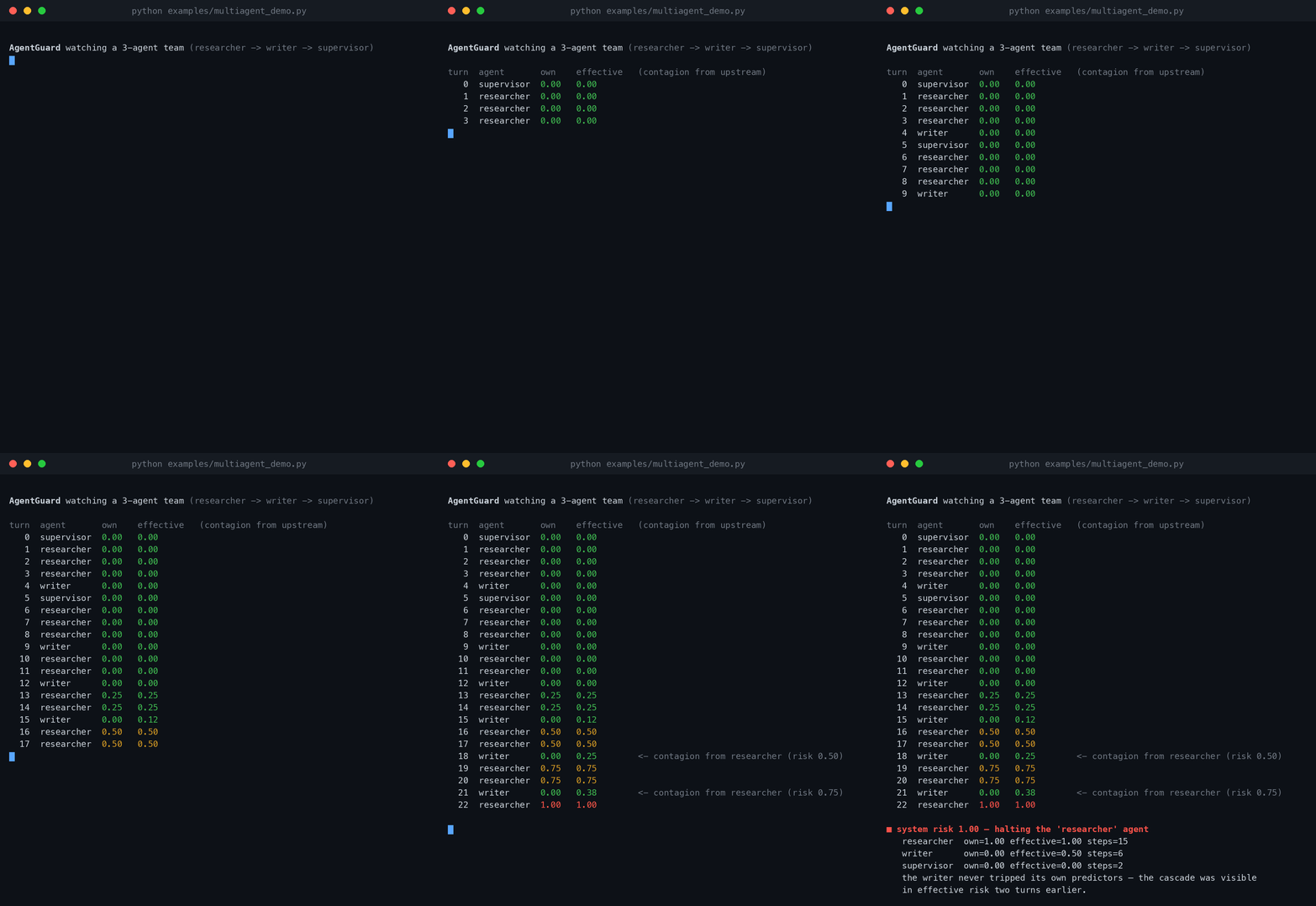
The writer never trips its own predictors — but its effective risk climbs turns before the failure surfaces, because its input comes from an agent at risk 0.9. The cluster-level view, kept.
For LangGraph, one callback routes every event to the right per-node
watcher via the langgraph_node metadata LangGraph already stamps:
from agentguard.adapters.langgraph import MultiAgentCallback

handler = MultiAgentCallback(mg, auto_intervene="halt")
graph.invoke(state, config={"callbacks": [handler]})
agentguard serve # dashboard at http://127.0.0.1:4318/
Point your existing instrumentation at it — no agent code changes:
POST /v1/traces. LLM / TOOL / RETRIEVER spans
become Steps; runs are keyed by trace id.POST /ingest {"run_id": "...", "step": {...}} from anywhere.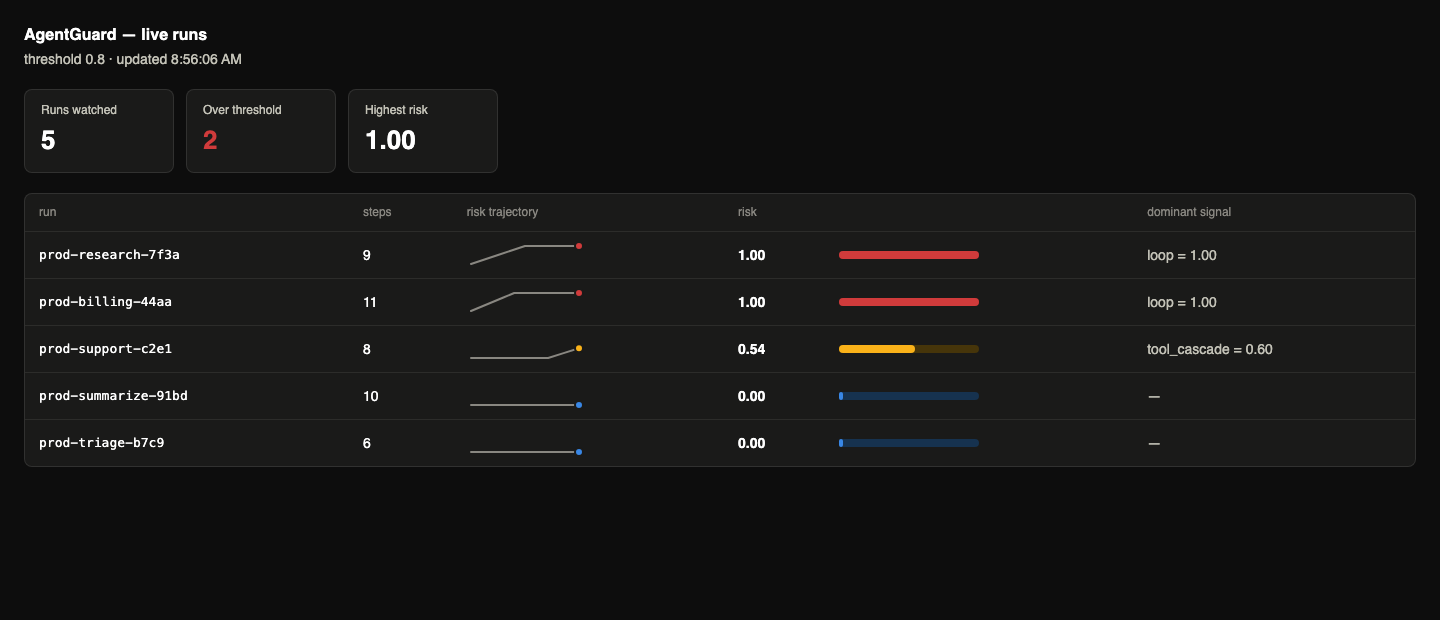
Every concurrent run with its risk trajectory sparkline, a severity
meter, and the dominant signal — the reactive-tools view, made
predictive. GET /runs serves the same state as JSON for your own
alerting.
AgentGuard ships as a Claude Code hook — a coding session that starts
looping on the same failing command gets held for confirmation instead of
burning the afternoon. In .claude/settings.json:
{
  "hooks": {
    "PreToolUse":  [{"matcher": "*", "hooks": [{"type": "command", "command": "agentguard hook"}]}],
    "PostToolUse": [{"matcher": "*", "hooks": [{"type": "command", "command": "agentguard hook"}]}]
  }
}
At the risk threshold the hook answers with a permission "ask" — the human decides, with the sub-scores as the reason. Same discipline, new host.
pip install "agentguard-predict[mcp]"
claude mcp add agentguard -- agentguard mcp
Exposes start_run / record_step / get_risk / explain_run /
end_run over MCP, so any MCP-capable agent can stream its own steps in
and read its risk back — and explain_run retrieves similar past
failures from the server's failure memory across runs.
from agentguard.memory import FailureMemory

guard = Guard(memory=FailureMemory())   # in-memory store; Chroma via [memory]

# ... failed runs get stored on close; on the next risky run:
for match in watcher.explain(k=3):
    print(f"{match['similarity']:.2f}  {match['summary']}")
# 0.94  dominant signal loop; loop=1.00 ...; tool tail: search -> summarize -> search
Failure signatures (sub-score trajectory + tool-sequence tail) are embedded into a vector store; a new high-risk run retrieves its nearest past failures so the alert reads "this looks like the 14 past runs that looped on search→summarize→search" — retrieval-augmented explanation.
Retrieval is hybrid by default: dense signature-text embeddings, a
trajectory embedding of the sub-score time series (so a slow-ramp loop
matches other slow-ramp loops by shape), and keyword overlap, fused with
reciprocal-rank fusion. Pick one with mode="dense" | "trajectory" | "keyword".
Once enough failures accumulate, cluster them into a taxonomy:
for cluster in memory.taxonomy():
    print(f"{cluster['size']} runs — {cluster['exemplar']}")
# 14 runs — dominant signal loop; loop=1.00 ...; tool tail: search -> summarize -> search
#  6 runs — dominant signal tool_cascade; ...; tool tail: fetch -> fetch -> fetch
Pure-python k-means over trajectory embeddings, k chosen by silhouette — your agent's failure modes, named and counted.
python -m unittest discover -s tests   # core tests need nothing but Python
pip install -e . numpy scikit-learn langchain-core mcp   # full suite + demos
CI runs the no-dependency matrix (3.9 / 3.11 / 3.13) plus a full-extras job that executes every demo end-to-end. MIT licensed.
Download counts and popularity will appear here as the collector receives them.
| Version | Published | Direct dependencies | Open version |
|---|---|---|---|
| 0.4.1 | 11 Jul 2026 | 6 |
This describes our collected data; it is not a security assessment.
Observed since 20 Oct, 22:06 UTC
No superseded metadata states collected. Unchanged observations do not create new revisions.
package:809976e709200ff01cb0cf36e191787a6937da331f2d7ecc7e6802184476e88f