

 Repository
Current collected state Current
Observed since 20 Oct, 22:09 UTC
No superseded metadata states collected. Unchanged observations do not create new revisions.
A runtime governance layer that enforces hard behavioral bounds in autonomous agents.
A Rigorous Engineering Kernel for Bounded Autonomous Agents


A deterministic runtime governance engine that enforces bounded, auditable execution for autonomous AI agents.
Agent-Harness is a deterministic governance runtime that acts as a non-bypassable Runtime Execution Firewall between an agent's reasoning loop and real-world execution surfaces. It translates environmental feedback (risk, effort, stagnation) into strict mathematical execution budgets. When an agent exceeds its bounds, the Harness forcibly terminates execution.
Autonomous agents rely on "soft" boundaries (prompt engineering, RLHF). Under sustained failure or adversarial conditions, agents ignore these and enter unbounded loops. Agent-Harness replaces soft boundaries with a runtime execution firewall that dynamically tracks Effort, Exploration, and Risk. Once budgets deplete, permission to execute always collapses.
Most AI safety solutions are probabilistic (LLM validation) or stateless (regex). Agent-Harness introduces Stateful Determinism—enforcing physical runtime bounds that an agent cannot reason its way out of.
| Feature / Risk | Without Agent-Harness | With Agent-Harness |
|---|---|---|
| Runaway Loops | Infinite token burn & cost | Deterministically halted via STAGNATION |
| Prompt Injection | Agent goal hijacking | Blocked via GuardrailStack |
| Malicious Code | Direct os.system execution | Intercepted & session terminated |
| Cost Control | Manual monitoring | Hard-capped effort & risk budgets |
| Auditability | Opaque/Manual logs | SHA256 hash-chained JSONL traces |
| Safety Logic | Hardcoded in prompts (soft) | Enforced by external kernel (hard) |
| Capability | Agent-Harness | NeMo Guardrails | Llama Guard | Guardrails AI | LangChain Limits |
|---|---|---|---|---|---|
| Stops a runaway agent mid-loop | ✅ | ❌ | ❌ | ❌ | ⚠️ max_iterations only |
| Agent cannot bypass it | ✅ External sidecar | ⚠️ In-app | ⚠️ Wrapper | ❌ In-process | ❌ In-framework |
| Detects stagnation (busy ≠ productive) | ✅ Signal-based | ❌ | ❌ | ❌ | ❌ |
| Blocks dangerous tool calls before execution | ✅ Guardrail stack | ⚠️ Dialog-level | ❌ Text only | ✅ Validators | ❌ |
| Works without an LLM in the safety path | ✅ Pure math | ❌ Uses LLM | ❌ Is an LLM | ⚠️ Some regex | ✅ |
| Cryptographic audit trail | ✅ SHA256 chain | ❌ | ❌ | ❌ | ❌ |
| Multi-agent budget coordination | ✅ SharedBudgetPool | ❌ | ❌ | ❌ | ❌ |
| Same input → same decision, always | ✅ Deterministic | ❌ Probabilistic | ❌ Probabilistic | ⚠️ Heuristic | ✅ Static |
| Works across any LLM vendor | ✅ | ⚠️ NVIDIA stack | ⚠️ Meta models | ✅ | ⚠️ LangChain only |
Key difference: Other systems ask "is this output safe?" — Agent-Harness asks "should this agent still be allowed to act?"
1. Prevent Runaway Loops — Agents frequently retry failing tools indefinitely. Agent-Harness detects stagnation (zero reward across steps) and halts execution deterministically via FailureType.STAGNATION.
2. Bound LLM API Costs — Effort budgets drain faster when the agent fails to produce real environment progress, preventing token burn from "reasoning theater" (verbose monologue with zero action).
3. Secure Tool Execution — Every tool call passes through GuardrailStack before execution, blocking dangerous code patterns (os.system(), exec(), PII leakage). The dangerous call never reaches the execution surface.
4. Multi-Agent Stability — SharedBudgetPool and CascadeDetector enforce global budget limits across swarms, preventing cascading agent spawn failures.
5. Compliance Audit Trails — SHA256 hash-chained JSONL logs provide tamper-evident, non-repudiable decision history for regulated environments (finance, healthcare, enterprise).
Agent-Harness uses deterministic budget math to guarantee bounded execution without LLM inference.
Install the lightweight engine via pip to integrate governance into your Python logic:
# Install via pip
pip install agentharnessengine

# Or install from source
git clone https://github.com/Sarthaksahu777/Agent-Harness
cd Agent-Harness
pip install -e .
Deploy a non-root, multi-stage optimized governance proxy in seconds. This is the recommended method for production environments to ensure non-bypassable enforcement:
# Start the Governance Proxy + Metrics Stack
docker-compose -f deployment/docker-compose.yml up -d

# Check health
curl http://localhost:8080/health
The proxy exposes port 8080 (Production) and 8081 (Dev/Hot-reload).
A minimal, framework-free implementation of the engine checking a basic step progression:
from governance.kernel import GovernanceKernel
from governance.profiles import BALANCED

# 1. Initialize the Kernel with a standard behavioral profile
kernel = GovernanceKernel(profile=BALANCED)

# 2. Simulate environmental signals on an agent step
result = kernel.step(reward=0.6, novelty=0.1, urgency=0.0)

if result.halted:
    print(f"TERMINATED: {result.failure}")
else:
    print(f"ALLOWED. Remaining Effort: {result.budget.effort:.2f}")
Agent-Harness intercepts execution across three distinct, modular layers. It strictly separates the "Mind" (Agent Reasoning) from the "Body" (Tool Execution).
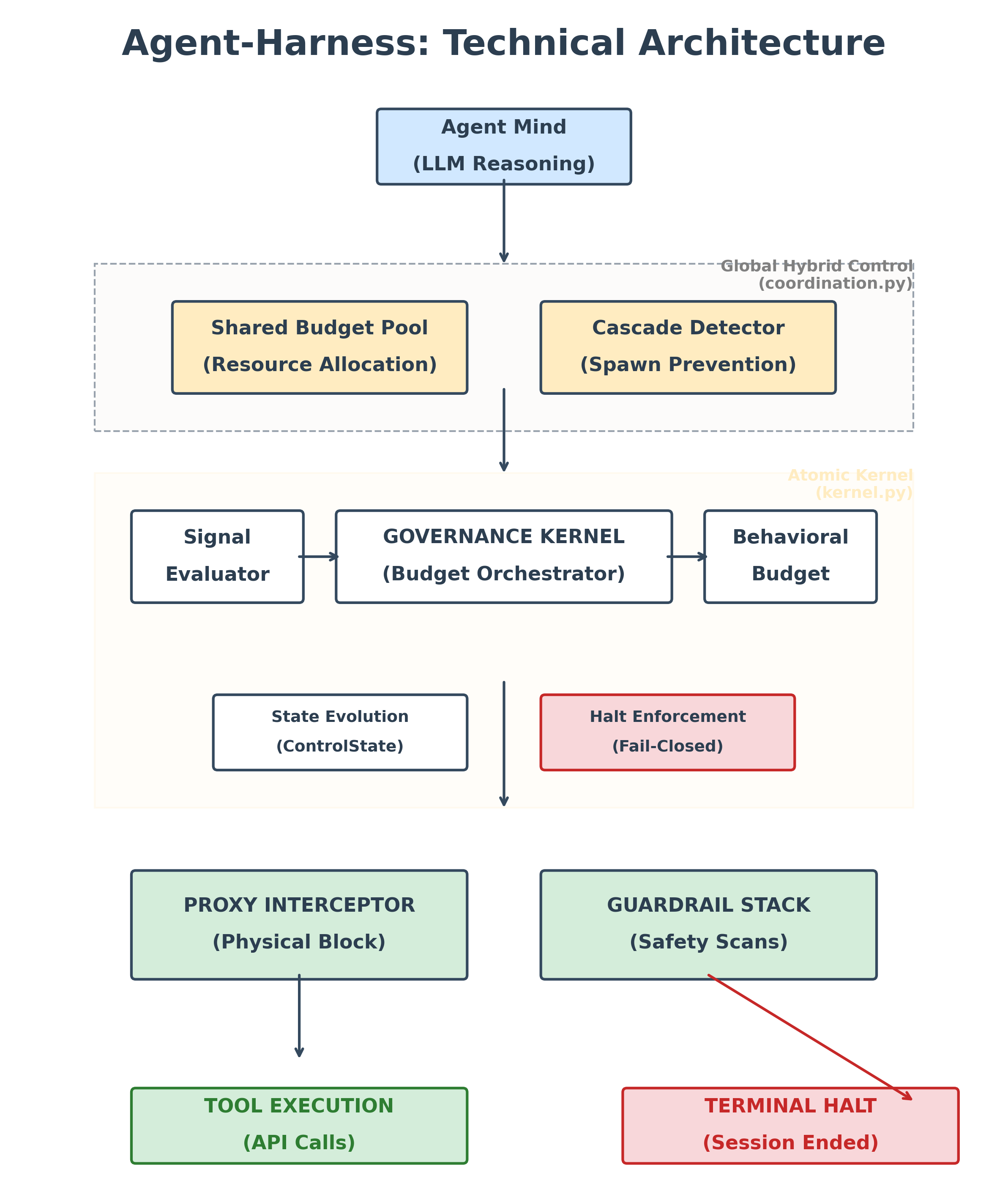
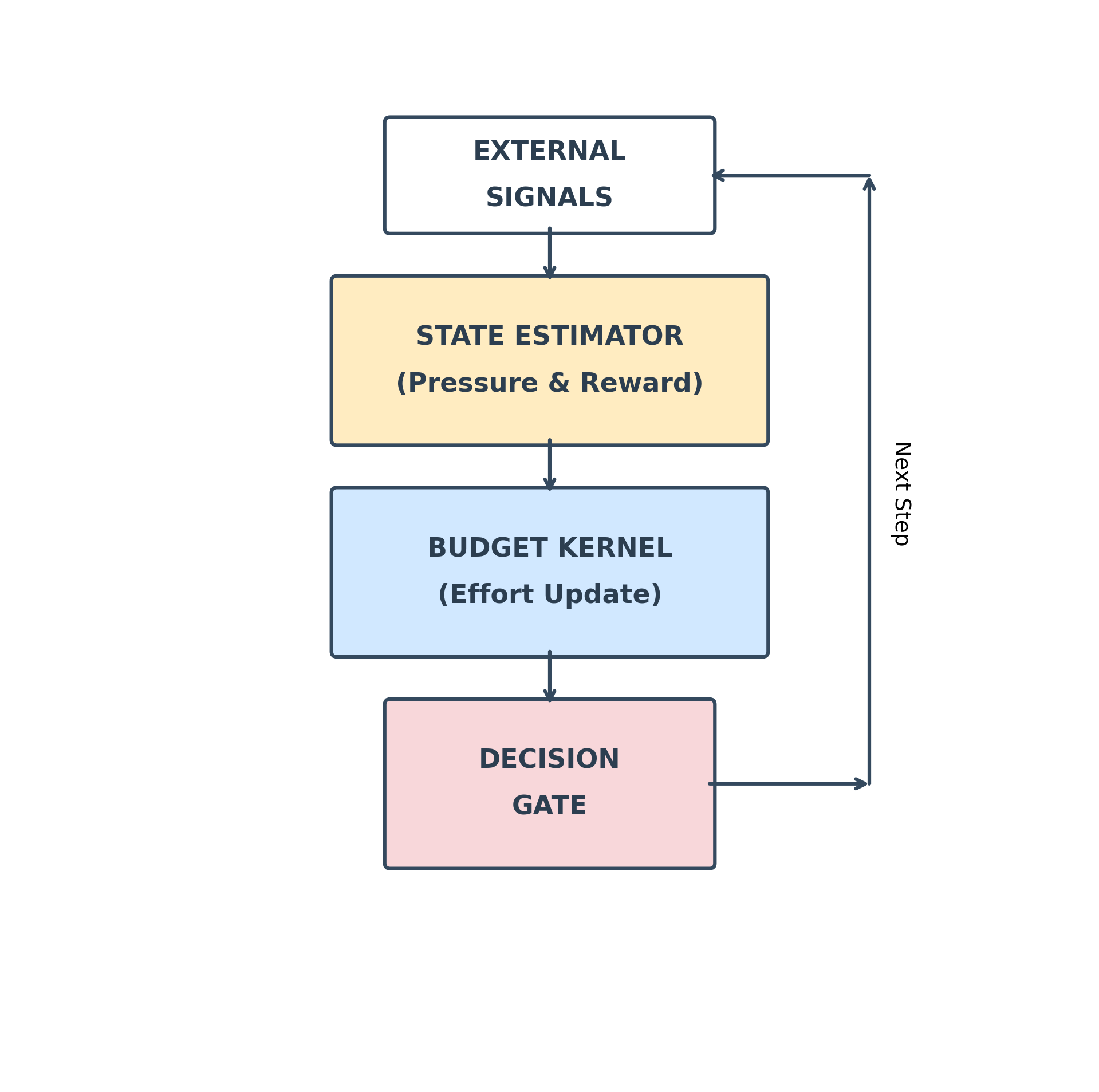
Every tool call goes through a deterministic processing flow before execution:
ALLOW or HALT.The internal kernel state update algorithm ensures that no action is taken without a fresh budget calculation.
Here is how the Agent-Harness reacts to standard scenarios:
1. Successful Step (Allowed)
[KERNEL] Action: query_database (args: search="Q3 revenue")
[KERNEL] Signals: Reward=0.8, Novelty=0.1, Urgency=0.0
[KERNEL] Status: ALLOWED.
[KERNEL] Remaining Effort: 0.98. Executing tool...
2. Blocked Tool Call (Guardrail Triggered)
[KERNEL] Action: execute_python (args: code="os.system('cat /etc/passwd')")
[GUARDRAIL] Triggered: code_execution
[GUARDRAIL] Reason: Potentially dangerous code pattern detected (matched: \bos\.system\s*\()
[KERNEL] Status: HALTED.
[KERNEL] Result: FailureType.SAFETY (Guardrail violation). Block 403.
3. Halted Agent (Budget Exhausted / Stagnation)
[KERNEL] Action: search_web (args: query="retry 104")
[KERNEL] Signals: Reward=0.0, Difficulty=1.0, Urgency=0.4
[KERNEL] ⚠️ Effort depleted to 0.15.
[KERNEL] Status: HALTED.
[KERNEL] Result: FailureType.EXHAUSTION (effort_exhausted). Session terminated.
Based on the src/governance/ module structure, the repository is composed of several critical files:
kernel.py (GovernanceKernel): The central state machine. Deterministic orchestrator that receives signals, evaluates budgets, and enforces terminal halt conditions based on progress accumulation.guardrails.py (GuardrailStack): Pluggable security detectors that intercept and block dangerous payloads.audit.py (HashChainedAuditLogger): Records a cryptographically immutable JSONL log of every system decision.evaluation.py (SignalEvaluator): Normalizes external semantic signals before integrating them into the core control state.profiles.py & behavior.py: Defines agent temperament patterns (e.g., BALANCED, CONSERVATIVE).Agent-Harness natively implements the 15-Point AI Governance Checklist via deterministic runtime execution mechanisms:
| Governance Rule | Enforcement Mechanism |
|---|---|
| 1. Unbounded Behavior (Prevent infinite loops) | Finite effort and persistence budgets deplete with action. Zero budget = Terminal Halt. |
| 2. Runtime Control (Intervene during execution) | Dynamic step() evaluates signals at runtime (Hz) and updates control state immediately. |
| 3. Deterministic Behavior (Same inputs → Same decision) | State transitions use hardcoded, versioned matrices. No random seeds exist in the Kernel. |
| 4. Explainable Halting (Explicit halt reasons) | Halts return explicit FailureType flags (e.g., OVERRISK, STAGNATION) and precise string reasons. |
| 5. Fail-Closed Semantics (Default to block) | Once halted, state freezes permanently. Proxy middleware returns 403 on any error. |
| 6. Physical Enforcement (Physically block actions) | ProxyEnforcer intercepts all tool calls at the network level, forcing halts. |
| 7. Auditability (Log every decision) | Hash-chained SHA256-linked entries in append-only JSONL files. CLI verification utility provided. |
| 8. Accountability (Who authorized this?) | Multi-agent coordination mechanisms track agent_id and parentage for every logged action. |
| 9. Risk Containment (Bound risky actions) | Dedicated risk budget accumulator. Hard caps trigger an immediate terminal halt. |
| 10. Progress Discrimination (Busy ≠ Productive) | Stagnation detection windows identify and halt cycles of low-reward, busy-work activity. |
| 11. Bad Telemetry Resilience (If sensors lie, slow down) | trust signal dampens positive feedback (reward) but correctly passes negative feedback (difficulty). |
| 12. Model-Agnosticism (Work across vendors) | The Kernel consumes dimensional Signals (floats), completely independent of the LLM or embeddings used. |
| 13. Human Override (Humans remain authority) | The reset() method requires explicit calls. There is no autonomous self-healing from terminal failures. |
| 14. Compliance Readiness (Support reporting) | Hash-chained JSONL trace exports. Prometheus metrics natively broadcast at /metrics. |
| 15. Scalability (Scale across multiple agents) | SystemGovernor and SharedBudgetPool manage swarms globally to prevent cascading swarm failures. |
Behavioral budgets (effort, persistence) are strictly bounded and monotonically depleting. Under sustained failure, the budget inevitably crosses the exhaustion threshold, forcing a terminal halt.
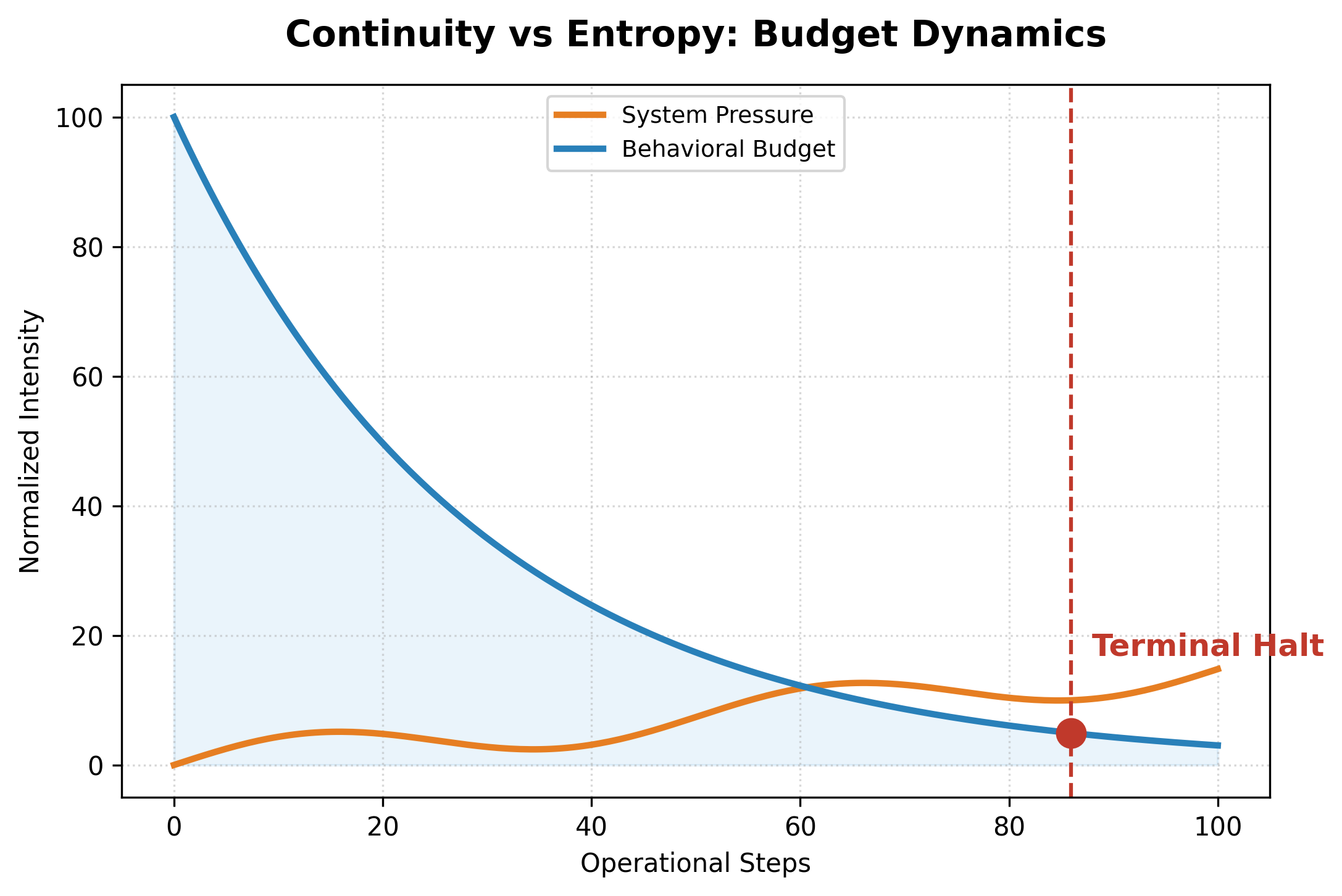
| Failure | Trigger | Consequence |
|---|---|---|
| EXHAUSTION | Effort drops below threshold | Terminal halt |
| STAGNATION | Zero reward beyond stagnation window | Terminal halt |
| OVERRISK | Risk exceeds maximum limit | Immediate 403 |
| SAFETY | Exploration capacity exceeded | Session severed |
| EXTERNAL | Hard step fuse limit reached | Instant halt |
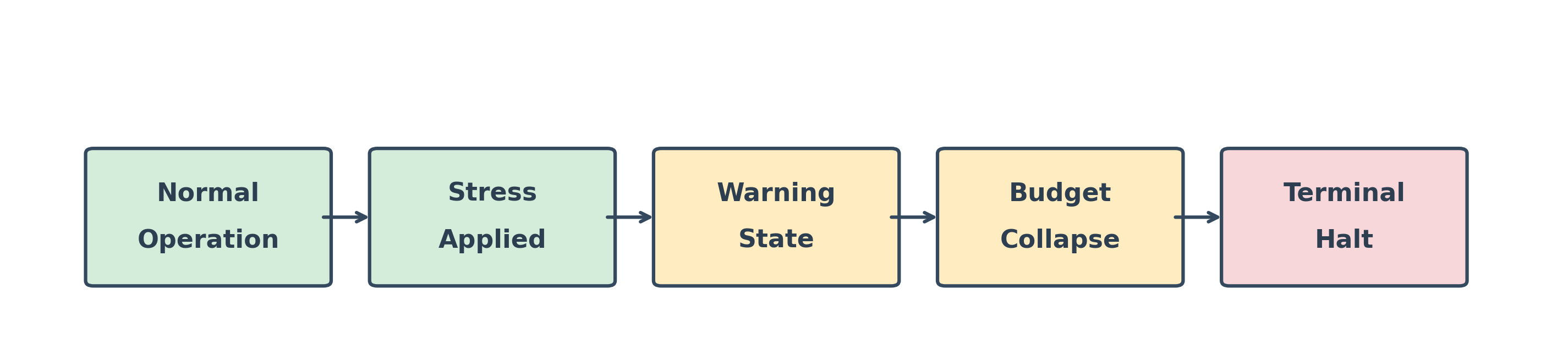
State transitions: Healthy → Warning (low ROI) → Critical (near boundary) → Terminal Halt (EXHAUSTION, STAGNATION, OVERRISK). A 403 permanently ends the session.
The Harness detects native abstractions across common LLM agent frameworks and enforces boundaries transparently. Working wrapper examples are located in integrations/:
AgentExecutor loops (langchain_ollama.py, langchain_openai.py).crewai_ollama.py, crewai_openai.py).UserProxyAgent conversations (autogen_ollama.py, autogen_openai.py).openai_sdk.py, openai_sdk_ollama.py).Agent-Harness/
├── src/
│ └── governance/ # Core kernel, budgets, evaluators, mechanisms
├── problems/ # S-class problem sets and benchmarks
├── integrations/ # Connectors for LangChain, AutoGen, CrewAI, OpenAI
├── examples/ # Demonstrations of layered governance and edge cases
├── tests/ # PyTest suites verifying mathematical limits
├── docs/ # Deep dives and visual assets
├── deployment/ # Docker, Compose, and Dashboards
├── scripts/ # Utility and maintenance scripts
└── config/ # YAML configuration bindings
Agent-Harness is designed for high-frequency runtime interception with near-zero overhead. Values below are from a real benchmark of 10,000 kernel.step() calls on commodity hardware.
| Metric | Value | Notes |
|---|---|---|
| Step Latency (Median) | ~0.06ms | Full kernel evaluation (signal processing + budget update). |
| Step Latency (P99) | ~0.23ms | Worst-case tail latency under sustained load. |
| Guardrail Check (Median) | ~0.07ms | Full GuardrailStack.check_all() with 3 detectors. |
| Throughput | ~13k step()/sec | Single-threaded on standard hardware. |
| Memory (Kernel Delta) | ~2 KB | Kernel + internal state after 100 steps (excludes Python runtime). |
Native anti-gaming logic in extractor.py:
env_state_delta hasn't moved.# Live terminal dashboard
python -m governance.visualizer
# Prometheus metrics export
curl http://localhost:8080/metrics
# Verify audit chain integrity
python scripts/replay_audit.py verify audit_chain.jsonl
FailureType flags and physical session termination. No auto-recovery—humans must explicitly reset().GuardrailStack catches malicious patterns via regex without LLM inference.ControlState except through deterministic evaluator signals.Agent-Harness enforces bounded execution. It is designed with a specific threat landscape in mind.
What it PROTECTS against:
os.system(), exec()) when they shouldn't.What it DOES NOT protect against:
Agent-Harness is validated against extreme operational conditions to ensure zero-bypass governance:
monte_carlo_stress.py) that executes 12,000 randomized trajectories per run to verify that governance invariants hold under chaotic conditions.GuardrailStack against known prompt injection, PII leakage, and dangerous code patterns (regex-based detection).SharedBudgetPool and CascadeDetector tests.PromptInjectionDetector, PIIDetector, and CodeExecutionGuard use hardcoded regex strategies. They may raise false positives on highly contextual payloads or miss deeply obfuscated attacks.reward, novelty) provided by the broader orchestrator. If the orchestrator feeds "fake" rewards, the Engine cannot know it is hallucinating.kernel.reset()) conservatively.The Agent-Harness roadmap focuses on broadening the scope of autonomous safety. Key research directions include:
CONSERVATIVE and AGGRESSIVE profiles based on historical session hashes.For a full list of documentation and research papers, see the Master Index.
Download counts and popularity will appear here as the collector receives them.
| Version | Published | Direct dependencies | Open version |
|---|---|---|---|
| 1.2.0 | 14 Mar 2026 | 12 |
This describes our collected data; it is not a security assessment.
Shared repository data · GitHub
Observed since 20 Oct, 22:09 UTC
No superseded metadata states collected. Unchanged observations do not create new revisions.
package:6b9e05e40afc2f2a007e29a5957d6bde9e19b2f5f5deab9619c39ffe7e91747e