
 Repository
Current collected state Current
Observed since 20 Oct, 22:15 UTC
No superseded metadata states collected. Unchanged observations do not create new revisions.
Turn an LLM into a gated, sandboxed, resumable construction loop over your codebase.
Turn an LLM into a gated, sandboxed, resumable construction loop over your codebase.
Describe your pipeline in one YAML file — agent steps, mechanical test gates, and
trusted actions — and agentic-dev-loop runs it end to end: agent and command steps get
kernel-level sandboxing via Docker, verdicts route the graph, every boundary is
checkpointed, and nothing gets committed until every gate passes.
flowchart LR
    dev["agent: dev"] --> test{{"test gate"}} --> review["agent: review"] --> qa["agent: qa"] --> commit["action: commit"]
    test -- fail --> dev
    review -- fail --> dev
    qa -- fail --> dev
| Feature | What it gives you |
|---|---|
| Stage-gated agent loop | Agents do the work, test stages verify it, and the pipeline only advances when each stage passes its gates — looping back with full context when one fails. |
| Kernel-level sandboxing | Agent work and command stages run isolated from your machine: no network access by default — authors opt specific stages in, no writes outside your workspace. No sandbox available → the run stops instead of degrading. |
| Crash-safe resume | Interrupt a run at any time and pick it up later — finished stages stay finished, and you resume from exactly where it stopped. |
| Live graph visualisation | Follow every run in the browser: stage status, pass/fail verdicts, retry cycles, and live console output as it happens. |
| Extensible | Plug in your own actions, tools, and document loaders to adapt the loop to your projects. |
The fixed policies are the product: fail fast on missing config/secrets, no silent fallbacks, verdicts only from artifacts, bounded retries, per-attempt artifact hygiene, a single clean-worktree-gated commit point, and no default LLM timeout (agent runs are long).
Prerequisites
| Requirement | Detail |
|---|---|
| Python | ≥ 3.12 |
| Docker engine | Engine API ≥ 1.43 (Engine 24). Any compliant engine works — Docker Desktop, OrbStack, Colima, Rancher Desktop, podman docker-compat. On Windows, Linux-containers mode is required. |
| LLM API key | The env var named by your pipeline's api_key_env (e.g. OPENAI_API_KEY) must be set — a missing key fails fast, naming it. |
pip install agentic-dev-loop==1.0.0a3   # pin the current alpha release explicitly
agentic-dev-loop --version
On the first run the engine pulls the digest-pinned dev image
(ghcr.io/lukedawilson/agentic-dev-loop/dev) and verifies its digest — the
supply-chain check refuses to continue on a mismatch. If you're running
pre-publish tooling, point AGENTIC_DEV_LOOP_DEV_IMAGE at your locally built
image. Engine setup, first-run details, the full pipeline.yaml contract, and
troubleshooting for every fail-fast code live in
docs/setup.md.
export OPENAI_API_KEY=...                          # whatever api_key_env names
agentic-dev-loop pipeline.yaml                     # run it
agentic-dev-loop pipeline.yaml --dry-run           # validate first — no LLM, no Docker
agentic-dev-loop pipeline.yaml --resume <thread-id> --max-attempts 5
| Flag | Effect |
|---|---|
--dry-run | Full load-and-validate pass, then print the resolved plan. No LLM, no Docker, no state writes, no API key. Exit 0 on a clean load. |
--resume <thread-id> | Continue the latest checkpoint of a previous run (crash, Ctrl-C, exhaustion) with all accumulated notes intact. |
--max-attempts <n> | Override the pipeline's max_attempts. |
--refresh | Force re-provision of every setup: hook (bypasses the stamp cache). |
--clean-stamps | Delete cached provision stamps and exit. |
--no-viz / --viz-port <port> | Suppress the live graph view / set a preferred port (default 8321; falls back to a free port when busy). |
| extension flags | Document-loader flags (e.g. --plan, --aidlc-unit) appear once the pipeline's extensions are loaded — agentic-dev-loop PIPELINE --help shows them. |
Exit code is 0 on pipeline success, 1 otherwise.
What a run looks like (the shipped self-loop example):
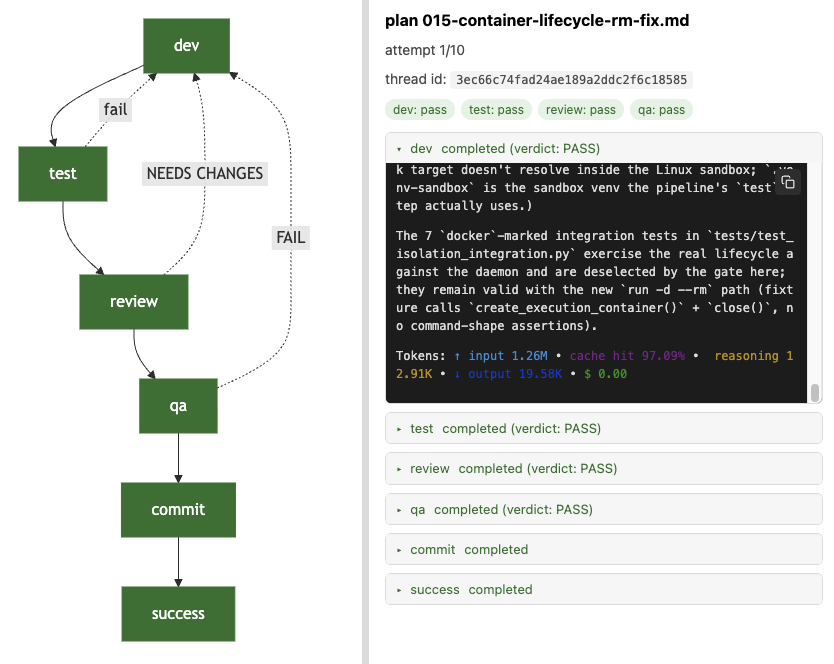
produces: files are hygiene-tracked.dev with the failing output.VERDICT: lines route
the graph. fail rewinds to dev and consumes an attempt.name: my-construction-loop
extensions:
- agentic_dev_loop.extensions.aidlc:AidlcExtension # bundled AI-DLC doc loader
additional_files:
- ../README.md # shared context for every agent step
llm:
model: openai/deepseek-v4-pro
base_url: https://api.deepseek.com
api_key_env: OPENAI_API_KEY
max_attempts: 10 # CLI --max-attempts overrides
agents_dir: sdk_agents # your <name>.agent.md files
steps:
- name: dev
agent: dev
produces: implementation-summary.md
on_pass: test
- name: test
command: .venv-sandbox/bin/python -m pytest tests/ -q -m "not docker"
setup: python -m venv .venv-sandbox && .venv-sandbox/bin/pip install -e ".[dev]"
timeout: 600
on_pass: review
on_fail: { goto: dev, retry: true }
- name: review
agent: review
artifact: review-findings.md
verdicts: { pass: APPROVED, fail: NEEDS CHANGES }
on_pass: qa
on_fail: { goto: dev, retry: true }
- name: qa
agent: qa
artifact: qa-report.md
verdicts: { pass: PASS, fail: FAIL }
on_pass: commit
on_fail: { goto: dev, retry: true }
- name: commit
action: commit
params: { message: "feat: construct {subject} (agent dev loop)" }
| Key | Notes |
|---|---|
agent: / command: / action: | Exactly one per step. Agents live in agents_dir as <name>.agent.md; commands run sandboxed (mechanical, never an LLM call); actions are registered host-side functions. |
produces: / artifact: + verdicts: | Hygiene-tracked outputs vs verdict-parsed routing. The last VERDICT: line wins; stale artifacts are deleted at each attempt start. |
on_pass: / on_fail: | A step name, terminal success/failure, or {goto: X, retry: true}. No loops happen unless you write them. |
env: / setup: / network: | env: declares step vars (fixed safe base + declared vars only); setup: provisions the sandbox (command steps, network ON, stamp-cached); network: true grants egress to a command or agent step (default off) — see Per-stage networking. |
isolation: (optional) | Configures the sandbox — image override, resource caps, allow_git_mutations. It can never disable it. |
state_dir | Defaults to ~/.agentic-dev-loop/runs/<pipeline-hash>/ — artifacts and checkpoints live outside the sandbox mount. |
The sandbox is network-off by default. A step that legitimately needs egress — a QA step that curls a service it booted, an agent that must hit an API or fetch package metadata mid-conversation — declares it explicitly:
steps:
  - name: fetch-docs
    command: curl -fsSL https://example.com/spec.json -o spec.json
    network: true            # egress for this step only
--network none unless it declares
network: true. A networked step runs in a second, otherwise-identical
sandbox container (--read-only, --cap-drop ALL, single workspace mount)
on the Docker bridge network — the default network-none container is always
created too, so no infrastructure work happens mid-run.git clone git@github.com:lukedawilson/agentic-dev-loop.git
cd agentic-dev-loop
./setup-venv.sh # idempotent .venv setup (never touches bare pip)
# create .env with your LLM key (loaded by trigger-agentic-dev-loop.sh, never committed):
# echo 'OPENAI_API_KEY=...' > .env
python -m pytest tests/ -q # fast suite
python -m pytest tests/ -q -m "not docker" # skip engine-dependent tests
./trigger-agentic-dev-loop.sh --dry-run # run the shipped pipeline against this repo
./run-demo.sh # viz demo — scripted run replay, no pipeline needed
setup-venv.sh is safe to re-run and picks the right interpreter even on
machines with exotic Python installations.agentic-dev-loop/pipeline.yaml) dogfoods the tool on
its own repo — dev → test → review → qa → commit, with the engine's own
three agent definitions in sdk_agents/.ci.yml (unit + integration suite, ubuntu + windows),
publish-image.yml (multi-arch dev image, amd64 + arm64), release.yml
(PyPI publishing)..aidlc/aidlc-rules/aws-aidlc-rules/ with working docs (plans, units, state)
in aidlc-docs/. The bundled document loader autodetects the current unit
from aidlc-state.md via --aidlc-unit, or load any plan with --plan./unit-status, /epic-status,
/ticket-details, /update-subtask, /apply-aidlc-patches, and more.tests/sample_ext.py.Built on OpenHands SDK and LangGraph.
Download counts and popularity will appear here as the collector receives them.
| Version | Published | Direct dependencies | Open version |
|---|---|---|---|
| 1.0.0a5 | 20 Oct 2026 | 9 |
This describes our collected data; it is not a security assessment.
Shared repository data · GitHub
Observed since 20 Oct, 22:15 UTC
No superseded metadata states collected. Unchanged observations do not create new revisions.
package:22994baf875a6f93996272b3315d5443ccff05169d0cc08fefe86f81347606d6