
 Repository
Current collected state Current
Observed since 20 Oct, 22:17 UTC
No superseded metadata states collected. Unchanged observations do not create new revisions.
Universal record-and-replay for LLM agents.
Universal record-and-replay for LLM agents.
Status: pre-alpha, APIs will change.
AgentLab captures model calls, tools, state transitions, and timing into a
trace you can replay without hitting the network. It is built around a
framework-agnostic core and an HTTP capture layer that works with any SDK
that routes requests through httpx.
Per-LLM-call cost of running inside agentlab.record():
| metric | baseline | recorded | overhead |
|---|---|---|---|
| latency p50 | 13.5 ms | 14.7 ms | +1.16 ms |
| latency p99 | 14.4 ms | 15.9 ms | +1.52 ms |
Measured against an in-process loopback HTTP server with a 10 ms upstream delay (eliminates network jitter so the delta isolates SDK overhead: HTTP capture, span emit, JSONL write+fsync, matcher, LLMSpan build). Real LLM calls land in the 100 ms – 2000 ms range, so this works out to under 1% wall-clock overhead in practice.
Reproduce with:
uv run python scripts/bench_record_overhead.py --calls 200 --runs 5
pip install agentic-lab           # minimal SDK
pip install 'agentic-lab[ui]'     # + Starlette UI server
The PyPI distribution is agentic-lab; the importable Python
module is agentlab:
import agentlab as al
For local development, this repo is uv-managed:
git clone https://github.com/ambuj-krishna-agrawal/agentlab.git
cd agentlab
uv sync --all-extras --frozen
Use --frozen by default so your environment matches uv.lock and CI.
AGL-… code with a remediation sentence (auto-generated from src/agentlab/errors.py).AGENTS.md — invariants and quality gates contributors must respect.CONTRIBUTING.md — human-contributor process..env (git-ignored). Copy .env.example and set the
provider keys you use.src/agentlab/_defaults.toml and can be
overridden by AGENTLAB_* environment variables.src/agentlab/config.py.Five minutes from pip install to a trace you can replay without an
API key. The full runnable script ships in the wheel at
agentlab.examples.quickstart; the inline version:
import os
import openai
import agentlab as al

client = openai.OpenAI(
    api_key=os.environ["OPENROUTER_API_KEY"],
    base_url="https://openrouter.ai/api/v1",
)

# 1. Record.
with (
    al.record(agent_name="quickstart") as recording,
    al.agent(name="quickstart", version="0"),
    al.step(role=al.StepRole.EXECUTE),
):
    response = client.chat.completions.create(
        model="openai/gpt-4o-mini",
        messages=[{"role": "user", "content": "Reply with the single word 'ok'."}],
        max_tokens=16,
    )
print("model said:", response.choices[0].message.content)
print("trace at:  ", recording.directory)

# 2. Replay — no network, no key.
with al.replay(str(recording.directory)) as session:
    replay = client.chat.completions.create(
        model="openai/gpt-4o-mini",
        messages=[{"role": "user", "content": "Reply with the single word 'ok'."}],
        max_tokens=16,
    )
print("replay said:", replay.choices[0].message.content)
print("cache hits: ", session.cache_hits)
pip install 'agentic-lab[ui]' openai
export OPENROUTER_API_KEY=sk-or-...
python -m agentlab.examples.quickstart
agentlab serve --root ~/.agentlab/traces
# → http://127.0.0.1:7861/
The with al.agent(...) and al.step(...) envelopes give the
auto-emitted LLMSpan a typed parent (the V4 schema forbids LLM
under bare RUN). Production agents normally establish these once
near their entrypoints and don't repeat them per-call — see
agentlab.examples.workflows for that shape.
Reference agents under agentlab.examples cover the
Anthropic building-effective-agents
shapes:
| Folder | Shape | What it does |
|---|---|---|
workflows/ | Workflow (fixed code path) | Decompose → Wikipedia search → cite → LLM-as-judge → revise. |
autonomous/ | Autonomous (model picks each step) | LangGraph observe-plan-act loop that triages support tickets. |
hybrid/ | Workflow + autonomous sub-agent | Incident-response pipeline with autonomous investigation step. |
All three use OpenRouter via langchain-openai, real (or
realistic) tools, and can write traces into a local example_traces/
directory that agentlab serve can browse.
Inside an agentlab.record() block AgentLab patches httpx transport
methods, so every SDK that routes through httpx (which is most
modern Python LLM SDKs) lands its raw exchange in http.jsonl. That
file is the source of truth for replay; the typed LLMSpan is a
best-effort view layered on top.
The built-in matchers turn recognised exchanges into typed LLMSpans
out of the box:
| Provider | Endpoint(s) | Stream? |
|---|---|---|
| OpenAI chat completions | api.openai.com/v1/chat/completions | yes |
| OpenAI Responses | api.openai.com/v1/responses | yes |
| OpenAI Embeddings | api.openai.com/v1/embeddings | n/a |
| Azure OpenAI chat completions | *.openai.azure.com/openai/deployments/<dep>/chat/completions | yes |
| Anthropic Messages | api.anthropic.com/v1/messages | yes |
| AWS Bedrock — Invoke | bedrock-runtime.<region>.amazonaws.com/model/<id>/invoke[-with-response-stream] | partial1 |
| AWS Bedrock — Converse | bedrock-runtime.<region>.amazonaws.com/model/<id>/converse[-stream] | partial1 |
| Google Gemini | generativelanguage.googleapis.com/.../models/<m>:[stream]generateContent | yes |
| Vertex AI — Gemini | <region>-aiplatform.googleapis.com/.../models/<m>:[stream]generateContent | yes |
| Vertex AI — Anthropic (Claude) | <region>-aiplatform.googleapis.com/.../models/<m>:[stream]rawPredict | yes |
| OpenRouter | openrouter.ai/api/v1/chat/completions | yes |
| Together AI | api.together.{xyz,ai}/v1/chat/completions | yes |
| Groq | api.groq.com/openai/v1/chat/completions | yes |
| Mistral | api.mistral.ai/v1/chat/completions | yes |
| Fireworks | api.fireworks.ai/inference/v1/chat/completions | yes |
| DeepInfra | api.deepinfra.com/v1/openai/chat/completions | yes |
| Perplexity | api.perplexity.ai/chat/completions | yes |
OpenAI-compatible hosts (vLLM, Ollama, your private gateway) need one line:
import agentlab as al
from agentlab.llm.matchers.openai import HostPathMatcher

al.register_llm_provider(HostPathMatcher(
    name="my-vllm",
    host_suffix="llm.internal.example.com",
    path_prefix="/v1/chat/completions",
))
For wholly different body shapes, subclass agentlab.llm.LLMProviderMatcher.
The SDK is token-only by default — LLMSpan.cost.usd stays at
0.0 and the span is annotated with agentlab.llm.pricing.unknown=True.
Provider list-prices change too often to bake into the SDK. Operators
who want USD computed on every span install their own table:
from agentlab.llm.pricing import PriceRow, StaticPriceTable, set_price_table

set_price_table(StaticPriceTable(rows=(
    PriceRow("openai", "gpt-4o", 2.50, 10.00),
    PriceRow("anthropic", "claude-3-5-sonnet*", 3.00, 15.00),
)))
By default, exchanges that don't match any provider matcher log a
warning (one per (trace, host)) and the raw exchange remains in
http.jsonl. Power users can opt into stricter behaviour:
with al.record(strict_unknown_provider="raise"):  # or "emit_op"
    ...
"raise" surfaces the gap as UnknownLLMProviderError; "emit_op"
records the call as a typed OpSpan so the trace tree is complete
even without a matcher.
Generate traces with the bundled examples (they ship inside the wheel), then run the backend UI server against that local trace directory:
uv run python -m agentlab.examples.workflows.research_assistant --traces example_traces
uv run agentlab --root example_traces serve --port 7861
Optional frontend dev server with HMR:
cd frontend
npm install
npm run dev
The bundled runnable agents live in agentlab.examples and are available from
the Agents page when the server starts successfully.
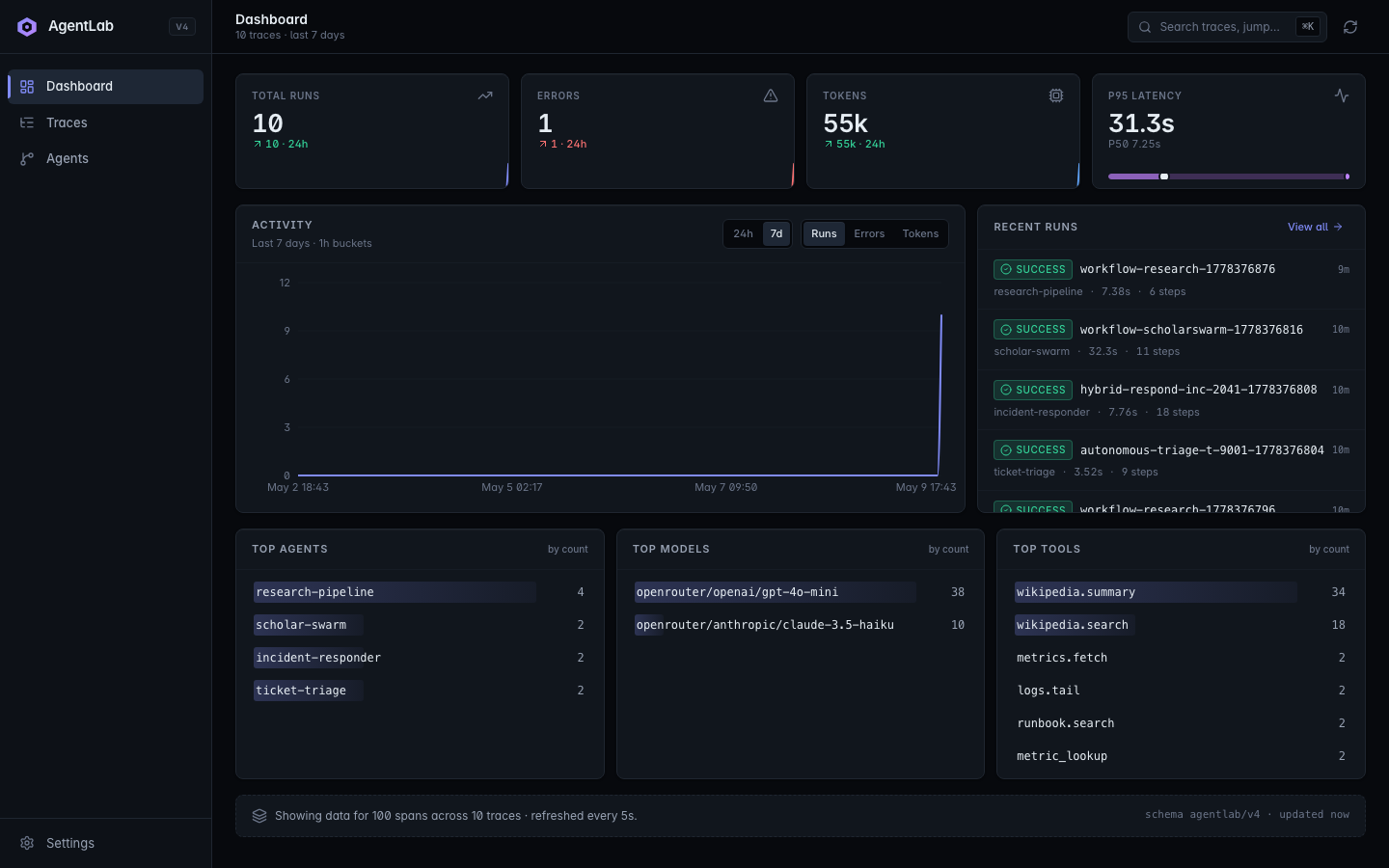
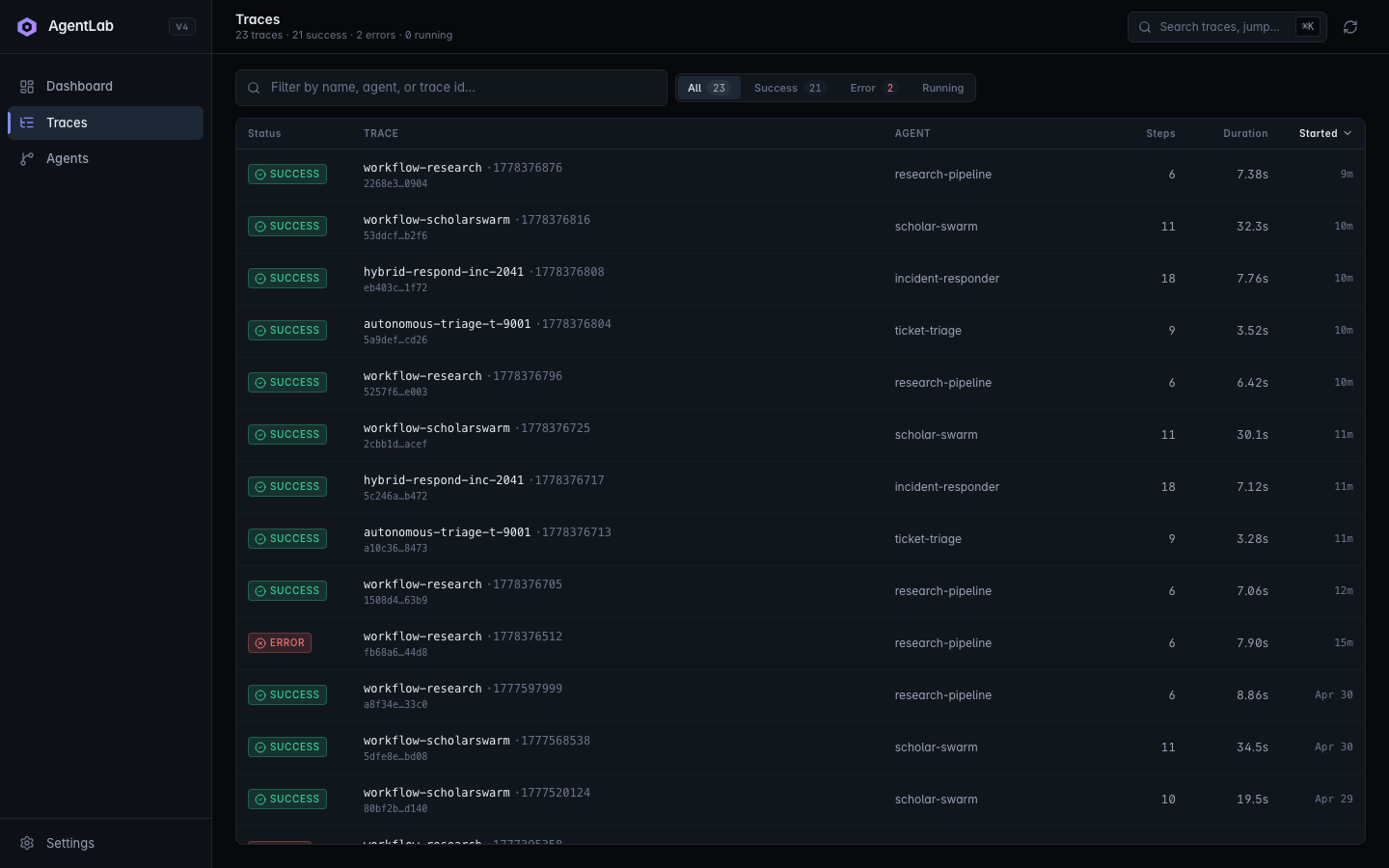
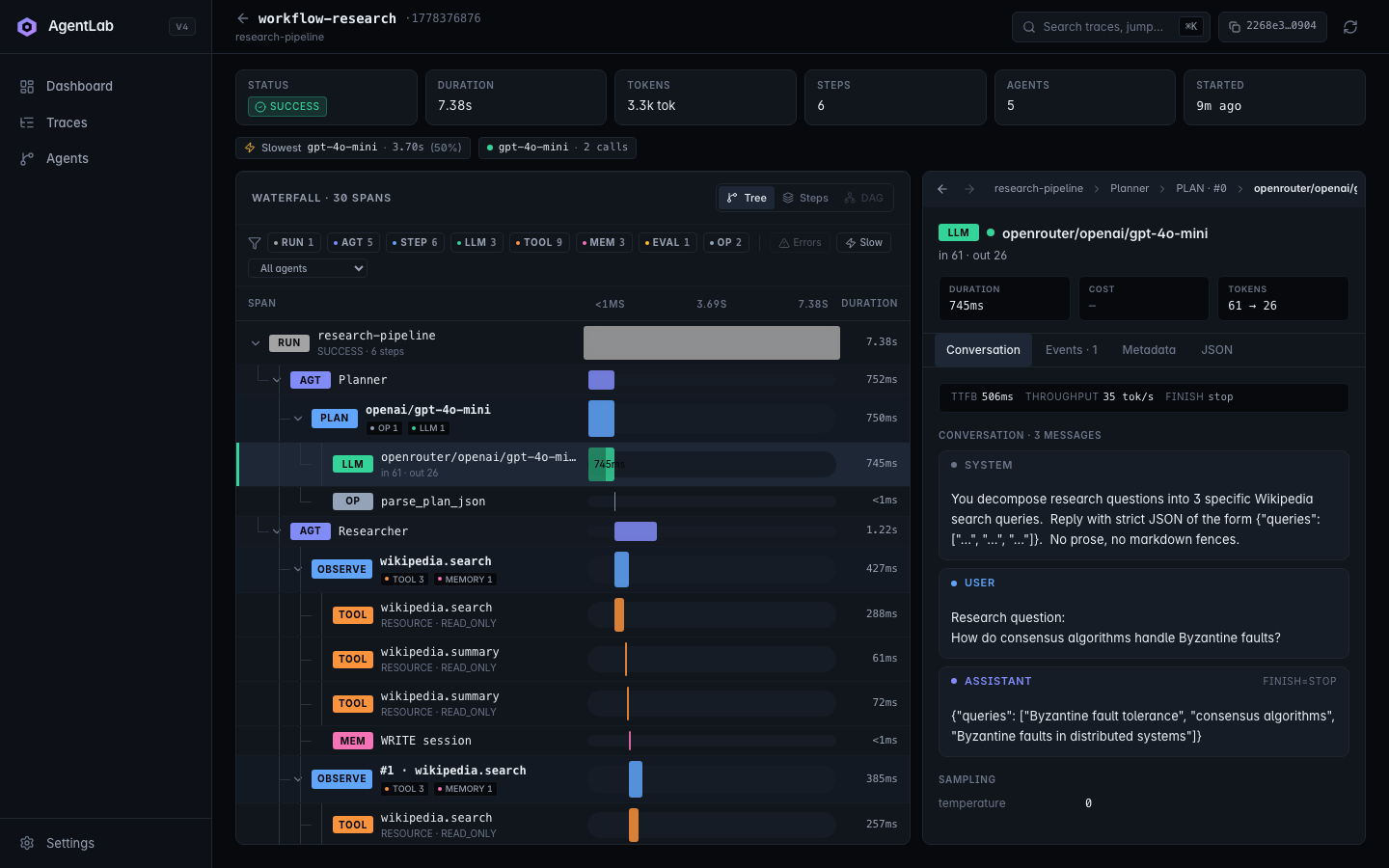
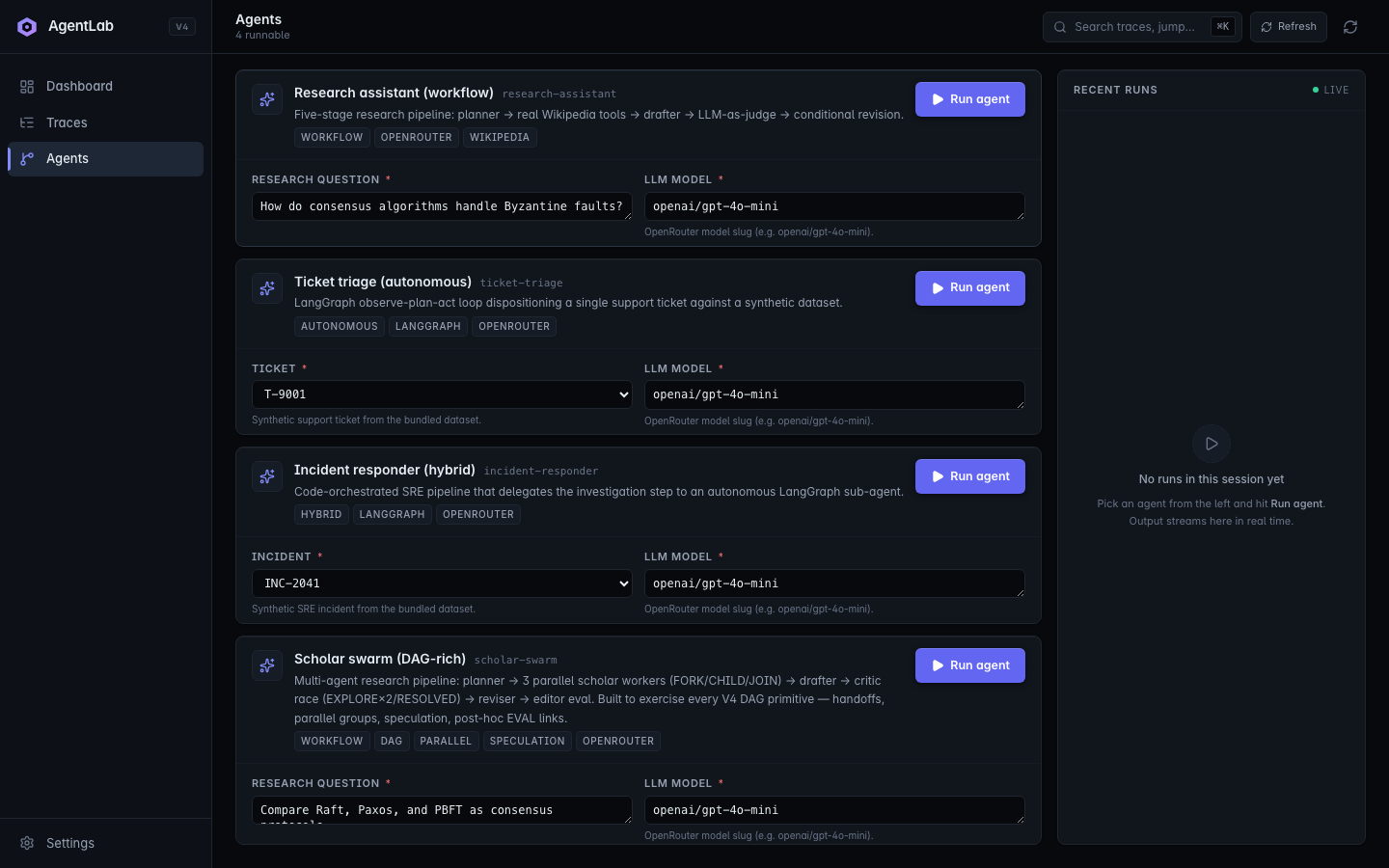
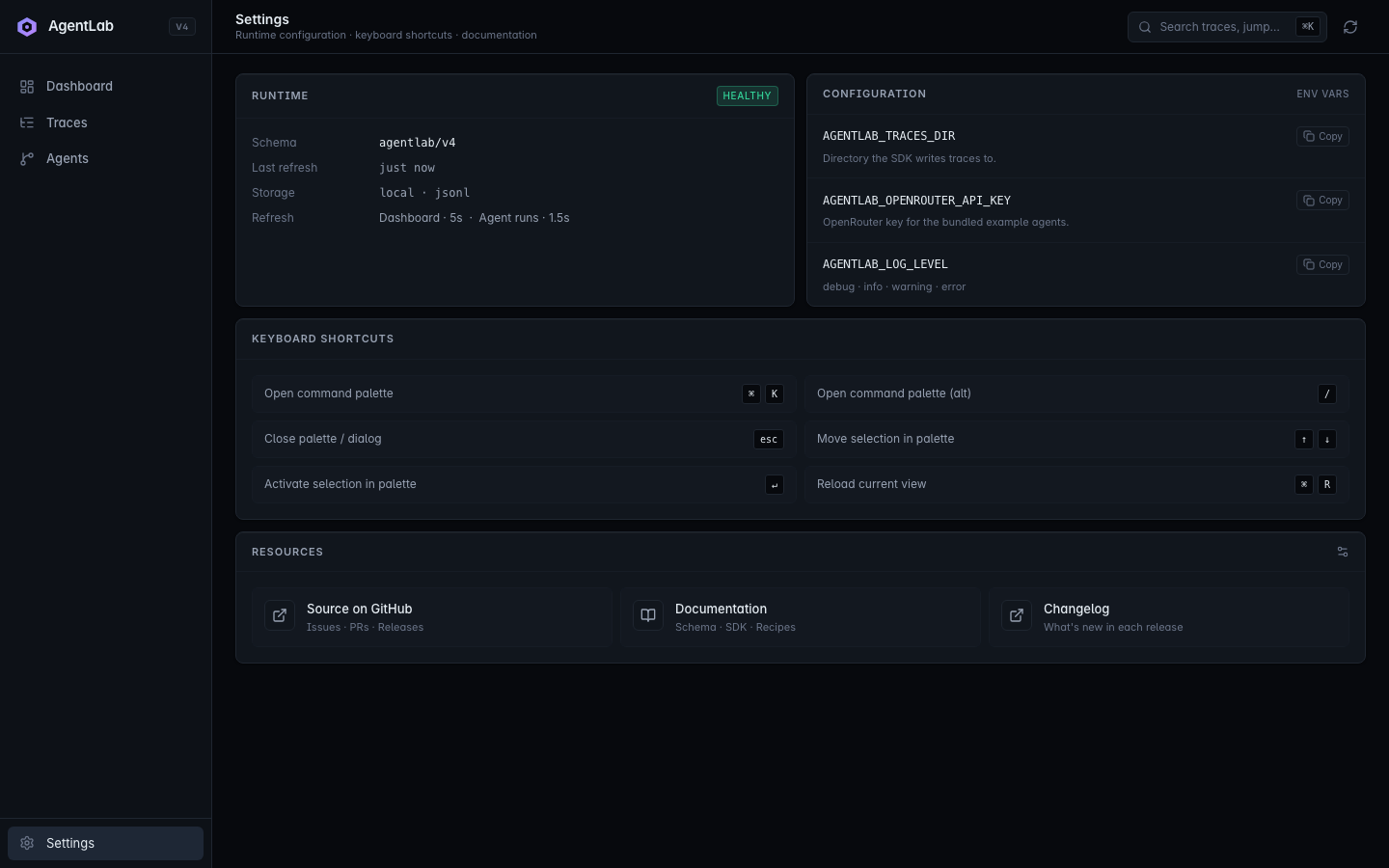
Run the local quality gate:
bash scripts/check.sh
Equivalent commands:
uv run ruff check .
uv run ruff format --check .
uv run mypy
uv run pytest tests/unit tests/integration -n auto --dist=worksteal
Current test tiers:
tests/unit/: hermetic unit tests (no real network).tests/integration/: in-process integration tests with mocked HTTP where needed.For live-provider smoke runs, use the runnable examples in example/ through
their CLIs or the UI Agents page.
agentlab/
├── src/agentlab/
│   ├── __init__.py          # public API surface
│   ├── cli.py               # `agentlab` console entry point
│   ├── config.py            # typed settings
│   ├── recorder.py          # public `record()` context manager
│   ├── _defaults.toml       # bundled non-secret defaults
│   ├── _proto/              # generated protobuf bindings (private)
│   ├── bridges/             # export bridges (e.g. OTel GenAI)
│   ├── core/                # recording primitives
│   ├── examples/            # bundled runnable agent seeds (shipped in wheel)
│   ├── io/                  # trace IO + HTTP capture
│   ├── integrations/        # framework adapters
│   ├── llm/                 # provider-agnostic LLM client
│   ├── replay/              # deterministic replay engine
│   ├── storage/             # JSONL + protobuf stores
│   ├── ui/                  # Starlette UI server + DTO mapping
│   ├── pytest.py            # pytest plugin
│   └── promote.py           # replay-test scaffold generator
├── frontend/                # React SPA for the UI server
├── proto/agentlab/v1/trace.proto
├── scripts/                 # check, proto regen, UI screenshot helpers
├── tests/{unit,integration}/
└── uv.lock
Apache 2.0 — see LICENSE.
Download counts and popularity will appear here as the collector receives them.
| Version | Published | Direct dependencies | Open version |
|---|---|---|---|
| 0.3.0 | 27 Jun 2026 | 24 |
This describes our collected data; it is not a security assessment.
Shared repository data · GitHub
Observed since 20 Oct, 22:17 UTC
No superseded metadata states collected. Unchanged observations do not create new revisions.
package:c9feea672556a0418a73565a586621de8ab7eea0bb87bb43cf8315475db422ef