
 Repository
Current collected state Current
Observed since 20 Oct, 22:18 UTC
No superseded metadata states collected. Unchanged observations do not create new revisions.
The Agentic Paradigm Ladder — executable, tested implementations of agent-engineering Levels 5-14 (genomes, evolution, capability contracts, a workflow compiler, and a skill-contract test harness).
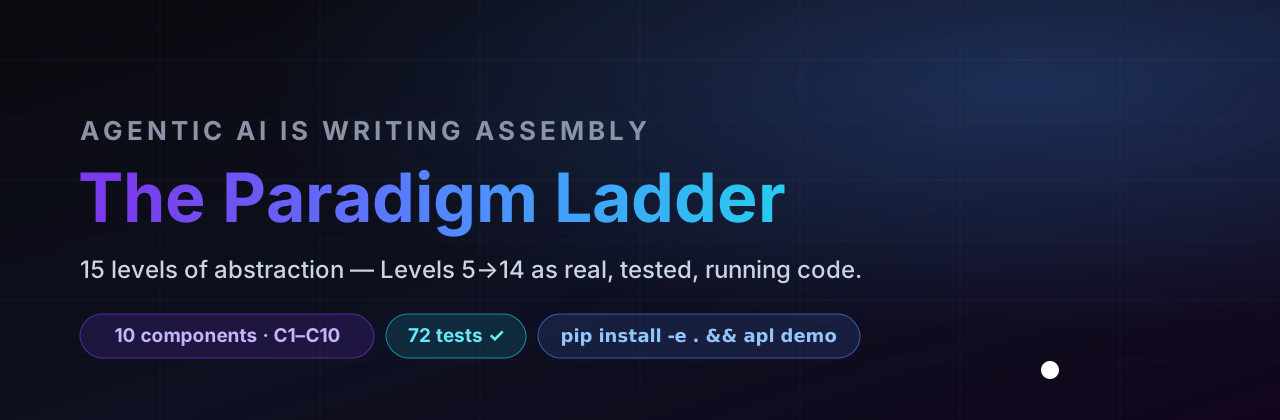
Agent development is stuck writing assembly.
This repo builds the missing abstraction ladder — Levels 5→14 — as real, tested, running code.






pip install -e . && apl demoPYTHONPATH wiring. Runs the Level-11 workflow compiler end-to-end and exits 0.
Clone → install → run, in a single line:
git clone https://github.com/nguyenminhduc9988/agentic-paradigm-ladder && cd agentic-paradigm-ladder && pip install -e . && apl demo
Already cloned? Just:
pip install -e . && apl demo
apl demo prints (click to expand)apl demo — compiling bundled workflow: examples/example_workflow.json
Workflow: research-digest-pipeline v1.0.0
Nodes before: 6 → after: 5
[dead_task_elimination]
- Removed 1 dead tasks: Legacy debug dump (unconsumed) (id=stale_debug)
[model_reroute]
- Summarize each document: summarize — rerouted from ~$0.0257 to ~$0.0000 (using glm-5-turbo)
- Analyze market signals: analyze — rerouted from ~$0.0085 to ~$0.0005 (using glm-5.1)
- Total savings: ~$0.0569 per cycle
[batch_detection]
- Found 1 batch opportunities: {analyze_market,analyze_risk}
[checkpoint_insertion]
- Inserted 2 checkpoint(s): ingest, report
SUMMARY
original_cost: $0.1208
optimized_cost: $0.0017
savings: 98.6%
✅ Demo complete — the Level 11 compiler optimized the workflow end-to-end.
💰 Cost $0.1208 → $0.0017 (98.6% saved)
apl command line| Command | What it does |
|---|---|
apl demo | 🚀 Self-contained end-to-end demo — the Level-11 workflow compiler. |
apl compile FILE | Compile & optimize any workflow (.yaml / .json). |
apl cost FILE | Estimate a workflow's per-cycle cost. |
apl graph FILE | Print a workflow as a text dependency graph. |
apl evolve | 🧬 Run the evolutionary skill-discovery dry-run (Levels 12–14). |
apl integrate | 🔌 Attach the ladder to a plain agent and guide it end-to-end. |
apl test | ✅ Run the full test suite — 72 tests across all packages. |
apl info | Print the paradigm ladder this repo implements. |
Run the tests yourself:
pip install -e '.[test]' && apl test
The ladder isn't just a library to read — it's a drop-in governor for any AI agent. One object, AgentIntegration, plugs into a bare async function or a LangChain / LlamaIndex / CrewAI / Autogen agent alike, and guides every aspect of its work: configuration, planning, compilation, contract validation, composition, observability, and evolution.
See it in one command:
apl integrate
That attaches the ladder to a plain agent and drives it across all seven lifecycle stages — here's the actual output:
①  configure : genome=researcher model=claude-sonnet-5 tools=['web_search', 'read_file', 'summarize']
②③ plan+compile : 2 node(s), cost $0.0257 -> $0.0001 (99.7% saved)
④  validate : rejected a contract-violating task (ContractMismatchError)
⑤b patterns : strategy->premium, chain->fallback
⑤a compose  : budget guard active, remaining=$0.08, critic approved=True
⑥  observe  : 1 observer event(s); trace() fail-safe with no tracer = True
⑦  record   : 1 TaskResult(s) captured as fitness signal
⑦  evolve   : best_fitness [0.98, 0.98, 0.98, 0.98] (non-decreasing=True)
✅ The ladder guided the agent across all 7 lifecycle stages.
Wire it into your own agent in 3 lines — any async (task: dict) -> dict callable works:
from agentlib.integration import AgentIntegration, FitnessEvaluator

async def my_agent(task: dict) -> dict:                 # ← YOUR agent (any framework)
    return {"answer": f"handled: {task['query']}", "cost": 0.02, "revenue": 1.0, "success": True}

guided = AgentIntegration(genome="researcher", budget=0.10,
                          fitness=FitnessEvaluator()).integrate(my_agent)
# `guided` is now a drop-in agent: contract-checked, budget-capped, traced, and self-recording.
| Aspect of work | Hook | Ladder level |
|---|---|---|
| 🧬 Identity / config | .configure() | L5 |
| 🗺️ Planning | .plan() | L10 |
| ⚙️ Workflow compilation | .compile_plan() | L11 |
| 🔒 Capability contracts | .check_contracts() · .guard_step() | L7–8 |
| 🧩 Composition | .wrap() | L6 |
| 🎛️ Design patterns | .strategy() · .chain() · .observe() | L9 |
| 🔭 Observability | .trace() | C1 |
| ♻️ Evolution | .record() · .evolve() | L12–14 |
| ⭐ All at once | .integrate(agent, plan=…) | — |
Full contract, adapters for popular frameworks, and precise hook signatures:
docs/INTEGRATION.md. Runnable reference:examples/integration_demo.py.
The interactive research page argues: agent development is stuck below Level 5 (the OOP-equivalent rung), while mainstream software engineering has built on Levels 5–11 — inheritance, functional composition, generics, interfaces, design patterns, metaprogramming, compilers — for decades. Levels 12–14 (agent OS, agent economy, autonomous discovery) are "nobody is building" territory.
This repo closes that gap with code, not more prose — every rung is an importable module with an automated test suite.
flowchart TB
subgraph L0_4 ["🟥 Levels 0–4 · below the abstraction floor"]
direction TB
A0["L0–L4 · prompts, loops, tools<br/><i>where most agents live today</i>"]
end
subgraph L5_11 ["🟩 Levels 5–11 · IMPLEMENTED here"]
direction TB
A5["L5 · Genomes & inheritance<br/><code>agentlib/genome.py</code>"]
A6["L6 · Functional composition<br/><code>agentlib/compose.py</code>"]
A7["L7–8 · Contracts & interfaces<br/><code>agentlib/contracts.py</code>"]
A9["L9 · Design patterns<br/><code>agentlib/patterns.py</code>"]
A11["L10–11 · Workflow compiler<br/><code>paradigm/agent_workflow_compiler.py</code>"]
A5 --> A6 --> A7 --> A9 --> A11
end
subgraph L12_14 ["🟪 Levels 12–14 · 'nobody is building' — IMPLEMENTED here"]
direction TB
A12["L12–14 · Discovery loop<br/><code>agentlib/evolution.py</code>"]
end
L0_4 --> L5_11 --> L12_14
flowchart LR
    G["🧬 AgentGenome<br/>(L5 · evolvable config)"] -->|specialize / mutate| C["🔧 Workflow Compiler<br/>(L11)"]
    C -->|dead-task elim<br/>model reroute<br/>batch · checkpoint · cache| P["📦 ExecutionPlan<br/>(optimized + priced)"]
    K["📇 Skill corpus<br/>(SKILL.md files)"] -->|discover + validate| H["🧪 Contract Harness<br/>(C2/C3)"]
    H -->|fitness signal| E["♻️ DiscoveryLoop<br/>(L12–14 · populations, elitism)"]
    G --> E
    E -->|published strategies| P
    E -.->|traces| O["🔭 Langfuse<br/>observability (C1)"]
The compiler and the evolution loop share the same genome type, and the evolution loop's selection pressure is real — it scores genomes by running the actual skill-contract validators against files on disk, not a mocked reward.
Each component maps to a specific ladder level and ships with its own tests. Full breakdown: docs/COMPONENTS.md.
| # | Level(s) | Component | Code | Tests |
|---|---|---|---|---|
| C1 | infra | 🔭 Observability smoke test vs. a live Langfuse backend | verify_tracing.py | live · exit 0 |
| C2 | infra | 🧪 Skill-contract harness — discovers & validates SKILL.md | skilltest/harness.py | 45 ✓ |
| C3 | infra | 📐 Frontmatter schema linter (semver version + dependencies) | skilltest/schema.py | ✓ |
| C4 | infra | 🪝 Code-review queue hook wired to a real agent-loop event | hooks/skill-codereview/ | live ✓ |
| C5 | 5 · 6 | 🧬 AgentGenome + composition decorators (with_critic, with_budget, pipe) | agentlib/genome.py · compose.py | 13 ✓ |
| C6 | 7 · 8 | 🔒 SkillContract + pre-execution pipeline type-checking | agentlib/contracts.py · type_check.py | 6 ✓ |
| C7 | 9 | 🎛️ Observer / Strategy / Chain-of-Responsibility wrappers | agentlib/patterns.py | 4 ✓ |
| C8 | 11 | 🚦 CI pipeline gating skills/** & scripts/** | .github/workflows/skills-ci.yml | validated |
| C9 | 10 · 11 | ⚙️ compile(genome_spec) → ExecutionPlan — inline · checkpoint · type-check | paradigm/agent_workflow_compiler.py | 4 ✓ |
| C10 | 12 · 13 · 14 | ♻️ DiscoveryLoop — populations, fitness, elitism, run vs. real files | agentlib/evolution.py · evolution_demo.py | live ✓ |
AgentGenome gives agents an inheritable, mutable config type with a registry (Factory pattern). compose.py adds pure decorators — with_critic, with_budget, with_memory, pipe — so behaviour is composed functionally instead of copy-pasted.SkillContract declares a skill's typed input/output. check_pipeline() runs a pre-flight type check over a chain of steps before any execution or optimization — catching mismatches statically.apl demo fires most of them and reports a modeled 98.6% cost cut.agentic-paradigm-ladder/
├── apl_cli.py # the `apl` entry point (one-liner front door)
├── pyproject.toml # pip install -e . → `apl` console script
├── index.html # the original interactive research page
├── agentlib/ # C5–C7, C10 — genomes, composition, contracts, evolution
├── skilltest/ # C2–C3 — SKILL.md contract & schema validation
├── paradigm/ # C9 — the workflow compiler
├── hooks/ # C4 — code-review queue hook
├── examples/ # bundled demo workflow + mini skill corpus
└── docs/ # spec, gap analysis, verification logs, components guide
PRs welcome. The bar is simple and enforced by CI:
pip install -e '.[test]'
apl test          # 72 tests must stay green
Every new skill contract must carry semver version: + a dependencies: list (C3), and every new pipeline step should declare a SkillContract (C6).
MIT — build on it freely.
Download counts and popularity will appear here as the collector receives them.
| Version | Published | Direct dependencies | Open version |
|---|---|---|---|
| 0.1.0 | 14 Jul 2026 | 4 |
This describes our collected data; it is not a security assessment.
Shared repository data · GitHub
Observed since 20 Oct, 22:18 UTC
No superseded metadata states collected. Unchanged observations do not create new revisions.
package:233d8203aa7ac9138e3a97fcb306534a3ecbee9a5f4c68e06d6b759488b91c6b