
 Repository
Current collected state Current
Observed since 20 Oct, 22:44 UTC
No superseded metadata states collected. Unchanged observations do not create new revisions.
Enforcement and audit layer for AI agents — argument-level tool firewall, trust scoring, tamper-evident audit log, and prompt-injection detection across the Anthropic & OpenAI SDKs, LangGraph, and MCP.


An enforcement layer for AI agents. AgentMoat sits between your agent's decisions and the actions it takes — inspecting tool-call arguments and blocking dangerous ones before they run, with a verifiable audit trail and an instant kill switch. Works across the Anthropic & OpenAI SDKs, LangGraph, and any MCP server; one line to drop in.
Autonomous agents don't just talk — they act: read documents, call tools, write files, hit APIs. The dangerous moment isn't the model saying something wrong, it's the model doing something wrong — and by the time a bad tool call reaches your filesystem or an internal API, detecting the prompt that caused it is too late.
AgentMoat is the enforcement layer in between. It checks the actual arguments of every tool call against your policy — path allow/deny lists, SSRF and path-traversal guards, rate limits — and blocks the call before it runs. It records every decision in a hash-chained audit log that can be independently verified line-by-line. It tracks how far each session has drifted from trusted input across agent hops. And it gives you a one-call kill switch for any session, or all of them.
Catching the injection that tried to trigger a bad action is useful, but it's a probabilistic heuristic attackers paraphrase around. So AgentMoat treats injection detection as one defense-in-depth signal layered on top of enforcement that doesn't depend on catching the prompt — the controls that actually block an action work whether or not the injection was recognized.
Measured against public datasets, one command, numbers quoted verbatim — including the
unflattering ones. Full methodology, caveats, and the exact derived policy are in
benchmarks/; machine-readable output with the commit hash is in
benchmarks/results/latest.json.
The benchmark dependencies are kept out of the base install — install the extra, then run:
pip install "agentmoat[benchmarks]"            # datasets, agentdojo, langdetect
python benchmarks/run.py                        # add --embeddings for the embedding rows
# the embedding pass also needs the [embeddings] extra:
# pip install "agentmoat[benchmarks,embeddings]" && python benchmarks/run.py --embeddings
The moat — tool firewall evaluated against AgentDojo attack cases (v1, 609 indirect-injection security cases):
This is an offline replay: each AgentDojo attack task's declared tool-call sequence is checked statically against the firewall layer. We do not run live agents or measure AgentDojo's task-utility metric — so read this as "evaluated against AgentDojo's attack cases", not "benchmarked on AgentDojo".
| Metric | Result |
|---|---|
| Attack catch rate | 86.0% (524 / 609) |
| — by least-privilege tool policy (only) | 524 |
| — by argument constraints (only) | 0 |
| — by both | 0 |
| False-positive rate (on 339 benign tool calls) | 0.0% |
| Per-call evaluation latency | p50 0.10 ms · p95 0.23 ms (excludes the LLM/API call) |
For each user task we allow exactly the tools its benign ground-truth run uses and deny the rest, then measure what that blocks on the paired attacks. Because the policy is derived from the same task suite it's later measured on, the benign-call false-positive rate is favorable by construction — read the 0.0% FPR as "simulates a well-configured least-privilege deployment", not a claim about arbitrary hand-written policies.
Constraint contribution, as measured: 0. All 524 catches come from least-privilege tool
policy denying an out-of-scope tool; the always-on argument constraints (path traversal, SSRF,
shell, sensitive paths) fire on none of these cases, because AgentDojo's attacks are
financial/messaging exfiltration, not the filesystem/network class those detectors target
(they're exercised in tests/test_constraints.py instead). The 85 uncaught cases (14%) all
reuse a tool the benign task itself uses — semantic misuse the firewall doesn't model — and
break down as 41 financial-transaction, 16 send/message, 16 write, 12 read
(full list in benchmarks/results/uncaught_cases.json).
Defense-in-depth, not the security boundary — injection-text detector vs. deepset/prompt-injections (263 injection / 399 benign):
| Path | Catch rate | FPR | Latency |
|---|---|---|---|
| Rule-based — overall | 5.3% (14 / 263) | 0.0% | p50 0.10 ms |
| Rule-based — English only | 8.9% (14 / 157) | 0.0% | — |
| Rule-based — non-English | 0.0% (0 / 106) | 0.0% | — |
| + Embeddings (opt-in) | +0 catches over rules | 0.0% | p50 27 ms |
The rule patterns are English-only, so splitting by detected language (via langdetect) tells
the real story: 8.9% on English attacks, 0.0% on the non-English ~40% of the corpus — the
English regexes cannot see non-English injection at all. The opt-in embedding pass added
zero catches over the rules here — the highest cosine similarity any attack reached against
a known-attack phrase was 0.629, below the 0.82 flag threshold — while costing hundreds of
times the latency (p50 27 ms vs 0.10 ms).
These unflattering numbers are in the README on purpose, because they are the thesis: regex/embedding injection detection is bypassable and is not the security boundary. It's a cheap signal layered on top; the boundary that actually stops a bad action is the deterministic tool-argument enforcement above, which blocks the call whether or not detection recognized the prompt. See THREAT_MODEL.md for exactly where detection helps and where it doesn't.
Generated with
python benchmarks/run.py --embeddingsagainstdeepset/prompt-injectionsand AgentDojov1. Reproduce with the steps inbenchmarks/README.md; the exact commit is recorded inresults/latest.json.
The strongest objection to AgentMoat is that this is already solved: bind each agent only the tools it needs at the framework level and you're done. It's a fair point, and our own benchmark makes it — all 524 firewall catches (the full 86.0%) were out-of-scope-tool policy catches, denying a tool the task never needed. Careful tool binding would have prevented every one. Read the 86.0% as evidence for least-privilege as a principle, not for this proxy as the only place to implement it.
What binding cannot do, and where the proxy earns its place:
See THREAT_MODEL.md for exactly where each of these holds and where it doesn't.
The per-call cost AgentMoat adds is sub-millisecond and dwarfed by the LLM/API round-trip it
sits in front of (which it does not change). Measured with python benchmarks/overhead.py:
| What | p50 | p95 |
|---|---|---|
| Injection scan per message (rule mode) | ~0.09 ms | ~0.15 ms |
| Argument-constraint check per tool call | ~0.01 ms | ~0.02 ms |
| End-to-end MCP proxy overhead per intercepted call | ~0.10 ms | ~0.16 ms |
The MCP-proxy row is the delta between a full proxied tools/call (request parse + injection +
argument constraints + tool policy + trust + event emission) and a direct upstream call, using a
zero-cost mock upstream — so it reflects AgentMoat's interception cost alone, not real
tool-server or transport latency. The injection-scan figure uses benign inputs, which are the
regex worst case (every pattern is scanned and none short-circuits on an early match), so the
latency is conservative — a real injection tends to match sooner and cost less. Numbers measured
on an AMD Ryzen 5 5600H (CPython 3.10, Windows); they exclude the LLM/API call and the ~80 MB
optional embedding model (off by default).
pip install agentmoat

# with extras
pip install "agentmoat[langgraph,openai]"
For development (editable install from source):
git clone https://github.com/Shashank-016/agentmoat
cd agentmoat
pip install -e ".[langgraph,openai]"   # extras optional; base install works on its own
import anthropic
from agentmoat import GuardedClient

# Wrap your existing client — same interface as anthropic.Anthropic()
client = GuardedClient(
    anthropic.Anthropic(),
    agent_id="researcher",
    policy_path="policy.yaml",   # optional
    mode="observe",              # "observe" | "enforce" | "interactive"
)

# Use it exactly as before. AgentMoat scans inputs, checks tool calls,
# logs every event, and (in enforce mode) blocks dangerous actions.
resp = client.messages.create(
    model="claude-haiku-4-5-20251001",
    max_tokens=512,
    messages=[{"role": "user", "content": "Summarize this document..."}],
)
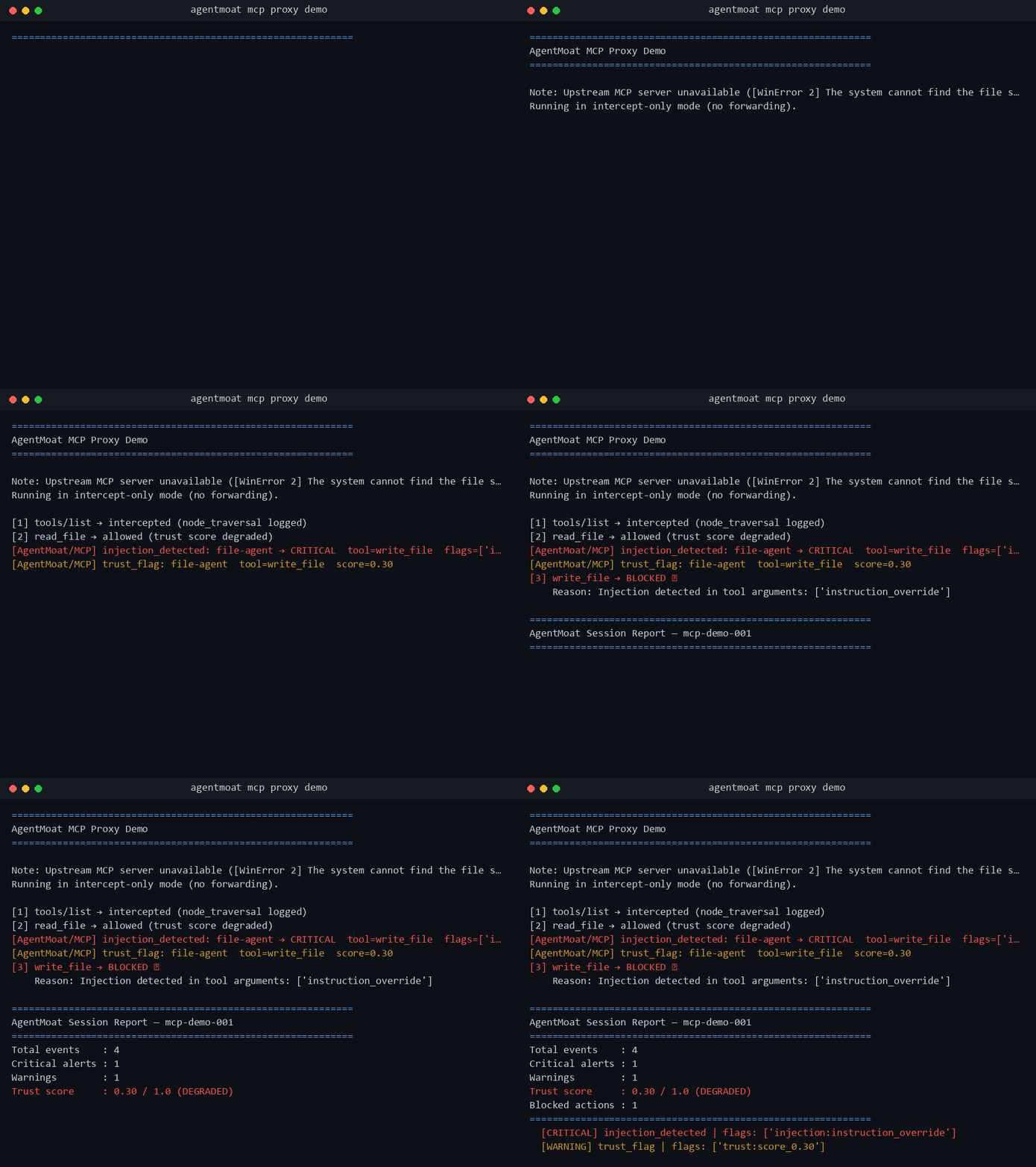
See it catch a real attack:
python examples/mcp_proxy_demo.py
# An agent reads a poisoned document and tries a privileged write —
# AgentMoat blocks it at the tool layer and prints a session report.
One line at the point you create your client or graph. Everything downstream is instrumented.
Anthropic SDK
from anthropic import Anthropic
from agentmoat import GuardedClient

client = GuardedClient(Anthropic(), agent_id="my-agent", policy_path="policy.yaml", mode="enforce")
OpenAI SDK
from openai import OpenAI
from agentmoat import GuardedOpenAI

client = GuardedOpenAI(OpenAI(), agent_id="my-agent", policy_path="policy.yaml", mode="enforce")
LangGraph — attach the callback to any graph/runnable:
from agentmoat import AgentMoatCallback

graph.invoke(state, config={"callbacks": [AgentMoatCallback(session_id="run-1")]})
Any MCP tool server — run AgentMoat as a transparent proxy, no agent code change at all. Point your MCP client at AgentMoat instead of the real server:
agentmoat mcp proxy stdio \
  --upstream-cmd "npx -y @modelcontextprotocol/server-filesystem /data" \
  --agent-id my-agent \
  --policy policy.yaml \
  --mode enforce
Async variants (AsyncGuardedClient, AsyncGuardedOpenAI) and streaming are supported with the
same interface. Events flow to an in-memory bus, an optional SQLite store, and a hash-chained
JSONL audit log; view them via the bundled FastAPI service and React dashboard (see below).
version: "1"
agents:
  researcher:
    allowed_tools: [web_search, read_file]
    denied_tools:  [write_file, execute_code]
    rate_limits:
      web_search: 10/minute

  writer:
    allowed_tools: [write_file, read_file]
    denied_tools:  [web_search, execute_code]
Tool names are only half the story — write_file("/etc/crontab", payload) passes a
name-level check for any agent allowed to use write_file. ToolPolicyEngine.check_arguments()
inspects the arguments of a tool call, combining always-on built-in detectors with
per-tool rules declared in the policy file:
agents:
  writer:
    tool_constraints:
      write_file:
        path_allowlist: ["/tmp/**", "./output/**"]   # only these globs are permitted
        path_denylist:  ["/etc/**", "~/.ssh/**"]      # these are always blocked
        max_arg_length: 10000                         # flag oversized argument values
      fetch:
        url_denylist: ["169.254.169.254", "localhost", "10.*"]
        # url_allowlist, arg_denylist also supported
Built-in detectors run on every tool call regardless of configuration:
| Detector | Flag | Triggers on |
|---|---|---|
| Path traversal | constraint:path_traversal | ../, ..\, or URL-encoded %2e%2e in any argument |
| SSRF targets | constraint:ssrf_target | URLs/hosts pointing at 169.254.169.254, localhost, 127.0.0.1, RFC-1918 ranges, metadata.google.internal |
| Shell metacharacters | constraint:shell_metachar | ;, |, &&, `, $(, >, < in arguments to tools whose name suggests command execution (exec, shell, command, run, bash, sh) |
| Sensitive path access | constraint:sensitive_path | /etc/, /root/, ~/.ssh, id_rsa, .env, credentials, /proc/ |
Violations are emitted as policy_violation events with severity="critical" and raise
AgentMoatException in enforce mode — both from the SDK wrappers (checked against the
arguments the model produced, before the agent runtime executes the tool) and from the MCP
proxy (checked before the call is forwarded upstream, where blocking actually prevents execution).
The table below is the detection layer — heuristics that flag suspicious input. Treat it as a signal, not the security boundary. Regex and embedding detection are pattern-based and bypassable (base64, homoglyphs, zero-width characters, paraphrasing, other languages — see THREAT_MODEL.md), so a determined injection will eventually slip past them. The boundary that actually stops a bad action is the deterministic tool-argument enforcement above (allow/deny policy + argument constraints), which blocks the call whether or not detection recognized the prompt that produced it.
| Threat | Detection Method | Default Severity |
|---|---|---|
| Jailbreak attempt | Regex: "ignore previous instructions", "you are now DAN" | Critical |
| System prompt exfiltration | Regex: "print your system prompt", "repeat everything above" | Critical |
| Role override | Regex: "act as if you have no restrictions" | Critical |
| Tool abuse via injection | Regex: "call the write_file tool" | Critical |
| Indirect injection (docs, web) | Regex + embedding similarity | Warning/Critical |
| Tool policy violation | YAML policy engine | Critical |
| Rate limit exceeded | Sliding window counter | Critical |
| Low-trust agent calling sensitive tools | Trust score degradation | Warning |
| Multi-agent trust chain poisoning | Multiplicative provenance tracking | Warning |
How AgentMoat's controls line up against the
OWASP Top 10 for Agentic Applications
(OWASP GenAI Security Project, published 9 Dec 2025). We're deliberate about not overstating this:
AgentMoat is a tool-action enforcement and audit layer, so it directly covers tool misuse and
is partial on most of the rest — shrinking blast radius and adding visibility rather than fully
preventing the root cause. Full rationale per item is in docs/owasp-mapping.md.
| OWASP ID | Risk | Status | AgentMoat control |
|---|---|---|---|
| ASI01 | Agent Goal Hijack | 🟡 Partial | Injection detection (heuristic) + trust provenance; downstream tool calls still enforced |
| ASI02 | Tool Misuse and Exploitation | 🟢 Covered | Policy engine + argument-level firewall, enforced at SDK wrappers and MCP proxy |
| ASI03 | Identity and Privilege Abuse | 🟡 Partial | Per-agent tool least-privilege; secret redaction in logs (no credential/identity management) |
| ASI04 | Agentic Supply Chain Vulnerabilities | ⚪ Out of scope | Forensic visibility via audit log only |
| ASI05 | Unexpected Code Execution | 🟡 Partial | Shell-metachar constraints, deny exec-style tools (no sandbox) |
| ASI06 | Memory and Context Poisoning | 🟡 Partial | Trust provenance + indirect-injection detection (no memory-store integrity) |
| ASI07 | Insecure Inter-Agent Communication | 🟡 Partial | Trust propagation + audit of handoffs (no transport auth/encryption) |
| ASI08 | Cascading Failures | 🟡 Partial | Kill switch, rate limits, bounded state, fail-closed engine |
| ASI09 | Human-Agent Trust Exploitation | 🟡 Partial | Approval gate with full call context + verifiable audit trail |
| ASI10 | Rogue Agents | 🟡 Partial | Tool/argument enforcement, trust flags, kill switch, audit log |
1 covered · 8 partial · 1 out of scope. AgentMoat is one layer — strongest at constraining and recording tool actions — meant to sit alongside identity, sandboxing, and supply-chain controls.
Every guarded client, callback, and the MCP proxy take a mode:
| Mode | Behavior |
|---|---|
"observe" (default) | Detect and log everything — never interrupts the agent. |
"enforce" | Raise AgentMoatException (or return a JSON-RPC error from the MCP proxy) on any hard violation. A fixed, pre-decided policy. |
"interactive" | Route violations to a human (or programmatic approver) for a real-time decision via ApprovalGate. A "deny" blocks the call just like enforce mode; an "approve" lets it through. |
"interactive" mode is for situations where a blanket policy is too coarse — let
a human apply judgment to a specific borderline case instead of pre-encoding
every exception:
from agentmoat import GuardedClient, ApprovalGate
from agentmoat.control import ApprovalRequest, ApprovalDecision

def slack_approval_handler(request: ApprovalRequest) -> ApprovalDecision:
    # Post to Slack, wait for a thumbs-up/thumbs-down reaction, etc.
    ...
    return "approve"  # or "deny"

client = GuardedClient(
    anthropic.Anthropic(),
    agent_id="researcher",
    mode="interactive",
    approval_gate=ApprovalGate(handler=slack_approval_handler),
)
Each request emits approval_required, then approval_granted or
approval_denied, so the full decision trail lands in the audit log. The
default handler (when no approval_gate= is supplied) prompts on the CLI with
a y/N confirmation — fine for local development, but register your own handler
(Slack, a web UI, a queue) for anything running unattended. A misbehaving or
exception-raising handler defaults to "deny" — approval gates fail closed.
Note: trust_flag warnings never hard-block in enforce mode (a low trust
score alone shouldn't halt an agent), but in interactive mode they still
route through the approval gate — a human's explicit "deny" blocks the call.
This gives interactive mode finer-grained control than a blanket policy.
Independent of mode, any session — or every session in the process — can be
halted immediately via KillSwitch:
from agentmoat.control import get_default_kill_switch

switch = get_default_kill_switch()
switch.kill_session("session-123")   # halt one session
switch.kill_all()                    # halt every session in this process
switch.revive_session("session-123") # restore it
switch.status()                      # {"global": False, "killed_sessions": [...]}
A killed session's next intercepted action raises AgentMoatKilled (a subclass
of AgentMoatException) — or, for the MCP proxy, returns a JSON-RPC error
(AGENTMOAT_SESSION_KILLED) — before any API call or tool execution happens.
A critical session_end event with flags=["kill:tripped"] is emitted first,
so the halt is visible in the audit trail.
The same switch is reachable over HTTP once the audit API is running. The
/control routes are behind the same AGENTMOAT_API_KEY authentication as
the rest of the audit API (see below) — so set that key, then present it:
export AGENTMOAT_API_KEY=secret-123
curl -X POST http://localhost:8000/control/kill/session-123 -H "X-API-Key: $AGENTMOAT_API_KEY"
curl -X POST http://localhost:8000/control/kill-all        -H "X-API-Key: $AGENTMOAT_API_KEY"
curl -X POST http://localhost:8000/control/revive/session-123 -H "X-API-Key: $AGENTMOAT_API_KEY"
curl http://localhost:8000/control/status                  -H "X-API-Key: $AGENTMOAT_API_KEY"
These endpoints affect sessions in the API process only — a multi-process
deployment needs a shared backing store (see Roadmap) for one trip to halt
every worker. Authentication is enforced only when AGENTMOAT_API_KEY is set:
if you leave it unset the API (including the kill switch) stays open for
backward compatibility and logs a warning — always set it before exposing the
API, so an unauthenticated kill-all can't be turned into a denial-of-service
against your own agents.
AuditLogger (passed via audit_log= to any guarded client/callback) writes one JSON
object per line to a durable JSONL file. By default (chained=True) every record also
carries prev_hash — the SHA-256 record_hash of the previous line, with a genesis value
of 64 zeros for the first line in a fresh file — and its own record_hash, a digest over
the record's canonical JSON plus prev_hash. Editing or deleting any line breaks the link
to the next record, so tampering is always detectable, not just guessable. The chain
survives process restarts (it resumes from the last line on disk) and rotations (the new
file's first record continues from the rotated file's last hash).
agentmoat audit verify agentmoat_audit.jsonl
# ✓ Chain intact — 1,432 records verified
#   (or, if a line was edited or removed:)
# ✗ Chain broken at line 87 — record was modified or a prior line was deleted

agentmoat audit tail agentmoat_audit.jsonl -n 50
agentmoat audit stats agentmoat_audit.jsonl   # counts by event_type and severity
This gives you a forensic trail suitable for SOC 2 / ISO 27001 evidence: an auditor (or an incident responder) can independently confirm that the log they're looking at is the complete, unaltered record AgentMoat produced — not a reconstruction. It does not, by itself, prove who tampered with a file; pair it with filesystem-level access controls and off-host replication for full chain-of-custody guarantees.
AgentMoat observes raw LLM messages, tool arguments, and responses — which routinely carry
secrets you don't want copied into the audit trail or shown on the dashboard. Every event
payload is therefore redacted before it is persisted: redact() runs inside
make_payload(), so the SQLite store, the JSONL audit log, and the dashboard only ever see
masked values. It walks nested dicts/lists and replaces recognizable secrets/PII with a
«REDACTED:<kind>» placeholder, and runs before truncation so a secret can't dodge the
pattern by landing on the truncation boundary.
What it catches out of the box: OpenAI-style API keys, AWS access key IDs, GitHub tokens, JWTs, PEM private-key blocks, and email addresses.
from agentmoat.events import make_payload

make_payload(message="my key is sk-ABCDEFGHIJ1234567890abcdef")
# {'message': 'my key is «REDACTED:openai_api_key»'}
Redaction is on by default. Disable it for local debugging via the environment —
AGENTMOAT_REDACT=0 (also accepts false/no/off) — or programmatically, which takes
precedence over the env var:
from agentmoat.redaction import set_redaction_enabled

set_redaction_enabled(False)  # raw payloads; True to force on, None to fall back to the env var
# 1. Install
pip install -e ".[langgraph]"

# 2. Start the audit API
uvicorn api.main:app --reload

# 3. Start the dashboard
cd dashboard
npm install
npm run dev
# → http://localhost:5173

# 4. Run the demo
python examples/langgraph_demo.py
See dashboard/README.md for dashboard-specific setup, including how to
authenticate against an API started with AGENTMOAT_API_KEY set.
pytest
AgentMoat tracks information provenance across agent hops. When a session processes external content (a file, a web page, a user upload), its trust score degrades:
Initial:          1.0  (TRUSTED  — human instructions)
After file read:  0.3  (EXTERNAL — external content processed)
After handoff:    0.21 (EXTERNAL — downstream agent inherits low trust)
After injection:  0.0  (UNTRUSTED — flagged)
When trust drops below 0.5, any attempt to call a sensitive tool (write, execute, send, delete) emits a trust_flag warning even if the tool is otherwise policy-allowed.
The agent-guardrail space is active and several of these projects are more mature or better funded than AgentMoat. They mostly solve a different part of the problem — detection quality, output validation, conversational rails — and AgentMoat is complementary to all of them. AgentMoat's specific angle is deterministic enforcement at the tool boundary, delivered as SDK wrappers and a transparent MCP proxy in one package, with a hash-chained tamper-evident audit log, a human-in-the-loop interactive mode, and no cloud dependency (the default rule path runs fully local, no external model calls).
| Project | Primary focus | Does better than AgentMoat | Where AgentMoat differs |
|---|---|---|---|
| LlamaFirewall (Meta) | ML-based guardrails — prompt-injection/jailbreak detection (PromptGuard), agent-alignment auditing (AlignmentCheck), insecure-code scanning (CodeShield) | Far stronger, model-based detection and alignment auditing; backed by Meta | AgentMoat's boundary is deterministic tool-argument enforcement, not detection; ships a transparent MCP proxy and tamper-evident audit log |
| NeMo Guardrails (NVIDIA) | Programmable conversational rails via the Colang DSL — topical, dialog, input/output rails | Mature, broad integrations, rich conversation-flow control; NVIDIA-backed | AgentMoat enforces at the tool-call layer (arguments, policy) rather than the conversation layer, and works transparently over MCP with no app rewrite |
| Guardrails AI | LLM output validation — a large hub of validators (structure, PII, toxicity, format) | Much larger validator ecosystem; strong structured-output/validation story | AgentMoat targets actions (what a tool call does) rather than validating model text output, and adds MCP-proxy enforcement + audit integrity |
| Invariant Labs | Agent security tooling — a policy/analysis language for agent traces and MCP-focused security (e.g. MCP scanning, a guardrailing gateway) | Deeper trace-analysis policy language and dedicated MCP vulnerability scanning; the closest overlap on MCP | AgentMoat bundles SDK wrappers + proxy enforcement + hash-chained audit + interactive approval in one local package with no cloud/Explorer component |
Honest summary: if you want the strongest detection, pair AgentMoat with LlamaFirewall's models; if you need conversational rails, NeMo is purpose-built; for output-schema validation, Guardrails AI has the ecosystem. AgentMoat's bet is that the durable security control is stopping the action at the tool boundary and being able to prove what happened — which is why it leads with enforcement and a verifiable audit log rather than detection. Capabilities of the other projects move fast; check their current docs before relying on any specific feature above.
GuardedOpenAI / AsyncGuardedOpenAI wrap openai.OpenAI / AsyncOpenAIAsyncGuardedClient wraps AsyncAnthropic for async codebasesGuardedStream / AsyncGuardedStream intercept messages.stream()agentmoat audit verifymode="interactive" routes violations through ApprovalGate/controlMIT — see LICENSE
Download counts and popularity will appear here as the collector receives them.
| Version | Published | Direct dependencies | Open version |
|---|---|---|---|
| 0.1.1 | 25 Aug 2026 | 24 |
This describes our collected data; it is not a security assessment.
Observed since 20 Oct, 22:44 UTC
No superseded metadata states collected. Unchanged observations do not create new revisions.
package:0fb4459b9c97f8587188c0b6144dc179f20a712130f57591ce095d3a7a07ef05