
 Repository
Current collected state Current
Observed since 20 Oct, 22:47 UTC
No superseded metadata states collected. Unchanged observations do not create new revisions.
AI Agent Framework — automates tasks using AI agents in Docker containers
Security by design, not by prompt.


Stop running agents in YOLO mode. Build them with isolation, policy, and modular control.
Agento is an open-source, self-hosted platform for building modular agentic software with hard runtime boundaries, controlled tool access, secure secrets handling, and deployment-specific extensibility.
Modern agent stacks are powerful, but in practice they are often glued together from prompts, scripts, MCP servers, and broad permissions. The result is fragile and risky: duplicated files, unclear tool access policies, missing human approval steps, over-permissioned agents, and no clean way to route the right task to the right agent and model.
Agento is extensible by design. Creating and sharing custom modules is simple. Want to distribute your QA agent as a reusable template? Package it as a self-contained module and share it with your team, your clients, or the community.
DECISIONS.md D-SSH-1). A scheduled agent runs as the cron container's own uid, but the store is not reachable from it: it lives in a root-only file that a root-owned program reads before dropping privilege in-process, so it never crosses an execve (D-SSH-1 residual channel (6), closed 2026-09-23).Teams adopting AI agents quickly run into the same issues:
We keep hearing the same failure stories: deleted workspaces, leaked emails, agents browsing beyond intended domains, and automations acting with more access than they should ever have had.
Agento brings structure, security, and extensibility to agentic systems through:
Agento is inspired by Magento Open Source — especially its extensibility, extension-first architecture, and strong community model — but rethought for the age of AI agents, MCP tools, and secure autonomous workflows.
uv tool install agento-core           # Install the CLI
mkdir my-project && cd my-project
agento install                        # Interactive wizard — scaffolds, starts, migrates
Agento runs four service containers plus MySQL. All but one share the agento-net bridge
network — the Artifacts container deliberately joins none of it:
/mcp, SSE /sse). Designed to be the only container that holds tool credentials (known gaps: zero-trust).agento run. Holds no upstream service credentials and no direct database access — only its own harness credential (in its per-run HOME) and its run's toolbox capability, scoped to one agent_view and expiring. Headless jobs run the agent inside the cron container and inherit its env (a known gap, see zero-trust). Communicates with the toolbox exclusively through MCP tool calls.versioned_artifacts published tree. On no shared network and holding no secret, published on 127.0.0.1 only, so an artifact is readable by a person at the host and by no agent.Agento uses a Magento-inspired modular architecture. Each module is a self-contained package.
Core modules ship with the framework in src/agento/modules/ (jira, claude, codex, pi, core, crypt, agent_view, versioned_artifacts).
User modules live in app/code/ and are deployment-specific (gitignored by default).
Every module contains a module.json manifest and optional companion files:
| File | Purpose |
|---|---|
module.json | Module manifest (name, version, tools, knowledge) |
di.json | Dependency injection configuration |
events.json | Observer declarations for event-driven extensibility |
config.json | Default config values with field metadata |
cron.json | Scheduled job definitions |
sql/*.sql | Schema migrations |
data_patch.json | Data patches applied during setup |
Config follows a 3-level fallback: ENV vars (CONFIG__MODULE__PATH) take highest priority, then DB (core_config_data), then config.json defaults. Config can be scoped per agent_view for multi-tenant setups.
Events use an observer pattern. Modules declare observers in events.json and the framework dispatches events synchronously during lifecycle hooks (job start, job complete, schedule tick, etc.).
For end users, demos, PoC, and self-hosting:
uv tool install agento-core          # or: pip install agento-core
mkdir my-project && cd my-project
agento install                        # Interactive wizard — scaffolds, starts, migrates
The installer offers Basic (recommended) and Advanced modes. Basic uses sensible defaults. Advanced lets you configure Docker project name, MySQL port, and timezone for multi-instance setups.
agento doctor # Verify prerequisites
agento admin launches an interactive terminal dashboard for operational visibility and configuration management.
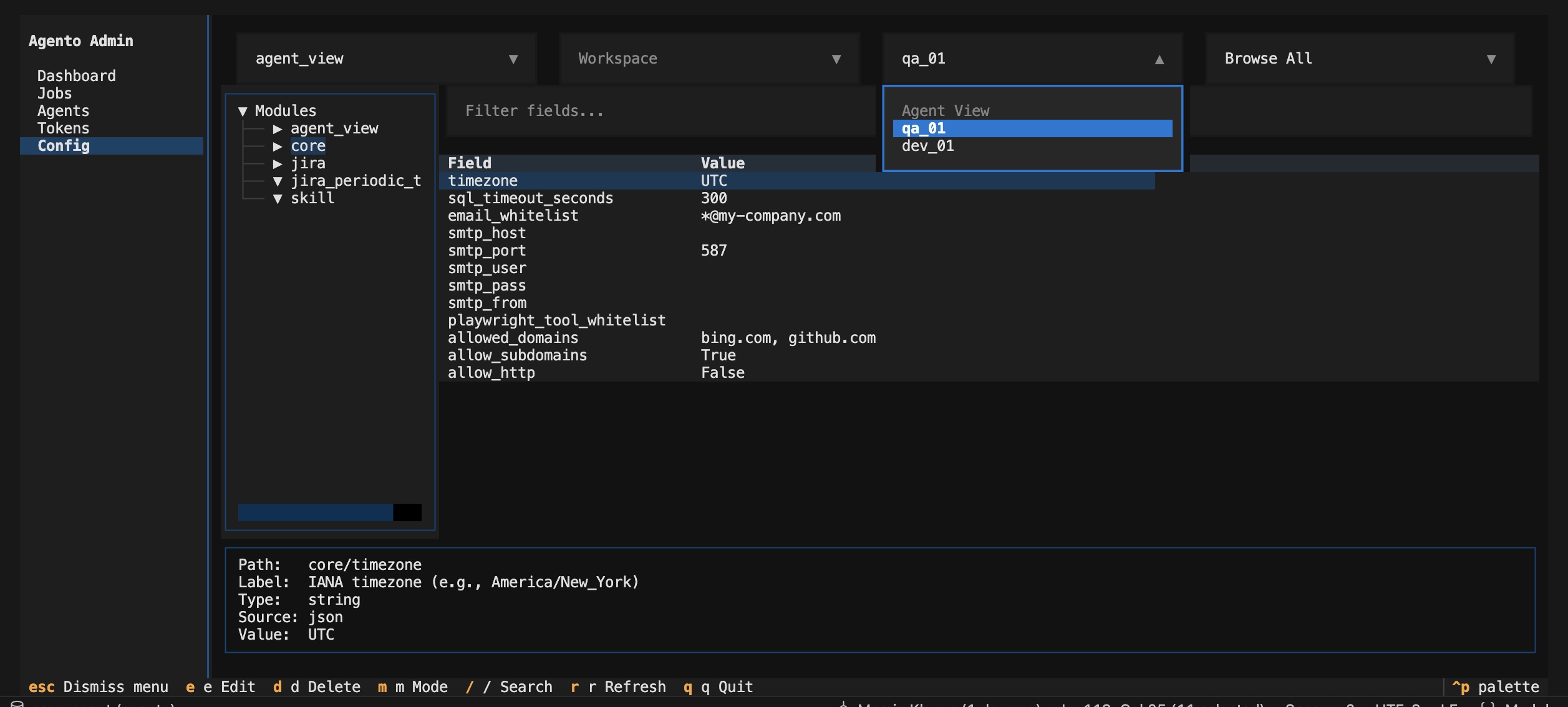
Keyboard-first with full mouse support. See Admin TUI docs for details.
agento module:add my-app \
  --description="My application module" \
  --tool mysql:mysql_prod:"Production database (read-only)"
This creates a module in app/code/my-app/ with a module.json, config.json, and knowledge/ directory. Set credentials with:
agento config:set my_app/tools/mysql_prod/host 10.0.0.1
agento config:set my_app/tools/mysql_prod/pass secret123
See Creating a Module for the full guide.
Full developer documentation is available in docs/:
agento commandsOne module = one integration = a complete package. The framework provides the mechanics, Core defines meaning, and Modules deliver features — every milestone stays backward-compatible and keeps the Python/Node.js security boundary intact.
events.json, cross-module composition)setup:upgrade — migrations, data patches; cron is rendered by the container's root installer){subject}_{verb}_{before|after})db_schema.json (deferred)Legend: ✅ shipped · 🟡 in progress · ⚪ planned. This is the short preview — see the full roadmap in ROADMAP.md.
Contributions are welcome. See CONTRIBUTING.md for guidelines on setting up a development environment, running tests, and submitting pull requests.
MIT. See LICENSE for the full text.
Download counts and popularity will appear here as the collector receives them.
| Version | Published | Direct dependencies | Open version |
|---|---|---|---|
| 0.17.2 | 19 Oct 2026 | 10 |
This describes our collected data; it is not a security assessment.
Observed since 20 Oct, 22:47 UTC
No superseded metadata states collected. Unchanged observations do not create new revisions.
package:c1d9712d30ab44f2da42ace628048357ea58cd68bc9aae283e5c3aab8ef704fd