
Current collected state Current
Observed since 21 Oct, 08:55 UTC
No superseded metadata states collected. Unchanged observations do not create new revisions.
Framework-agnostic reasoning trace visualization tool for AI agents.

agentvis visualizes an agent’s reasoning trace and run, giving you clear insight into what’s happening behind the scenes and why the agent chose a particular path or triggered a specific tool call. By surfacing behavior that is often opaque, it helps reveal the factors that may have influenced the LLM to select a particular action or tool.
By exposing the influence flow behind each decision, it transforms opaque agent behavior into something understandable and actionable — so you can confidently refine and improve your prompts, which is often the hardest part of building reliable agents. 🧠✨

Install core:
pip install agentvis
With LangChain support:
pip install agentvis[langchain]
from langchain_tavily import TavilySearch
from langchain_google_genai import ChatGoogleGenerativeAI
from langchain.agents import create_agent
from langchain.messages import HumanMessage
import os

os.environ["TAVILY_API_KEY"] = "<your-tavily-api-key>"

tavily_search = TavilySearch(
    max_results=5,
    search_depth="basic",
)

llm = ChatGoogleGenerativeAI(
    model="gemini-2.5-flash-lite",
    temperature=0.7,
    google_api_key="<your-google-api-key>",
)

agent = create_agent(
    llm,
    [tavily_search],
    system_prompt=(
        "You are a helpful web search agent. "
        "Use the Tavily tool when you need fresh information from the web."
    ),
)

result = agent.invoke(
    {"messages": [HumanMessage("Top warm countries and weather of each.")]}
)
messages = result["messages"]
from agentvis.framework.langchain import LangChainAdapter
from agentvis.core.export import ExportFactory
from agentvis.core import AgentVis

graph = AgentVis.build_agent_graph(messages=LangChainAdapter().convert(messages))
link = ExportFactory.export_graph(graph=graph, export_strategy="link")  # export_strategy = "link" | "json"
print(link)
Open the printed
linkin your browser to inspect the full reasoning trace of your agent.
from tavily import TavilyClient
from langchain_google_genai import ChatGoogleGenerativeAI
from langchain.agents import create_agent
from langchain.messages import HumanMessage
from deepagents import create_deep_agent
import os

os.environ["TAVILY_API_KEY"] = "<your-tavily-api-key>"
tavily_client = TavilyClient(api_key=os.environ["TAVILY_API_KEY"])
def internet_search(
    query: str,
    max_results: int = 5,
    topic: Literal["general", "news", "finance"] = "general",
    include_raw_content: bool = False,
):
    """Run a web search"""
    return tavily_client.search(
        query,
        max_results=max_results,
        include_raw_content=include_raw_content,
        topic=topic,
    )

llm = ChatGoogleGenerativeAI(
    model="gemini-2.5-flash-lite",
    temperature=0.7,
    google_api_key="<your-google-api-key>",
)

research_subagent = {
    "name": "research-agent",
    "description": "Used to research more in depth questions",
    "system_prompt": "You are a great researcher",
    "tools": [internet_search],
    "model": llm,
}
subagents = [research_subagent]
agent = create_deep_agent(model=llm,subagents=subagents)
messages = []
subagent_messages = defaultdict(list)
namespace_to_tool_mapping = {}

for chunk in agent.stream(
    {"messages": [{"role": "user", "content": "what are the main components used to make cough syrup and give me detailed answer for each component"}]},
    stream_mode=["updates", "tasks"],
    subgraphs=True,
):
    if not (isinstance(chunk, tuple) and len(chunk) == 3):
        continue
    namespace, event_type, payload = chunk
    is_subagent = bool(namespace)

    if event_type == "tasks" and isinstance(payload, dict):
        if payload.get("name") != "tools":
            continue
        task_id = payload.get("id", "")
        tool_call = (payload.get("input") or {}).get("tool_call")
        if not task_id or not isinstance(tool_call, dict):
            continue
        tool_call_id = tool_call.get("id")
        if not tool_call_id:
            continue
        namespace_to_tool_mapping[f"tools:{task_id}"] = tool_call_id
    elif event_type == "updates" and isinstance(payload, dict):
        if is_subagent:
            tool_call_id = next(s for s in namespace if s.startswith("tools:"))
            for _, data in payload.items():
                if data and "messages" in data:
                    if hasattr(data["messages"], "value"):
                        new_msgs = data["messages"].value
                    else:
                        new_msgs = data["messages"]
                    subagent_messages[tool_call_id].extend(new_msgs)
        else:
            for _, data in payload.items():
                if data and "messages" in data:
                    if hasattr(data["messages"], "value"):
                        new_msgs = data["messages"].value
                    else:
                        new_msgs = data["messages"]
                    messages.extend(new_msgs)

old_keys = list(subagent_messages.keys())
for key in old_keys:
    new_key = namespace_to_tool_mapping[key]
    subagent_messages[new_key] = subagent_messages.pop(key)
from agentvis.framework.langchain import LangChainAdapter
from agentvis.core.export import ExportFactory
from agentvis.core import AgentVis

graph = AgentVis.build_agent_graph(messages=LangChainAdapter().convert(messages,subagent_msgs))
link = ExportFactory.export_graph(graph=graph, export_strategy="link")  # export_strategy = "link" | "json"
print(link)
Open the printed
linkin your browser to inspect the full reasoning trace of your agent.
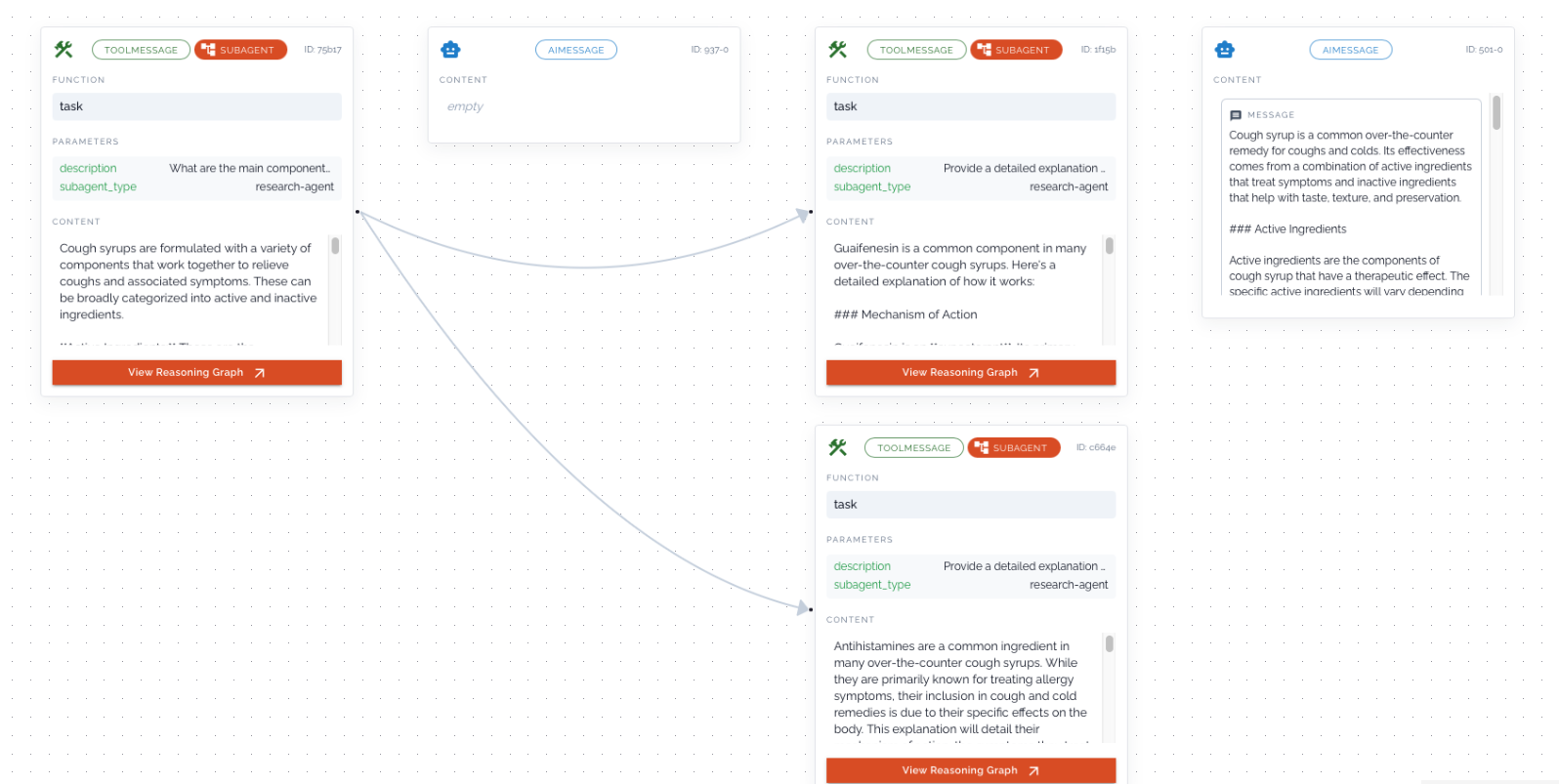
Currently, agentvis generates reasoning graphs for both single-agent and multi-agent systems. Multi-agent setups can provide deeper insights, especially as many modern AI applications are increasingly moving toward autonomous agent architectures.
At the moment, we also attempt to surface certain connections that help explain what may have influenced the LLM to choose a particular tool call. These insights can help identify shortcomings or missing context in prompts or tool outputs.
This project is licensed under the Apache License 2.0.
Download counts and popularity will appear here as the collector receives them.
| Version | Published | Direct dependencies | Open version |
|---|---|---|---|
| 0.1.7 | 12 Mar 2026 | 3 |
This describes our collected data; it is not a security assessment.
Observed since 21 Oct, 08:55 UTC
No superseded metadata states collected. Unchanged observations do not create new revisions.
package:ad3127cb75a255dc9bbad2701ce687606e875b530014169d07cd76b4ba306684