
 Repository
Current collected state Current
Observed since 21 Oct, 08:56 UTC
No superseded metadata states collected. Unchanged observations do not create new revisions.
Observability and mesh layer for multi-agent AI systems — track what your agents decided, why they decided it, and how they're connected.
Agent runtime observability and provenance layer for multi-agent AI systems.
When agents delegate, loop, and fanout across tools and models, the final output tells you nothing. AgentWeave makes the decision chain the first-class artifact — every span carries W3C PROV-O provenance on OpenTelemetry: which agent acted, which model ran, what was consumed, what was generated, and how much it cost.
Three paths to instrumentation: decorators, auto-instrumentation, or zero-code proxy. Any OTLP backend.
agent.nix                          94ms
├── llm.claude-sonnet-4-6          81ms  ← prompt_tokens=847, completion_tokens=312
├── tool.delegate_to_max           312ms
│   └── agent.max                  298ms
│       ├── llm.gemini-2.0-flash   187ms ← prompt_tokens=1203, completion_tokens=89
│       └── tool.web_search         94ms
├── llm.claude-sonnet-4-6          80ms  ← found it
└── tool.deploy_portfolio           48ms
graph LR
    subgraph Agents["Agents — proxy mode"]
        A1["Anthropic Agent"]
        A2["Gemini Agent"]
        A3["OpenAI Agent"]
    end

    SDK["Any Agent — SDK decorators / auto_instrument()"]

    subgraph Proxy["AgentWeave Proxy :4000"]
        P["Multi-Provider Proxy"]
    end

    subgraph LLMs["Upstream LLMs"]
        AN[api.anthropic.com]
        GO[generativelanguage.googleapis.com]
        OA[api.openai.com]
    end

    subgraph Observability
        OT["OTLP Collector — Tempo / Jaeger / Langfuse"]
        GR["AgentWeave Dashboard"]
    end

    A1 -- "ANTHROPIC_BASE_URL" --> P
    A2 -- "GOOGLE_GENAI_BASE_URL" --> P
    A3 -- "OPENAI_BASE_URL" --> P
    SDK -- "OTel spans" --> OT

    P -- "/v1/messages" --> AN
    P -- "/v1beta/models/*" --> GO
    P -- "/v1/chat/completions" --> OA
    P -- "OTel spans" --> OT
    OT --> GR
Three paths to instrumentation:
auto_instrument()) — one call patches Anthropic and OpenAI SDKs. No decorators needed.@trace_agent, @trace_llm, @trace_tool) — wrap your functions directly in Python, TypeScript, or Go. Zero infrastructure needed.
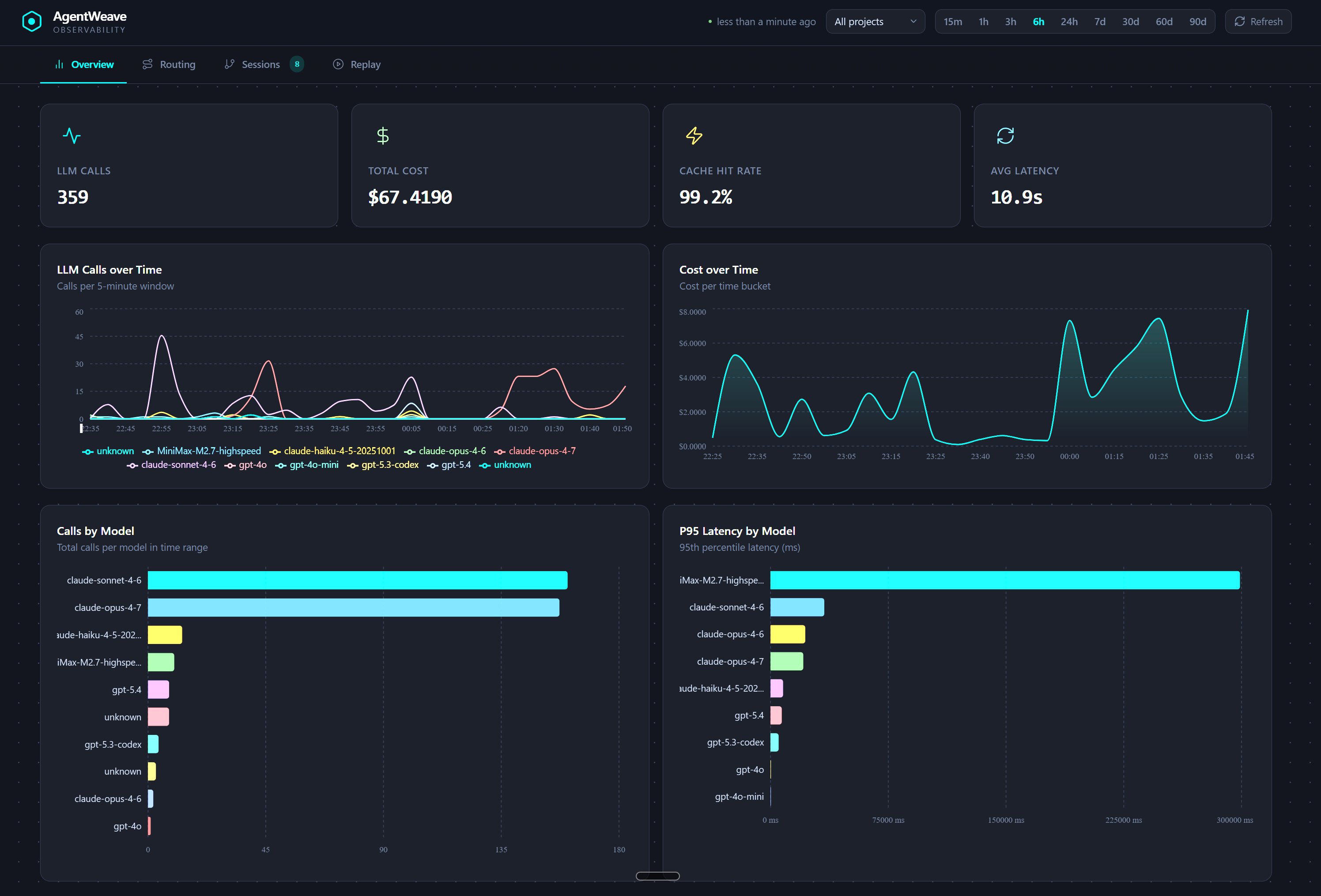
Main dashboard overview (KPIs, latency, token/cost trends, and agent/model breakdowns)
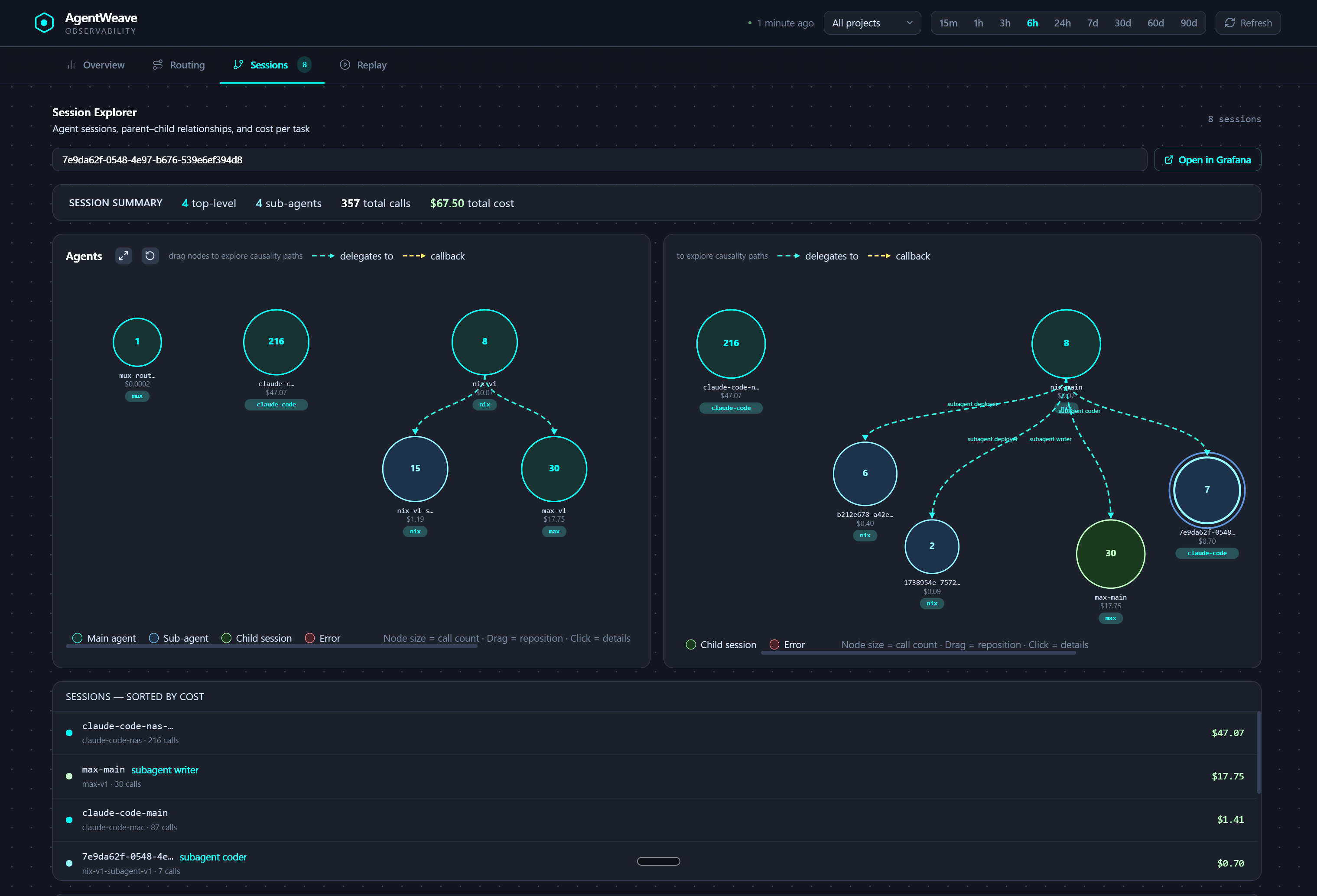
Session explorer view
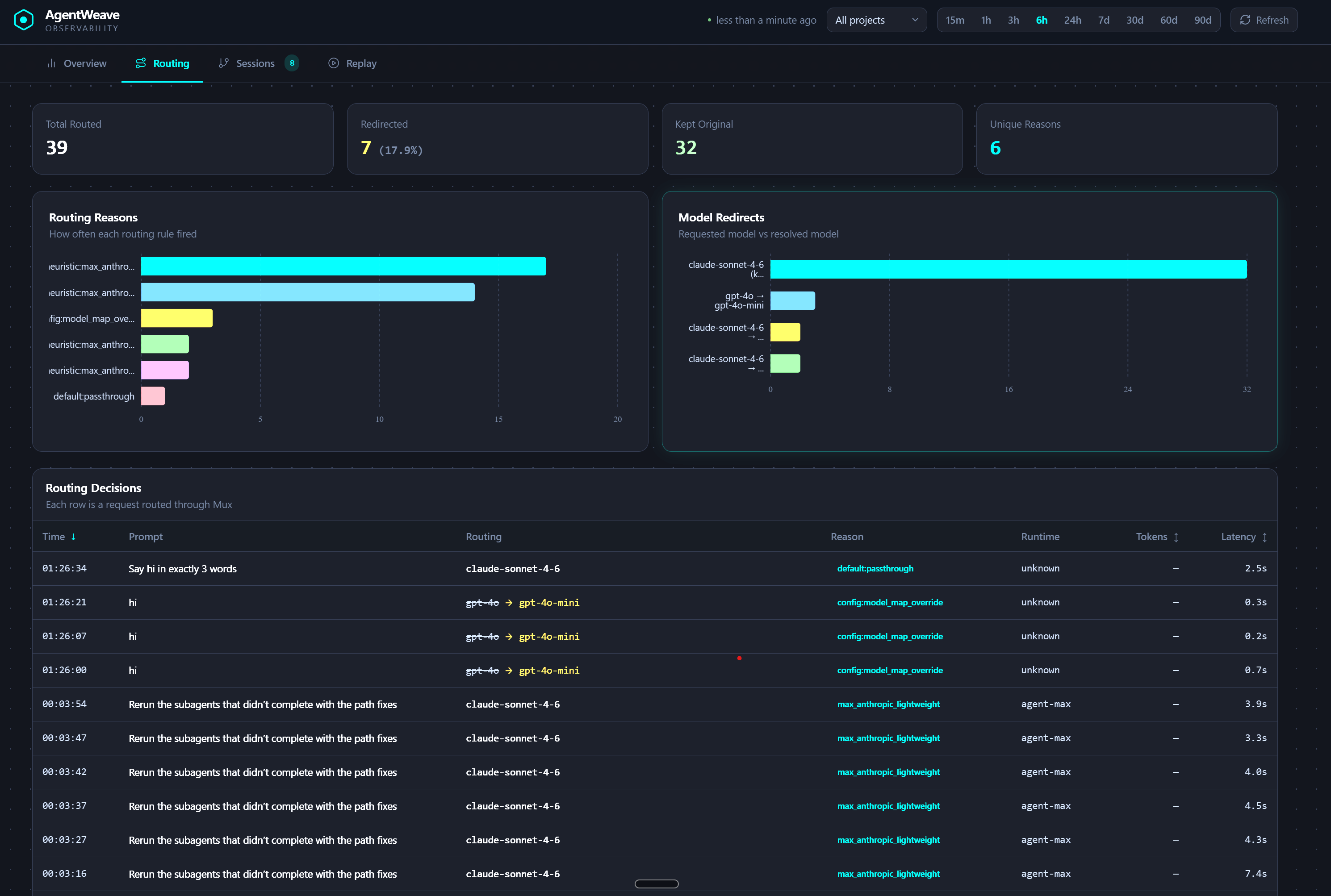
Routing view
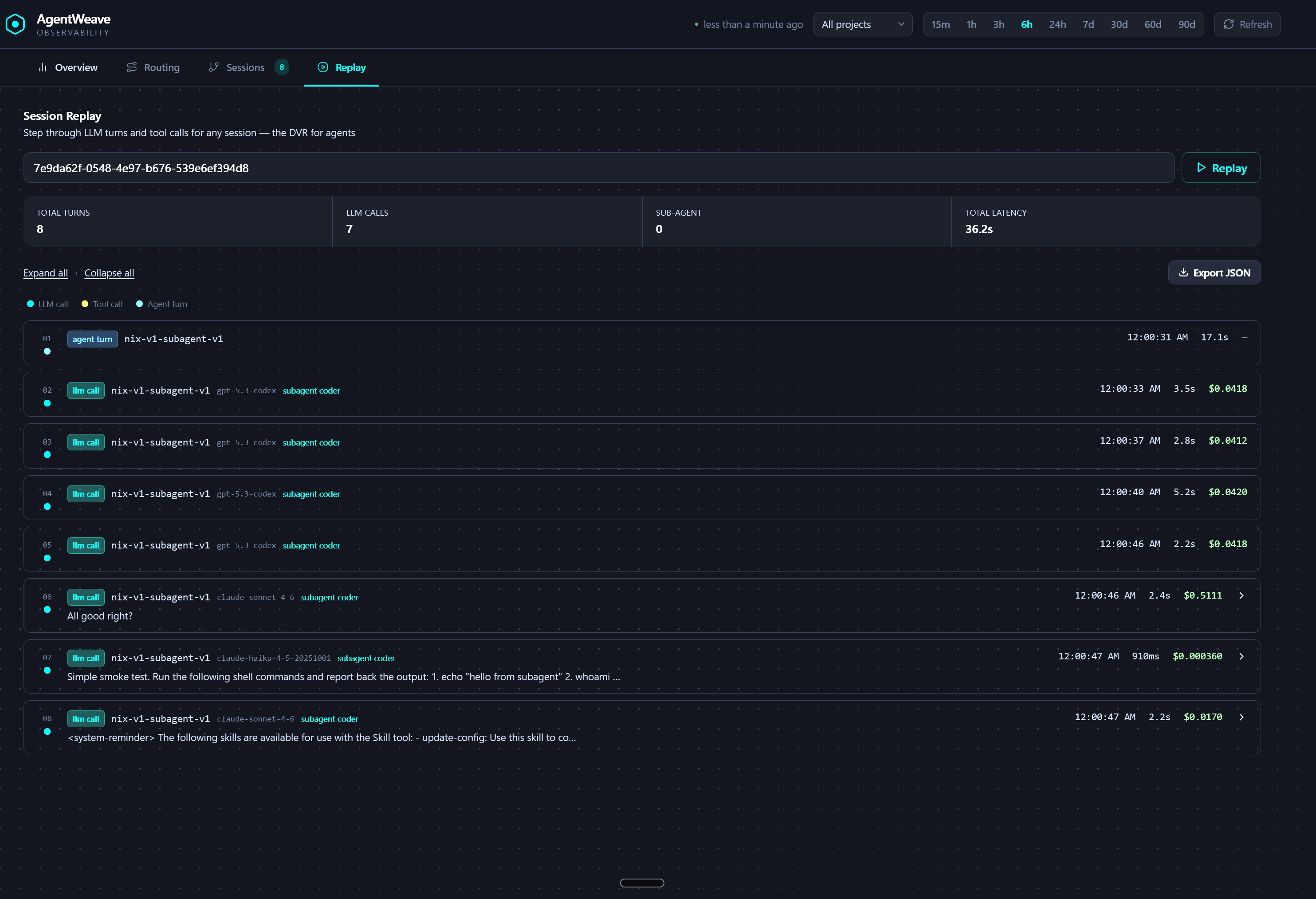
Replay / debug view
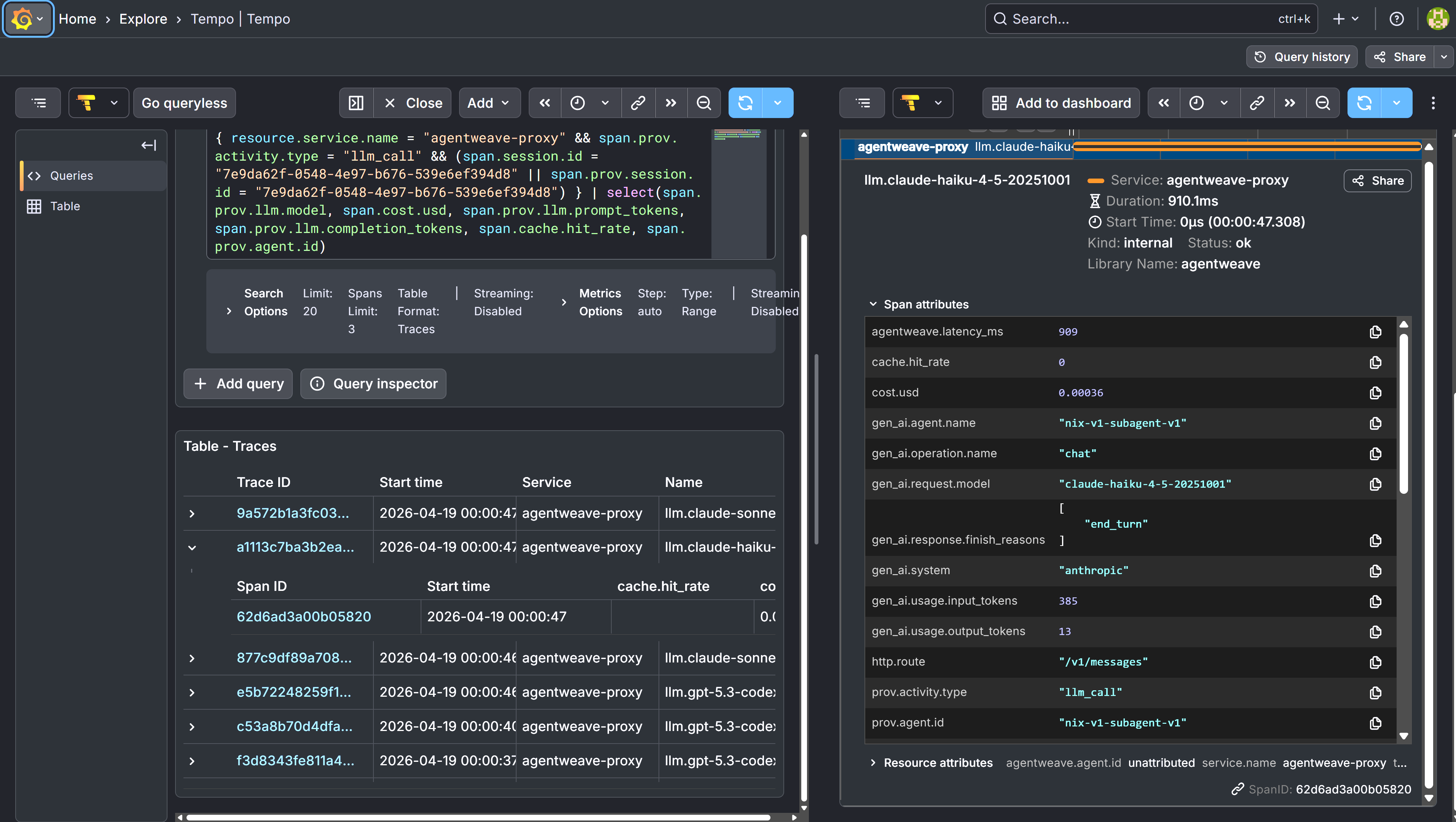
Grafana / Tempo trace view
Tools like OpenLIT, Langfuse, and LangSmith are good at answering: what did my LLM do? Token counts, latency, cost per request, prompt logging. If you have a single agent or a single app making LLM calls, those tools cover the problem well.
AgentWeave answers a different question: what did my agent system do?
When one agent delegates to another across different machines, frameworks, or providers, you lose the thread. A trace that stops at the process boundary tells you nothing about why the overall task failed, which agent introduced the bad output, or where the cost actually went.
| OpenLIT / Langfuse / LangSmith | AgentWeave | |
|---|---|---|
| Single-agent LLM tracing | Great | Basic |
| Cost and token tracking per request | Great | Supported |
| Prompt management, evals, playground | Yes (varies) | Out of scope |
| Cross-agent delegation traces | No | Core feature |
| Traces spanning multiple machines | No | Core feature |
| Proxy-based, zero code changes | No | Yes |
| Open source, self-hosted, no SaaS tier | Varies | Yes (MIT) |
The intended use: run OpenLIT or Langfuse inside each agent for deep per-agent observability, and point them all at AgentWeave for the system view above that. The delegation graph, cross-agent cost rollups, and traces that span process boundaries are what AgentWeave adds.
No cloud, no SaaS, no enterprise tier. Just the tool.
AgentWeave is in developer preview. Start with a local proxy and a local OTLP collector; private dogfood deployments live in runbooks, not in the public quickstart.
| SDK | Language | Install |
|---|---|---|
| sdk/python | Python | pip install agentweave-sdk |
| sdk/js | TypeScript / JavaScript | npm install agentweave-sdk |
| sdk/go | Go | go get github.com/arniesaha/agentweave-go |
pip install "agentweave-sdk[proxy]"
agentweave proxy start --port 4000 --endpoint http://localhost:4318
export ANTHROPIC_BASE_URL=http://localhost:4000/v1
Use your normal provider API key in the client environment. Proxy-side key injection and private NodePort URLs are dogfood-only conveniences, not required for the public developer-preview path.
from agentweave import auto_instrument

auto_instrument()  # patches Anthropic + OpenAI SDKs automatically

# Every client.messages.create() and client.chat.completions.create()
# now emits OTel spans with token counts — no wrappers needed.
from agentweave import AgentWeaveConfig, trace_agent, trace_llm, trace_tool

AgentWeaveConfig.setup(
    agent_id="my-agent-v1",
    agent_model="claude-sonnet-4-6",
    otel_endpoint="http://localhost:4318",
)

@trace_llm(provider="anthropic", model="claude-sonnet-4-6",
           captures_input=True, captures_output=True)
def call_claude(messages: list) -> ...:
    return client.messages.create(...)

@trace_tool(name="web_search", captures_input=True, captures_output=True)
def web_search(query: str) -> str:
    ...

@trace_agent(name="my-agent")
async def handle(message: str) -> str:
    response = call_claude(messages=[{"role": "user", "content": message}])
    return web_search(response.content[0].text)
All three spans link to the same trace ID. Open any OTLP backend and you see the waterfall.
| Framework | Example |
|---|---|
| LangGraph | examples/langgraph |
| CrewAI | examples/crewai |
| AutoGen | examples/autogen |
| OpenAI Agents SDK | examples/openai-agents-sdk |
Patch LLM SDK client methods with a single call — no decorators needed.
from agentweave import auto_instrument, uninstrument

auto_instrument()                              # patch all detected SDKs
auto_instrument(providers=["anthropic"])        # selective
auto_instrument(captures_output=True)          # include response preview

uninstrument()                                 # restore originals
Messages.create) and OpenAI (Completions.create), sync + async@trace_llm — auto-instrumentation detects existing spans and skips to avoid double-tracingauto_instrument() twice is safe@trace_agentRoot span for an agent turn. Nests all downstream tool and LLM calls.
@trace_agent(name="nix")
def handle(message: str) -> str: ...
Pass session_id to group all spans from a single user conversation together.
The value is attached as session.id on every span, making it a filterable
dimension in Grafana / Tempo.
@trace_agent(name="nix", session_id="conv-abc123")
def handle(message: str) -> str: ...
The proxy also accepts the X-AgentWeave-Session-Id header for zero-code
session tagging — see docs/session-grouping.md.
@trace_toolSpan for any tool call — file ops, API calls, shell commands, A2A delegation.
@trace_tool(name="delegate_to_max", captures_input=True, captures_output=True)
def delegate_to_max(task: str) -> dict: ...
@trace_llmSpan for LLM invocations. Auto-extracts token counts and stop reason from Anthropic, OpenAI, and Google Gemini response shapes.
@trace_llm(provider="anthropic", model="claude-sonnet-4-6", captures_output=True)
def call_claude(messages: list) -> anthropic.Message: ...
Captured automatically:
prov.llm.prompt_tokens / prov.llm.completion_tokens / prov.llm.total_tokensprov.llm.stop_reasonprov.llm.response_preview (first 512 chars, when captures_output=True)When agents delegate to sub-agents, use the sub-agent attribution parameters to link child sessions to their parent and distinguish agent roles in traces.
# Main agent — tags itself as the root session
@trace_agent(name="nix", session_id="sess-main-123", agent_type="main", turn_depth=1)
def main_agent(msg: str) -> str:
    return delegate_to_sub(msg)

# Sub-agent — linked to parent session
@trace_agent(name="max", parent_session_id="sess-main-123",
             agent_type="subagent", turn_depth=2)
def sub_agent(task: str) -> str:
    return call_llm(task)
Set AGENTWEAVE_PARENT_SESSION_ID and the SDK auto-populates prov.parent.session.id, defaults agent_type to "subagent", and turn_depth to 2:
export AGENTWEAVE_PARENT_SESSION_ID=sess-main-123
When using the proxy, pass sub-agent context via HTTP headers:
| Header | Span attribute | Example |
|---|---|---|
X-AgentWeave-Parent-Session-Id | prov.parent.session.id | sess-main-123 |
X-AgentWeave-Agent-Type | prov.agent.type | subagent |
X-AgentWeave-Turn-Depth | prov.session.turn | 2 |
import { traceAgent } from 'agentweave-sdk';

const subAgent = traceAgent({
  name: 'max',
  parentSessionId: 'sess-main-123',
  agentType: 'subagent',
  turnDepth: 2,
})(async (task: string) => {
  return callLlm(task);
});
| Attribute | Description |
|---|---|
prov.parent.session.id | ID of the parent session that spawned this sub-agent |
prov.agent.type | "main", "subagent", or "delegated" |
prov.session.turn | Turn depth: 1 = main session, 2 = first-level sub-agent |
| Attribute | Description |
|---|---|
prov.activity.type | tool_call, agent_turn, or llm_call |
prov.agent.id | Agent identifier |
prov.agent.model | Model name |
prov.used | Serialized inputs consumed by the activity |
prov.wasGeneratedBy | Output produced by the activity |
prov.wasAssociatedWith | Agent responsible for the activity |
prov.llm.provider | anthropic, openai, or google |
prov.llm.prompt_tokens | Input token count |
prov.llm.completion_tokens | Output token count |
prov.llm.total_tokens | Total tokens |
prov.llm.stop_reason | Why the model stopped |
prov.task.label | Human-readable label for the task this agent is executing |
Full schema: sdk/python/agentweave/schema.py
For agents you can't instrument with decorators (Claude Code, Node.js, any runtime), run the AgentWeave proxy — a transparent HTTP server that sits between your agents and their LLM providers. Works with Claude Code out of the box — just set ANTHROPIC_BASE_URL in ~/.claude/settings.json (setup guide).
pip install "agentweave[proxy]"
agentweave proxy start --port 4000 --endpoint http://localhost:4318 --agent-id my-agent

# Point agents at the proxy — no code changes needed
export ANTHROPIC_BASE_URL=http://localhost:4000
export GOOGLE_GENAI_BASE_URL=http://localhost:4000
export OPENAI_BASE_URL=http://localhost:4000
OpenAI/Codex streaming note:
/v1/chat/completions needs stream_options.include_usage=true for token usage/v1/responses and /codex/responses do not support stream_options; usage should arrive in the final response.completed eventOne port, all providers. Every LLM call gets a span automatically.
Docker / k8s setup: see
deploy/docker/Dockerfile
AgentWeave emits standard OTLP HTTP — works with any compatible backend:
| Backend | Endpoint |
|---|---|
| Grafana Tempo | http://tempo:4318 — recommended for self-hosted |
| Jaeger | http://jaeger:4318 |
| Langfuse v3 | https://cloud.langfuse.com/api/public/otel |
| Console (dev) | from agentweave import add_console_exporter; add_console_exporter() |
| Topic | Doc |
|---|---|
| Claude Code proxy setup | docs/claude-code-proxy.md |
| Session grouping | docs/session-grouping.md |
| Proxy setup | docs/proxy-setup.md |
| Production hardening | docs/production-hardening.md |
| Provider compatibility | docs/compatibility.md |
| Deterministic trace IDs | docs/deterministic-trace-ids.md |
| Span linking design | docs/span-linking-design.md |
| Proxy benchmarks | docs/benchmarks.md |
| Versioning policy | docs/versioning.md |
git clone https://github.com/arniesaha/agentweave && cd agentweave
pip install -e "./sdk/python[dev]"

pytest sdk/python                                    # 237 Python tests
(cd sdk/js && npm ci && npx jest --verbose)           # 10 TypeScript tests
(cd sdk/go && go test ./... -v)                       # 4 Go tests
MIT
Download counts and popularity will appear here as the collector receives them.
| Version | Published | Direct dependencies | Open version |
|---|---|---|---|
| 0.3.1 | 28 May 2026 | 13 |
This describes our collected data; it is not a security assessment.
Observed since 21 Oct, 08:56 UTC
No superseded metadata states collected. Unchanged observations do not create new revisions.
package:b5e4fb011efe2fc907a0eca7500017361345df4cb18c031ce3b81a023914c167