

 Repository
Current collected state Current
Observed since 21 Oct, 09:01 UTC
No superseded metadata states collected. Unchanged observations do not create new revisions.
The tool is used for building and driving workflows specifically tailored for AI initiatives. It can be used to construct AI agents.


Agere is a lightweight framework for building and driving AI agents or applications based on task flows. By defining specific jobs or handlers, Agere can automatically organize and execute complex task flows.
Agere has no third-party dependencies.
pip install agere
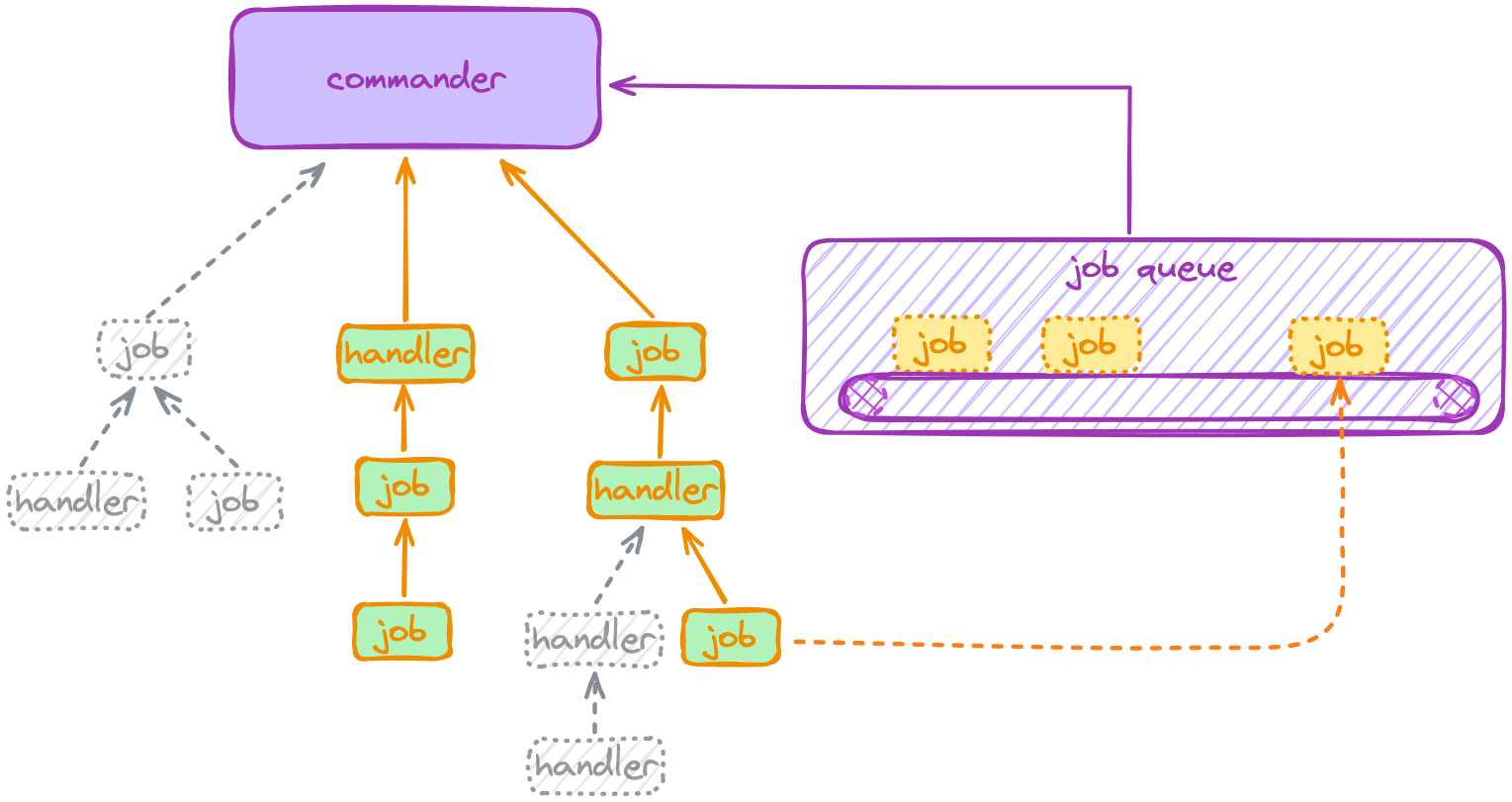
Includes Commander, Job, and handler. Each TaskNode has one parent and 0-n children. These nodes form a tree structure, where each node determines its own task completion based on the status of all its child nodes.
Commander is responsible for organizing and scheduling task flows, managing an asynchronous Job queue. It is the top-level TaskNode.
Job is a class, it is automatically scheduled by the Commander and managed in an asynchronous queue, ensuring sequentiality. Each Job has a task method, which wraps the actual task of the Job. Jobs can submit new Jobs or call handlers. You can think of it as submitting tasks to a superior.
Handler is a method or function. Called directly by the caller without queue waiting, but it is still a part of the TaskNode system. A handler can submit new Jobs or call other handlers. You can think of it as delegating tasks to subordinates.
Callbacks can be added at various stages of a task, such as: task start, task completion, encountering exceptions, task termination, Commander ending, etc.
For example, if you want to build an application where multiple AI roles participate in a group chat, it can be broken down into the following task units. (Assuming we call llm in a streaming manner to get replies. The reply object mentioned here refers to the iterable object obtained when calling llm, meaning that the information of an exchange is determined, but the actual generation and receipt of the information may not have started yet and needs to be completed in the subsequent iteration.)
This application uses a preemptive chat method, as opposed to a turn-based multi-round dialogue mechanism, to mimic real-life multi-person chat scenarios. By breaking down the complex task into two Jobs and two handlers, the Commander can automatically organize and execute the task. In this way, you only need to focus on what to do next, without needing to plan globally, effectively reducing the difficulty of building complex processes. The specific implementation of this process can be referred to in the example code: openai_group_talk.
This project is licensed under the MIT License.
Note: This library is migrated from the commander in gptui's kernel.
Download counts and popularity will appear here as the collector receives them.
| Version | Published | Direct dependencies | Open version |
|---|---|---|---|
| 0.2.0 | 27 Jan 2024 | 0 |
This describes our collected data; it is not a security assessment.
Observed since 21 Oct, 09:01 UTC
No superseded metadata states collected. Unchanged observations do not create new revisions.
package:eac1f92832529be3acf04e0ccd6e17701b9e074392f2b6ac396c1c62c1b3cf84