
 Repository
Current collected state Current
Observed since 21 Oct, 10:38 UTC
No superseded metadata states collected. Unchanged observations do not create new revisions.
Vendor-neutral local guardrails for AI engineering workstations


AI Engineering Guardrails is a local, vendor-neutral toolkit for applying consistent guidance, skills and narrow checks across OpenAI Codex, Claude Code, Cursor, GitHub Copilot in VS Code and Visual Studio, and JetBrains AI Assistant/Copilot.
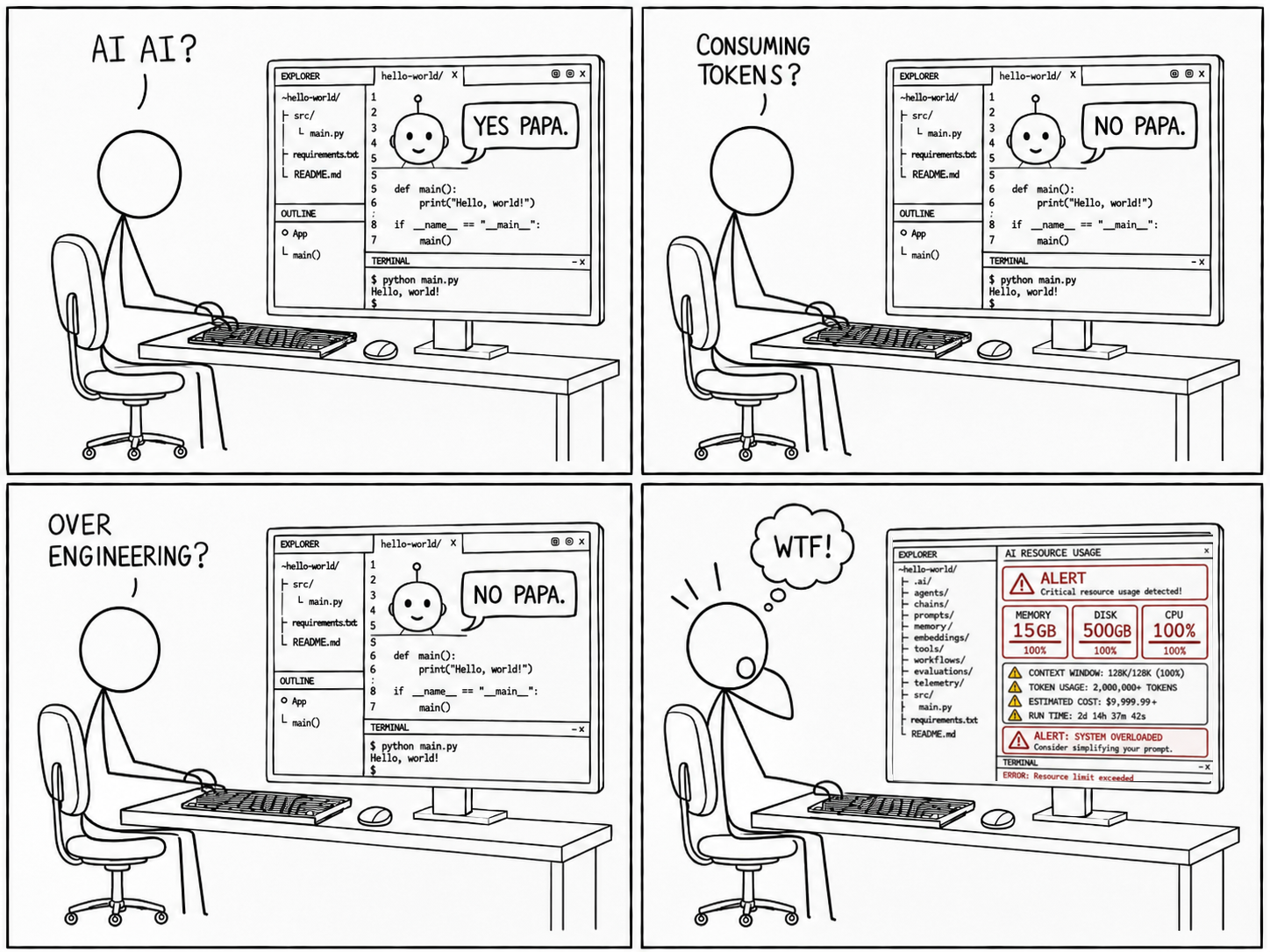
It renders one canonical policy for each supported product. Its deliberately limited aim is to help agents inspect first, preserve user work, avoid secrets and destructive operations, verify changes, and report what happened. Think of it as a seatbelt, not a committee meeting.
This is defence in depth, not a replacement for product approvals, sandboxing, operating-system permissions, branch protection, cloud IAM, Kubernetes RBAC, or a human release decision.
Python 3.11+ is required. Install the published package with pipx and preview before writing anything. Do not use sudo, Administrator, or an elevated shell.
pipx install ai-engineering-guardrails

ai-guardrails install --dry-run
ai-guardrails install
ai-guardrails status
For contributor work or a reviewed local checkout instead:
git clone https://github.com/ZarrenSpryXplor/ai-engineering-guardrails.git
cd ai-engineering-guardrails
pipx install .
The default install detects local supported products, uses no cloud login, and changes no main model, approval setting, sandbox, network setting, routing profile, or terminal decoration. If no product is detected, it makes no change and prints the explicit command to use.
For a direct Git install, pin a reviewed tag or full commit rather than a moving branch:
pipx install 'git+https://github.com/ZarrenSpryXplor/ai-engineering-guardrails.git@<reviewed-tag-or-full-commit>'
The package is published on PyPI through Trusted Publishing. Maintainers should follow the release guide for protected approvals, version/tag checks, and provenance.
Terminal visibility is opt-in. Claude Code can use a managed local status line; Codex uses its native /statusline fields; Cursor CLI keeps its documented /status-indicators control.
ai-guardrails statusline preview --product all --profile standard
ai-guardrails statusline install --product all --profile standard --dry-run
ai-guardrails statusline install --product all --profile standard
ai-guardrails activity --since 24h
ai-guardrails receipt --compact
Routing is also opt-in. It installs static, bounded roles; it does not classify prompts, choose a model at runtime, or grant authority.
ai-guardrails routing show --profile balanced --product codex
ai-guardrails routing set balanced --product codex --dry-run
ai-guardrails routing set balanced --product codex
Assurance tools stay local and offline. They inspect metadata, repository state, supplied reports, and bounded component files; they do not run analyzers, execute downloaded instructions, or award a magical “all bugs gone” sticker.
ai-guardrails policy audit
ai-guardrails task init --repo . --dry-run
ai-guardrails component inspect ./reviewed-skill
ai-guardrails skills audit
ai-guardrails docs audit --path README.md
See evidence and assurance for task setup, report comparison, trust records, and the limits of each result.
The operator documentation hub is the durable entry point. It gives each audience one place to start instead of making this README do every job.
| If you need to… | Read… |
|---|---|
| Install, update, recover, inspect state, or use waivers | Quick user guide and operations |
| Understand product versions, paths, and limitations | Compatibility |
| Enable terminal UX, activity, complexity, receipts, or demo mode | Terminal UX |
| Audit policy evidence, use a task contract, or inspect an external skill/instruction | Evidence and assurance |
| Delegate bounded work safely | Routing and cost |
| Use or extend language and infrastructure support | Capability packs and skills catalogue |
| Write or review substantive technical documentation | Technical writing and skills catalogue |
| Change canonical policy or understand the design | Policy authoring and architecture |
| Review threat boundaries and enterprise examples | Threat model, enterprise output, and Spacelift |
The project is MIT licensed. It makes no claim to be a universal security boundary or to save a particular amount of money, time, or tokens.
Download counts and popularity will appear here as the collector receives them.
| Version | Published | Direct dependencies | Open version |
|---|---|---|---|
| 1.4.0 | 13 Aug 2026 | 1 |
This describes our collected data; it is not a security assessment.
Shared repository data · GitHub
Observed since 21 Oct, 10:38 UTC
No superseded metadata states collected. Unchanged observations do not create new revisions.
package:ea9260ac07ad048a5ff739f3a0c34733af422c7afa348dfaabbac16deab6d88d