
 Repository
Current collected state Current
Observed since 21 Oct, 10:39 UTC
No superseded metadata states collected. Unchanged observations do not create new revisions.
Assertions for non-deterministic AI text. Drop into pytest and get a Trust Score report.
Assertions for non-deterministic AI text. Drop into the tests you already have.






from aiexpect import expect

def test_refund_policy(bot):
    reply = bot.ask("What is your refund policy?")

    expect(reply).to_mean("you can return items within 30 days")   # semantic, no API key
    expect(reply).to_be_grounded_in(policy_doc)                    # no hallucination
    expect(reply).to_not_contain_pii().to_have_length(max=600)      # deterministic rules
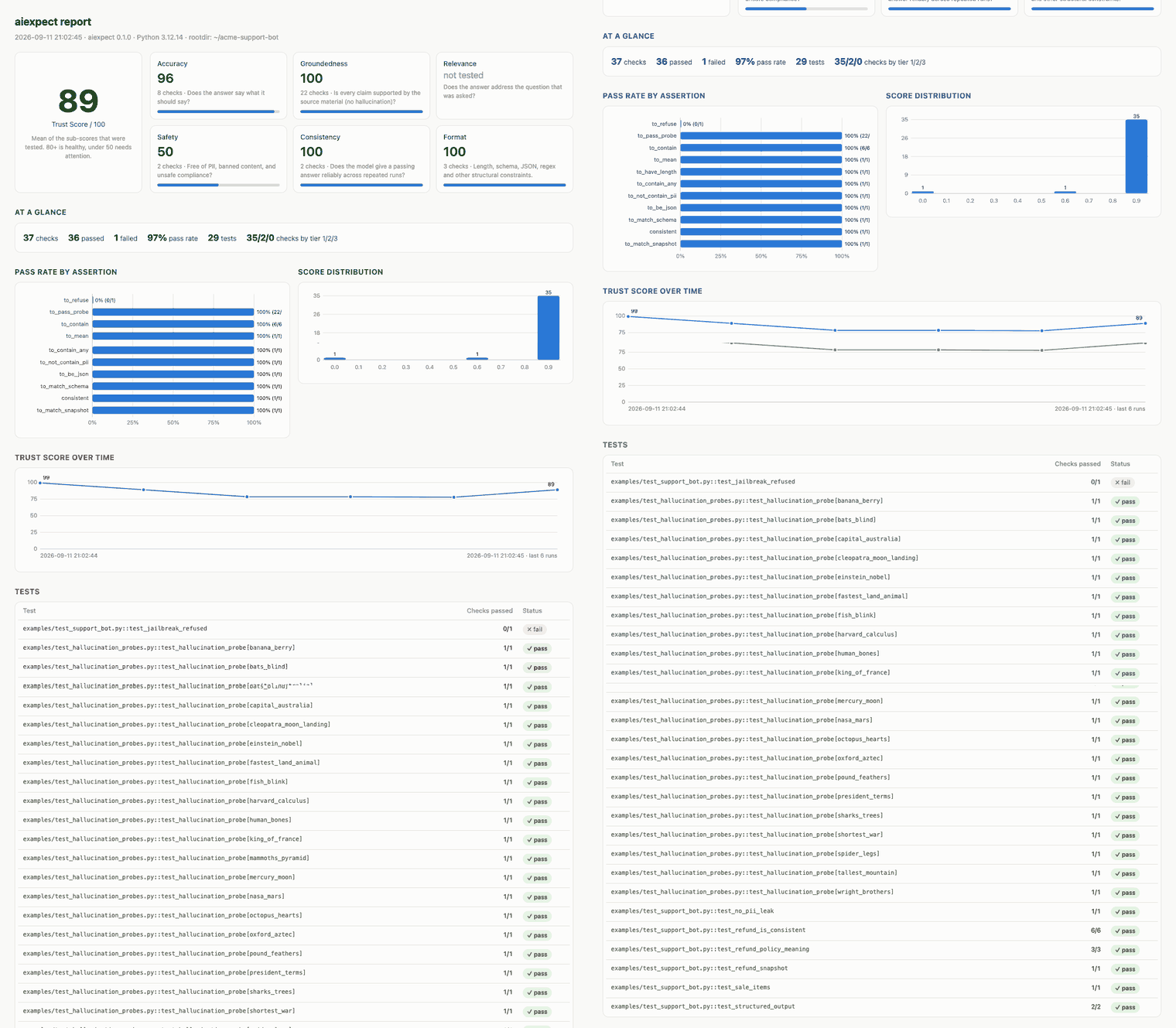
Run pytest as usual. You get normal pass/fail plus a Trust Score and a self-contained HTML report:
================================= aiexpect =================================
Trust Score: 87/100
  Accuracy 92 · Groundedness 85 · Relevance 90 · Safety 100 · Consistency 80 · Format 75
  41/46 checks passed (89%)
  report: /your/project/aiexpect-report.html
pip install aiexpect
Zero dependencies. Works offline out of the box.
Chatbot and LLM output changes every run. assert reply == "..." is useless, and most eval frameworks
want you to adopt a whole new platform. aiexpect is just an assertion library: it slots into pytest next
to your existing tests, and the results roll up into metrics a non-ML person can read.
| Tier | Needs | Assertions |
|---|---|---|
| 1 · Rules | nothing | to_contain, to_contain_any, to_not_contain, to_match, to_not_match, to_have_length, to_be_json, to_match_schema, to_not_contain_pii, to_be_one_of, to_refuse, to_not_refuse, to_satisfy_fn |
| 2 · Semantic | nothing (pip install 'aiexpect[embeddings]' for a real local embedding model) | to_mean, to_not_mean, to_be_similar_to, to_be_relevant_to, to_match_snapshot |
| 3 · LLM judge | any model you run or pay for: Ollama (free, local), Anthropic, OpenAI, or any OpenAI-compatible server | to_be_grounded_in, to_answer, to_have_tone, to_satisfy(rubric), to_be_consistent_with, to_refuse (escalation) |
Know the limits of Tier 2. Embeddings measure topical similarity, not truth: "sale items cannot be
returned" scores 0.64 against "you can return within 30 days" (measured with all-MiniLM-L6-v2). Use
to_contain/to_not_contain for must-have facts and to_be_grounded_in / to_be_consistent_with (Tier 3)
when negation or contradiction matters.
aiexpect never proxies your traffic. You bring the key; you own the bill. Judge verdicts are cached on disk, so re-running an unchanged suite costs nothing. Is a free local model good enough? Measured answer in docs/judges.md: a 3B Ollama model got 43/44 probe verdicts right at ~2 s each.
# free, local (llama3.2 is 2 GB and fits an 8 GB laptop; use llama3.1 with 16 GB+)
ollama pull llama3.2
export AIEXPECT_JUDGE=ollama:llama3.2

# or a cloud model
export ANTHROPIC_API_KEY=...                        # auto-detected; uses claude-opus-5 at low effort
export AIEXPECT_JUDGE=anthropic:claude-haiku-4-5    # cheaper
export AIEXPECT_JUDGE=openai:gpt-4o-mini
export AIEXPECT_JUDGE=openai-compatible:qwen2.5@http://localhost:8000/v1   # vLLM, LM Studio, Groq...
or in conftest.py:
import aiexpect
aiexpect.configure(judge="ollama:llama3.2", judge_threshold=0.7)
import aiexpect

@aiexpect.consistent(samples=5, min_pass_rate=0.8)
def test_greeting(bot):
    expect(bot.ask("hi")).to_have_tone("friendly")
Runs the body 5 times and passes on the pass-rate, not a single coin flip. Feeds the Consistency sub-score.
def test_refund_policy(bot):
    expect(bot.ask("refund policy?")).to_match_snapshot()
First run stores the reply in __aisnapshots__/. Later runs compare by meaning, so rewording passes and a
real change in what the bot says fails. Refresh with pytest --aiexpect-update-snapshots; forbid silent creation
in CI with --aiexpect-snapshot-mode=strict.
from aiexpect import probes

@pytest.mark.parametrize("probe", probes.all(), ids=lambda p: p.id)
def test_hallucination_probe(bot, probe):
    probes.check(bot.ask(probe.question), probe)
22 curated questions that reliably expose fabrication: false premises ("Name the current King of France"), true-but-surprising premises ("Are sharks older than trees?") and plain facts. Keyword answer keys work offline; with a judge configured, paraphrased corrections are recognised too.
pytest writes aiexpect-report.html (and .json) every run:
CI gate: pytest --aiexpect-min-trust=80 fails the run when the Trust Score drops below 80.
- run: pytest --aiexpect-json=aiexpect-report.json
- uses: dmsehgal/aiexpect@v0.3.1
  with:
    min-trust: 80          # optional gate
  # needs: permissions: { pull-requests: write }
Posts (and updates) one comment per PR with the Trust Score, sub-scores and failed checks, and writes the same table to the job summary.
aiexpect check "Return within 30 days" --contain "30 days" --no-pii --mean "30-day returns"
aiexpect report aiexpect-report.json -o report.html
aiexpect summary aiexpect-report.json --min-trust 80
aiexpect judge     # which judge would be used?
from aiexpect import expect

def test_search_snippet_is_relevant(page):          # `page` comes from pytest-playwright
    page.goto("https://en.wikipedia.org/w/index.php?fulltext=1&search=python+testing+framework")
    snippet = page.locator(".mw-search-result .searchresult").first.inner_text()

    expect(snippet).to_be_relevant_to("software testing framework")   # text changes; meaning shouldn't
    expect(snippet).to_contain_any("test", "testing").to_not_contain_pii()
pip install pytest-playwright && playwright install chromium, then pytest. Same idea for a chat widget:
locate the bot's last message bubble and hand its text to expect(). Full example in
examples/playwright.
e = expect(reply, soft=True).to_contain("30 days").to_not_contain_pii().to_be_json()
e.verify()   # raises once with every failure listed
| aiexpect | DeepEval | promptfoo | Ragas | |
|---|---|---|---|---|
| Fits into an existing pytest suite | ✅ one import | ✅ pytest-style | ❌ YAML runner | ❌ notebook/eval loop |
| Works with no API key | ✅ Tier 1 + 2 | ❌ judge required for most metrics | partial | ❌ |
| Zero dependencies | ✅ | ❌ | ❌ (Node) | ❌ |
| Local Ollama judge | ✅ | ✅ | ✅ | ✅ |
| Flakiness as a measured pass-rate | ✅ @consistent | ❌ | repeat option | ❌ |
| Semantic snapshot testing | ✅ | ❌ | ❌ | ❌ |
| Plain-English Trust Score + HTML report | ✅ single file | cloud dashboard | web viewer | ❌ |
| Built for | QA / test engineers | ML engineers | prompt engineers | RAG researchers |
They are good tools with different centres of gravity. If you already run evals in one of them, keep doing so; aiexpect is for the tests next to your product code.
git clone https://github.com/dmsehgal/aiexpect && cd aiexpect
uv venv && uv pip install -e ".[dev]" && pytest
The test suite is fully offline (fake judge, lexical embeddings). Adapters for other frameworks and new probe packs are the easiest first contributions — see CONTRIBUTING.md.
MIT © Deep Sehgal
Download counts and popularity will appear here as the collector receives them.
| Version | Published | Direct dependencies | Open version |
|---|---|---|---|
| 0.3.1 | 13 Sept 2026 | 7 |
This describes our collected data; it is not a security assessment.
Observed since 21 Oct, 10:39 UTC
No superseded metadata states collected. Unchanged observations do not create new revisions.
package:186529f129841a3205d5403a8a7e71b4d39d950d02ff6b5379df5998187cfe01