
 Repository
Current collected state Current
Observed since 21 Oct, 11:24 UTC
No superseded metadata states collected. Unchanged observations do not create new revisions.
Real-world energy per solved task for AI coding agents
Miles per gallon for AI coding. See what your AI coding agent really costs in energy, money and CO₂, find out what would cut it, and test whether tools and models live up to their claims on your code.
uvx aimpg report
New here? aimpg in 5 minutes walks you from install to your first numbers, the live status line, and your team's GitHub Action, with copy buttons for every command.
Using it as a GitHub Action? Add uses: kumarganduri/aimpg@v0.6.3 to a workflow and every pull request shows its AI cost, and every week your team's cost per working change. Copy the workflow from Team numbers, without a server.
YOUR AI CODING
  Energy   17.31 kWh – 156.95 kWh
  Money    $1,567 at API list prices (Anthropic's and OpenAI's; a subscription costs less)
  Output   454 commits made with AI help

  A typical kept commit:  20.0 Wh – 179.3 Wh · $1.63

WHAT WOULD HAVE SAVED THE MOST (measured on your logs; upper bounds that overlap)
  1. Start a fresh session after each commit: up to 41%–46% less energy, up to $457
     57% of the tokens your agents processed were conversation carried over from before your last commit.
     A fresh session has to rebuild some context, which isn't counted here, so the real saving is smaller.
     → After committing, start a new session (or /clear) for the next task, and give it a one-line summary if needed.
  2. Use a mid-size model for routine work: up to 17% less energy, $408
     95% of your AI energy ran on the largest models (Opus/Fable class).
     → Try Sonnet for routine fixes; check it's good enough on your own commits with `aimpg replay` (model picker).

WORKING CHANGES (commits that shipped and lasted 30 days)
  Available on 2026-10-13: aimpg is keeping your history so it can tell.
(Real output from the author's last 30 days.)
uv tool install aimpg && aimpg live install # shows the change, asks y/N, keeps a backup
⚡ task $1.96 · usual $2.05 · ctx 160k (92% from before your last commit) · /clear ≈ -92% per request · 5h 63%
After the agent commits, one line for you only (never sent to the model): "that commit cost $2.40 over 31 AI requests. 92% of the context is from earlier work: /clear before the next task saves ~92% per request." Undo with aimpg live uninstall.
Cursor keeps its token counts online. Download them at cursor.com/dashboard → Usage → Export CSV, then:
aimpg report --cursor-usage ~/Downloads/usage-events.csv --cursor-repo ~/code/myproject
Team export? Add --cursor-user "Your Name" to count only your rows.
aimpg report reads the Claude Code (and Codex CLI) logs already on your machine and ties every AI request to the git commit it produced. Energy is shown as an honest range and translated into kettles, phone charges, EV kilometres and CO₂. Money is the cost at Anthropic's and OpenAI's API list prices; on a subscription you pay less, so read it as the value of the work, not your bill.
aimpg report --share also writes a card to post, with totals only (no repo names, commit messages or code), and prints a one-line post to go with it:
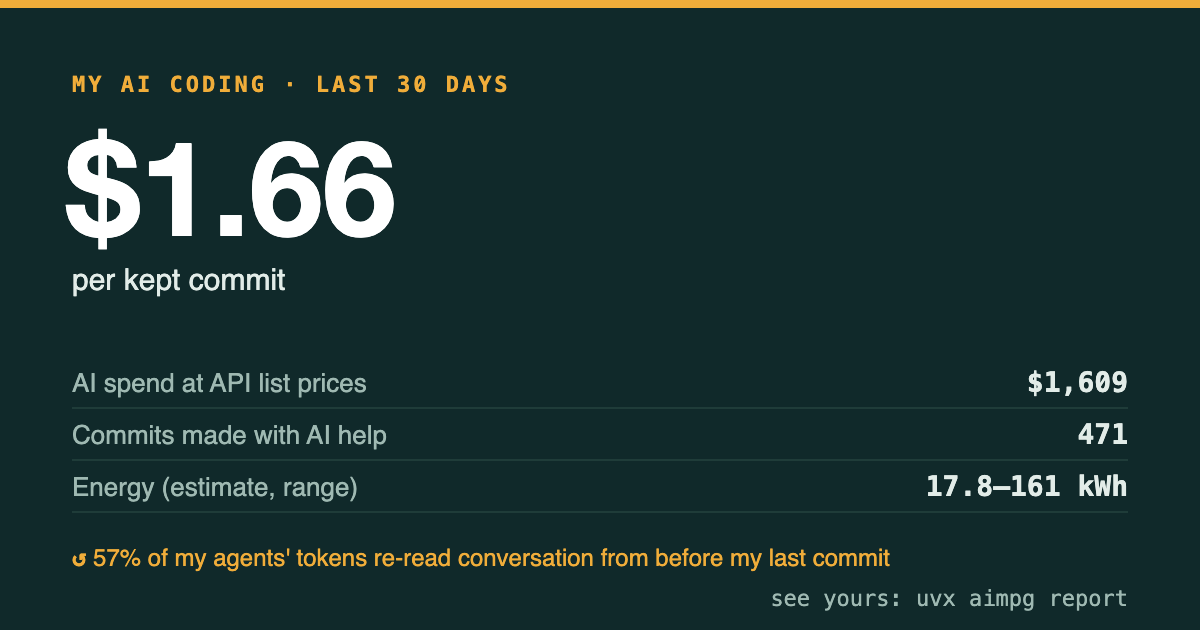
The receipt replays your own logs under "what if" rules and tells you what would have saved the most, in Wh and dollars. For example: how much energy went into re-reading old conversation in long sessions, or into running the biggest model for routine fixes.
aimpg replay select ~/my-repo                      # free: finds commits your tests can judge
aimpg replay models ~/my-repo --cap 15 --task-mode tests
model         solved  $ / solved task  energy per solved task
sonnet         10/10            $0.12  0.5–6.3 Wh ≈ <1 full phone charges
opus           10/10            $0.33  2.0–21.9 Wh ≈ <1–1.3 full phone charges
haiku           8/10            $0.38  3.3–28.0 Wh ≈ <1–1.6 full phone charges

Use sonnet: it solved 100% of tasks (best: 100%) at 3.1x lower cost per solved task than haiku.
(Real result on the author's Legwork repo, 10 commits per model, $7.56 total.) The cheapest model per token was the most expensive per task: Haiku needed about 38 requests and 2.5 minutes per task, where Sonnet needed 7 requests and 25 seconds. Sonnet was cheapest on 9 of the 10 commits.
It re-does your real past commits with each model in a locked sandbox, and your own tests decide what counts as solved.
Make it the team's default: aimpg defaults --repo . reads that evidence and proposes the repo's default model for Claude Code; --apply writes it to .claude/settings.json (it asks first and keeps a backup). Commit it, and everyone on the repo starts with the model your own tests showed is good enough; anyone can still switch with /model.
Token savers, prompts, hooks, CLAUDE.md files, models, even other agents: one command reruns your real commits both ways in a locked sandbox, and your own tests judge them.
aimpg verify --challenger rtk --claim "rtk saves tokens"          # a token saver
aimpg verify --append-prompt "Be terse."                          # your own prompt (or --claude-md / --settings)
aimpg verify --challenger haiku                                   # a cheaper model
aimpg verify --challenger codex:gpt-6.1-sol                       # another agent (needs an OpenAI API key)
aimpg verify --challenger "cmd:aider --yes --message {task}" --hosts api.openai.com --key-env OPENAI_API_KEY
It shows the plan and the worst-case cost, and spends nothing until you type y (default: 10 commits × 2 repeats, $15 cap). The answer is always to one question: does the challenger solve as much, for less?
CLAIM: rtk saves tokens
VERDICT: NOT PROVEN
  · energy difference not proven

  setup                     solved      $ per solved   energy per solved task
  claude-code                36/40             $0.17   0.9–11.8 Wh
  claude-code+rtk            32/40             $0.21   1.1–14.2 Wh

  Energy, same tasks: +10% (interval -11%…+35%, 17 shared solved commits)
That's the real result on the author's Legwork repo: no reliable energy saving shown on one repo (RTK advertises token savings; a larger, pre-registered study across several public repos is under way). Your repo may differ, and now you can check.
Every run writes a record (~/.aimpg/verify/*.record.json) holding versions, both setups, each run's tokens, $ and outcome, and the verdict, but never code, diffs or commit messages. Repo and commits are hashed unless you add --public. Anyone can recheck the math and the record's consistency for free with aimpg verify --check record.json (it can't prove the runs happened), and rerun a public record on their own machine with aimpg verify --rerun record.json --repo <clone>, which first shows every command, hook and prompt the record would run and asks before running them. Private records keep only fingerprints (SHA-256) of your prompts, CLAUDE.md, settings and commands, never the text. Records also list every redone attempt and excluded commit.
Share it: aimpg submit <record> publishes a stripped-down copy on the public scoreboard (no code, prompts, commit ids or repo name). It shows the exact file first and asks, then opens a pull request. Results only count once enough repos and people back them, and only independent reruns make the headline.
Same model: the energy test decides (it must hold at every corner of the energy ranges). Different models or agents: cost per solved task decides, because model sizes are secret. A challenger that solves more than 10 points fewer tasks is never "supported". Codex runs are measured from its own logs and priced from OpenAI's published prices. Codex logs in with an OpenAI API key (a ChatGPT subscription login can't be used inside the sandbox); the key is written to the run's throwaway folder and deleted when the run ends. Other commands are judged on solve rate and time only.
aimpg pr --base main            # markdown summary of this branch's AI energy and cost
aimpg pr --base main --post     # add it as a comment on the open PR (uses gh)
⚡ AI energy for this pull request
73.4 Wh – 564.0 Wh ≈ 4–33 full phone charges · 34–258 g CO₂ · $5.76 API-equivalent
Each developer who opts in shares a small note on their own commits (cost, energy range, request count; never prompts or code) as git notes that travel with the repo:
aimpg notes push # writes notes on your AI-assisted commits and pushes refs/notes/aimpg
Then add the GitHub Action to the repo:
# .github/workflows/aimpg.yml
on:
  pull_request:
  schedule: [{cron: "0 8 * * 1"}]          # weekly team rollup
permissions: {contents: read, pull-requests: write}
jobs:
  aimpg:
    runs-on: ubuntu-latest
    steps:
      - uses: actions/checkout@v4
        with: {fetch-depth: 0}
      - uses: kumarganduri/aimpg@v0.6.3   # or pin a commit SHA: it runs with your repo token
        with:
          mode: ${{ github.event_name == 'pull_request' && 'pr' || 'rollup' }}
          comment: "true"
On pull requests it posts the PR's AI cost ("$4.10 · 0.20–1.90 kWh · 9 model requests"). Weekly, it writes the team's cost per working change, waste ratio and trend to the run summary. Working changes are judged from the repo's own history. Team numbers appear only once at least 5 people share notes (min-group lowers it if your team agrees), and never per person. Anyone with read access to the repo can read the notes.
aimpg export --csv ai-energy.csv --no-subjects --no-authors
One row per AI-assisted commit: date, repo, energy range, CO₂ range and cost. Teams can combine everyone's files. The privacy switches drop commit messages and author emails.
For a standard figure, aimpg sci --json sci.json reports your carbon intensity in the Green Software Foundation's SCI for AI format (Consumer SCI). It uses the spec's units: per million tokens, per AI-assisted commit (a "workflow execution" for agentic AI), and per working change. The JSON lists the boundary, every input with its source, and what's left out. Embodied hardware emissions come from Google's measured per-prompt figures; grid intensity is location-based, because the spec doesn't let offsets or renewable certificates lower the score.
  per million tokens         2.18–21 g CO₂e
  per AI-assisted commit     19.3–185 g CO₂e
  per working change         available from 2026-10-13
report, pr and export run entirely on your machine with no network calls (except --fetch for git fetch, and pr --post, which talks to GitHub). Your code and prompts are never uploaded. Replays send only the agent's own work to the model API, from a sandbox that can't read your home folder.
Matching requests to commits: when the agent runs git commit, the commit lands inside that tool call, so the match is exact. Within a session, requests since the previous commit belong to the next one. Work before a 2h+ break is shown separately as lead-up. Hand-made commits are matched only if you authored them and they touch files the session edited. On the author's history, a hand-labeled check matched 20/20 commits correctly (evals/).
Working changes: aimpg keeps a small history of what each commit cost (never prompts or code), because Claude Code deletes its own logs after 30 days. Once a commit is 30 days old, it is judged: still on the main branch and not reverted or largely rewritten counts as a working change. The receipt then shows cost per working change and a waste ratio (AI spend on work that didn't last).
Energy: an estimate with stated assumption ranges, not a measurement: a physical formula, not a price proxy. Prefill compute for new input, one KV-cache re-read per output token (so long contexts cost more), plus datacenter overhead. Model sizes aren't public, so every number is a range. Overheads follow Google's full-stack measurement of a median Gemini prompt (chips, host CPU and memory, idle capacity, cooling ≈ 1.7× the chips alone), and a chat-sized prompt on a mid-size model comes out at 0.017–0.34 Wh, bracketing Google's disclosed 0.24 Wh (arXiv 2508.15734). Sources for every factor are in aimpg/factors.json, aimpg/prices.json and aimpg/equivalences.json.
Replays: each run starts from the code just before your commit, in a fresh, history-free copy, inside a sandbox (Seatbelt on macOS, bubblewrap on Linux). The only network allowed is the model API, through an allowlisting proxy. Your own tests judge the result, and edited tests are always restored before judging. Every token count is cross-checked against Claude Code's own totals. Details are in docs/designs/aimpg-design.md.
Questions people ask (is it sponsored, are the energy numbers guesses, is it safe to run): see the FAQ.
--cursor-repo and requests are matched to your next own commit there by time alone (shown as "by time only"). Replays and verify need macOS or Linux and an API key (about $0.10–0.30 per run). On Linux install bubblewrap (sudo apt install bubblewrap); Ubuntu 24.04+ also needs a one-time AppArmor rule for bwrap, which aimpg prints if it's missing.report, live and the team commands are untested there; replays and verify need macOS or Linux.--task-mode tests shows the agent the tests, which makes tasks easier than real work but keeps comparisons fair.MIT
Download counts and popularity will appear here as the collector receives them.
| Version | Published | Direct dependencies | Open version |
|---|---|---|---|
| 0.7.0 | 18 Oct 2026 | 0 |
This describes our collected data; it is not a security assessment.
Observed since 21 Oct, 11:24 UTC
No superseded metadata states collected. Unchanged observations do not create new revisions.
package:a115144ef0ad03fdbfcebffc9b9992660b9311b8b0827768d0edd60a7f41a136