
 Repository
Current collected state Current
Observed since 20 Oct, 21:47 UTC
No superseded metadata states collected. Unchanged observations do not create new revisions.
agentdeck-ai
The open game console and Research system for investigating AI behavior
The game console for AI agents.
An open system for putting AI agents inside explicit game worlds, observing what they do, and producing traceable knowledge about their behavior.
Why Games? · Replay · Quick Start · Research Arc · Research Artifacts · Current Boundary · Docs · Examples · Specs · AI-First
AgentDeck turns behavioral questions into explicit, inspectable situations: define a Game or reuse an existing one, compose its Players, run controlled Matches, preserve the canonical event stream, and determine what the resulting Records support.
It is useful when static prompt-response evaluation is not enough. By putting agents inside structured games, AgentDeck makes state, incentives, and resource tradeoffs explicit so behavior is easier to observe, compare, replay, and explain.
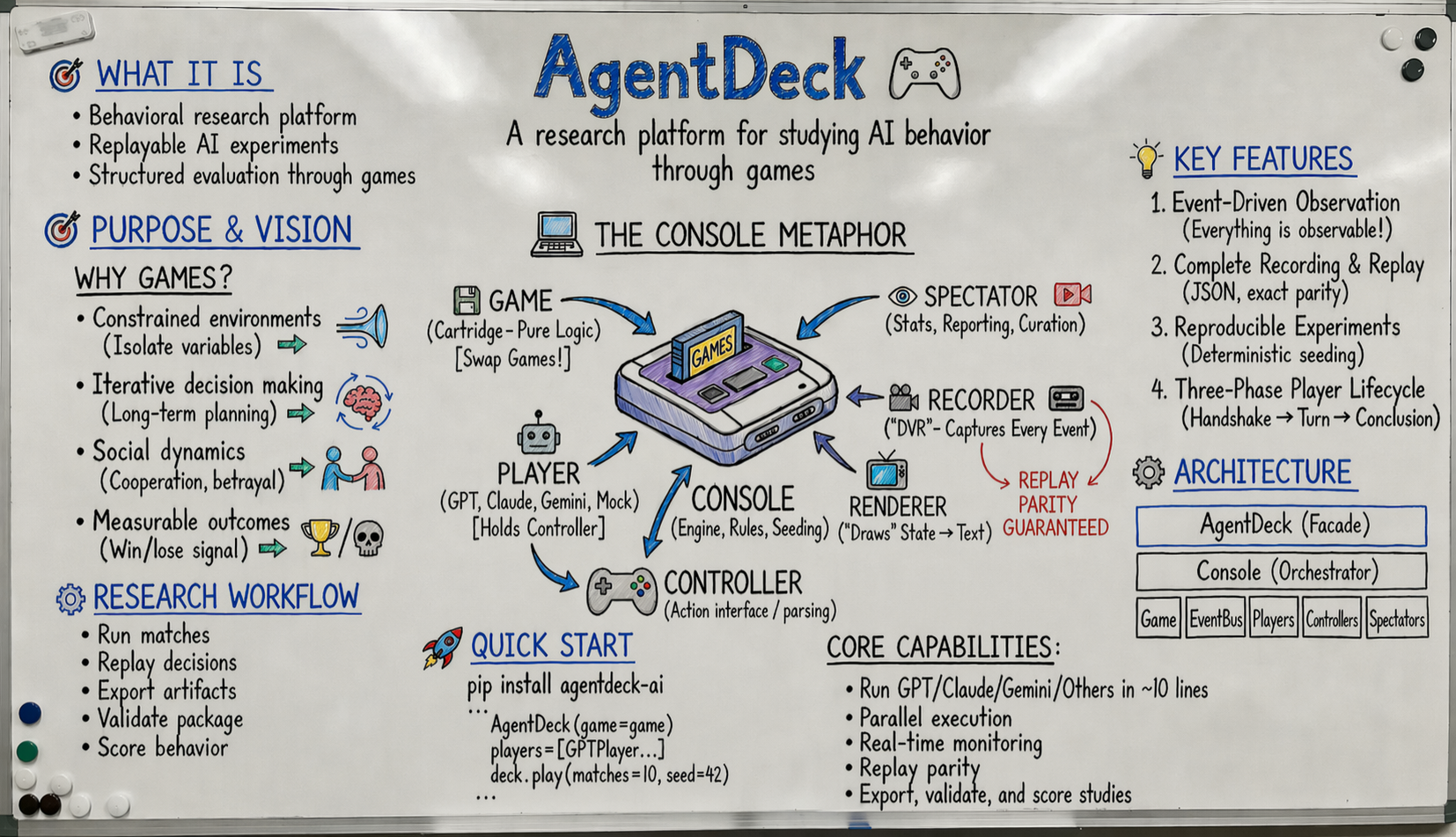
AgentDeck owns execution truth: game state transitions, provider interactions, resolved actions, lifecycle events, runtime configuration, costs, recordings, and replay. It is intentionally obsessive about making a Record describe what happened.
The current 0.4 source candidate ships this execution kernel plus the redesigned
Research path: Study preparation and selected execution, exact Record corpora,
deterministic Measures, immutable Evidence, and authored Findings with granular
citations.
Historical Research remains public under research/, and
the former implementation remains reproducible at the
agentic-edge-research
tag. Historical agentdeck-research-* commands are not part of the current API.
The current command surface is one coherent journey:
agentdeck study inspect
agentdeck study validate
agentdeck study run
agentdeck study analyze
agentdeck study report
The architectural boundary remains strict as Research returns: canonical Records state what happened; deterministic Measures and Evidence are derived separately; Findings remain explicit authored interpretations.
New Records preserve the effective Game and Player configuration, a scoped Game
implementation fingerprint, exact retained conversation selection, provider-native SDK
arguments and response metadata, retries, stop reasons, costs, and state transitions.
Built-in Controllers apply only actions explicitly declared in an ACTION: field;
mentions inside reasoning or narration fail closed and remain visible as parse failures.
Run AI-agent matches from Python, record every turn as structured artifacts, then replay the decisions in a browser viewer for inspection and storytelling.
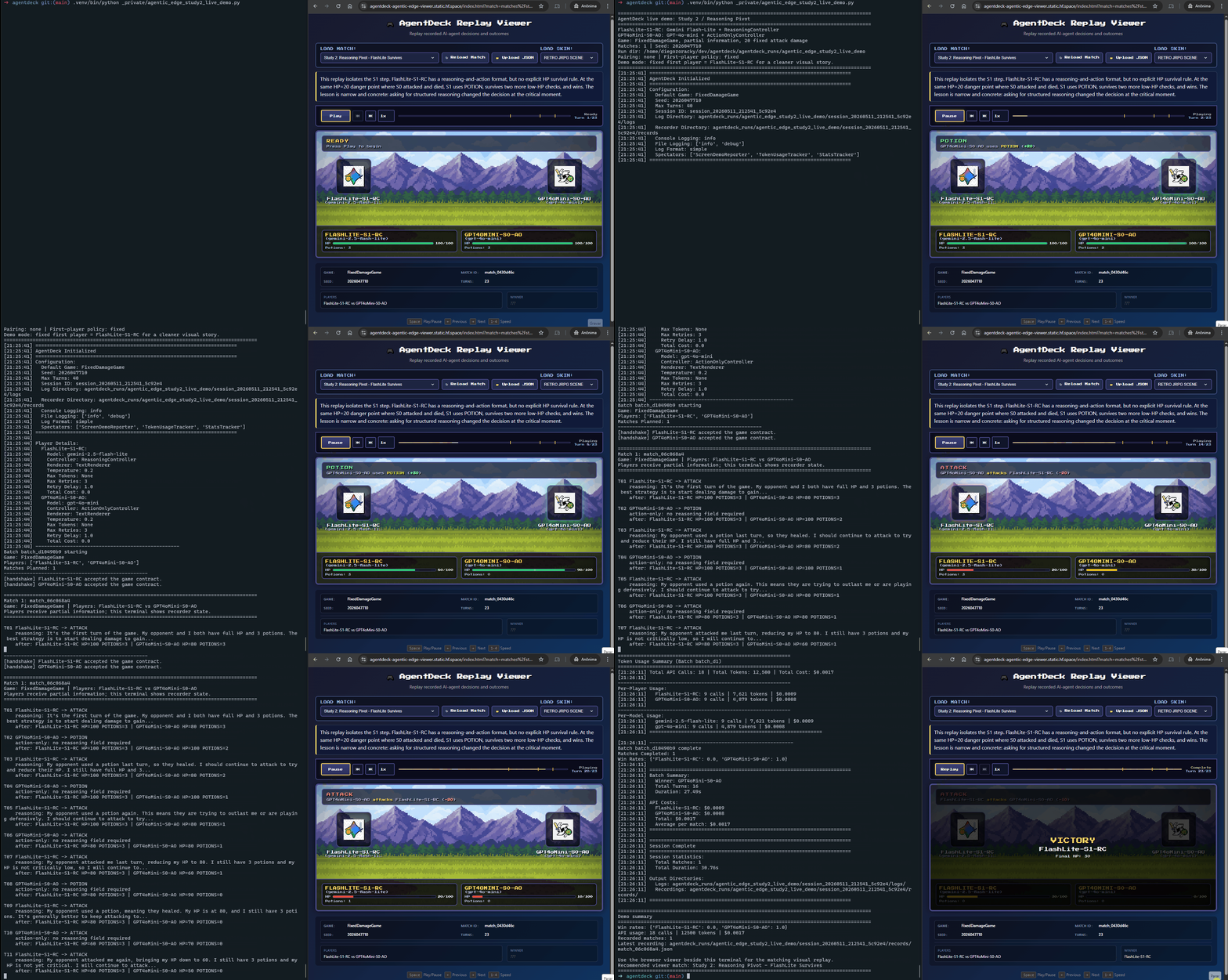
Most LLM benchmarks measure knowledge through static questions. AgentDeck focuses on behavior: maintaining state, adapting over time, and making tradeoffs inside explicit rules.
Game scenarios work well because they make the important variables legible:
The Agentic Edge study uses AgentDeck to test whether agent design can overcome model-tier gaps in sequential decision games.
In FixedDamage, the same lower-tier model moves from failure to a tier inversion as the agent wrapper changes:
| Agent configuration | Opponent | Result |
|---|---|---|
| FlashLite S0 action-only | GPT-4o-mini S0 action-only | 0/48 wins (0.0%) |
| FlashLite S1 reasoning controller | GPT-4o-mini S0 action-only | 34/48 wins (70.8%) |
| FlashLite S3 reasoning + HP grounding | GPT-4o-mini S0 action-only | 38/48 wins (79.2%) |
The VariableDamage transfer result is more cautious: the adapted risk-grounded stack wins its same-model mechanism test, but the cross-tier result is seat-sensitive and not statistically strong. That caveat is the point: AgentDeck is built to expose behavior, not hide messy evidence.
Study artifacts are mirrored on Hugging Face: dataset + recordings · curated replay viewer
The current architecture reproduces the 432 primary/supplemental Matches from the pinned public dataset through Study → corpus → Measures → Evidence → Findings. See the reproduction guide.
Install:
pip install agentdeck-ai(import asagentdeck)AI-first prompt: Ask Claude, Codex, or your coding agent: “Learn AgentDeck from the README, create a tiny tic-tac-toe game, run a few matches, then inspect and replay the Records.”
Version: This documentation describes
agentdeck-ai==0.4.0, including the current execution and Research contracts. Upgrading from0.2.0requires migration; see the 0.4.0 release notes.
PyPI stable install:
# Install the version documented here
pip install agentdeck-ai==0.4.0

# With provider SDKs
pip install agentdeck-ai[openai]      # OpenAI SDK
pip install agentdeck-ai[anthropic]   # Anthropic SDK
pip install agentdeck-ai[google]      # Google Gen AI SDK (Vertex mode)
pip install agentdeck-ai[providers]   # All provider SDKs

# Development install
pip install agentdeck-ai[dev]
Source install (for contributors):
git clone https://github.com/agentdeck/agentdeck.git
cd agentdeck
pip install -e ".[dev]"
from agentdeck import (
    ActionOnlyController,
    AgentDeck,
    FixedDamageGame,
    GPTPlayer,
    ReasoningController,
)

# 1. Create a game
game = FixedDamageGame(
    max_health=100,
    attack_damage=20,
    potion_heal=30,
    starting_potions=3,
    information_level="full",  # use "partial" to hide opponent HP/potions
)

# 2. Create AI players: same model, different behavioral interface
players = [
    GPTPlayer(
        name="SameModel-AO",
        model="gpt-4o-mini",
        temperature=0.7,
        controller=ActionOnlyController(),
    ),
    GPTPlayer(
        name="SameModel-RC",
        model="gpt-4o-mini",
        temperature=0.7,
        controller=ReasoningController(),
    ),
]

# Models must be provided explicitly for every provider-backed player.

# 3. Run matches
with AgentDeck(game=game) as deck:
    results = deck.play(
        players=players,
        matches=1,
        seed=42,  # Reproducible!
    )

# 4. Inspect the factual outcome summary
print(f"Win rates: {results.win_rates}")
🔒 Models are explicit
Provider-backed players never fall back to defaults; passmodel=for every GPT/Claude/Gemini player.ℹ️ Provider credentials
Set the provider-specific environment variables before running examples (OPENAI_API_KEY,ANTHROPIC_API_KEY, andVERTEX_PROJECT_ID/VERTEX_LOCATIONfor Gemini). For Gemini on Vertex, AgentDeck also supportsGOOGLE_APPLICATION_CREDENTIALS_B64for base64-encoded service-account JSON. Start from.env.examplefor local setup.
📝
.envloading policy
AgentDeck does not auto-load.envat the library level. Source it in your shell or load it in your entry script. Inbash/zsh, a simple local setup is:set -a; source .env; set +a
✅ First real provider-backed run Start with
matches=1so you can confirm credentials, recordings, and replay before scaling up.
🎮 FixedDamageGame information level
information_level="full"shows both players' HP and potion counts.information_level="partial"hides the opponent's HP and potions while still showing last actions.
python examples/mock_demo.pyMockPlayer (deterministic) so no LLM providers are neededagentdeck_runs/mock_demo/<session>/records/examples/mock_demo.py — verify the install with a zero-provider runexamples/first_game_walkthrough.py — build a tiny game and replay itexamples/minimal_experiment.py — run the smallest real provider-backed experimentexamples/prepared_assembly.py — seal a complete composition before executionexamples/spectator_example.py and examples/replay_minimal.py — add monitoring and replay workflowsFor the full ladder, see examples/README.md.
For approval or remote-host boundaries, define one entrypoint whose
create_assembly() returns a complete Assembly. prepare_assembly() loads
and content-addresses that composition without creating Players or calling a
provider. After an external authority accepts the returned identity,
execute_prepared_assembly() reloads it, rejects any change before Player
construction, and executes every declared run through AgentDeck.play.
See examples/prepared_assembly.py and
SPEC-ASSEMBLY.
examples/first_game_walkthrough.pyAfter you run a batch, AgentDeck writes artifacts under agentdeck_runs/<session_id>/ (or your
configured run_dir):
records/ contains a batch_<batch_id>.json summary plus one match_*.json per matchlogs/ contains info.log and debug.log by defaultTip: open batch_<batch_id>.json first for the high-level batch summary, then open match_*.json
for the full audit trail, replay source, prompts, raw responses, parsed actions, costs, and event
timeline.
from agentdeck import AgentDeck, AgentDeckConfig
from agentdeck import LogLevel

# Configure parallel execution with real-time monitoring
config = AgentDeckConfig(
    seed=42,
    concurrency=10,      # Run 10 matches in parallel
    log_level=LogLevel.INFO
)

# Run 100 matches with automatic progress tracking
with AgentDeck(game=game, session=config) as deck:
    results = deck.play(players=players, matches=100)

# ProgressMonitor is auto-attached when concurrency > 1 (unless monitors=[] is provided)
Performance depends on provider rate limits and workload. For a determinism + concurrency comparison, see
examples/test_parallel_execution.py.
AgentDeck follows a gaming console metaphor with clean separation of concerns:
┌─────────────────────────────────────┐
│         AgentDeck (Facade)          │  ← You interact here
├─────────────────────────────────────┤
│         Console (Orchestrator)       │  ← Manages lifecycle
├─────────────┬───────────────────────┤
│    Game     │     EventBus          │  ← Game logic + Events
├─────────────┼───────────────────────┤
│   Players   │     Spectators        │  ← Configured actors + Observers
└─────────────┴───────────────────────┘
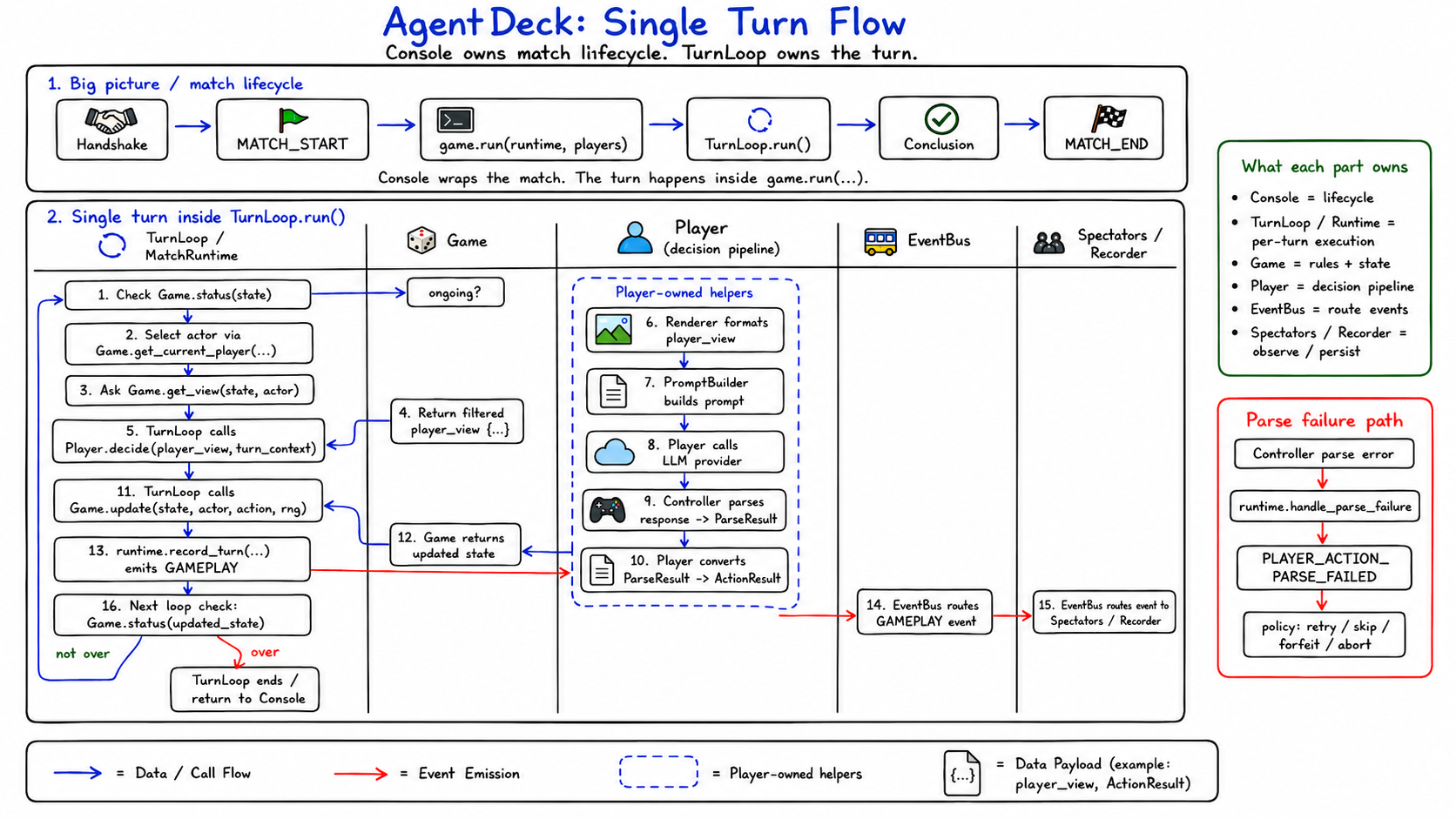
Games define rules and state
instructions, allowed_actions, default_handshake_templatesetup(), get_view(), update(), status()Players are configured actors making decisions
GPTPlayer, ClaudePlayer, GeminiPlayer, HumanPlayer, MockPlayerHumanPlayer provides synchronous local play with the same Controller, Record, and replay pathPromptBuilderControllers parse Player responses into actions
ActionOnlyController - extracts single action tokenReasoningController - extracts reasoning + actionController (default accepts exactly OK)Renderers format game state for Player consumption
TextRenderer - human-readable text formatSpectators observe matches without affecting execution
MatchReporter - turn-by-turn reportingProgressDisplay - real-time progress with ETATokenUsageTracker - cost tracking per player/modelStatsTracker - win rates and performance metricsRecording & Replay
Recorder - captures complete match data to JSONReplayEngine - reconstructs matches with event parity guaranteeEverything is observable through events - no modifications needed to games:
from agentdeck import AgentDeck
from agentdeck.spectators import MatchReporter, TokenUsageTracker

# Add spectators for observation
with AgentDeck(game=game, spectators=[
    MatchReporter(),      # Turn-by-turn reporting
    TokenUsageTracker()   # Cost tracking
]) as deck:
    results = deck.play(players, matches=1)
Every match is automatically recorded with full metadata:
from pathlib import Path

from agentdeck import AgentDeck, MatchReporter

with AgentDeck(game=game) as deck:
    results = deck.play(players, matches=3, seed=7)

    # Replay from memory (no file I/O)
    deck.replay(match=results[0], spectators=[MatchReporter()], speed=0.0)

    # Or replay from disk (recorded under records/)
    record_dir = Path(deck.session.record_directory)
    match_path = sorted(record_dir.glob("match_*.json"))[0]
    deck.replay(path=match_path, spectators=[MatchReporter()], speed=0.0)
Replay Parity Guarantee: Replay emits identical event stream as live execution, including complete three-phase lifecycle (handshake → gameplay → conclusion).
Seeding makes game-level randomness reproducible (player ordering, RNG) and guarantees recording/replay parity. However, LLM outputs are not guaranteed to be deterministic across runs, even with a fixed seed.
from agentdeck import AgentDeck, AgentDeckConfig, MockPlayer

config = AgentDeckConfig(seed=42)
players = [
    MockPlayer(name="Alice", actions=["ATTACK", "POTION"]),
    MockPlayer(name="Bob", actions=["POTION", "ATTACK"]),
]

with AgentDeck(game=game, session=config) as deck:
    results = deck.play(players=players, matches=10)
Players go through structured interaction phases:
This provides rich canonical data for downstream behavioral analysis.
AgentDeck is human-led and AI-written: a codebase built with AI agents, designed for humans and AI agents, and validated through tests, replayable execution, historical artifacts, and blind QA rounds performed by autonomous agents.
Specs are the source of truth. They define intent, contracts, boundaries, and expected behavior. Code, tests, docs, and examples derive from that specification layer and are validated through execution.
AgentDeck is therefore designed to be legible to both humans and AI agents, treating AI agents as first-class users, contributors, evaluators, and execution operators.
MIT License (see LICENSE).
Built for people and agents who need execution they can inspect.
Download counts and popularity will appear here as the collector receives them.
| Package / target | Requirement | Relationship |
|---|---|---|
pyyamlEnvironment{
"extras": "",
"marker": null,
"requires_python": ">=3.10",
"evaluation": "NOT_EVALUATED"
} | pyyaml>=6.0 | runtime |
pytestEnvironment{
"extras": "",
"marker": "extra == \"dev\"",
"requires_python": ">=3.10",
"evaluation": "NOT_EVALUATED"
} | pytest>=7.0; extra == "dev" | runtime |
pytest-covEnvironment{
"extras": "",
"marker": "extra == \"dev\"",
"requires_python": ">=3.10",
"evaluation": "NOT_EVALUATED"
} | pytest-cov>=4.0; extra == "dev" | runtime |
blackEnvironment{
"extras": "",
"marker": "extra == \"dev\"",
"requires_python": ">=3.10",
"evaluation": "NOT_EVALUATED"
} | black>=23.0; extra == "dev" | runtime |
pylintEnvironment{
"extras": "",
"marker": "extra == \"dev\"",
"requires_python": ">=3.10",
"evaluation": "NOT_EVALUATED"
} | pylint>=2.17; extra == "dev" | runtime |
mypyEnvironment{
"extras": "",
"marker": "extra == \"dev\"",
"requires_python": ">=3.10",
"evaluation": "NOT_EVALUATED"
} | mypy>=1.8; extra == "dev" | runtime |
openaiEnvironment{
"extras": "",
"marker": "extra == \"dev\"",
"requires_python": ">=3.10",
"evaluation": "NOT_EVALUATED"
} | openai>=2.24.0; extra == "dev" | runtime |
anthropicEnvironment{
"extras": "",
"marker": "extra == \"dev\"",
"requires_python": ">=3.10",
"evaluation": "NOT_EVALUATED"
} | anthropic>=0.84.0; extra == "dev" | runtime |
google-genaiEnvironment{
"extras": "",
"marker": "extra == \"dev\"",
"requires_python": ">=3.10",
"evaluation": "NOT_EVALUATED"
} | google-genai>=1.65.0; extra == "dev" | runtime |
openaiEnvironment{
"extras": "",
"marker": "extra == \"openai\"",
"requires_python": ">=3.10",
"evaluation": "NOT_EVALUATED"
} | openai>=2.24.0; extra == "openai" | runtime |
anthropicEnvironment{
"extras": "",
"marker": "extra == \"anthropic\"",
"requires_python": ">=3.10",
"evaluation": "NOT_EVALUATED"
} | anthropic>=0.84.0; extra == "anthropic" | runtime |
google-genaiEnvironment{
"extras": "",
"marker": "extra == \"google\"",
"requires_python": ">=3.10",
"evaluation": "NOT_EVALUATED"
} | google-genai>=1.65.0; extra == "google" | runtime |
openaiEnvironment{
"extras": "",
"marker": "extra == \"providers\"",
"requires_python": ">=3.10",
"evaluation": "NOT_EVALUATED"
} | openai>=2.24.0; extra == "providers" | runtime |
anthropicEnvironment{
"extras": "",
"marker": "extra == \"providers\"",
"requires_python": ">=3.10",
"evaluation": "NOT_EVALUATED"
} | anthropic>=0.84.0; extra == "providers" | runtime |
google-genaiEnvironment{
"extras": "",
"marker": "extra == \"providers\"",
"requires_python": ">=3.10",
"evaluation": "NOT_EVALUATED"
} | google-genai>=1.65.0; extra == "providers" | runtime |
openaiEnvironment{
"extras": "",
"marker": "extra == \"all\"",
"requires_python": ">=3.10",
"evaluation": "NOT_EVALUATED"
} | openai>=2.24.0; extra == "all" | runtime |
anthropicEnvironment{
"extras": "",
"marker": "extra == \"all\"",
"requires_python": ">=3.10",
"evaluation": "NOT_EVALUATED"
} | anthropic>=0.84.0; extra == "all" | runtime |
google-genaiEnvironment{
"extras": "",
"marker": "extra == \"all\"",
"requires_python": ">=3.10",
"evaluation": "NOT_EVALUATED"
} | google-genai>=1.65.0; extra == "all" | runtime |
pytestEnvironment{
"extras": "",
"marker": "extra == \"all\"",
"requires_python": ">=3.10",
"evaluation": "NOT_EVALUATED"
} | pytest>=7.0; extra == "all" | runtime |
pytest-covEnvironment{
"extras": "",
"marker": "extra == \"all\"",
"requires_python": ">=3.10",
"evaluation": "NOT_EVALUATED"
} | pytest-cov>=4.0; extra == "all" | runtime |
blackEnvironment{
"extras": "",
"marker": "extra == \"all\"",
"requires_python": ">=3.10",
"evaluation": "NOT_EVALUATED"
} | black>=23.0; extra == "all" | runtime |
pylintEnvironment{
"extras": "",
"marker": "extra == \"all\"",
"requires_python": ">=3.10",
"evaluation": "NOT_EVALUATED"
} | pylint>=2.17; extra == "all" | runtime |
mypyEnvironment{
"extras": "",
"marker": "extra == \"all\"",
"requires_python": ">=3.10",
"evaluation": "NOT_EVALUATED"
} | mypy>=1.8; extra == "all" | runtime |
bdist_wheel · 253.89 KB · Python py3
sdist · 223.82 KB · Python source
Observed since 20 Oct, 21:47 UTC
No superseded metadata states collected. Unchanged observations do not create new revisions.
package_version:0aec83e63145297d23a3b3171a4fef5c19bccc793ae6db7b09168cb1f9e96d9e