
 Repository
Current collected state Current
Observed since 20 Oct, 23:34 UTC
No superseded metadata states collected. Unchanged observations do not create new revisions.
agent-torch
large population models
making complexity simple
differentiable learning over millions of autonomous agents



Many grand challenges like climate change and pandemics emerge from complex interactions of millions of individual decisions. While LLMs and AI agents excel at individual behavior, they can't model these intricate societal dynamics. Enter Large Population Models (LPMs): a new AI paradigm to simulate millions of interacting agents, capturing collective behaviors at societal scale. It's like scaling up AI agents exponentially to understand the ripple effects of countless decisions. While LLMs enable "digital humans", LPMs are the path to "digital nations".
AgentTorch, our open-source platform, makes building and running massive LPMs accessible. It's optimized for GPUs, allowing efficient simulation of entire cities or countries. Think PyTorch, but for large-scale agent-based simulations. AgentTorch LPMs have four design principles:
LPMs are already making real-world impact. They're being used to help immunize millions of people by optimizing vaccine distribution strategies, and to track billions of dollars in global supply chains, improving efficiency and reducing waste. Our long-term goal is to "re-invent the census": built entirely in simulation, captured passively and used to protect country-scale populations. Our research is making an impact - winning awards at AI conferences and being deployed across the world. Learn more about our research and vision.
AgentTorch is building the future of decision engines - inside the body, around us and beyond!
https://github.com/AgentTorch/AgentTorch/assets/13482350/4c3f9fa9-8bce-4ddb-907c-3ee4d62e7148
Install the most recent version from source using pip:
> pip install git+https://github.com/agenttorch/agenttorch
Some models require extra dependencies that have to be installed separately. For more information regarding this, as well as the hardware the project has been run on, please see
docs/install.md.
Alternately, the easiest way to install AgentTorch (v0.4.0) is from pypi:
> pip install agent-torch
AgentTorch is meant to be used in a Python >=3.9 environment. If you have not installed Python 3.9, please do so first from python.org/downloads.
The following section depicts the usage of existing models and population data to run simulations on your machine. It also acts as a showcase of the Agent Torch API.
# re-use existing models and population data easily
from agent_torch.models import covid
from agent_torch.populations import astoria

# use the executor to plug-n-play
from agent_torch.core.executor import Executor
from agent_torch.core.dataloader import LoadPopulation

# agent_"torch" works seamlessly with the pytorch API
from torch.optim import SGD

loader = LoadPopulation(astoria)
simulation = Executor(model=covid, pop_loader=loader)

simulation.init()
simulation.execute()
Copyright (c) 2023-2025 Ayush Chopra
This project is licensed under the GNU Affero General Public License v3.0 (AGPL-3.0). This means:
For commercial licensing options or inquiries about using this software in a proprietary product, please reach out to request a license wavier.
A detailed explanation of the architecture of the Agent Torch framework can be found here.
A tutorial on how to create a simple predator-prey model can be found in the
tutorials/ folder.
from agent_torch.core.llm.archetype import Archetype
from agent_torch.core.llm.behavior import Behavior
from agent_torch.core.llm.backend import LangchainLLM
from agent_torch.populations import NYC
user_prompt_template = "Your age is {age} {gender},{unemployment_rate} the number of COVID cases is {covid_cases}."
# Using Langchain to build LLM Agents
agent_profile = "You are a person living in NYC. Given some info about you and your surroundings, decide your willingness to work. Give answer as a single number between 0 and 1, only."
llm_langchain = LangchainLLM(
    openai_api_key=OPENAI_API_KEY, agent_profile=agent_profile, model="gpt-3.5-turbo"
)
# Create an object of the Archetype class
# n_arch is the number of archetypes to be created. This is used to calculate a distribution from which the outputs are then sampled.
archetype = Archetype(n_arch=7)
# Create an object of the Behavior class
# You have options to pass any of the above created llm objects to the behavior class
# Specify the region for which the behavior is to be generated. This should be the name of any of the regions available in the populations folder.
earning_behavior = Behavior(
    archetype=archetype.llm(llm=llm_langchain, user_prompt=user_prompt_template), region=NYC
)
kwargs = {
    "month": "January",
    "year": "2020",
    "covid_cases": 1200,
    "device": "cpu",
    "current_memory_dir": "/path-to-save-memory",
    "unemployment_rate": 0.05,
}
output = earning_behavior.sample(kwargs)
Thank you for your interest in contributing! You can contribute by reporting and fixing bugs in the framework or models, working on new features for the framework, creating new models, or by writing documentation for the project.
Take a look at the contributing guide for instructions on how to setup your environment, make changes to the codebase, and contribute them back to the project.
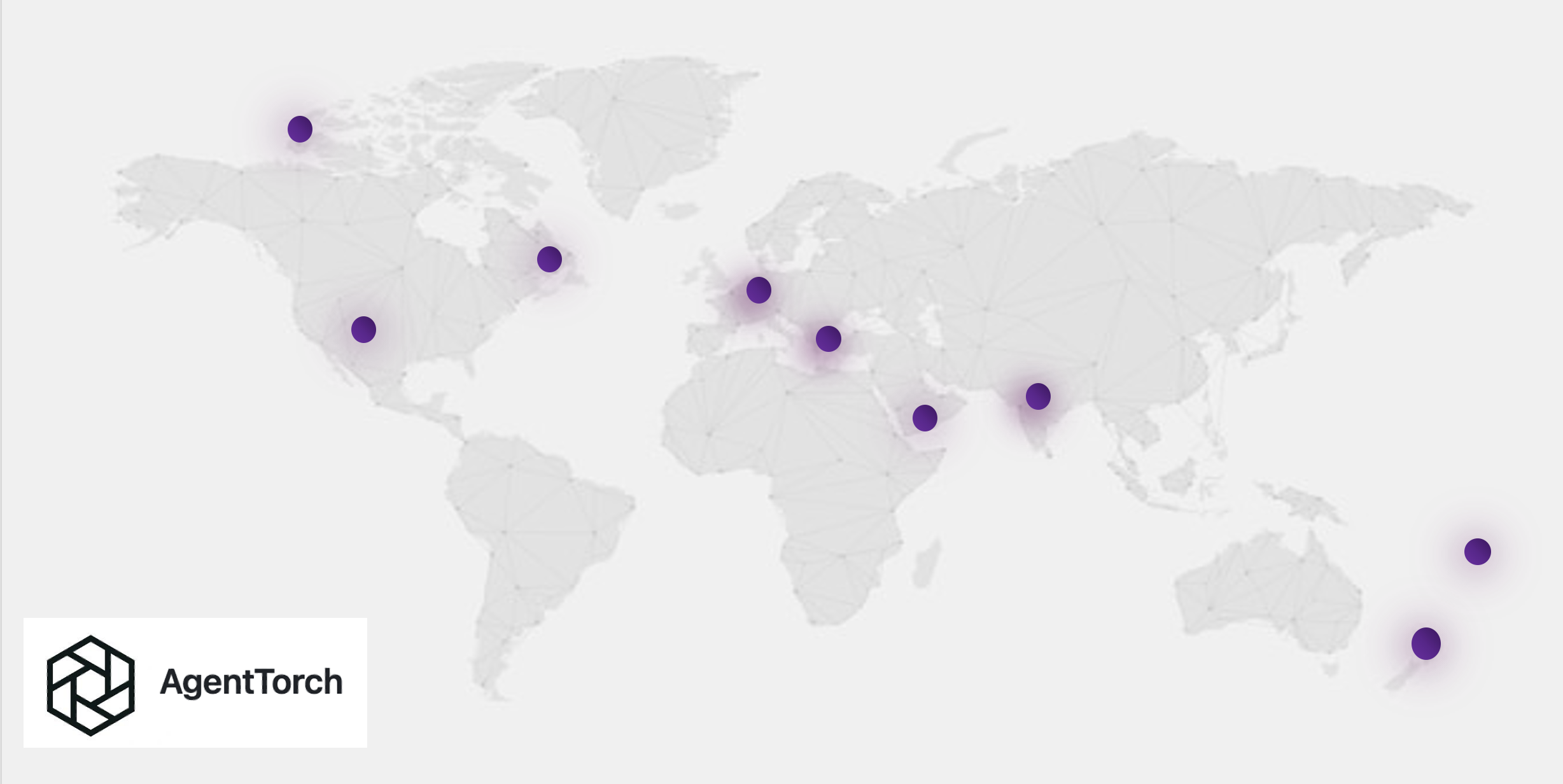
AgentTorch models are being deployed across the globe.
Download counts and popularity will appear here as the collector receives them.
| Package / target | Requirement | Relationship |
|---|---|---|
numpyEnvironment{
"extras": "",
"marker": null,
"requires_python": ">=3.8",
"evaluation": "NOT_EVALUATED"
} | numpy>=1.24.3 | runtime |
pandasEnvironment{
"extras": "",
"marker": null,
"requires_python": ">=3.8",
"evaluation": "NOT_EVALUATED"
} | pandas>=1.5.0 | runtime |
torchEnvironment{
"extras": "",
"marker": null,
"requires_python": ">=3.8",
"evaluation": "NOT_EVALUATED"
} | torch>=2.1.2 | runtime |
torch_geometricEnvironment{
"extras": "",
"marker": null,
"requires_python": ">=3.8",
"evaluation": "NOT_EVALUATED"
} | torch_geometric>=2.5.3 | runtime |
omegaconfEnvironment{
"extras": "",
"marker": null,
"requires_python": ">=3.8",
"evaluation": "NOT_EVALUATED"
} | omegaconf>=2.3.0 | runtime |
asyncioEnvironment{
"extras": "",
"marker": null,
"requires_python": ">=3.8",
"evaluation": "NOT_EVALUATED"
} | asyncio>=3.4.3 | runtime |
langchainEnvironment{
"extras": "",
"marker": null,
"requires_python": ">=3.8",
"evaluation": "NOT_EVALUATED"
} | langchain>=0.2.3 | runtime |
langchain-openaiEnvironment{
"extras": "",
"marker": null,
"requires_python": ">=3.8",
"evaluation": "NOT_EVALUATED"
} | langchain-openai>=0.1.8 | runtime |
networkxEnvironment{
"extras": "",
"marker": null,
"requires_python": ">=3.8",
"evaluation": "NOT_EVALUATED"
} | networkx>=3.0 | runtime |
tqdmEnvironment{
"extras": "",
"marker": null,
"requires_python": ">=3.8",
"evaluation": "NOT_EVALUATED"
} | tqdm>=4.66.4 | runtime |
dspyEnvironment{
"extras": "",
"marker": null,
"requires_python": ">=3.8",
"evaluation": "NOT_EVALUATED"
} | dspy>=0.1.5 | runtime |
daskEnvironment{
"extras": "",
"marker": null,
"requires_python": ">=3.8",
"evaluation": "NOT_EVALUATED"
} | dask>=2024.12.1 | runtime |
bdist_wheel · 18,781.02 KB · Python py3
sdist · 18,318.47 KB · Python source
Observed since 20 Oct, 23:34 UTC
No superseded metadata states collected. Unchanged observations do not create new revisions.
package_version:54f5d3a175bc32d194a2c87c2524c2889ecbc60ff36ef3adea7a4408d8fee94b