
 Repository
Current collected state Current
Observed since 20 Oct, 18:46 UTC
No superseded metadata states collected. Unchanged observations do not create new revisions.
adabound
AdaBound optimization algorithm, build on PyTorch.


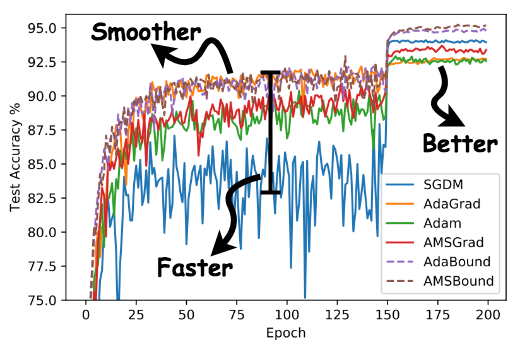
An optimizer that trains as fast as Adam and as good as SGD, for developing state-of-the-art deep learning models on a wide variety of pupolar tasks in the field of CV, NLP, and etc.
Based on Luo et al. (2019). Adaptive Gradient Methods with Dynamic Bound of Learning Rate. In Proc. of ICLR 2019.
AdaBound requires Python 3.6.0 or later. We currently provide PyTorch version and AdaBound for TensorFlow is coming soon.
The preferred way to install AdaBound is via pip with a virtual environment.
Just run
pip install adabound
in your Python environment and you are ready to go!
As AdaBound is a Python class with only 100+ lines, an alternative way is directly downloading adabound.py and copying it to your project.
You can use AdaBound just like any other PyTorch optimizers.
optimizer = adabound.AdaBound(model.parameters(), lr=1e-3, final_lr=0.1)
As described in the paper, AdaBound is an optimizer that behaves like Adam at the beginning of
training, and gradually transforms to SGD at the end.
The final_lr parameter indicates AdaBound would transforms to an SGD with this learning rate.
In common cases, a default final learning rate of 0.1 can achieve relatively good and stable
results on unseen data.
It is not very sensitive to its hyperparameters.
See Appendix G of the paper for more details.
Despite of its robust performance, we still have to state that, there is no silver bullet. It does not mean that you will be free from tuning hyperparameters once using AdaBound. The performance of a model depends on so many things including the task, the model structure, the distribution of data, and etc. You still need to decide what hyperparameters to use based on your specific situation, but you may probably use much less time than before!
Thanks to the awesome work by the GitHub team and the Jupyter team, the Jupyter notebook (.ipynb)
files can render directly on GitHub.
We provide several notebooks (like this one) for better
visualization.
We hope to illustrate the robust performance of AdaBound through these examples.
For the full list of demos, please refer to this page.
If you use AdaBound in your research, please cite Adaptive Gradient Methods with Dynamic Bound of Learning Rate.
@inproceedings{Luo2019AdaBound,
  author = {Luo, Liangchen and Xiong, Yuanhao and Liu, Yan and Sun, Xu},
  title = {Adaptive Gradient Methods with Dynamic Bound of Learning Rate},
  booktitle = {Proceedings of the 7th International Conference on Learning Representations},
  month = {May},
  year = {2019},
  address = {New Orleans, Louisiana}
}
Download counts and popularity will appear here as the collector receives them.
| Package / target | Requirement | Relationship |
|---|---|---|
torchEnvironment{
"extras": "",
"marker": null,
"requires_python": ">=3.6.0",
"evaluation": "NOT_EVALUATED"
} | torch (>=0.4.0) | runtime |
bdist_wheel · 4.95 KB · Python py3
sdist · 4.84 KB · Python source
Observed since 20 Oct, 18:46 UTC
No superseded metadata states collected. Unchanged observations do not create new revisions.
package_version:7fd97867f85ff41d39a6447dfd1cd3a10391cd34f14f06d2d42f254091fc5958