

 Repository
Current collected state Current
Observed since 20 Oct, 21:50 UTC
No superseded metadata states collected. Unchanged observations do not create new revisions.
agentdynamics
Application performance monitoring for AI agents: flows, cost, reliability and process quality


APM for AI agents. AgentDynamics does for agents what AppDynamics does for services. It shows how your agents work through tasks, what each step costs, where flows loop, stall or fail, and whether the agent's process is any good.
pip install, one process, runs on a laptop or in Kubernetes.pip install agentdynamics
agentdynamics serve --open # console at http://127.0.0.1:8787
Then connect your agent with one of these options. Pick the first one that matches how your agent is built.
import agentdynamics
agentdynamics.init()      # auto-instruments Anthropic, OpenAI, LangChain/LangGraph and OpenTelemetry
Every model call is now tracked, with tokens, cost, latency, truncations and errors. To group calls into tasks and see your agent's flow, add a decorator and name the stages:
@agentdynamics.trace                     # one call = one task in the console
def handle_ticket(question):
    with agentdynamics.span("plan"):     # stages become nodes in the workflow graph
        plan = client.messages.create(...)
    with agentdynamics.span("act"):
        lookup_order(order_id)           # decorate tools with @agentdynamics.tool
    if escalated:
        agentdynamics.outcome("failed", reason="customer escalated")   # state it, don't let it be guessed
    ...
Without outcome(), success is inferred from errors, interrupts and follow-ups. The console always shows
which outcomes were stated and which were guessed; grades can also be posted afterwards by a person or an
eval pipeline (POST /api/outcomes), or by your own systems using your own ids: trace with
agentdynamics.trace("support", ticket_id="T-123") and post {"key": {"ticket_id": "T-123"}, "outcome": "rework"}
when the ticket is reopened.
agentdynamics run python app.py # like ddtrace-run / opentelemetry-instrument
export LANGSMITH_TRACING=true
export LANGSMITH_ENDPOINT=http://127.0.0.1:8787/langsmith
AgentDynamics speaks the LangSmith ingestion API, so graphs, nodes, threads and feedback arrive unchanged.
export OTEL_EXPORTER_OTLP_TRACES_ENDPOINT=http://127.0.0.1:8787/v1/traces
GenAI semantic conventions, OpenInference and OpenLLMetry are all understood, over protobuf or JSON.
agentdynamics connect langsmith # prints the 4-line config to pull runs from your existing project
agentdynamics connect http prints a single curl call. agentdynamics connect logs shows how to point Fluent Bit or Vector at AgentDynamics.
agentdynamics doctor # checks URL + key, sends a test trace, confirms it shows up
The console's Get started page shows the same snippets and turns green when your first trace arrives.
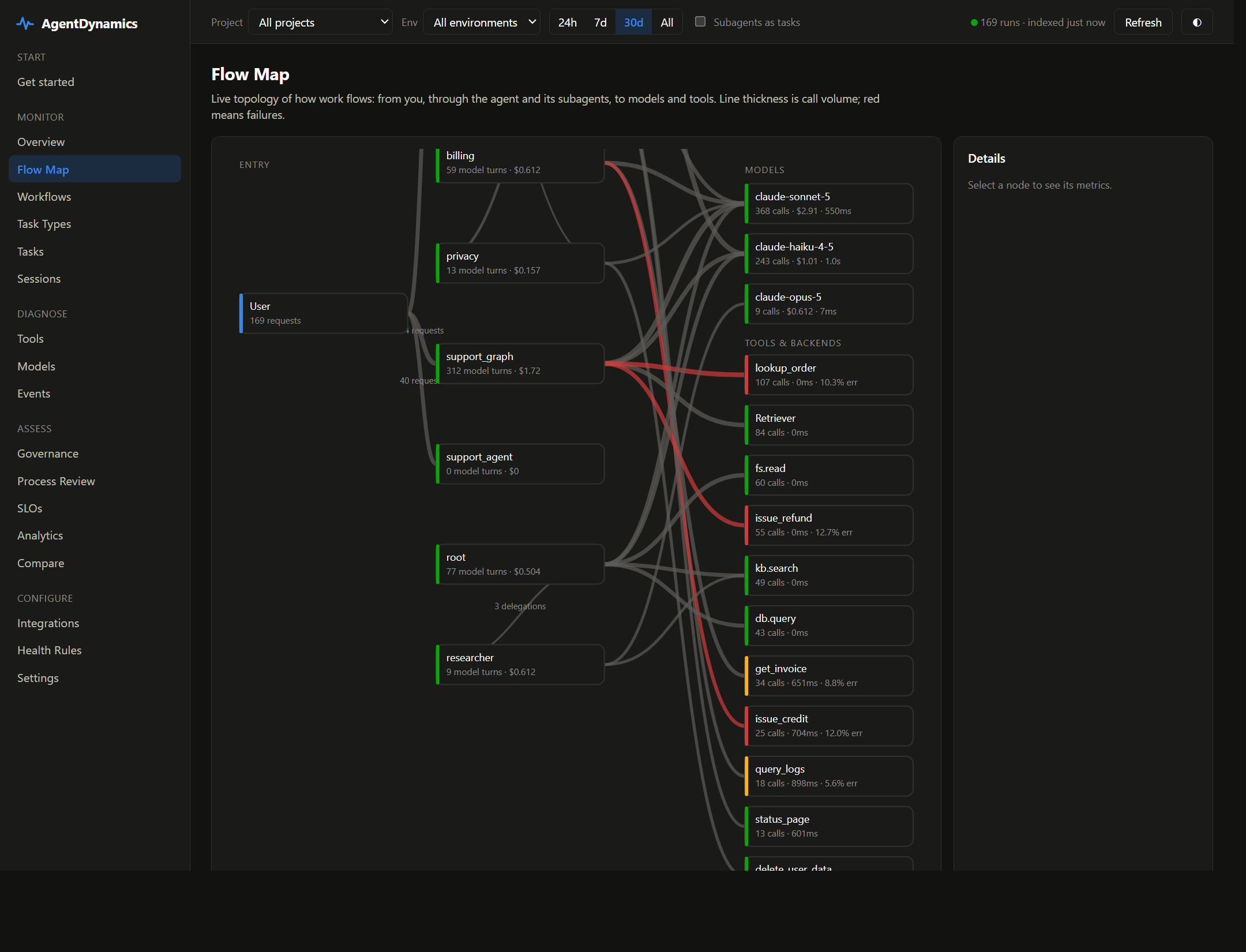
The Flow Map: where work goes, what each hop costs, and what is failing. Red edges are errors.
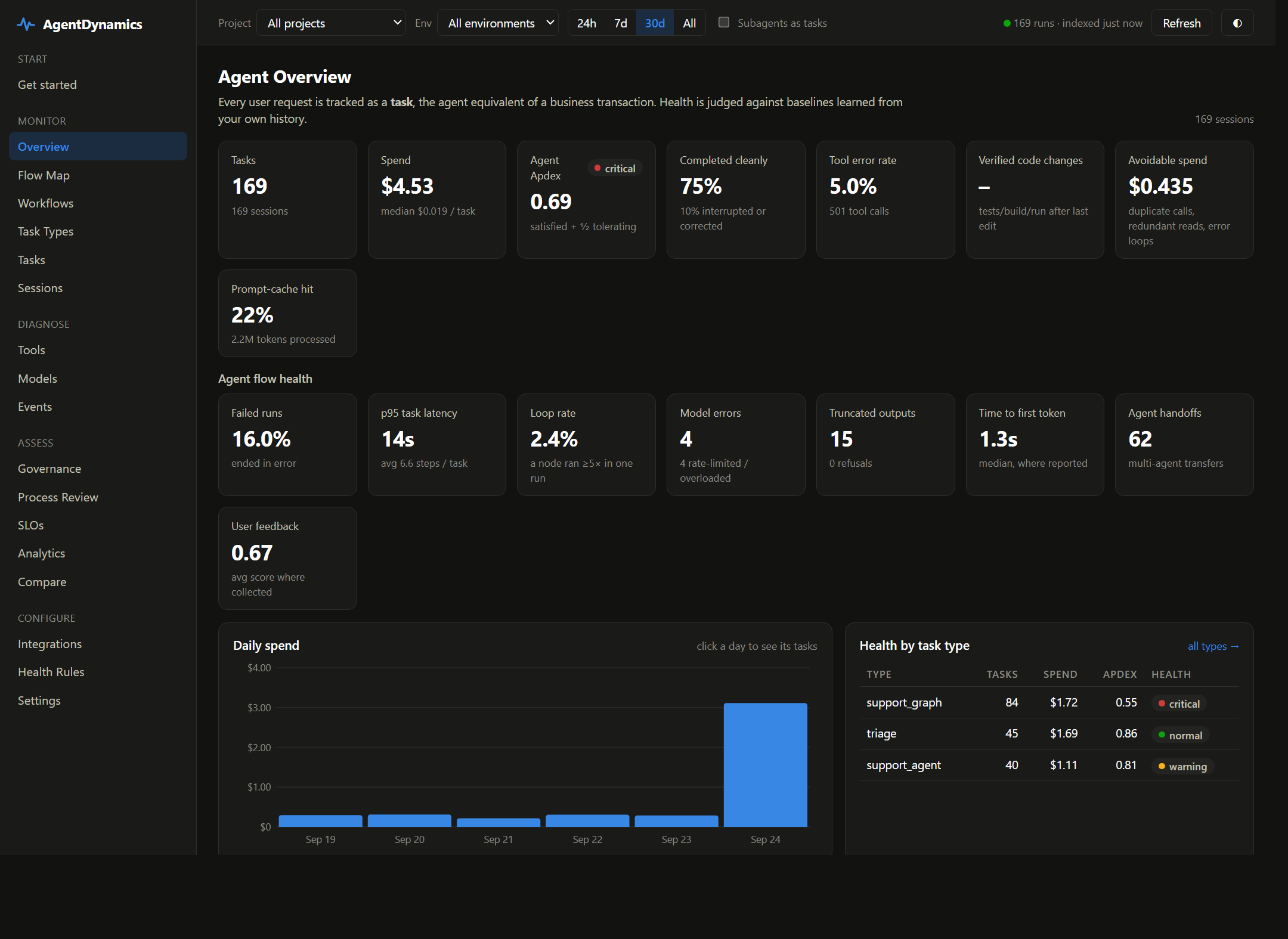
The Overview: cost, Apdex and flow health against baselines learned from your own history.
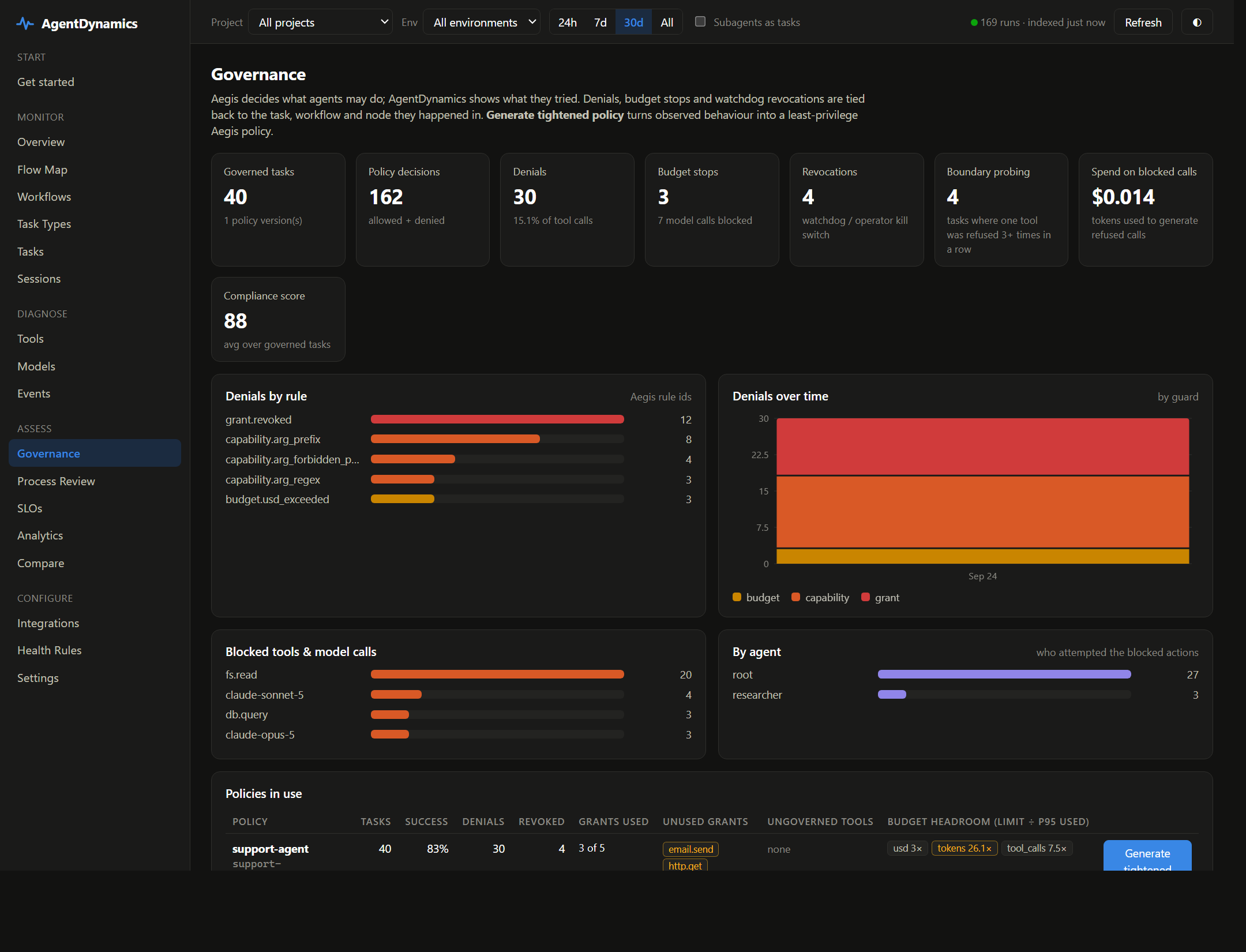
Governance: what Aegis refused, which rule refused it, and which grants are never used.
Reproduce these locally from synthetic traffic, no API keys needed:
agentdynamics --data .demo-data --claude-root "" serve --port 8790 &
LANGSMITH_ENDPOINT=http://127.0.0.1:8790/langsmith python examples/langgraph_style_app.py 70
python examples/otel_multiagent.py 45 http://127.0.0.1:8790
AGENTDYNAMICS_URL=http://127.0.0.1:8790 python examples/governed_agent.py 40
| Flow Map | Live topology: users → agents (including agent-to-agent handoffs) → models and tools, with volume, latency and errors |
| Workflows | The real execution graph mined from your traces: path variants and their success rates, loops, the critical node, handoffs |
| Task snapshots | Span-tree waterfall for each request: context growth, cost against the baseline, what went wrong, what the user said next |
| Baselines & Apdex | "Normal" cost and latency per workflow, learned automatically, plus an agent Apdex score |
| Health rules & alerts | 29 rules (runaway cost, policy denials, boundary probing, tripwires, revocations, retry loops, node loops, truncation, rate limits, ping-pong handoffs, unverified code changes, …) sent to Slack, PagerDuty or webhooks, routed by project, rule and severity |
| Tools & Models | Error rate and p95 per tool; per model TTFT, tokens/s, truncation rate, cache hit rate and spend, and the estimate beside what Anthropic billed (with an Admin API key) |
| SLOs | Success rate, Apdex, good-task rate, latency and cost objectives with error budgets and burn rates |
| Governance | Aegis policy enforcement per task: denials by rule, budget stops, kill-switch revocations, unused grants, policy export, and what a policy change would refuse |
| Incidents & trust | Tripwires, probing, refused calls and revocations about one agent, grouped into one incident with its evidence; revoke the agent or resolve it as real or a false alarm, and alert once per incident. Each agent's trust score (0-100) weighs that evidence by age and by the verdicts given, and is exported to Prometheus. An optional checker has a model review each incident in shadow mode, and keeps score of how often it agreed with you |
| Process Review | Scores how well the agent works (efficiency, focus, reliability, verification, context, autonomy, compliance) and suggests fixes |
| Analytics & Compare | Any metric by any dimension; compare models, prompts or releases side by side |
The full metric catalog is in docs/METRICS.md.
Aegis decides what an agent may do. AgentDynamics shows what it did. Connecting them takes one call:
from agentdynamics.integrations import aegis as governance
governance.instrument(kernel, root, watchdog=governance.Watchdog(max_repeated_denials=3))
That call sets up four flows:
review={"tools": ["payments.refund"]}).agentdynamics policy export writes a tighter, least-privilege policy from observed behaviour. aegis ratify and aegis drift verify its declaration; agentdynamics policy check replays the traffic that actually ran through it and reports how much it would refuse, so a policy change can be gated in CI.The console's Governance page shows denials, budget stops, revocations, unused grants and budget headroom per policy version. See docs/GOVERNANCE.md.
agentdynamics.init(url=None, api_key=None, project=None, environment=None, capture_content=None) | Connect and auto-instrument. Every argument falls back to an environment variable (below). Safe to call twice. |
@agentdynamics.trace / @trace("name") / with trace("name", prompt=..., thread_id=..., user_id=...) | One task. A nested trace becomes a node. Works on sync and async functions. |
with agentdynamics.span("node") | A stage or graph node. Model and tool calls inside it are attributed to the node. |
@agentdynamics.tool / @tool(name="search") | Records a function as a tool call: arguments, output size and errors. |
t.feedback("user_rating", 0.0..1.0) | Attach a user or eval score to a task (with trace(...) as t). |
with agentdynamics.llm_call(model, max_tokens=..., input=...) as c: ... c.usage(input_tokens=..., output_tokens=...) | Records a call from any other model client (local models, raw HTTP), with the same gating as the patched SDKs. |
agentdynamics.flush() | Wait for queued telemetry. This also runs automatically at exit. |
Environment variables:
| Variable | Default | Purpose |
|---|---|---|
AGENTDYNAMICS_URL | http://127.0.0.1:8787 | Where to send telemetry |
AGENTDYNAMICS_API_KEY | none | Ingest key, if auth is on |
AGENTDYNAMICS_PROJECT | current folder name | Project the telemetry is filed under |
AGENTDYNAMICS_ENVIRONMENT | development | Environment label |
AGENTDYNAMICS_CAPTURE_CONTENT | 1 | 0 sends sizes only, never prompt text |
AGENTDYNAMICS_DISABLED | unset | 1 turns everything off |
Telemetry is sent from a background thread with a bounded queue. Your agent never waits on it and never fails because of it.
agentdynamics keys create --role ingest     # for apps / collectors
agentdynamics keys create --role read       # for people and Grafana
agentdynamics keys create --role admin      # for rules, SLOs and config
agentdynamics keys create --role read --project checkout    # one team: sees and sends only its projects
docker compose -f deploy/docker-compose.yml up -d   # AgentDynamics + OpenTelemetry Collector gateway
The store is a SQLite file by default. For several instances behind a load balancer, or a database you back up
and operate like any other, use Postgres: pip install "agentdynamics[postgres]" and set
AGENTDYNAMICS_DB_URL=postgresql://... (or deploy/docker-compose.postgres.yml). One instance is elected to
write the analysis; the others serve the console and take ingest, and one takes over if the writer goes away.
An existing install moves with its history: agentdynamics store copy --to postgresql://..., then
agentdynamics store verify.
store_content = false to keep metadata only./metrics, /healthz, a status page for every source, and alerts to Slack,
PagerDuty or any webhook: health-rule events and SLO burn-rate pages, delivered in order with retries
(agentdynamics alerts test checks a destination end to end).See deploy/ and docs/ARCHITECTURE.md.
pip install -e ".[test,toml]" && pip install "aegis-kernel>=0.4.0"
python -m unittest discover tests   # real LangSmith/Anthropic/OpenAI SDKs, Aegis kernel, OTLP protobuf, pull connectors
Demo traffic is under What it looks like above. CLAUDE.md has the architecture and the invariants to work within; ROADMAP.md is what is planned and what is deliberately not.
Apache 2.0. See LICENSE.
Download counts and popularity will appear here as the collector receives them.
| Package / target | Requirement | Relationship |
|---|---|---|
tomliEnvironment{
"extras": "",
"marker": "python_version < \"3.11\" and extra == \"toml\"",
"requires_python": ">=3.10",
"evaluation": "NOT_EVALUATED"
} | tomli; python_version < "3.11" and extra == "toml" | runtime |
psycopgEnvironment{
"extras": "binary",
"marker": "extra == \"postgres\"",
"requires_python": ">=3.10",
"evaluation": "NOT_EVALUATED"
} | psycopg[binary]>=3.1; extra == "postgres" | runtime |
langchain-coreEnvironment{
"extras": "",
"marker": "extra == \"test\"",
"requires_python": ">=3.10",
"evaluation": "NOT_EVALUATED"
} | langchain-core==0.2.33; extra == "test" | runtime |
langsmithEnvironment{
"extras": "",
"marker": "extra == \"test\"",
"requires_python": ">=3.10",
"evaluation": "NOT_EVALUATED"
} | langsmith==0.1.99; extra == "test" | runtime |
anthropicEnvironment{
"extras": "",
"marker": "extra == \"test\"",
"requires_python": ">=3.10",
"evaluation": "NOT_EVALUATED"
} | anthropic==0.87.0; extra == "test" | runtime |
openaiEnvironment{
"extras": "",
"marker": "extra == \"test\"",
"requires_python": ">=3.10",
"evaluation": "NOT_EVALUATED"
} | openai==2.30.0; extra == "test" | runtime |
bdist_wheel · 266.87 KB · Python py3
sdist · 353 KB · Python source
Observed since 20 Oct, 21:50 UTC
No superseded metadata states collected. Unchanged observations do not create new revisions.
package_version:be56790614d7347bb552d2d70da92beff089e55c69bdd949366d0f763809a09b