
 Repository
Current collected state Current
Observed since 20 Oct, 22:55 UTC
No superseded metadata states collected. Unchanged observations do not create new revisions.
agentpoke
Drop-in pytest plugin for regression-testing AI agents — snapshot baselines, semantic comparison, mock LLMs
Capture your agent's outputs, store them as baselines, and catch regressions in CI — with one decorator.


English · 中文 · Quick Start · How It Works · How It Compares
You ship an AI agent. It works great. Two weeks later, you update a prompt, swap a model, or bump a dependency — and something breaks. But you don't notice until a user complains, because there's no test that catches agent behavior regressions.
Traditional unit tests don't work for agents. The outputs are non-deterministic natural language, so you can't just assertEqual — and writing fixtures by hand costs more than writing the agent.
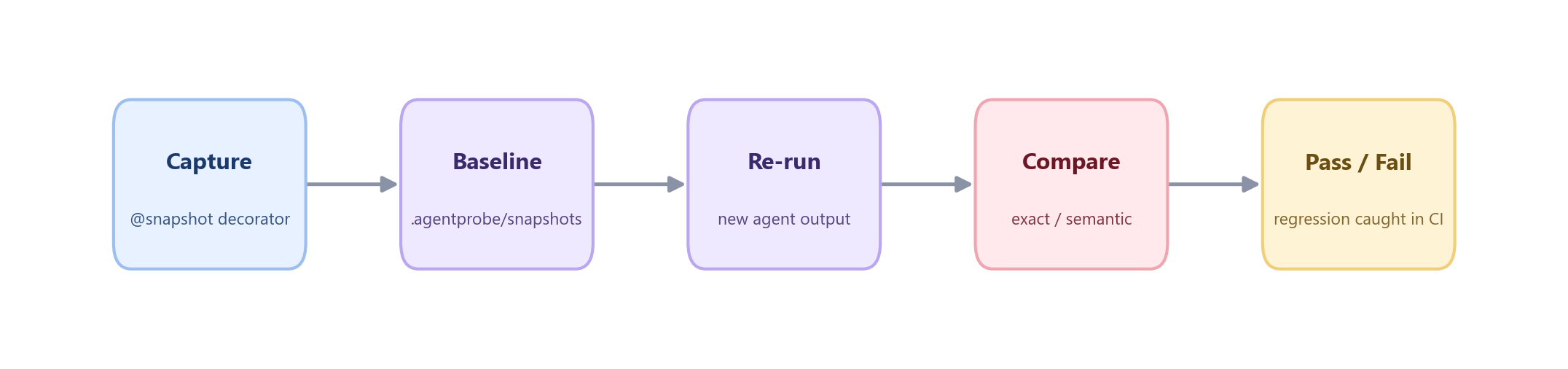
AgentProbe fixes this. One decorator captures your agent's output and saves it as a baseline snapshot. On the next run, it compares the new output against the baseline — exact match or semantic similarity. If something changed, the test fails. Run it in CI, and you catch regressions before they hit production.
pip install agentpoke
Heads up: the PyPI distribution is
agentpoke(the nameagentprobewas taken), but you import it asagentprobein code —from agentprobe import ....
from agentprobe import snapshot

@snapshot("summarize_article")
def test_summarize():
    result = my_agent.summarize("The quick brown fox jumps over the lazy dog.")
    return result
First run: creates a baseline in .agentprobe/snapshots/summarize_article.json. Next runs: compares the output against the baseline and fails if they differ. async def tests work the same way. Snapshots are meant to be committed, so CI can compare against them.
Non-deterministic fields and credentials are handled before comparison:
# mask volatile fields at any depth so they don't cause spurious mismatches
@snapshot("summarize_article", redact=["timestamp", "request_id"])

# scrub API keys, tokens, JWTs and emails even inside free text,
# plus your own regex shapes (also globally via --agentprobe-redact-secrets)
@snapshot("summarize_article", redact_secrets=True, redact_patterns=[r"internal-\d{4}"])
MockLLM is a drop-in replacement for openai.Client that returns scripted responses, so agent logic tests hit no API:
from agentprobe import MockLLM

mock = MockLLM(responses=[
    "The document discusses three main topics.",
    {"tool_calls": [{"id": "1", "function": {"name": "search", "arguments": '{"q": "test"}'}}]},
])

result = mock.chat.completions.create(messages=[{"role": "user", "content": "Summarize this doc"}])
assert "three main topics" in result.choices[0].message.content
assert mock.call_count == 1  # mock.calls records everything; mock.reset() for reuse
Scripted responses are consumed in order; default_response= covers the tail once they run out.
Async agents, streaming, and failure injection work the same way:
from agentprobe import AsyncMockLLM, Flaky, MockRateLimitError

# AsyncMockLLM drops in wherever an agent holds openai.AsyncOpenAI
mock = AsyncMockLLM(responses=["Hello!"])
result = await mock.chat.completions.create(messages=[{"role": "user", "content": "hi"}])

# stream=True yields delta chunks with the real client's chunk shape
stream = await mock.chat.completions.create(messages=[...], stream=True)
async for chunk in stream:
    print(chunk.choices[0].delta.content or "", end="")

# script failures to test retry and fallback logic offline:
# raises twice, then returns "recovered" on the third call
mock = MockLLM(responses=[Flaky(MockRateLimitError("slow down"), times=2, then="recovered")])
A plain exception instance in the list raises once when its turn comes; MockTimeoutError and MockServerError ship alongside MockRateLimitError, or bring your own exception.
Verify your agent calls the right tools, in the right shape:
from agentprobe import assert_no_tool_called, assert_tool_called, assert_tool_sequence

assert_tool_called(tool_calls, "web_search", times=1)
assert_tool_called(tool_calls, "web_search", with_args={"query": "latest news"})
assert_tool_sequence(tool_calls, ["web_search", "summarize"])
assert_no_tool_called(tool_calls, "delete_file")
The variants cover the messy real cases:
assert_tool_sequence(..., contiguous=True) catches planner reorderings where a tool must immediately follow another.min_times/max_times replace times when the exact count is non-deterministic: assert_tool_called(tool_calls, "api_call", max_times=3) bounds a flaky retry.assert_max_tool_calls(tool_calls, 10) budgets the whole run, not just one tool (zero calls still passes).with_args is a nested subset match and also accepts OpenAI-style JSON string arguments.assert_tool_not_called_with(tool_calls, "run", {"sudo": True}) allows the tool but fails on a dangerous argument subset.from pydantic import BaseModel
from agentprobe import assert_schema
class AgentResponse(BaseModel):
answer: str
confidence: float
sources: list[str]
def test_output_structure():
output = my_agent.run("What is the capital of France?")
result = assert_schema(output, AgentResponse)
assert result.confidence > 0.8
Record what an agent did step by step, then assert over the trace or snapshot it:
from agentprobe import Trace, assert_tool_sequence

trace = Trace()
trace.record_llm("planning the search")
trace.record_tool_call("search", {"query": "rainfall 2023"})
trace.record_event("retry", attempt=2)
trace.record_tool_call("fetch", {"url": "https://example.com"})

assert_tool_sequence(trace.tool_calls, ["search", "fetch"])
assert trace.names == ["llm", "search", "retry", "fetch"]
# trace.to_dict() is snapshot-friendly for full-run regression tests
Record token usage and assert the run stayed under a USD budget — catching regressions that quietly burn more money. Pricing comes from a dict, a callable, or TokenTracker's price table (pip install toktally):
from agentprobe import assert_cost_under

assert_cost_under(trace, 0.05, pricing={"gpt-4o": (0.005, 0.015)})  # (input, output) per 1k tokens
AgentProbe registers as a pytest plugin automatically:
def test_with_fixture(agentprobe):
    output = my_agent.run("Hello")
    result = agentprobe.capture("greeting_test", output)
    assert result.passed
pytest tests/                                        # run tests
pytest tests/ --agentprobe-update                    # regenerate baselines after intentional changes
pytest tests/ --agentprobe-mode=semantic --agentprobe-threshold=0.85
pytest tests/ --agentprobe-evalport=results.json     # export the run as an EvalPort ResultSet
When a snapshot changes, AgentProbe prints a unified diff between the stored JSON and the current output, so CI logs show the exact field or sentence that drifted. The standalone CLI mirrors the flags: agentprobe run, agentprobe run --mode semantic --threshold 0.9, agentprobe update.
--agentprobe-evalport=PATH writes the run's snapshot results as an EvalPort-compatible ResultSet, the open interchange format from EvalPort, so dashboards and CI tooling that already speak it can consume AgentProbe results directly. Each capture becomes one test-case result carrying a single agentprobe_snapshot grader: passed carries over, similarity becomes score (baseline creates and updates never compared anything, so they fall back to 1.0), and message becomes reason.
The same mapping works as a library call:
from agentprobe import to_resultset, write_resultset

resultset = to_resultset(snap.results, suite_id="my-agent")
write_resultset(snap.results, "resultset.json")
A failed comparison also saves the actual output to .agentprobe/last_run/, so you can review and accept drift without re-running the test suite:
agentprobe diff              # baseline vs last failing run, with similarity scores
agentprobe diff summarize    # just one snapshot
agentprobe diff --stat       # one line per snapshot: +added -removed counts, for triage before drilling in
agentprobe diff --html report.html  # self-contained HTML report for sharing or CI artifacts
agentprobe review            # walk each failing run: see the diff, then accept, reject, or skip it
agentprobe review --check    # CI gate: list pending failing runs, exit 1 if any
agentprobe accept            # promote all last-run outputs to baselines
agentprobe accept summarize  # promote just one
That is the everyday loop: CI goes red, agentprobe diff shows exactly which sentence moved, agentprobe accept blesses the new normal. No hand-editing JSON, no blind update of everything.
| Mode | How it works | When to use |
|---|---|---|
exact (default) | String equality after serialization | Deterministic agents, structured outputs |
fuzzy | Cosine similarity over character 3-gram sets, pure stdlib, no install | Catching wording drift in CI without an embedding model |
semantic | Cosine similarity via sentence-transformers (pip install agentpoke[semantic]) | Non-deterministic LLM outputs, paraphrase-level equivalence |
| Feature | AgentProbe | DeepEval | Promptfoo |
|---|---|---|---|
| pytest native | Yes (plugin) | Separate runner | CLI only |
| Snapshot baselines | Yes | No | No |
| Semantic comparison | Yes | Yes | Yes |
| Mock LLM | Yes (built-in: async, streaming, failure injection) | No | Partial |
| Tool call assertions | Yes | No | No |
| Schema validation | Yes (Pydantic) | Partial | No |
| Cloud required | No | Optional | No |
| Config format | Python code | Python code | YAML |
- name: Run agent tests
  run: |
    pip install agentpoke
    pytest tests/ -v
Commit .agentprobe/snapshots/ so CI can compare against them.
Do I need an API key?
No. MockLLM gives you deterministic tests without any API calls. Testing against a real LLM needs that provider's key, which is your agent's dependency, not AgentProbe's.
What about flaky tests from non-deterministic outputs?
Use semantic mode with an appropriate threshold, or use MockLLM to make the underlying LLM deterministic.
Does it work with LangChain / CrewAI / AutoGen? Yes. AgentProbe tests your agent's output, not its internals. Call your agent inside the test function and return the result.
Shipped: async agent tests, tool-call assertions (presence, count bounds, ordering, forbidden-argument checks), multi-step tracing, cost tracking via TokenTracker, in-terminal visual diffs for snapshot mismatches plus self-contained --html diff reports, pytest-xdist parallel runs with atomic snapshot writes, pattern-based secret scrubbing for snapshots, interactive snapshot review (agentprobe review walks each changed snapshot and lets you accept or reject it one at a time), EvalPort-compatible ResultSet export (--agentprobe-evalport=PATH) for downstream eval tooling, and a MockLLM that covers async clients, streaming chunks, and scripted failure injection.
Planned:
fuzzy mode is pure stdlib.)Contributions welcome. If you're testing AI agents in production and have ideas for what's missing, open an issue.
Stop shipping untested agents.
Download counts and popularity will appear here as the collector receives them.
| Package / target | Requirement | Relationship |
|---|---|---|
clickEnvironment{
"extras": "",
"marker": null,
"requires_python": ">=3.10",
"evaluation": "NOT_EVALUATED"
} | click>=8.0 | runtime |
pydanticEnvironment{
"extras": "",
"marker": null,
"requires_python": ">=3.10",
"evaluation": "NOT_EVALUATED"
} | pydantic>=2.0 | runtime |
pytestEnvironment{
"extras": "",
"marker": null,
"requires_python": ">=3.10",
"evaluation": "NOT_EVALUATED"
} | pytest>=7.0 | runtime |
openaiEnvironment{
"extras": "",
"marker": "extra == \"all\"",
"requires_python": ">=3.10",
"evaluation": "NOT_EVALUATED"
} | openai>=1.0; extra == "all" | runtime |
sentence-transformersEnvironment{
"extras": "",
"marker": "extra == \"all\"",
"requires_python": ">=3.10",
"evaluation": "NOT_EVALUATED"
} | sentence-transformers>=2.0; extra == "all" | runtime |
pytestEnvironment{
"extras": "",
"marker": "extra == \"dev\"",
"requires_python": ">=3.10",
"evaluation": "NOT_EVALUATED"
} | pytest>=7.0; extra == "dev" | runtime |
ruffEnvironment{
"extras": "",
"marker": "extra == \"dev\"",
"requires_python": ">=3.10",
"evaluation": "NOT_EVALUATED"
} | ruff>=0.4; extra == "dev" | runtime |
openaiEnvironment{
"extras": "",
"marker": "extra == \"openai\"",
"requires_python": ">=3.10",
"evaluation": "NOT_EVALUATED"
} | openai>=1.0; extra == "openai" | runtime |
sentence-transformersEnvironment{
"extras": "",
"marker": "extra == \"semantic\"",
"requires_python": ">=3.10",
"evaluation": "NOT_EVALUATED"
} | sentence-transformers>=2.0; extra == "semantic" | runtime |
bdist_wheel · 30.58 KB · Python py3
sdist · 116.52 KB · Python source
Observed since 20 Oct, 22:55 UTC
No superseded metadata states collected. Unchanged observations do not create new revisions.
package_version:f97276cf47a16e17d7af574f9d3d8bfb7caa87cdcd94627ffe87d2ec4e2720e9