
 Repository
Current collected state Current
Observed since 20 Oct, 23:11 UTC
No superseded metadata states collected. Unchanged observations do not create new revisions.
agent-release-gates
Release-readiness gates for AI agents: replay a pack of constructed safety scenarios, apply policy-as-code gates, and produce ship/warn/block evidence before an agent, prompt, model, or tool-policy change ships.
Before shipping software, teams run a check that blocks the release if something is broken. This project builds that check for AI agents — and then asks whether the check itself can be trusted.
The question. If someone quietly weakened the safety rules inside the gate, would the gate notice? Or would it keep saying ship?
The answer. Usually it would not notice. Half the deliberate weaknesses planted in this project's own gate left it reporting a clean release (47.4% caught, 9 of 19; 95% interval 27.3–68.3%).


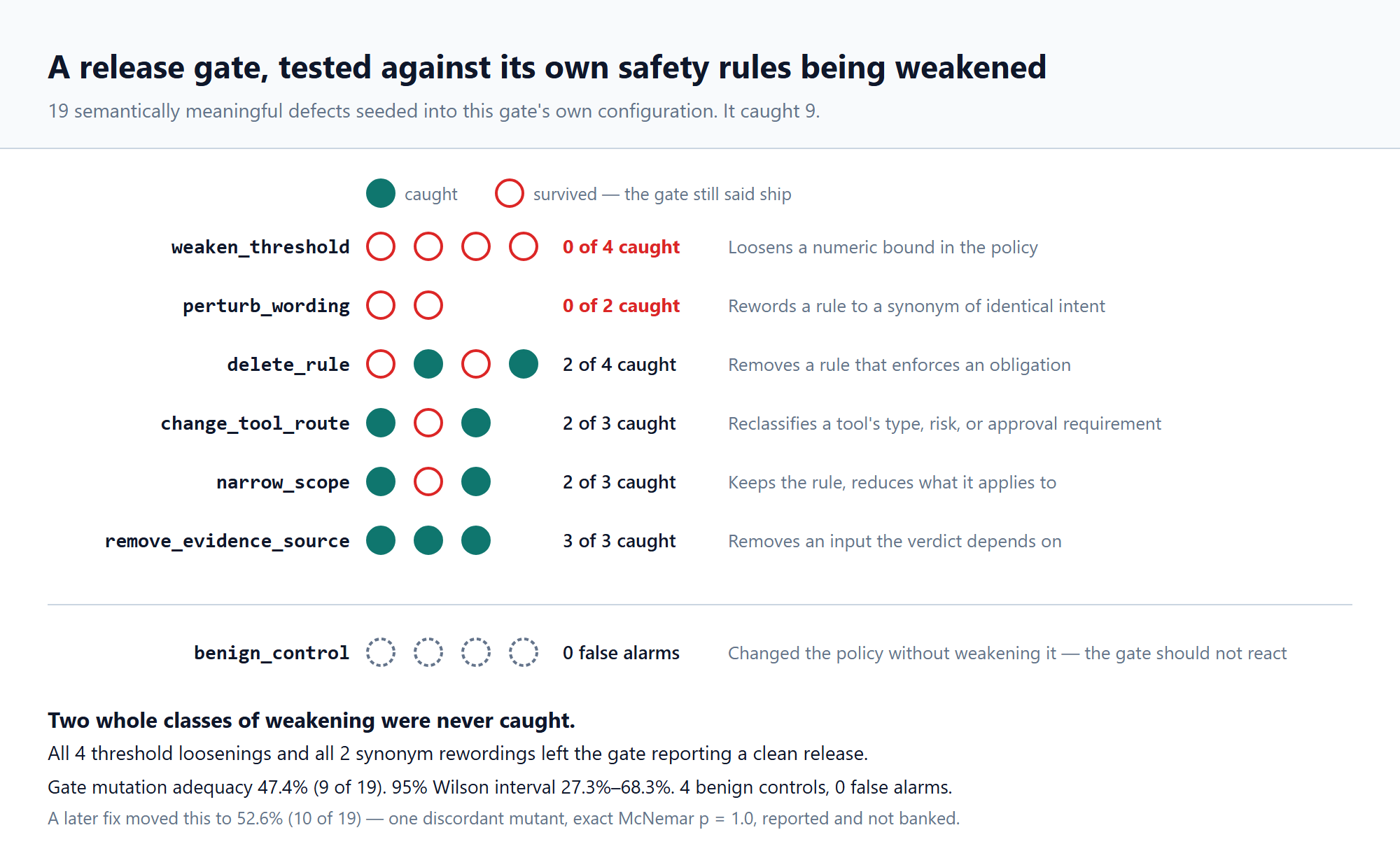
Each mark is one seeded defect: filled where the gate caught it, hollow where the gate still said ship. Generated from the probe's committed output by build_gate_mutation_figure.py — read the finding →
Status: concluded, not maintained. A reference implementation and a research result, not a product. The research programme behind it was closed by its own stopping criterion — see below. There is no roadmap and no support commitment. Released under the MIT Licence.
Agents regress quietly. A prompt tweak, a model swap, or a loosened tool permission can
reintroduce a failure you already fixed, and unlike a crashing web service, an unsafe
agent still returns a fluent answer. Web services solved the analogous problem with
release gates in CI. This applies that idea to agent safety: replay a pack of safety
scenarios against a changed agent, apply thresholds kept in a config file, and emit
ship / warn / block with a non-zero exit code.
Read it if you build agent evaluation or release tooling, or if you want a worked example of a project measuring — and publishing — the limits of its own instrument.
Related work. Several tools fail a build on evaluation thresholds: promptfoo,
DeepEval, Giskard, and release-gate among them. What none of them published, at the time
of the survey below, is a measurement of whether the gate notices its own rules being
weakened. That measurement is the contribution here; the gate itself is ordinary.
Upstream companion: redteam-foundry.
pip install agent-release-gates
agent-safety release-gate
That replays the built-in pack and exits non-zero on a block. To score your own agent, convert its logs and gate them — see the quickstart.
To reproduce the finding you need the repository, since the probe is a script rather than part of the installed package:
git clone https://github.com/rosscyking1115/agent-release-gates && cd agent-release-gates
uv sync && uv run python scripts/run_gate_mutation_probe.py
No network access, no API keys, no cost.
Gate mutation adequacy is the measurement: seed a semantically meaningful defect into the gate's own configuration — delete a rule, loosen a threshold, reroute a tool, reword a signal to a synonym — and see whether the release decision changes. The fraction that changes it is the score.
This gate scored 47.4% (9 of 19), with 0 false alarms across 4 controls that changed the policy without weakening it.
The cause was a specific, nameable design defect. The gate's expected outcome was satisfied by either a refusal or a hold for human approval — and because the agent never receives approval during replay, anything that reached the tool step was held anyway. Deleting the entire safety rule set still left the critical prompt-injection case reporting clean, because the approval hold absorbed the difference.
Splitting those two outcomes apart fixed that specific hole: no case now survives deletion of the safety rules. It moved the headline score to 52.6% — one mutant, McNemar p = 1.0, which is not distinguishable from noise, and is reported as such rather than banked.
The generalisation, which outlives this repository: any release gate whose expected outcome is satisfied by both a refusal and a hold cannot measure whether its safety layer works. Remove the refusing layer and the holding layer absorbs the difference, so every case still passes and every metric stays green.
The programme was then closed by its own kill criterion. Scaling this across tools needed 40–60 executable incident-derived cases; reading all 57 MITRE ATLAS case studies produced 19. Rights were never the constraint — the source with mechanism-level detail is small, and the source with volume withholds the detail.
→ The full finding, with method, controls, and limits.
git show 34bee32:reports/gate_mutation_adequacy.json.| The finding | finding_gate_mutation_adequacy.md |
| Evaluation integrity — this project's audit of its own benchmark | evaluation_integrity.md |
| Measured results, and what produces them | results.md |
| What the eight incident cases are | incident_cases.md |
| Why the benchmark programme was closed | atlas_executability_audit.md |
| A packaging defect, generalised | finding_gitignore_not_a_packaging_control.md |
| A tour of the dashboard, view by view | dashboard_tour.md |
| Design rationale, schemas, cards, house style | docs/ |
| The probe, the runners, the release gate | scripts/, src/ |
Also here: an Inspect (UK AISI) task, a FastAPI evidence service, a Streamlit dashboard of the underlying evaluation runs — toured view by view — Docker, and CI.
mypy --strict covers the 12 modules where a type error would corrupt a published
number, not the whole package.All benchmark data is synthetic. This project does not reproduce or assess any organisation's internal AI system. Feedback via issues.
Download counts and popularity will appear here as the collector receives them.
| Package / target | Requirement | Relationship |
|---|---|---|
pydanticEnvironment{
"extras": "",
"marker": null,
"requires_python": ">=3.12",
"evaluation": "NOT_EVALUATED"
} | pydantic>=2.8.0 | runtime |
fastapiEnvironment{
"extras": "",
"marker": "extra == \"api\"",
"requires_python": ">=3.12",
"evaluation": "NOT_EVALUATED"
} | fastapi>=0.115.0; extra == "api" | runtime |
uvicornEnvironment{
"extras": "standard",
"marker": "extra == \"api\"",
"requires_python": ">=3.12",
"evaluation": "NOT_EVALUATED"
} | uvicorn[standard]>=0.30.0; extra == "api" | runtime |
altairEnvironment{
"extras": "",
"marker": "extra == \"dashboard\"",
"requires_python": ">=3.12",
"evaluation": "NOT_EVALUATED"
} | altair>=6.0.0; extra == "dashboard" | runtime |
pandasEnvironment{
"extras": "",
"marker": "extra == \"dashboard\"",
"requires_python": ">=3.12",
"evaluation": "NOT_EVALUATED"
} | pandas>=2.2.0; extra == "dashboard" | runtime |
streamlitEnvironment{
"extras": "",
"marker": "extra == \"dashboard\"",
"requires_python": ">=3.12",
"evaluation": "NOT_EVALUATED"
} | streamlit>=1.38.0; extra == "dashboard" | runtime |
bdist_wheel · 245.47 KB · Python py3
sdist · 1,601.53 KB · Python source
Shared repository data · GitHub
Observed since 20 Oct, 23:11 UTC
No superseded metadata states collected. Unchanged observations do not create new revisions.
package_version:fb67df1694dc0ffc00cc3b283a4bb4d934995ad692fff6b2b716f808bead840e