

 Repository
Current collected state Current
Observed since 20 Oct, 21:44 UTC
No superseded metadata states collected. Unchanged observations do not create new revisions.
agentcrawl-ai
Self-hosted web scraping and Markdown extraction for AI agents.


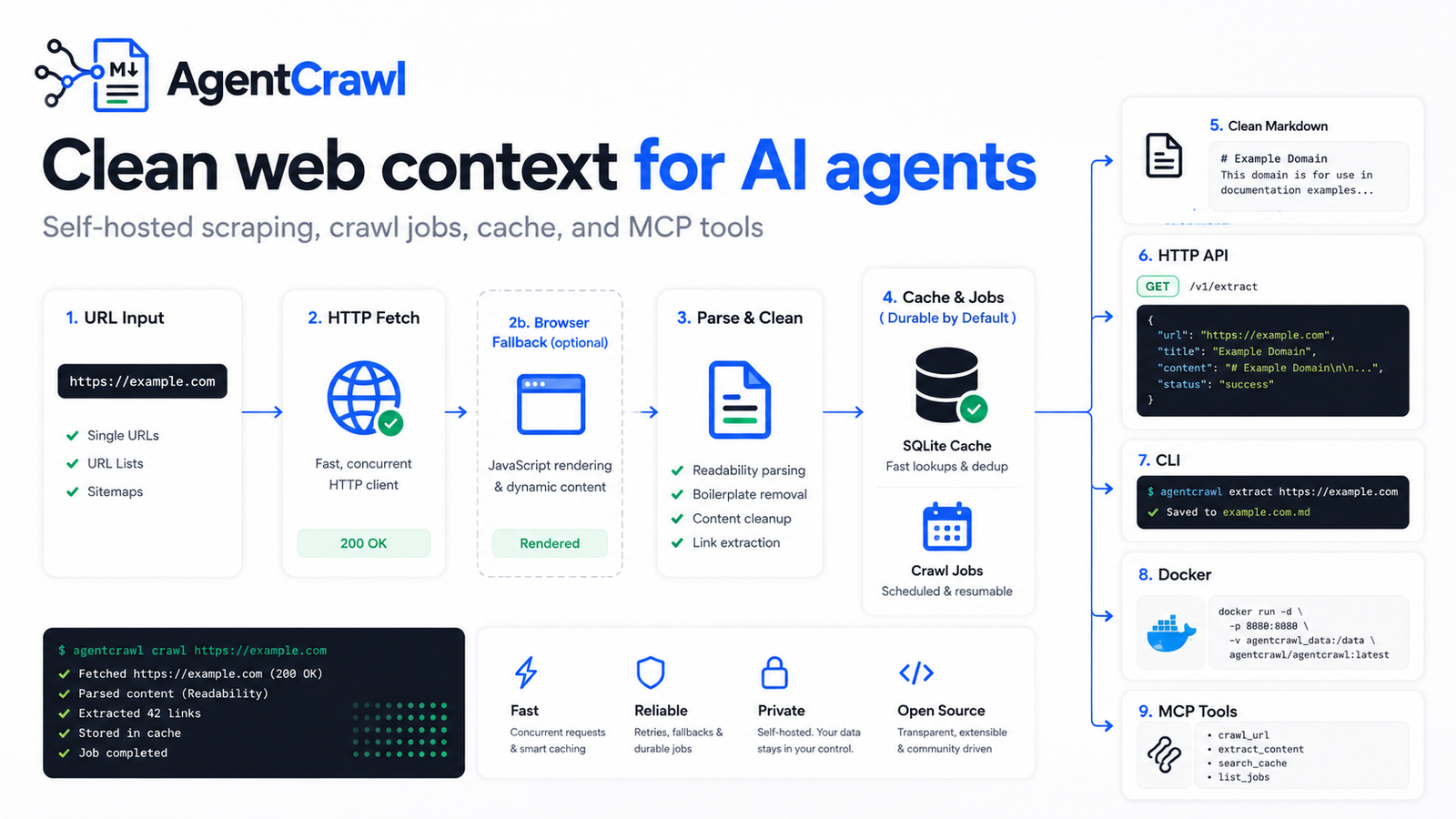
🕷️ A small self-hosted crawler for AI agents.
AgentCrawl gives agents a simple way to read normal web pages without pasting raw HTML into chat or routing every URL through a hosted scraper. It turns pages and local documents into Markdown, text, links, metadata, JSON-LD, and crawl results. It runs from the CLI, Python, Docker/API, or as an MCP server.
The project is early, intentionally modest, and being worked on steadily: accessible pages first, clean output, local state, honest failures.
pip install agentcrawl-ai
agentcrawl scrape https://docs.python.org/3/library/json.html
Pages that only render with JavaScript need the browser extra ([browser], then
python -m playwright install chromium); agentcrawl doctor tells you whether
the browser can start. The browser presents itself as the Chrome it is and waits
out self-clearing checks such as Cloudflare's "Just a moment…", ticking the
Turnstile checkbox when one is still showing, as a person would; the [stealth]
extra, recommended for sites behind Cloudflare, retries a refused page once with
Patchright. A page that still
asks for a CAPTCHA and is recognised as one comes back as
error_type: "client_challenge" with the signals seen and a next_step, not as
content.
Pull requests that change the engine, and a weekly run, check it against real public sites (docs, Wikipedia, GitHub, Hacker News, Django docs, a JavaScript-rendered page) in the live smoke workflow.
python -m pip install "agentcrawl-ai[mcp]"
agentcrawl setup                 # registers the MCP server in Claude Code, Codex, Gemini CLI, Cursor, VS Code
agentcrawl doctor --client all   # aligned / stale / missing per client
setup shows the exact change for each client and asks before applying it (--yes to skip the question, --dry-run to only look). Claude Code, Codex and Gemini CLI are changed through their own mcp add command; Cursor and VS Code get a JSON write with a backup next to the file. Other clients: register python -m agentcrawl mcp by hand.
By default the MCP exposes the core tools an agent needs: scrape_url, scrape_many, map_site, crawl_site and extract_structured, plus search_web when a search engine is configured. Set AGENTCRAWL_MCP_PROFILE=full for the operator tools (job history, cancellation, failure inspection, retries, usage, cache, change checks). Coding agents should follow INSTALL_FOR_AGENTS.md.
The MCP only fetches URLs by default: local file paths are refused, because an agent can be steered by the pages it reads. To let it read a docs folder, set AGENTCRAWL_ALLOW_LOCAL_FILES=true and AGENTCRAWL_LOCAL_FILES_ROOT=/path/to/docs. The Python library and the CLI still read local files by default.
An agent skill (Claude Code, Codex, Cursor, OpenClaw and other clients that read SKILL.md) teaches the agent when and how to use AgentCrawl, including reading long pages section by section:
npx skills add JorG18/agentcrawl
The skill lives in skills/agentcrawl/SKILL.md and is also on ClawHub for OpenClaw. ClawHub publishes every skill under MIT-0; that covers the skill text only, the code stays Apache-2.0.
pip install agentcrawl-ai
agentcrawl scrape https://docs.python.org/3/library/json.html
from agentcrawl import AgentCrawl

crawler = AgentCrawl({"fetcher": "http"})
document = crawler.scrape("https://docs.python.org/3/library/json.html")

print(document.markdown)
print(document.metadata)
docker run --rm -p 8000:8000 \
  -e AGENTCRAWL_API_KEYS="replace-with-a-long-random-key" \
  ghcr.io/jorg18/agentcrawl:latest

curl http://127.0.0.1:8000/health
# Read-only local dashboard. It follows the API auth setting, so send the key:
# curl -H "authorization: Bearer replace-with-a-long-random-key" \
#   http://127.0.0.1:8000/api/dashboard/summary
# Header-less browser view (single-operator hosts only):
#   -e AGENTCRAWL_DASHBOARD_PUBLIC=true  →  open http://127.0.0.1:8000/dashboard
Or with Compose:
cp .env.example .env
# Replace AGENTCRAWL_API_KEYS and AGENTCRAWL_API_KEY in .env
docker compose up -d
curl http://127.0.0.1:8000/health
Agents often need web context, but raw HTML is a mess. A useful page can arrive mixed with navigation, cookie text, related links, footer links, scripts, and layout junk.
AgentCrawl is a small local layer for that. Give it a URL, get something an agent can read, and keep the cache, jobs, and failures in your own environment.
What works today:
agentcrawl dashboard or open /dashboard on the API server (it follows the API auth setting).robots.txt support, SSRF protections, unsafe redirect blocking, and private-network controls.AgentCrawl Community is the self-hosted trust layer:
| Included | Notes |
|---|---|
| CLI | Scrape, crawl, inspect jobs, manage cache, backup, restore. |
| Python library | Local use from scripts and agent runtimes. |
| HTTP API | FastAPI server for self-hosted deployments. |
| MCP | Standards-based stdio MCP server for agent clients. |
| Docker / GHCR | Public image built and smoke-tested by GitHub Actions. |
| Durable crawls | SQLite jobs, events, checkpoints, retries, and failure records. |
| Local dashboard | Read-only static HTML over SQLite via agentcrawl dashboard and /dashboard; the HTTP view follows the API auth setting. |
| Quality extraction | Markdown, links, metadata, JSON-LD/provenance, tables, code blocks. |
| Web search | search in the library, API (/v1/search), MCP (search_web) and CLI: search, then read the top results with the query as the relevance query. Opt-in with AGENTCRAWL_SEARCH_ENGINE=serper + SERPER_API_KEY (duckduckgo needs no key but often answers automated clients with a bot check, reported as an error). |
| llms.txt | map reads a site's /llms.txt links; agentcrawl llms-txt URL generates one from a bounded crawl. |
| Whole page or not | Every result carries metadata.coverage: status is complete, truncated (token budget, endpoint limit), partial (needed JavaScript, browser failed, network never went idle, empty page), blocked or failed, and reasons lists why. |
| Citable chunks | formats=["chunks"]: pieces of about chunk_tokens (default 400) that keep tables and code whole, with the heading path, a cite_url text-fragment link and, with query, a BM25 score. |
| Browser actions and screenshots | browser_actions (click, type, press, scroll, scroll_to_end, virtual_scroll, wait, wait_for; at most 25 bounded steps) run before the page is read, and formats=["screenshot"] returns a full-page PNG. Local Playwright only; a failed step fails the scrape with the step named. |
| JSON endpoints behind a page | formats=["api"] renders the page and lists the same-site JSON calls it made (XHR/fetch): method, URL, status, size, call count and the response's shape (keys and types, never values). Secret-looking query values (token, key, session...) are replaced by REDACTED; third-party hosts (analytics, payments) are left out. Report only, needs a local browser; at most 30 endpoints per page (metadata.api_truncated), bodies over 2 MB are listed without a shape. |
| Logged-in pages | agentcrawl login URL --session NAME opens a browser where you sign in by hand; --session NAME (library browser_session, MCP session) then reads pages with that login. Sessions are stored locally with owner-only permissions. |
| Web components and iframes | In the browser, text inside open Shadow DOM and visible iframes is copied into the page before it is read (browser_shadow_dom, browser_iframes, both on). |
| Adaptive crawl | crawl(query=...) (API/MCP/CLI --query) visits the most relevant links first and stops after stop_after_irrelevant pages in a row that do not match. |
| Change tracking | Every page carries markdown_sha256, etag and last_modified; diff() / agentcrawl diff URL --previous FILE / MCP check_changes send conditional requests and return a unified diff; crawl(previous_hashes=...) marks pages new, changed or unchanged. |
| Batch scraping | scrape_many in the library, API (/v1/scrape_many), MCP and CLI (scrape-many). |
| Framework adapters | agentcrawl.integrations.langchain.AgentCrawlLoader and agentcrawl.integrations.llama_index.AgentCrawlReader yield pages or citable chunks. A zero-dependency TypeScript client for the HTTP API lives in sdk/typescript. |
| Structured extraction without an LLM | CSS schemas (extract-css, /v1/extract_css, MCP extract_structured): deterministic, zero tokens. generate_css_schema(url, "what to extract") (MCP describe=) has your LLM write the schema once; reuse it for free. |
| Reading long pages in parts | formats=["outline"] lists sections with the tokens each returns; section="s4" (or heading text) returns one; max_tokens caps the output. The MCP keeps a page for 10 minutes, so outline then sections is one download. |
| Firecrawl-compatible API | /v2/scrape, /v2/map, /v2/search, /v2/crawl and /v2/batch/scrape answer Firecrawl's v2 SDKs: point api_url at your server. Options AgentCrawl cannot honour are refused with the reason. |
| Local stealth and proxies | Real Chrome identity, native browser TLS, the [stealth] extra (Patchright retry), the opt-in [cloak] engine (CloakBrowser), and proxy as a comma-separated list rotated per page. |
| Summaries | formats=["summary"] with your own LLM (AGENTCRAWL_LLM_MODEL); a failure never fails the page. |
| Query-aware budgets | query= keeps the passages that matter (BM25) when a page is larger than the output budget. |
| Browser fallback | Optional local browser (kept open between pages, four at a time) or Camofox, not required for the default image. One time budget per page (page_budget_ms, 45 s) covers every step. |
| Lightweight docs | Install, examples, operations, release, quality notes. |
Community is self-hosted: everything above runs on your machine, with your browser, your proxies and your LLM.
Community is everything that runs on your own machine: the extraction engine, the local browser with its stealth retry, proxies you bring, your own LLM. A page it recognises as a challenge is reported with the reason and a next_step instead of being returned as content.
What costs money to operate belongs to AgentCrawl Enhanced, a hosted API (planned): managed residential and mobile proxies, geolocation, a managed browser fleet, CAPTCHA solving, schedules, webhooks, retained datasets, teams and billing.
Measured in October 2026 against Crawl4AI, Scrapling and Firecrawl (full results, method and limits):
fit_markdown (2 % smaller live, 18 % larger offline).How the engine gets there:
<main>, <article>, documentation/content containers, or text-rich fallback blocks;language-python and lang-javascript;Run the report locally:
python -m benchmarks.quality_report
Authentication is enabled by default. Configure at least one API key before exposing the server:
export AGENTCRAWL_API_KEYS="replace-with-a-long-random-key"
python -m pip install "agentcrawl-ai[server]"
agentcrawl serve --host 0.0.0.0 --port 8000
Health check:
curl http://127.0.0.1:8000/health
Code written for Firecrawl's v2 API works against the same server (the SDK's
default skipTlsVerification is accepted; certificates are still verified):
from firecrawl import Firecrawl

app = Firecrawl(api_key="replace-with-a-long-random-key", api_url="http://127.0.0.1:8000")
doc = app.scrape("https://docs.python.org/3/library/json.html", formats=["markdown"])
Scrape a URL:
curl http://127.0.0.1:8000/v1/scrape \
  -H "authorization: Bearer replace-with-a-long-random-key" \
  -H "content-type: application/json" \
  -d '{"url":"https://docs.python.org/3/library/json.html","formats":["markdown","links","metadata"]}'
Main endpoints (everything except /health requires the bearer key; the dashboard follows the same setting unless AGENTCRAWL_DASHBOARD_PUBLIC=true):
GET    /health                     (unauthenticated)
GET    /dashboard                  (see AGENTCRAWL_DASHBOARD_PUBLIC)
GET    /api/dashboard/summary      (see AGENTCRAWL_DASHBOARD_PUBLIC)
POST   /v1/scrape
POST   /v1/scrape_many
POST   /v1/search
POST   /v1/map
POST   /v1/crawl
GET    /v1/jobs/{job_id}
GET    /v1/jobs/{job_id}/events
DELETE /v1/jobs/{job_id}
GET    /v1/failures
GET    /v1/jobs/{job_id}/failures
POST   /v1/jobs/{job_id}/failures/retry
POST   /v1/extract
POST   /v1/extract_css
GET    /v1/usage
GET    /v1/stats
DELETE /v1/cache
Several pages at once, and structured data without an LLM:
agentcrawl scrape-many https://example.com/a https://example.com/b
AGENTCRAWL_SEARCH_ENGINE=serper SERPER_API_KEY=... agentcrawl search "fastapi dependency injection" --limit 3
agentcrawl scrape https://example.com/docs/faq --query "refund policy"

cat > products.json <<'JSON'
{"baseSelector": "div.product",
 "fields": [{"name": "title", "selector": "h2"},
            {"name": "price", "selector": ".price", "transform": "number"},
            {"name": "url", "selector": "a", "type": "attribute", "attribute": "href", "transform": "url"}]}
JSON
agentcrawl extract-css https://shop.example.com/catalog --schema products.json
Scraping a local dev server (localhost/127.x) is refused by default by the SSRF guard. Allow it on purpose with --allow-private-network or AGENTCRAWL_ALLOW_PRIVATE_NETWORK=true; the CLI's local mode reads the same AGENTCRAWL_* variables as MCP (--airgap, --allowlist, --audit, --timeout-ms, --no-robots, --no-browser-fallback override them). scrape, scrape-many, extract-css, map and crawl exit 1 when the result has errors.
The CSS schema supports text, attribute, html, regex, nested and list fields; the selector subset is documented in agentcrawl/css_extract.py, and anything outside it is rejected instead of silently matching nothing.
OpenAPI docs are available at /docs when the server is running.
Generate a dependency-free static HTML snapshot from any AgentCrawl SQLite database:
agentcrawl dashboard --db agentcrawl.db --output dashboard.html
When the API server is running, the same read-only view is available at /dashboard (HTML) and /api/dashboard/summary (JSON). The dashboard reports job status, crawl queue, open failures, cache domains, and usage units without sending data to any hosted service.
Because that is the same operational data GET /v1/stats protects, the HTTP dashboard follows AGENTCRAWL_AUTH_ENABLED: with auth on it needs the bearer key, and with auth off (local/dev) it stays open. A browser cannot send a bearer header, so a single-operator host that wants the header-less view sets AGENTCRAWL_DASHBOARD_PUBLIC=true. The static file above needs no server at all.
Start an asynchronous crawl:
agentcrawl --remote crawl https://example.com --max-pages 25 --max-depth 2
HTTP clients can attach an idempotency key so retries return the original job instead of starting a duplicate:
curl http://127.0.0.1:8000/v1/crawl \
  -H "authorization: Bearer replace-with-a-long-random-key" \
  -H "content-type: application/json" \
  -H "Idempotency-Key: docs-crawl-2026-06-06" \
  -d '{"url":"https://example.com","max_pages":25,"max_depth":2}'
Running jobs checkpoint their queue, visited URLs, retry attempts, progress, and extracted documents in SQLite. Transient page failures use persisted exponential backoff without occupying a crawl worker. They are reclaimed after a service restart.
Read completed documents page by page:
agentcrawl --remote job JOB_ID --offset 0 --limit 100
Run a local command when a crawl finishes with terminal failures:
agentcrawl crawl https://example.com \
  --alert-on-failure \
  --cmd 'python notify.py'
The command receives JSON on stdin with source, failure_count, and failures.
Inspect or cancel a job:
agentcrawl --remote job JOB_ID
agentcrawl --remote job-cancel JOB_ID
/v1/stats reports queue readiness, delayed retries, running and cancelling jobs, crawl failures by status, open retryable failures, and open failures by error type.
Community supports local document ingestion without sending file contents to a hosted parser:
agentcrawl scrape ./notes.md
agentcrawl scrape ./data.json
agentcrawl scrape ./feed.xml
agentcrawl scrape ./report.docx      # also .xlsx and .pptx, no extra needed
python -m pip install "agentcrawl-ai[docs]"
agentcrawl scrape ./report.pdf
agentcrawl scrape ./scanned.pdf --ocr # needs the Tesseract binary
Current document support:
| Input | Support |
|---|---|
| HTML | Main-content Markdown extraction. |
| Markdown | Passed through as Markdown. |
| Text | Passed through as plain Markdown text. |
| JSON | Pretty-printed inside a fenced json block. |
| XML/RSS/Atom | Preserved inside a fenced xml block. |
| CSV/TSV | Rendered as a Markdown table (delimiter sniffed); also for URLs served as text/csv. Shape in metadata; rows beyond 5 000 are reported as omitted. |
| DOCX / XLSX / PPTX | Read with the standard library: headings, lists and tables from Word; one Markdown table per sheet; one section per slide in presentation order. Size-checked before unzipping. |
Extracted page-by-page to Markdown with the optional docs extra. Enforces size/page safety limits and rejects encrypted PDFs. A PDF with no text layer says so in metadata.warning; ocr=true (--ocr, AGENTCRAWL_OCR) reads it with Tesseract. |
PDF and Office files fetched from URLs are converted the same way, detected by content type or, for generic binary responses, by file extension.
The default package and default Docker image use HTTP extraction. Add browser rendering only when a site needs JavaScript:
python -m pip install "agentcrawl-ai[browser]"
python -m playwright install chromium
Pages behind a login: sign in once in a visible browser, then read as that user.
Passwords and 2FA never pass through AgentCrawl; only the resulting cookies are
saved, under ~/.agentcrawl/sessions (or AGENTCRAWL_SESSIONS_DIR), readable
only by you.
agentcrawl login https://wiki.example.org --session work
agentcrawl scrape https://wiki.example.org/team/roadmap --session work
agentcrawl sessions            # list; agentcrawl logout --session work deletes
Infinite feeds and virtualized lists (only the visible rows exist in the page):
from agentcrawl import AgentCrawl

feed = AgentCrawl(
    {
        "fetcher": "browser",
        "browser_actions": [
            {"type": "scroll_to_end", "max_scrolls": 20},
            # or, for a recycled list: {"type": "virtual_scroll", "selector": "#rows"},
        ],
    }
).scrape("https://example.org/feed")
Sites that challenge automated browsers: the stealth extra retries a page the
browser got as a challenge or a 403/429 once with Patchright, on the next proxy
if you gave several. Both browsers wait out "Just a moment…" pages and tick a
Cloudflare Turnstile checkbox that is still showing, in your own browser
(AGENTCRAWL_BROWSER_CHALLENGE_CLICK=false turns that off). No solver service is
called and no image CAPTCHA is attempted. In the 0.6.0 benchmark, with this
extra, AgentCrawl and Scrapling's StealthyFetcher were tied within noise on
pages read (benchmarks).
python -m pip install "agentcrawl-ai[stealth]"
python -m patchright install chromium
export AGENTCRAWL_BROWSER_ENGINE=patchright   # optional: use it for every page
Another opt-in engine is CloakBrowser's patched Chromium. In two 400-page runs
it opened 7 to 9 Cloudflare pages plain Chromium could not, but lost a few others
(eBay, Prime Video) and is slower, so the total stayed level; try it on a site
the [stealth] retry does not open.
python -m pip install "agentcrawl-ai[cloak]"
python -m cloakbrowser install                # downloads the browser binary
export AGENTCRAWL_BROWSER_ENGINE=cloak
CLOAKBROWSER_BINARY_PATH points
at one you already have.user_agent yourself contradicts that fingerprint.python -m cloakbrowser update
is yours to run.AGENTCRAWL_BROWSER_CONCURRENCY=1 if launches are refused (the error says so).The cdp engine attaches to a Chrome you started yourself, so pages are read by
a real Chrome on your own connection. Start it with a dedicated profile (Chrome
refuses remote debugging on your default profile):
google-chrome --remote-debugging-port=9222 --user-data-dir="$HOME/.agentcrawl-chrome"
export AGENTCRAWL_BROWSER_ENGINE=cdp
export AGENTCRAWL_CDP_URL=http://127.0.0.1:9222   # the default
cdp_url is accepted. The network guard, page budget and
actions apply as with the other engines.proxy is refused (start
Chrome with --proxy-server instead).AgentCrawl({"proxy": "http://user:pass@p1:8080, http://user:pass@p2:8080"})
AgentCrawl also supports an optional external Camofox REST backend:
export AGENTCRAWL_BROWSER_BACKEND=camofox
export AGENTCRAWL_CAMOFOX_URL=http://127.0.0.1:9377
export AGENTCRAWL_CAMOFOX_ACCESS_KEY=replace-if-access-control-is-enabled
Disable cache for one scrape or choose a TTL of up to 30 days:
{"url":"https://example.com","cache":false}
{"url":"https://example.com","cache_ttl_seconds":3600}
Clear all cache entries or filter by domain or exact URL:
agentcrawl --remote cache-clear
agentcrawl --remote cache-clear --domain example.com
agentcrawl --remote cache-clear --url https://example.com/page
Use SQLite online backup before deployment or migration:
agentcrawl backup --db agentcrawl.db --output-dir ./backups
Pass --env-file to copy a protected environment file into the backup directory without printing secret values. Restore refuses to overwrite an existing database unless --force is provided and verifies the backup before copying:
agentcrawl restore --backup-db ./backups/agentcrawl-YYYYMMDD-HHMMSS.db --db agentcrawl.db --force
The HTTP server rejects local file paths, localhost, private networks, non-HTTP schemes, embedded URL credentials, and redirects to non-global addresses. Local files remain available through the Python library.
Do not expose the API without authentication, TLS, request limits, and network controls. See SECURITY.md and docs/OPERATIONS.md.
AgentCrawl Community does not require an LLM for scraping, crawling, API, Docker, or MCP usage. Prompt-driven extract() (and POST /v1/extract) is optional: install agentcrawl-ai[llm] and configure llm or llm_model, or agentcrawl-ai[ollama] with llm_provider="ollama" to keep extraction on your machine. Pass a Pydantic model or a JSON Schema object as the schema: the answer is validated against it, and a wrong shape is sent back to the model with the failing path ($.price: expected number, got string) instead of being returned. With a model configured (AGENTCRAWL_LLM_MODEL, e.g. anthropic:claude-haiku-4-5), generate_css_schema(url, "each product: name, price") writes a CSS schema once, checked by running it on the page, and formats=["summary"] adds a short summary. Built-in web search is disabled by default; keep search in your agent/provider layer unless you explicitly configure a search backend.
Your agent can run on a large model while a small one you choose reads the pages. With formats=["json"] and a JSON Schema, the page goes to the configured model and only the validated JSON comes back, so the page never enters the agent's context. In MCP, pass schema to scrape_many (one URL is fine); in the API, json_options: {"schema": ..., "prompt": ...}; on /v2, Firecrawl's {"type": "json", "schema": ...} format.
# Any LangChain model id; any OpenAI-compatible endpoint works, e.g. OpenRouter:
export AGENTCRAWL_LLM_MODEL=openai:openai/gpt-4o-mini
export OPENAI_API_KEY=<your OpenRouter key>
export OPENAI_BASE_URL=https://openrouter.ai/api/v1
export AGENTCRAWL_LLM_MAX_PAGES=20   # pages one call may send to the model (default 20)
The model, its key and endpoint come only from your configuration, never from a request, so a caller cannot switch you to an expensive model or send your key elsewhere. A batch over AGENTCRAWL_LLM_MAX_PAGES is refused before any call, and crawls do not take json (each page would be a call). With no model configured, metadata.json_error says so and the agent reads the Markdown instead.
pip install -e ".[server,mcp,llm,dev]"
pytest -q
ruff check agentcrawl tests examples benchmarks
See ROADMAP.md.
AgentCrawl Community is licensed under Apache License 2.0. Commercial modules and hosted services are separate products and are not included in this repository.
Download counts and popularity will appear here as the collector receives them.
| Package / target | Requirement | Relationship |
|---|---|---|
html2textEnvironment{
"extras": "",
"marker": null,
"requires_python": ">=3.10",
"evaluation": "NOT_EVALUATED"
} | html2text<2026.0.0,>=2025.4.15 | runtime |
langchain-anthropicEnvironment{
"extras": "",
"marker": "extra == \"anthropic\"",
"requires_python": ">=3.10",
"evaluation": "NOT_EVALUATED"
} | langchain-anthropic<2.0.0,>=1.4.4; extra == "anthropic" | runtime |
langchainEnvironment{
"extras": "",
"marker": "extra == \"anthropic\"",
"requires_python": ">=3.10",
"evaluation": "NOT_EVALUATED"
} | langchain<2.0.0,>=1.3.2; extra == "anthropic" | runtime |
pydanticEnvironment{
"extras": "",
"marker": "extra == \"anthropic\"",
"requires_python": ">=3.10",
"evaluation": "NOT_EVALUATED"
} | pydantic<3.0.0,>=2.13.4; extra == "anthropic" | runtime |
playwrightEnvironment{
"extras": "",
"marker": "extra == \"browser\"",
"requires_python": ">=3.10",
"evaluation": "NOT_EVALUATED"
} | playwright<2.0.0,>=1.60.0; extra == "browser" | runtime |
cloakbrowserEnvironment{
"extras": "",
"marker": "extra == \"cloak\"",
"requires_python": ">=3.10",
"evaluation": "NOT_EVALUATED"
} | cloakbrowser<0.7.0,>=0.6.0; extra == "cloak" | runtime |
playwrightEnvironment{
"extras": "",
"marker": "extra == \"cloak\"",
"requires_python": ">=3.10",
"evaluation": "NOT_EVALUATED"
} | playwright<2.0.0,>=1.60.0; extra == "cloak" | runtime |
httpx2Environment{
"extras": "",
"marker": "extra == \"dev\"",
"requires_python": ">=3.10",
"evaluation": "NOT_EVALUATED"
} | httpx2<3.0.0,>=2.0.0; extra == "dev" | runtime |
pytestEnvironment{
"extras": "",
"marker": "extra == \"dev\"",
"requires_python": ">=3.10",
"evaluation": "NOT_EVALUATED"
} | pytest>=8.0.0; extra == "dev" | runtime |
ruffEnvironment{
"extras": "",
"marker": "extra == \"dev\"",
"requires_python": ">=3.10",
"evaluation": "NOT_EVALUATED"
} | ruff<0.17,>=0.13.0; extra == "dev" | runtime |
pymupdfEnvironment{
"extras": "",
"marker": "extra == \"docs\"",
"requires_python": ">=3.10",
"evaluation": "NOT_EVALUATED"
} | pymupdf<2.0.0,>=1.26.0; extra == "docs" | runtime |
langchainEnvironment{
"extras": "",
"marker": "extra == \"llm\"",
"requires_python": ">=3.10",
"evaluation": "NOT_EVALUATED"
} | langchain<2.0.0,>=1.3.2; extra == "llm" | runtime |
pydanticEnvironment{
"extras": "",
"marker": "extra == \"llm\"",
"requires_python": ">=3.10",
"evaluation": "NOT_EVALUATED"
} | pydantic<3.0.0,>=2.13.4; extra == "llm" | runtime |
mcpEnvironment{
"extras": "",
"marker": "extra == \"mcp\"",
"requires_python": ">=3.10",
"evaluation": "NOT_EVALUATED"
} | mcp<2.0.0,>=1.27.1; extra == "mcp" | runtime |
pydanticEnvironment{
"extras": "",
"marker": "extra == \"mcp\"",
"requires_python": ">=3.10",
"evaluation": "NOT_EVALUATED"
} | pydantic<3.0.0,>=2.13.4; extra == "mcp" | runtime |
langchain-ollamaEnvironment{
"extras": "",
"marker": "extra == \"ollama\"",
"requires_python": ">=3.10",
"evaluation": "NOT_EVALUATED"
} | langchain-ollama<2.0.0,>=1.1.0; extra == "ollama" | runtime |
langchainEnvironment{
"extras": "",
"marker": "extra == \"ollama\"",
"requires_python": ">=3.10",
"evaluation": "NOT_EVALUATED"
} | langchain<2.0.0,>=1.3.2; extra == "ollama" | runtime |
pydanticEnvironment{
"extras": "",
"marker": "extra == \"ollama\"",
"requires_python": ">=3.10",
"evaluation": "NOT_EVALUATED"
} | pydantic<3.0.0,>=2.13.4; extra == "ollama" | runtime |
langchain-openaiEnvironment{
"extras": "",
"marker": "extra == \"openai\"",
"requires_python": ">=3.10",
"evaluation": "NOT_EVALUATED"
} | langchain-openai<2.0.0,>=1.2.2; extra == "openai" | runtime |
langchainEnvironment{
"extras": "",
"marker": "extra == \"openai\"",
"requires_python": ">=3.10",
"evaluation": "NOT_EVALUATED"
} | langchain<2.0.0,>=1.3.2; extra == "openai" | runtime |
pydanticEnvironment{
"extras": "",
"marker": "extra == \"openai\"",
"requires_python": ">=3.10",
"evaluation": "NOT_EVALUATED"
} | pydantic<3.0.0,>=2.13.4; extra == "openai" | runtime |
semchunkEnvironment{
"extras": "",
"marker": "extra == \"quality\"",
"requires_python": ">=3.10",
"evaluation": "NOT_EVALUATED"
} | semchunk<5.0.0,>=4.0.0; extra == "quality" | runtime |
fastapiEnvironment{
"extras": "",
"marker": "extra == \"server\"",
"requires_python": ">=3.10",
"evaluation": "NOT_EVALUATED"
} | fastapi<1.0.0,>=0.125.0; extra == "server" | runtime |
pydanticEnvironment{
"extras": "",
"marker": "extra == \"server\"",
"requires_python": ">=3.10",
"evaluation": "NOT_EVALUATED"
} | pydantic<3.0.0,>=2.13.4; extra == "server" | runtime |
uvicornEnvironment{
"extras": "standard",
"marker": "extra == \"server\"",
"requires_python": ">=3.10",
"evaluation": "NOT_EVALUATED"
} | uvicorn[standard]<1.0.0,>=0.38.0; extra == "server" | runtime |
patchrightEnvironment{
"extras": "",
"marker": "extra == \"stealth\"",
"requires_python": ">=3.10",
"evaluation": "NOT_EVALUATED"
} | patchright<2.0.0,>=1.58.0; extra == "stealth" | runtime |
playwrightEnvironment{
"extras": "",
"marker": "extra == \"stealth\"",
"requires_python": ">=3.10",
"evaluation": "NOT_EVALUATED"
} | playwright<2.0.0,>=1.60.0; extra == "stealth" | runtime |
bdist_wheel · 199.04 KB · Python py3
sdist · 464.57 KB · Python source
Observed since 20 Oct, 21:44 UTC
No superseded metadata states collected. Unchanged observations do not create new revisions.
package_version:feb3edf2730e53b66c30fb49046ef7fccc602aba98b146f3bf2d22b3c71dba51